
Effective Strategies to Fix Duplicate Content for SEO

July 3, 2026
Category:
Uncategorized
To fix duplicate content, you must identify the offending URLs and implement one of three technical solutions: use canonical tags to signal the preferred version, set up 301 redirects to point duplicates to a main page, or utilize the noindex tag to prevent search engines from indexing specific pages. Choosing between these depends on whether you want to preserve link equity, consolidate authority, or simply hide redundant content.
Duplicate content occurs when multiple URLs within your site (or across different sites) display the same or very similar information. While not always a direct penalty, it forces search engines to guess which version is the “master” copy. This uncertainty leads to wasted crawl budget and diluted link equity. When Google cannot decide which page is the most relevant for a query, your visibility suffers because search signals are split between competing URLs. In practice, solving this problem requires more than just picking one method from a list. You need to understand why the duplication exists in the first place, whether it is caused by faceted navigation in e-commerce or server-side configuration errors. Once you diagnose the root cause, you can apply a surgical fix that preserves your ranking potential rather than accidentally deleting valuable indexed pages.
- Use rel=”canonical” tags for subtle URL variations like UTM parameters or session IDs.
- Implement 301 redirects to merge authority from old or outdated duplicate URLs into a primary page.
- Apply noindex instructions for low-value pages, such as print versions or internal search results.
Identifying the Different Types of Duplicate Content
Understanding how to fix duplicate content requires you to first categorize the problem. Most issues fall into two categories: internal duplication (within your own domain) and external duplication (someone else copying your work). Internal duplication is often a structural byproduct of modern web design, such as having multiple versions of a page accessible via different URL parameters or sorting filters. Internal duplicates are typically harmless if handled correctly, but they can become problematic if they overlap significantly in search intent. For example, a product page with several color options might generate different URLs for each variant. If these pages do not offer distinct text, search engines may struggle to understand which one to rank. A common real-world case is when an e-commerce site creates unique URLs for every possible filter combination (size, color, price), leading to thousands of near-identical pages that confuse web crawlers. External duplication is a different matter entirely. This happens when scraper sites or competitors pull your content and host it on their own domains. While you cannot control what others do, you can use Google’s tools to signal which version is the original source. If a site has been heavily scraped, it may negatively impact how search engines crawl your high-quality pages because they are wasting time on lower-authority copies of your work.
How to Use Canonical Tags Correctly
The canonical tag, or rel=”canonical”, is often the most effective way to handle minor variations of a page. A canonical tag tells search engines: “This URL is the master version; please give all credit and ranking signals to this specific link.” This is ideal for situations where you want both pages to be accessible by users but only want one to appear in search results. For instance, if your site uses parameters for tracking or sorting (e.g.,?sort=price_low), these URLs can create duplicates of the same category page. By adding a self-referencing canonical tag to the main category page and using the parameter URLs as “canonicalized” versions, you ensure all link authority concentrates on a single, clean URL. According to Google’s documentation on canonicalization, this is one of the best ways to manage large amounts of similar content without losing SEO value. However, you must avoid a common mistake: using a canonical tag that points to a URL that returns a 404 error or a redirect. A canonical tag is a hint, not a directive like a 301 redirect. If the link you point to is broken or constantly changing, search engines will likely ignore your instruction and continue to treat the duplicate as an independent entity.
When dealing with e-commerce product filters, do not try to redirect every filtered URL. Use canonical tags pointing back to the main category page instead; otherwise, you create massive crawl budget waste through endless redirect loops.
Comparing Fix Strategies: Which Method Should You Choose?
Deciding between a canonical tag, a 301 redirect, or a noindex tag depends on your ultimate goal for the duplicate page. If the page provides value to users but is redundant for search engines, use a canonical tag. If the page is an old version of something that has moved, use a 301 redirect. If the page is low-quality “thin” content that you want to keep online for users but never in Google’s index, use noindex.
| Method | Best Use Case | Impact on Link Equity | Primary Goal |
|---|---|---|---|
| Canonical Tag | Subtle URL variations (e.g., UTM parameters) | High (Consolidates equity) | Signaling preferred version |
| 301 Redirect | Old/moved pages or merged content | Very High (Passes most equity) | Removing the duplicate entirely |
| Noindex Tag | Low value or thin duplicate pages | Minimal (Removes from index only) | Hiding redundant pages |
Using a 301 redirect is the “heavy-duty” option. It physically moves a user and a crawler from one URL to another. This is the most effective way to ensure that all the link juice accumulated by an old page is transferred to your new, optimized version. If you do not use redirects when merging content, you risk losing the historical authority those duplicate pages built over time.
Resolving Keyword Cannibalization and Content Overlap
When multiple pages on your website target the same keyword or intent, you are facing more than just a technical duplication issue; you are likely dealing with what is keyword cannibalization. This occurs when two or more pages from your own site compete for the same search query, causing Google to struggle between which one to rank. Instead of having one strong page at the top, you end up with two mediocre pages that fail to reach the first page. Fixing this often requires a strategic content audit. You must determine if these pages are actually different or if they are simply overlapping versions of the same topic. If they are essentially the same, your best course of action is to merge them into one comprehensive, high-authority piece of content and redirect the old URLs to the new one. This consolidation strategy strengthens your topical authority and provides a much better experience for users looking for definitive answers. In some cases, you might find that fixing these overlaps is the first step in addressing broader site performance issues. If you notice your rankings dropping because multiple pages are fighting each other, it could be a symptom of an underlying structural problem that forces you to ask how do i recover lost organic traffic. Addressing duplication is frequently the catalyst for reclaiming those lost positions.
The Technical Audit Workflow
To effectively fix duplicate content, you must move from diagnosis to execution using a systematic approach. First, use a tool like Google Search Console to look at the “Page indexing” report. Specifically, check the “Indexed, not currently optimized” and “Duplicate without user-selected canonical” sections. This will give you a list of URLs that Google has already identified as duplicates or those where Google has chosen a different canonical version than you intended. Once you have this list, cross-reference it with your crawl data from tools like Screaming Frog to see if these URLs are being linked internally within your site’s navigation. If your own internal links are pointing to non-canonical versions of pages, search engines will spend time and budget crawling the wrong ones. After identifying the problem areas, implement a tiered response. For simple parameter issues like tracking IDs or session tokens, rely on self-referencing canonical tags. If you find entire sections of a site that are redundant, such as an old version of your blog migrated to a new subdomain, use 301 redirects. Finally, for pages that serve users but add no SEO value (like PDFs of print menus or internal search result pages), apply the `noindex` directive via your CMS settings.
Managing Faceted Navigation and URL Parameters
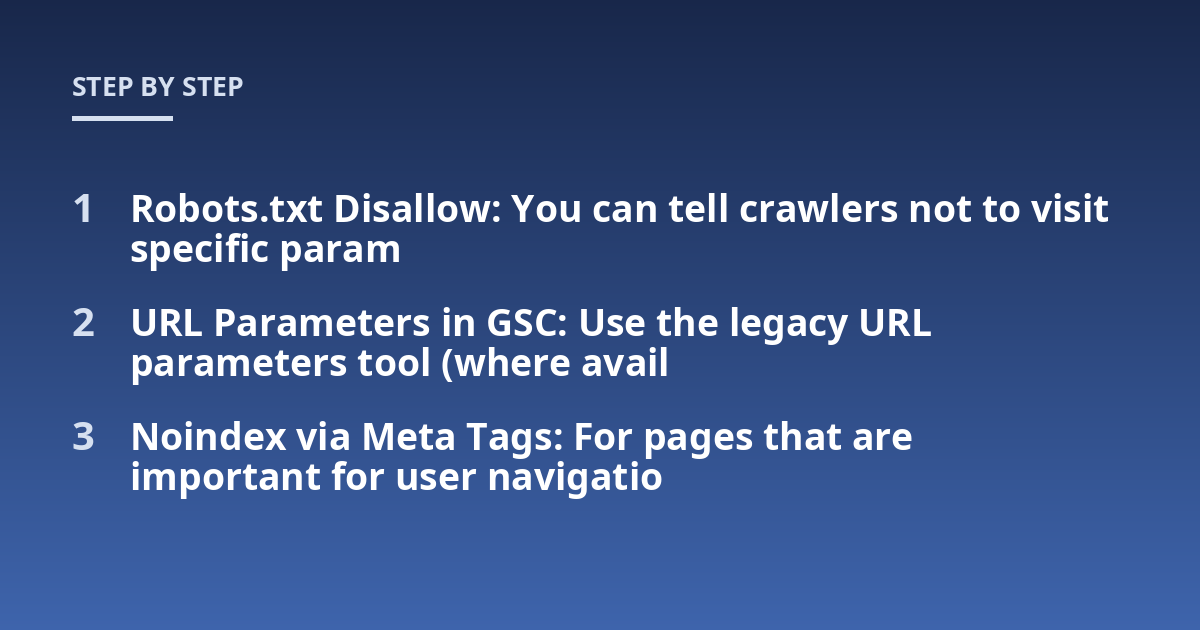
In larger e-commerce sites, fixing duplicate content often becomes a battle against “infinite crawl paths.” Faceted navigation allows users to filter products by size, color, price, and brand. Each combination can create a new, unique URL. For example: `example.com/shoes?color=blue&size=10`. If you have 50 filters, the number of potential URLs grows exponentially, most of which provide no unique value to search engines. To manage this without ruining the user experience, use one of these three approaches:
- Robots.txt Disallow: You can tell crawlers not to visit specific parameter patterns. This is highly effective for preventing massive crawl budget waste on filter-heavy sites.
- URL Parameters in GSC: Use the legacy URL parameters tool (where available) or structural cues to signal that certain parameters do not change page content significantly.
- Noindex via Meta Tags: For pages that are important for user navigation but create duplicate content, apply a `noindex` tag specifically to those filtered results. This allows users to land on them from external links while preventing them from appearing in search indexes.
Before disallowing parameters in robots.txt, ensure that the pages you are blocking do not contain any unique content or critical internal links that Google needs to discover other parts of your site.
Frequently Asked Questions
Does duplicate content cause a search engine penalty?
Google does not issue “penalties” specifically for duplicate content. Instead, it uses its algorithms to choose one version of the page and ignore the others. The risk is indirect: you lose SEO authority because your ranking signals are spread across multiple URLs instead of being concentrated on a single master page.
Should I use canonical tags or redirects if two pages are identical?
If both pages provide value to different user segments, use a canonical tag. If one page is obsolete and should no longer exist for users, use a 301 redirect. Redirecting can be more aggressive in consolidating authority but creates a break in the browsing experience if a user has bookmarked the old URL.
What is the impact of duplicate content on crawl budget?
When search engines encounter many duplicate pages, they waste “crawl budget” processing URLs that have already been seen. This means your new or updated content might take longer to be indexed because the crawler is busy navigating through redundant parameter-driven versions of existing pages.
How can I tell if my site has significant duplication?
The best way is to check Google Search Console for “Duplicate, Google selected different canonical than user” errors. If this number is growing steadily, your site structure is likely creating more duplicates than you are currently managing with tags or redirects.
Other posts from the category
There are no posts for the selected category.

Latest posts from the category
-

What makes an effective Category Page for AI
June 5, 2026
-

What Influences the cost of AI Optimisation
June 1, 2026
-

Organisation Schema: how to help AI understand your brand
May 27, 2026