
Optimizing Content for AI Search Experiences
August 2, 2026
Category:
Uncategorized
To optimize content for answer engines like Google AI Overviews, you must shift your focus from keyword density to demonstrable topical authority by answering user queries exhaustively. This involves structuring content using clear, direct answers immediately following the heading, integrating authoritative sources naturally, and ensuring structured data accurately reflects expert knowledge.
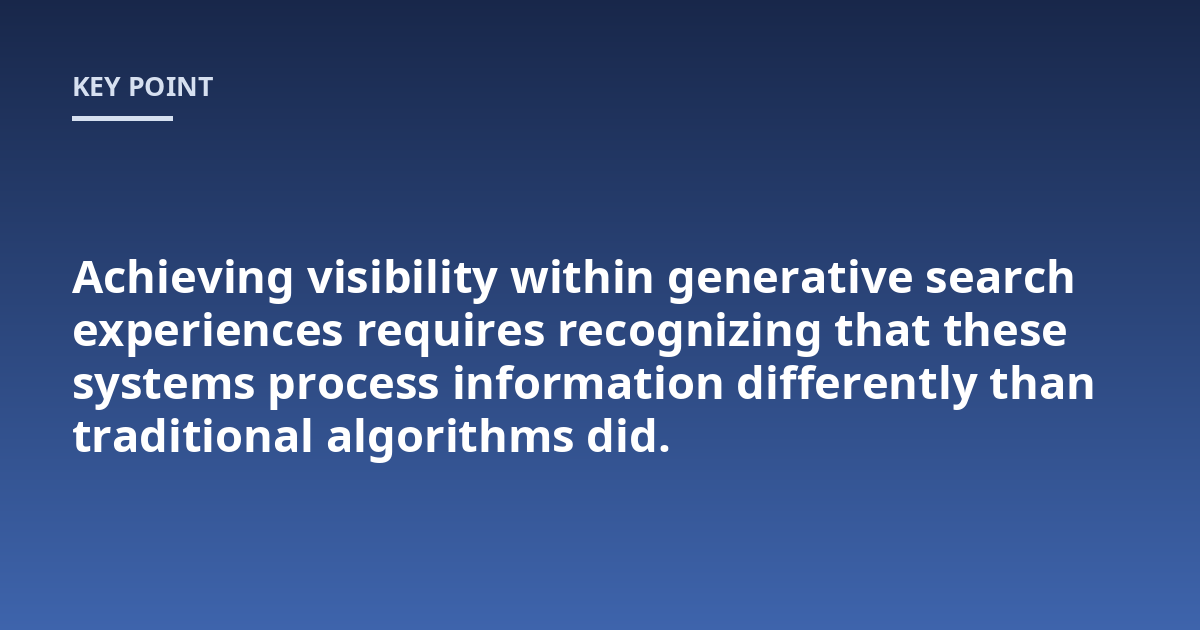
Achieving visibility within generative search experiences requires recognizing that these systems process information differently than traditional algorithms did. Instead of chasing specific characters or exact keyword matches, modern SEO demands producing highly reliable, exceptionally clear narratives backed by demonstrable expertise across every subtopic you address. We’ve seen firsthand how deeply structuring knowledge, not just words, is the current requirement for ranking visibility.
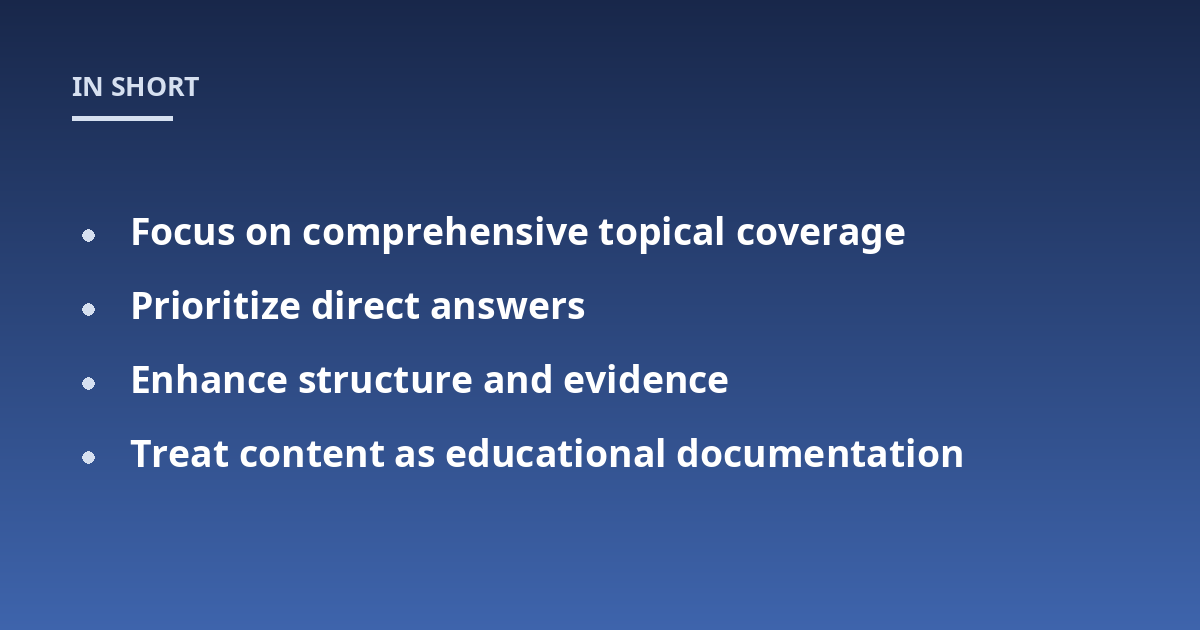
- Focus on comprehensive topical coverage: Answer related questions exhaustively to build deep authority signals around a core concept.
- Prioritize direct answers: Lead with concise, authoritative responses (40-80 words) directly under your headings.
- Enhance structure and evidence: Use schema markup like structured data for AI Overviews and cite external authorities when making factual claims.
- Treat content as educational documentation: The goal is to answer the user’s informational need completely, moving beyond simple keyword targeting.
What does it mean to optimize content for generative search engines?
Optimizing content for generative search engines means structuring your information so that AI models can easily extract precise answers and synthesize them into conversational snippets or direct Overviews. It moves SEO emphasis from keyword stuffing to demonstrating definitive, verifiable expertise on a specific topic cluster.
In practice, this demands an overhaul of content creation: every section must function as a miniature, self-contained knowledge base for that subsection. If you are writing about process efficiency in agencies, for instance, simply listing benefits isn’t enough. You need step-by-step protocols and the decision criteria at each junction point. Consider how a user needs to build expertise on your site; guide them logically through concepts.
When planning content architecture, map out not just what people search for, but what follows that initial query. If users frequently ask “what are the risks” after reading about “benefits,” dedicate a fully fleshed section to those constraints immediately following the benefits discussion. This anticipates informational gaps before Google’s AI does.
The most reliable approach here is usually simple: write for the person asking the question, assuming they know nothing else about it at that moment. You build trust one discrete answer block after another. For deeper guidance on implementation, reviewing strategies like Structured Data for AI Overviews can help solidify your technical foundation.
How does topical depth impact perceived content authority?
Topical depth significantly increases perceived content authority because it signals to search algorithms that the creator possesses a comprehensive understanding of an entire subject domain, not just surface-level keywords. Authority is built by covering related subtopics fully and accurately within one resource.
Think about specialized machinery documentation; you wouldn’t just list model names. You’d detail installation guides, troubleshooting for common electrical faults, maintenance schedules using specific torque settings, and required safety gear at the primary service area in Miami or Dallas. That breadth proves expertise. We see this concept applied when creating guides on complex international SEO requirements, making sure to address region-specific nuances.
A deficiency in depth forces the AI model to pull information from multiple, fragmented sources, weakening your site’s standing as the definitive source for that topic. You need to show relationships between concepts, how Concept A affects Outcome C when filtered through Methodology B. This interconnectedness is what modern search features recognize.
For agencies looking into digital infrastructure, mastering How to Build a Multilingual SEO Strategy with AI in 2026 helps show depth across language parameters, which Google must also evaluate for comprehensiveness. Your content needs the architecture of an encyclopedia article, not a blog post.
What specific structured data schema types help answer engines understand context?
To improve clarity for AI Overviews, you must implement precise structured data that moves beyond basic Article or Breadcrumb schema; look specifically into schemas like FAQPage, HowTo, and potentially specialized ProductSchema if applicable. These markups give explicit instructions to the search engine crawlers about the nature of the content block.
The primary mistake practitioners make is implementing only what is required by a tool’s checklist, rather than selecting schema that accurately represents the knowledge flow. For instance, if you have a multi-step process, like deploying a new WordPress setup, using the HowTo schema explicitly lays out prerequisites, steps, and expected outcomes in machine-readable format.
| Schema Type | What it tells AI | When to Use It |
|---|---|---|
| FAQPage | A distinct set of Question/Answer pairs, optimizing for featured FAQ boxes. | When answering common user queries directly within the text body. |
| HowTo | A sequential, mandatory process with defined prerequisites and steps. | For tutorials, guides on processes (e.g., filing taxes, building a website). |
| Article/BlogPosting | The core format and authorship context of the entire piece. | On every main article page; combine with specific types for detail. |
Proper use ensures that when an AI overviews a topic, it pulls data from labeled components rather than guessing based on surrounding prose. You should always verify your implementation against Google’s documentation guidelines for the most current directives.
How can content automation improve or undermine search visibility?
Content automation has the power to significantly scale topical depth and consistency, improving visibility by ensuring massive coverage of related concepts without sacrificing structural integrity. However, indiscriminate use risks creating thin, algorithmically bloated content that lacks genuine human insight.
When employed correctly, AI tools excel at synthesizing known best practices or drafting high volumes of variation pages based on a core expert outline. For instance, an agency can automate the initial drafts for location-specific service pages across fifty cities, adhering strictly to local schema and necessary legal disclaimers. This is visible scaling power.
Conversely, if you automate everything without injecting primary research or localized case context, the “human polish”, the resulting content feels generic. Search engines can often detect patterns of machine generation when the underlying expertise isn’t truly present. Think of it like generating thousands of basic paragraphs: they fill space, but they don’t demonstrate mastery.
To manage this risk while leveraging power tools, focus automation efforts on non-expert heavy lifting. For example, you can use AI for initial competitive analysis structuring or drafting complex international language variations, leaving the core narrative frameworks and unique insights for human refinement. This balance is crucial for AI-Powered Content Automation: A Step-by-Step Guide for Agencies.
What practices help ensure content remains authoritative when using AI assistance?
The best way to keep automated or generated content authoritative is to treat the AI output as a high-quality, highly detailed first draft that requires rigorous expert validation and factual grounding. You must become the final quality gate, checking every assertion against verifiable sources.
Your role shifts from writer to editor and subject matter validator. When reviewing text, ask: Is this claim precise? Can I cite a specific regulation or study to back this up? If you cannot answer that question with hard evidence, like material specifications for HVAC systems in Denver, the content point needs expansion or removal.
This rigorous validation process is what separates high-scoring educational resources from disposable filler. A key action is cross-referencing the primary claims with established industry standards, such as consulting guidelines published by recognized national bodies Authoritative Industry Body. Remember that even with advanced tooling for building content structures across multiple locales, verifying the local legal language is non-negotiable.
By enforcing this cycle of generation, refinement, and external validation, you build documented evidence that boosts your E-E-A-T signals beyond what mere keyword optimization can achieve. You are proving competence, not just matching search terms.
How should I structure content for maximum clarity when addressing technical topics?
When addressing complex or highly technical subjects, like advanced multilingual deployments or specific software integration protocols, you must adopt a hierarchical structure that funnels the reader from broad concepts to granular details. Start with definitions, build out processes using numbered steps, and conclude with actionable takeaways.
Avoid burying critical information in long paragraphs. Instead, use bulleted lists for requirements, comparison tables for options (like different CRM tiers), and distinct H3 headings for each major component of the topic. This segmentation is highly digestible for both human readers scanning quickly and machine crawlers mapping knowledge nodes.
Consider this framework when building out a guide on Why Hreflang Tags Matter More Than Ever for Global SEO: Introduction (What it is), Core Concept Definition, Technical Implementation Steps (Numbered List), Common Errors (Checklist), and Final Best Practices. Notice the systematic progression.
FAQ
What is important to know about optimizing for answer engines like Google AI Overviews?
The primary focus must be on establishing comprehensive topical authority by answering user questions fully and definitively, rather than just including keywords. Structure your content with direct answers at the top of every section, support all major claims with verifiable data or external sources, and use clear schema markup to help search engines parse your expertise accurately.
When should optimizing for answer engines like Google AI Overviews be discussed with a professional?
A consultation becomes useful when you suspect your content strategy isn’t effectively capturing the depth of user intent, or if technical implementations, such as structured data deployment, feel confusing. Early assessment helps confirm whether fundamental gaps exist in your site architecture or content modeling before significant time and budget are spent optimizing incorrectly.
How should someone prepare for a consultation about optimizing for answer engines like Google AI Overviews?
You should compile examples of content that currently performs well, list the specific search questions you cannot satisfactorily answer on your own site, and detail which technical areas (like multilingual setups or schema) are causing development roadblocks. Bringing existing performance data provides a concrete baseline for discussion.
What risks or limits can optimizing for answer engines like Google AI Overviews have?
The main risk is over-optimization into an artificial structure that alienates human readers by feeling too segmented or robotic. Another limit is that you cannot control the final presentation; search engines decide how to synthesize your content. Therefore, prioritize factual accuracy and deep coverage over chasing perceived algorithmic features.
How often should optimizing for answer engines like Google AI Overviews be reviewed?
This optimization process requires continuous monitoring because search engine requirements change rapidly. A review cycle of every quarter is a standard baseline, but any time you launch a major site overhaul or see core search behavior shift, an immediate content audit focusing on generative visibility should take place.
Conclusion: Integrating AI Clarity into Your Content Strategy
Mastering how to optimize for answer engines like Google AI Overviews means shifting your mindset from satisfying robots to educating sophisticated information processors. The process is less about clever tricks and more about creating a genuinely impeccable, well-evidenced repository of knowledge that anticipates every follow-up question your audience might have.
To start implementing this robust strategy immediately, audit your top ten service pages. For each one, ensure you have defined answers for the five most related questions surrounding the core service, these will become your foundational H3 sections, each starting with a direct answer. If you want more hands-on assistance building these advanced technical layers into WordPress structures, look into dedicated How to Automate WordPress SEO with AI Tools practices.
The actionable step today is auditing your evidence: make sure every substantial claim on your site has a supporting citation or internal link that points toward deeper proof. This elevates content from mere writing to demonstrable expertise.
Other posts from the category
There are no posts for the selected category.

Latest posts from the category
-

What makes an effective Category Page for AI
June 5, 2026
-

What Influences the cost of AI Optimisation
June 1, 2026
-

Organisation Schema: how to help AI understand your brand
May 27, 2026