
AIO for eCommerce: how AI drives sales without increasing traffic

February 6, 2026
Category:
AI Marketing
In the 2026 landscape, purchases increasingly begin not with a click on search results, but with a ready-made answer in AI search and assistant interfaces. An online shop can generate more orders without growing traffic if AI accurately “understands” the product range, terms, and value proposition – and if customers see clear answers before they even land on the site. This is precisely where AIO audits and managed AI visibility come into play.
Why sales can grow even when traffic stays flat
Growth used to follow a fairly linear path: more impressions -> more clicks -> more orders. Now, part of that journey is absorbed by generative answers. Users receive comparisons, recommendations, and delivery or returns explanations upfront, so those who do visit the site arrive with stronger purchase intent. In eCommerce, this means the quality of the “path to purchase” depends not only on ads and rankings, but also on how AI presents your product – who it suits, how it differs, and what the risks and conditions are.
Three ways AI influences eCommerce sales
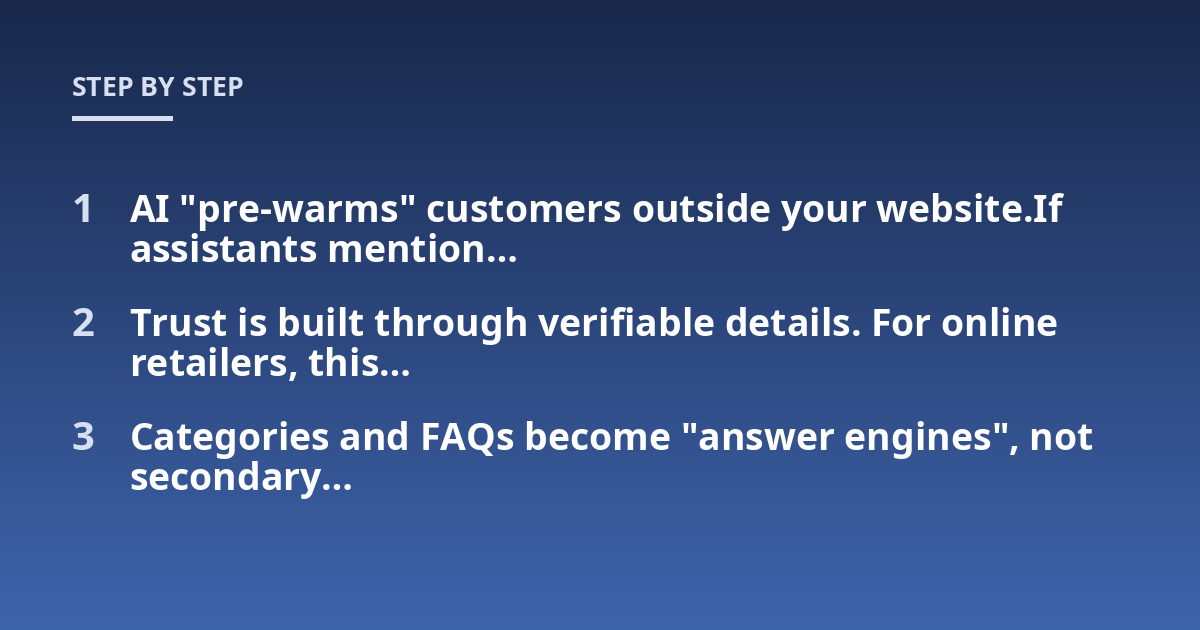
- AI “pre-warms” customers outside your website.If assistants mention your shop accurately and in context, users arrive ready to buy. If the assistant mixes up models, specifications, sizes, compatibility, or delivery terms, you risk losing the customer before they even click. The goal of AIO is therefore not “more text”, but ensuring AI consistently extracts facts rather than filling in gaps with guesswork.
- Trust is built through verifiable details. For online retailers, this is especially visible: returns policies, warranties, processing times, payment options, customer support, and product origin. In the AI ecosystem, these become AI trust signals. The clearer and more consistent these elements are, the more likely assistants are to recommend your brand – and the fewer doubts customers have before buying.
- Categories and FAQs become “answer engines”, not secondary pages.Category pages and FAQs are increasingly cited by AI when helping users choose products. If a category lacks clear selection criteria, or FAQs rely on vague wording, assistants will pull answers from other sources instead. Effective AI content optimisation means proactively addressing key questions in the right order: how to choose, what differentiates options, what limitations exist, and what purchase conditions apply.
Focus checklist: what to improve in your online store
Product pages: AI-ready product content without fluff
- Clear product names and descriptions with no ambiguity – one model, one designation, consistent terminology.
- A “fits / doesn’t fit” section covering compatibility, use cases, and limitations (helpful for reducing returns).
- Well-structured specifications: comparison tables, feature lists, configuration options.
- Transparent terms: delivery, returns, warranty, payment – visible near the product, not buried in the footer.
- Short micro-answers (two to three lines) for common questions – these are often what AI extracts first.
Categories: AIO for eCommerce starts with decision logic
- A four-to-six-line introduction: who the category is for, how to choose, what to consider.
- Filters and attributes aligned with how people actually search – not just internal database convenience.
- Comparison blocks: “difference between A and B”, “best option for X”, “common mistakes when choosing”.
FAQ: optimising FAQs for AI as a conversion tool
FAQs should not exist merely as an SEO block, but to ensure both AI and customers clearly understand conditions. Structure matters more than volume: one question, one precise answer, followed by detail where needed. Key topics to cover include EU delivery options, returns, warranty terms, authenticity or certification (where relevant), customer support, and processing times.
How Tsoden approaches AIO for eCommerce
At Tsoden, we view an online shop as a system of data and meaning. We start by defining the “brand truth” – what you sell, to whom, and under what conditions. Next comes the AIO audit: analysing how AI systems interpret your catalogue, categories, and terms, and identifying where distortions occur and why. We then structure content so AI reliably extracts facts rather than guessing, and implement AI monitoring to keep answers accurate as product ranges and EU markets evolve.
Conclusion
If you want sales growth without necessarily increasing traffic, start by checking how AI describes your products, categories, and purchasing conditions – where it confuses models, blurs distinctions, or loses trust signals. Then rebuild product pages, categories, and FAQs around concise answers, clear comparisons, and verifiable conditions. This strengthens AI visibility and reduces customer hesitation on the path to purchase. A practical next step is to request an AIO audit from Tsoden and identify the specific factors that directly influence conversion in generative search.
Other posts from the category
-

What makes an effective Category Page for AI
June 5, 2026
-

What Influences the cost of AI Optimisation
June 1, 2026
-

Organisation Schema: how to help AI understand your brand
May 27, 2026

Latest posts from the category
-
What makes an effective Category Page for AI
June 5, 2026
-
What Influences the cost of AI Optimisation
June 1, 2026
-
Organisation Schema: how to help AI understand your brand
May 27, 2026