
How to identify and fix AI misinterpretations (common pitfalls)

March 4, 2026
Category:
AI Marketing
AI misinterpretations usually don’t happen because your “content is bad”, but because your brand is described differently in different places, key constraints are buried, and the answers AI needs can’t be cleanly extracted. To fix this, start by locking in a single reference positioning and run an AIO audit: it will show where AI is “filling in the blanks” or borrowing meaning from competitors.
Why AI Gets Things Wrong About Your Business in the First Place
Generative systems assemble answers from fragments: product pages, category pages, FAQs, and external mentions. As a company grows, the number of pages, language versions, and sources increases – and messaging starts to drift. To AI, that looks like multiple versions of the same truth, so answers become inaccurate or fragmented.
That leads to the core principle: you don’t solve this by “rewriting text”, but by removing contradictions and controlling what AI treats as the primary source.
Common pitfalls: 7 typical perception errors – and how to fix them
-
“Different versions of the same service” on your site and elsewhere
Symptom: AI calls you an agency one moment, a platform the next, then an integrator; it mixes up your segment or audience.
Why it happens: inconsistent wording across landing pages, FAQs, profiles, and publications.
How to fix it: define your “brand truth” (1-2 paragraphs: what you do, for whom, and where the boundaries are) and bring key pages into one consistent terminology; then update external descriptions so they don’t clash with your site.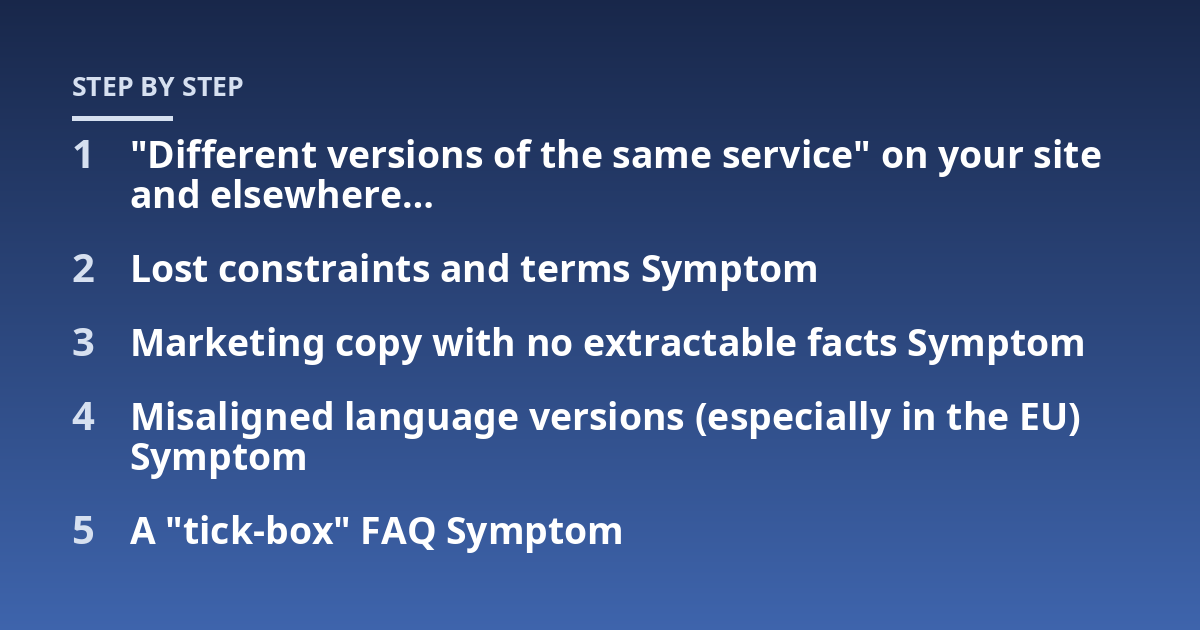
-
Lost constraints and terms
Symptom: AI confidently claims things you don’t actually offer (geography, availability, support, terms).
Why it happens: constraints are hidden, written in “legal fog”, or scattered across documents.
How to fix it: add a “Who it’s for / Who it’s not for” block on product pages plus a dedicated terms/conditions block; repeat the critical constraints in the FAQ as short, direct answers. -
Marketing copy with no extractable facts
Symptom: AI responds in generic phrases and can’t explain what makes you different.
Why it happens: there’s no quotable structure – lists, criteria, or explicit comparisons.
How to fix it: rebuild pages for “AI-readable content”: one question, one answer, then details; put features and terms into explicit blocks (lists/table-like logic), no metaphors. -
Misaligned language versions (especially in the EU)
Symptom: you’re recommended in one country, but in another you might as well not exist.
Why it happens: different languages = different meanings, different page sets, different promises.
How to fix it: keep the same page framework across languages and synchronise key messaging and terms; when scaling across the EU, it’s sensible to start with a reference positioning and a check of current interpretation. -
A “tick-box” FAQ
Symptom: AI mixes up rules, timelines, support, returns/cancellation, availability.
Why it happens: answers are long, ambiguous, and don’t lead with the point.
How to fix it: make FAQ an AEO tool: a 1-3 sentence direct answer upfront, followed by exceptions and links to the primary source; synchronise FAQs across languages. -
Weak trust signals
Symptom: AI doesn’t include you in the shortlist, even when you’re relevant.
Why it happens: too few verifiable details – process, responsibility boundaries, documents, transparent terms.
How to fix it: add “evidence” blocks: how delivery/onboarding works, what’s included, what’s not, and where rules are documented. For AI, these are markers that the information can be repeated safely. -
A one-off push instead of a system
Symptom: you’re “visible” today, and a month later the answers drift again.
Why it happens: AI answers evolve as new sources appear.
How to fix it: lock results in with AI monitoring – regular checks of mention accuracy and ongoing strategy tweaks. Tsoden explicitly calls out monitoring as part of the work: checking how models interpret information about your company and competitors, with regular adjustments.
How Tsoden Typically Fixes Distortions
In practice, it looks like a sequence: AI rating and diagnostics -> AIO audit -> structure and data fixes -> content adaptation around real user questions -> ongoing interpretation checks. This cycle exists for a reason: perception errors are rarely a “one-button” fix, they’re usually a chain of small mismatches across pages and languages.
Summary
- Lock in a reference brand positioning and a “must not invent / constraints” list, what AI should never have to guess.
- Collect 10-20 real commercial queries and check how AI describes you in responses: where it confuses category, terms, or geography.
- Run an AIO audit to identify the pages and external sources driving distortions, and produce a prioritised fix plan.
- Rebuild product pages, categories, and FAQs into the format “short core -> details -> primary source”, and synchronise meaning across languages.
- Maintain results through AI monitoring, so new pages, translations, and mentions don’t dilute your “single version of truth”.
Other posts from the category
-

What makes an effective Category Page for AI
June 5, 2026
-

What Influences the cost of AI Optimisation
June 1, 2026
-

Organisation Schema: how to help AI understand your brand
May 27, 2026

Latest posts from the category
-
What makes an effective Category Page for AI
June 5, 2026
-
What Influences the cost of AI Optimisation
June 1, 2026
-
Organisation Schema: how to help AI understand your brand
May 27, 2026