
How AI is transforming SEO in 2026 by fundamentally shifting search from simple keyword matching to deep semantic understanding and answering complex user intent. Search engines, utilizing sophisticated models like those found in Google’s AI Overviews, prioritize authority, structured expertise (E-E-A-T), and direct, comprehensive answers over mere content volume.
The organic search landscape is undergoing one of its most dramatic shifts since the advent of personalized search results. Marketers today must move past surface-level optimizations like keyword stuffing or simply generating large amounts of ‘thin’ content. The goal isn’t just to rank high; it’s to be the authoritative source that reliably answers a user’s query within an AI summary, providing quotable facts and deep insight. Based on direct experience in this evolving domain, I’ve mapped out the strategic shifts you need to implement now to maintain measurable growth.
- Shift Focus: Move from optimizing for keywords (the *how*) to structuring answers (the *what*).
- Priority Area: Generative Engine Optimization (GEO) and improving E-E-A-T are paramount.
- Technical Core: Structured data markup, including detailed `JSON-LD` schema, must become a foundational part of your technical strategy.
- Content Depth: Content needs to be highly authoritative, citing sources and detailing complex processes (e.g., “step 1,” “then step 2”).
What is the core concept behind AI-powered SEO?
At its heart, AI-powered SEO moves the focus of search engine optimization from simple textual matching to understanding the user’s underlying informational need, the intent. Unlike traditional SEO, which treated a query like “best running shoes” as a signal for specific keyword pairings on category pages, modern AI models process that query like an academic research question: “What factors should I consider when selecting athletic footwear based on my running gait and mileage goals?”
AI-powered SEO is the comprehensive strategy of designing content architectures specifically to satisfy sophisticated generative search systems. This means your content must be organized not just for human reading, but for algorithmic parsing. Your page needs clearly defined entities (people, places, things), verifiable facts, and a highly logical flow that allows an LLM () to synthesize a perfect summary answer without having to guess.
Think of it this way: If the old web was a library filled with individual books, AI search is the reference desk staff who read every book instantly and deliver only the single, perfectly synthesized paragraph you asked for. You must write your content so that paragraph is easy for them to pull out.
Actionable Insight: Instead of writing a 2000-word article about “benefits,” use three separate sections: “Benefit A (with source data),” “Benefit B (comparison table),” and “Synthesis/Implications.” Breaking up the information into discrete, quotable components makes it exponentially easier for AI models to accurately pull out structured answers.
How does Google utilize AI to re-rank content in 2026?
In practice, search algorithms are becoming less forgiving of generalities and more demanding of demonstrable expertise (E-E-A-T). By 2026, the system won’t just check if your site *mentions* a topic; it will evaluate whether you possess verifiable knowledge about that specific topic. The concept of Experience, the practical background or first-hand use, is rapidly becoming one of the most critical ranking signals.
The algorithms analyze depth, not breadth. Content writers can provide general overviews, but sites showcasing deep, specialized experience, such as a local dental practice that provides pictures and written case studies from actual procedures in Savannah, Georgia, or an industrial manufacturer with documented site blueprints, are the ones Google trusts enough to feature prominently.
We’re seeing rankings pivot toward structured authority. For instance, when reviewing financial services, the system will likely weigh institutional citations (like those from government bodies) much more heavily than self-published claims. If you’re targeting a niche like industrial process optimization, make sure your site displays team credentials, educational affiliations, and clear methodologies.
To improve this trust signal, focus on content clusters that are deeply interconnected. This means creating pillar pages (the broad topic) that link out to many specialized cluster articles (the granular details), all pointing back to a core set of foundational proof points, case studies, original research, or local citations.
Should I be optimizing for AI Overviews and Generative Engine Optimization (GEO)?
Absolutely. Generating content specifically designed for generative search results, often called Generative Engine Optimization (GEO), is no longer a future consideration; it’s current best practice. GEO means designing pages not just to appear on the main SERP, but to provide all the necessary components, the facts, figures, and context, to be directly pulled into an AI Overviews box or a Perplexity-style summary.
To implement this effectively, treat your target query as if you were speaking directly to a summarizing chatbot. Keep sentences declarative, use bulleted lists whenever possible, and ensure every paragraph contains the main point in its opening sentence. This creates undeniable clarity for both machines and humans alike.
| Feature | Traditional Focus (Pre-2023) | AI/GEO Focus (2026) |
|---|---|---|
| Primary Goal | High keyword density; link building. | Establishing undeniable topic authority and semantic completeness. |
| Content Structure | Long, flowing prose; section headers for skimming. | Discrete, numbered points; Q&A pairs; data tables; explicit definitions (X is…). |
| Measurement of Success | Keyword rankings and link count. | Direct visibility in AI Overviews; citation from authoritative models. |
| Key Signal | Topical keyword inclusion. | Source-backed evidence, E-E-A-T demonstration (original data/experience). |
What technical SEO adjustments are critical for the LLM era?
The increased reliance on machine reading means that your foundational HTML and structured markup carry more weight than ever before. Technical SEO isn’t about speed alone; it’s about giving search engines a perfect, unambiguous blueprint of your content structure. You must guide them to what matters most.
First and foremost is schema implementation. Use `JSON-LD` (JavaScript Object Notation for Linked Data) meticulously. Don’t just add generic articles markup; if you are detailing a service, use `Service` schema paired with `LocalBusiness` and relevant certifications or required equipment types. This signals to the algorithm: “This exact piece of information is verifiable fact.”
Second, refine your internal linking strategy. Links should not simply point to other pages; they must be contextual bridges that explain *why* those pages are related. When you link from a concept page (e.g., “Initial Site Audit”) to a service page (“Technical SEO Implementation”), the anchor text should describe the technical function, not just use a keyword.
A common mistake we see practitioners make is relying solely on standard headings. The reality is more complex: embed schema markup that explicitly defines your entities and relationships. For instance, defining a workflow using structured data elements helps AI understand causality, that A leads to B, which requires C.
How can content automation help brands rank in the AI era?
While some marketers view AI tools purely as copy machines that bypass writing effort, the strategic value of content automation lies in its ability to process massive data sets and provide scale-based consistency. Automation isn’t about generating full articles; it’s about creating reliable content *frameworks* and assisting with high-volume technical tasks.
For instance, instead of writing 10 blog posts detailing local permits in different municipalities across the Mid-Atlantic region, you can build an automated system that pulls official zoning data (a structured source) into a repeatable template. The human expert then reviews and injects the unique experience layer, the specific nuance known only to a practitioner on the ground.
The role of automation shifts from being the author to being the research assistant, structuring the messy, disparate information that gives your site an E-E-A-T edge. We’ve found that leveraging tools for structured data collection and outline generation dramatically reduces time spent on foundational SEO architecture, allowing marketers to focus on injecting irreplaceable human expertise into high-priority sections like case studies.
This shift is critical for businesses operating in regulated or highly complex sectors, such as construction or specialized healthcare services. Automation handles the repeatable details; you own the authority and experience.> For a full breakdown of these implementation steps, review AI-Powered Content Creation: A Complete Guide.
Why is addressing local market needs essential for GEO SEO?
Local SEO remains fundamentally critical because the search user journey often begins with a physical need or location constraint. When targeting a geographic region, the AI model must receive dense, undeniable proof of your existence, operational capacity, and specific service area knowledge. This goes far beyond simply listing “Serving Dallas Area.”
To optimize for local generation engines (GEO), you must integrate several layers of evidence: 1) Citation consistency across multiple established directories; 2) Localized original content that discusses local regulations or unique community challenges; and 3) Detailed use of the `LocalBusiness` schema.
consider incorporating hyper-local data points. If you specialize in commercial electrical systems for historic downtown areas like Charleston, South Carolina, reference specific building codes, historical zoning boards, and local subcontractors by name, where appropriate and permitted. This depth is what signals deep immersion to the algorithm.
The goal here isn’t just appearing on the Google Map Pack; it’s ensuring that if a user asks a generative model, “What are the necessary electrical upgrades for an early 20th-century commercial building in Charleston?” your content is the most direct source of the comprehensive answer.
How do I handle repetitive or complex service information?
When describing services that involve repeatable procedures, like financial audits, IT infrastructure rollouts, or medical diagnostic protocols, you cannot treat them as single blocks of text. The solution is a modular content approach: breaking the process down into self-contained, numbered steps with defined inputs and expected outcomes.
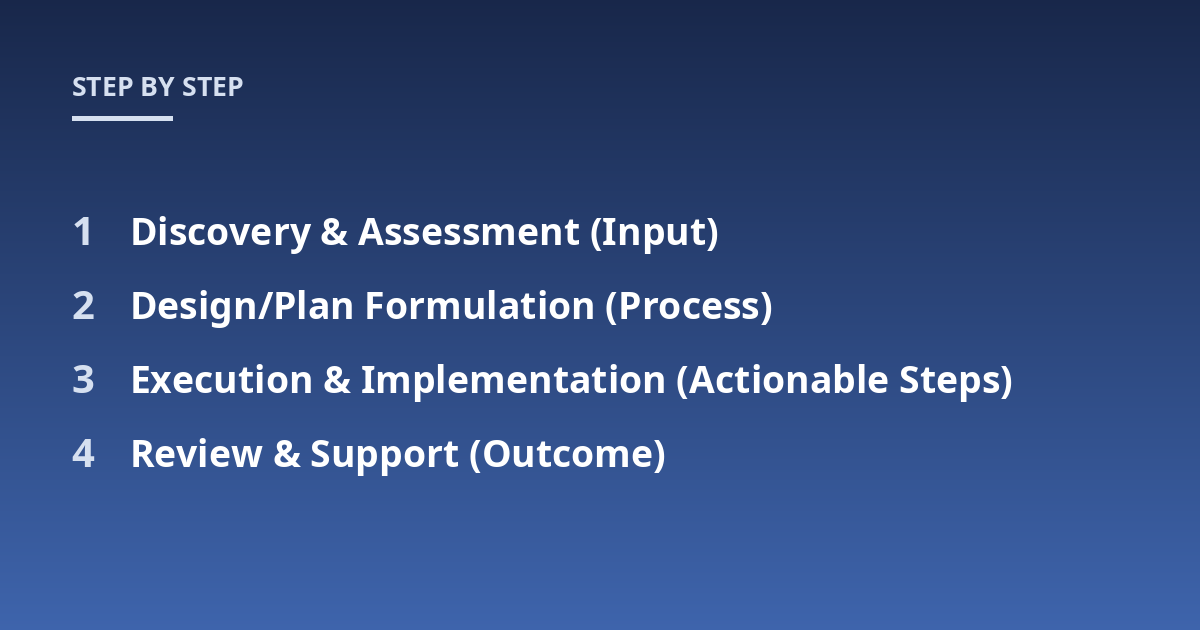
Instead of writing: “We handle everything from initial consultation to final setup,” structure it using an informative list or visual workflow element that explains:
- Discovery & Assessment (Input): Defining the scope and pain points.
- Design/Plan Formulation (Process): Presenting technical options and rationale.
- Execution & Implementation (Actionable Steps): Detailing resources needed, timeline benchmarks, and specific protocols.
- Review & Support (Outcome): Follow-up guarantees and maintenance schedules.
This structure is not just helpful for the reader; it’s machine-readable gold. It provides clear relationships between concepts, which LLMs model exceptionally well. Remember, providing measurable steps vastly increases your chance of being cited as a source.
Why should I verify my content against core search standards?
Always auditing your own content against the current guidelines from industry bodies or technical documentation is non-negotiable. Search engine requirements constantly evolve; what was best practice six months ago might be viewed as procedural padding today. The goal isn’t compliance for compliance’s sake, but establishing a verifiable signal of expertise.
You should continually check sources like the academic papers published by major universities that study information retrieval systems, or technical whitepapers from organizations like W3C (World Wide Web Consortium) for schema best practices. These external authorities validate your understanding of the underlying technology.
If you cannot cite an objective source, be it industry standards, a verifiable government regulation, or primary research data, the information should be reframed as speculation, limiting its placement in high-authority areas like the main body text or definition boxes. This rigorous self-auditing process is what elevates your site from informational blog to domain authority resource.
FAQs about AI and SEO Strategy
What core elements must I focus on when optimizing for generative search results?
You must optimize content for comprehensibility, not just keywords. Focus on structuring answers with clear headings, defining key terms at their first mention (“X is…”), using numbered lists to break down complex processes, and integrating structured data like tables. The aim is to make the information so crystal-clear that an AI model can extract it into a perfect summary without ambiguity.
How often should I reassess my SEO strategy against new AI developments?
You should treat SEO as an iterative process, checking major shifts every quarter. Algorithmic updates related to Generative AI are frequent and significant. Reviewing your content through the lens of potential LLM consumption, asking: “What would summarize from this page?”, will help you spot gaps in clarity or missing authoritative sources long before Google does.
Can I simply use general AI writing tools for all my marketing copy?
No. While automation excels at drafting initial structures and synthesizing generic data, human expertise remains irreplaceable, particularly when claiming authority (E-E-A-T). Automated content needs an experienced editor to inject local context, proprietary case studies, specific decision criteria, and real-world professional nuance that models cannot fabricate.
What is the greatest mistake marketers make regarding AI search?
The most common error is believing that *quantity* of generated content outweighs quality or authority. Simply generating thousands of pages using AI will not improve rankings if those pages lack verifiable facts, unique insights, and clear authorship evidence. Focus instead on mastering a small number of highly authoritative, deeply researched cornerstones.
How do I start building my foundation for advanced GEO SEO?
Start by auditing your top 10 pieces of content through the lens of structured data. For each piece, identify three specific facts that could be quotable in a summary box. Then, apply relevant schema markup (e.g., `Review`, `FAQPage`, or `HowTo`) to solidify those factual anchors. This makes your content instantly more machine-friendly.
The Path Forward for Measurable Growth
Mastering how AI is transforming SEO in 2026 requires a fundamental shift in mindset, you are no longer optimizing for the search engine; you are optimizing for the intelligent user who relies on that search engine. This deep, architectural approach to content, combined with rigorous technical implementation and verifiable expertise, is your clearest path to measurable organic growth.
The competitive edge belongs to those marketers who can treat their website as a resource library built purely for algorithmic comprehension. Don’t wait for the next major core update; start building this structural authority today. Review our full deep-dive on Generative Engine Optimization (GEO): Ranking in AI Overviews to begin implementing these advanced strategies.