
Building Topic Clusters and Pillar Pages That Rank in 2026
July 7, 2026
Category:
Uncategorized
Building topic clusters and pillar pages that rank requires you to stop writing isolated blog posts and start structuring content as interconnected topic ecosystems. A pillar page is a comprehensive, authoritative guide on a broad subject, supported by cluster content that answers specific subtopic questions. This architecture signals topical depth to search engines and AI systems, improving your eligibility for featured snippets, AI Overviews, and long-tail keyword rankings.
The old SEO playbook of targeting one keyword per page is dead. Google’s passage ranking, entity understanding, and AI-driven search models now reward sites that demonstrate comprehensive coverage of a subject. If you publish a 500-word article on “on-page SEO tips” and nothing else about SEO, you lose to a competitor whose pillar page covers the entire discipline with supporting cluster pages. That shift is what makes topic clusters the most durable organic growth strategy for mid-market and enterprise businesses.
The truth is, most marketers still organize their blogs by publication date. That works for news. For service businesses, it buries your expertise. This article walks through exactly how to build a cluster architecture, avoid the common mistakes that waste months of effort, and measure whether your structure is actually working. We draw on direct experience running content programs across SaaS, professional services, and ecommerce brands.
- A pillar page covers a broad topic comprehensively (2,500-5,000 words). Cluster pages target specific subtopics and link back to the pillar.
- Search engines and AI systems use internal topic-cluster signals to assess site authority on a subject.
- Start with keyword research grouped by intent, then build the pillar first and cluster pages in priority order.
- Monitor cluster performance through topic-level rankings and organic traffic changes to the pillar page, not just individual page metrics.
What Exactly Is a Topic Cluster and Pillar Page Architecture?
A topic cluster is a group of interlinked pages organized around one central pillar page. The pillar page covers the core subject broadly. Each cluster page addresses a specific question, subtopic, or related keyword and links back to the pillar. The pillar page, in turn, links out to each cluster page where it makes sense.
Think of it this way: if your topic is “technical SEO audit,” your pillar page covers what a technical audit is, why it matters, the main audit categories, and how to prioritize fixes. Cluster pages then dive deeper into crawl errors, index coverage, structured data validation, page speed, and mobile usability. Each cluster page points to the pillar, and the pillar links to every cluster page in context.
Here’s where it gets interesting: Google’s entity-based indexing evaluates how well a site covers a subject as a whole, not just individual pages. When you link them cleanly, you tell the search engine “this is the authoritative resource on technical SEO audits.” Based on what we’ve seen across dozens of projects, a well-executed cluster can improve pillar page rankings for high-volume terms while also lifting cluster page performance for long-tail queries.
From what we’ve observed across client projects, the single biggest mistake is building cluster content before the pillar page is complete. Without a strong pillar, your cluster pages have no central anchor to pass topical authority to. Always write the pillar first, even if it means publishing fewer pages in month one.
How Do You Choose Topics for a Pillar Page That Can Rank?
Start with audience needs, not keyword volume. The best pillar topics are subjects your customers actually search for and that your business credibly covers. A dental practice shouldn’t pillar on “general relativity.” A SaaS company shouldn’t pillar on “knitting patterns.” That sounds obvious, but we’ve seen brands stretch topics to chase volume.
Use these criteria to evaluate each candidate. First, the topic must have enough breadth to support 8-15 cluster subtopics. If you cannot name at least eight meaningful questions people ask about this subject, it is too narrow. Second, there must be demonstrated search demand. Use keyword research to validate monthly volume, but also look at “People also ask” boxes and related searches in Google SERPs. Third, the topic must align with your business goals. A pillar on “SEO for ecommerce” is valuable for an SEO agency serving ecommerce brands. A pillar on “Hiking trails in Colorado” is not.
Quick caveat: not every business needs a pillar page on every topic. Prioritize the subjects where you have genuine expertise, existing content you can consolidate, and commercial potential. For a B2B agency, typical high-priority pillars include the specific service lines (technical SEO, content strategy, local SEO) and the main buyer pain points (increasing organic traffic, reducing churn through content, scaling international SEO).
How to Perform Keyword Research for Topic Clusters
Keyword research for clusters differs from traditional page-level research. You are not looking for one keyword per page. You are building a keyword map where the pillar targets a broad head term and each cluster page targets a specific long-tail or mid-funnel query.
Start with a seed keyword that represents your core topic. For “building topic clusters and pillar pages that rank,” the seed is the phrase itself. Run that through a keyword research tool and collect all related queries. Group them by intent. Informational queries like “what is a topic cluster” become cluster page candidates. Commercial queries like “best topic cluster tool” may warrant a comparison page or a separate pillar.
Pay attention to question-based queries. “How do I structure a pillar page?” “What is the ideal word count for a pillar page?” “How many cluster pages do I need?” Each of these can become a self-contained cluster page that answers the question completely and links back to the pillar. This is where you naturally incorporate your secondary keywords without stuffing them.
Consider reading our guide on Keyword Research with AI: Finding High-Intent Queries for a deeper look at how to surface terms your competitors overlook. The method is the same whether you are doing it manually or with AI assistance: cluster by intent, then by topic, then by search volume priority.
What Makes a Pillar Page Rank? The Structural Requirements
A pillar page is not just a long blog post. It is a structured reference document. The page must be immediately scannable, internally linked, and comprehensive enough that a reader can understand the entire topic without leaving the pillar.
Here are the non-negotiable elements of a pillar page that ranks. A clear table of contents with anchor links to each major section. Each section should be a distinct H2 that answers one core question. Use H3s for subsections within each H2. Every section must link to the relevant cluster page where the reader can go deeper. The pillar page should include a summary or checklist at the end that recaps actionable takeaways.
Word count varies by topic, but effective pillar pages for mid-competition topics usually range from 2,500 to 5,000 words. The length is a byproduct of comprehensiveness, not a target. If you cover every meaningful subtopic, the word count will be appropriate.
| Element | Purpose | SEO Impact |
|---|---|---|
| Table of contents with anchor links | Helps users and crawlers navigate the page | Improves page experience, enables jump-to links in SERPs |
| Each H2 answers one question | Makes sections eligible for featured snippets and AI passaging | Directly supports snippet eligibility and overview inclusion |
| Internal links to cluster pages | Distributes topical authority across the cluster | Signals topic depth to search engines |
| Cluster pages link back to pillar | Concentrates link equity on the central resource | Strengthens pillar page rankings for broad terms |
| Primary keyword in H1 and lead paragraph | Signals topic relevance immediately | Improves snippet eligibility and voice-answer readiness |
Common Mistakes When Building Topic Clusters and Pillar Pages That Rank
The most common mistake we encounter is publishing the pillar page and cluster pages simultaneously without linking them properly. The pillar page links out to cluster pages, but the cluster pages do not link back. That breaks the cluster effect. Every cluster page must include at least one contextual link returning to the pillar.
Another frequent error is making the pillar page too shallow. A 1,200-word pillar page that merely summarizes each cluster topic does not provide enough value to rank. The pillar page must stand on its own as a thorough treatment of the subject. Readers should gain substantial knowledge from the pillar alone, then use cluster pages for deeper dives.
Counterintuitively, the fastest path to results is often the most measured one. Do not try to build ten clusters simultaneously. Start with one. Write the pillar page. Then produce two to three cluster pages per month for that topic. Monitor rankings and traffic. If the cluster drives measurable results after three months, expand to the next topic. If not, revisit your topic selection or content quality before scaling.
What mistakes should you avoid with this approach? Do not use thin cluster pages. A 300-word page that barely touches the subtopic will not rank and will not pass authority to the pillar. Each cluster page must be a complete answer to its specific question. Do not reuse cluster page content across multiple clusters. Each piece must be unique to its pillar. Do not ignore search intent. If the pillar topic is purely informational but your business has commercial goals, you will struggle to convert readers.
How Long Does It Take for Topic Clusters to Rank?
Expect six to twelve months before you see significant ranking improvement from a new cluster architecture. That timeline assumes the pillar and initial cluster pages are high quality, technically sound, and properly interlinked. If the site has existing authority, the timeline may be shorter. If it is a new domain, it may stretch to eighteen months.
In practice, we have seen pillar pages start ranking for long-tail variations within three months, while head terms take longer. The cluster pages often perform better initially because they target lower-competition queries. Over time, as the cluster matures, the pillar page gains traction for its target term.
Based on direct experience with a B2B SaaS client, their pillar page on “product-led growth SEO” moved from page four to page one over nine months. The cluster pages on “PLG SEO metrics,” “freemium funnel optimization,” and “user activation content” started ranking in months two through four. The pillar page only broke top ten when six of the eight planned cluster pages were published and
How to Build the Internal Link Structure for Topic Clusters
Internal linking is the glue that makes a topic cluster function. Without deliberate, contextual links between the pillar and each cluster page, you simply have a collection of loosely related articles. The linking pattern matters more than most marketers realize.
Every cluster page must contain at least two contextual links back to the pillar page. One link should appear naturally within the body text where it makes sense for the reader. The second should sit in a summary or “related reading” section at the bottom of the page. Do not stuff links into the first paragraph just for the sake of linking. Place them where a reader would genuinely want to go deeper on the main topic.
The pillar page should link to every cluster page at least once. Use descriptive anchor text that includes the cluster page’s target keyword, not generic phrases like “click here” or “read more.” For example, if your pillar is about technical SEO audits and one cluster page covers crawl errors, link with anchor text “guide to crawl error identification and fixes.”
Run a crawl of your site three months after launching a cluster. If any cluster page has fewer than two inbound links from the pillar or other cluster pages, that page is not contributing to the cluster’s topical authority. We use Screaming Frog or Sitebulb for this audit. Fix broken links immediately and add missing ones.
Consider creating a topic cluster spreadsheet or map that tracks every cluster page, its target keyword, its current URL, the pillar page URL, and the status of bidirectional links. This prevents orphan pages that nobody links to and ensures every piece of content participates in the architecture. Review this map quarterly as you add new cluster pages or retire outdated ones.
Measuring Success: Beyond Page-Level Metrics
Most SEO dashboards track individual page rankings and traffic. For topic clusters, that is insufficient. You need topic-level metrics that show whether the entire cluster is gaining authority and driving organic growth.
Track the following for each cluster. First, the aggregate organic traffic for the pillar plus all cluster pages combined. A rising total indicates the cluster is gaining traction. Second, the number of keywords for which any page in the cluster ranks in the top 10, top 5, and top 3 positions. As the cluster strengthens, more keywords should appear across more pages. Third, the pillar page’s ranking trajectory for its primary keyword. Fourth, the click-through rate from the pillar page to cluster pages. If users click from the pillar to cluster pages, the internal linking is working as intended.
Use Google Search Console’s query report filtered by page to identify which cluster pages drive impressions and clicks. Compare before and after launching the cluster architecture. If you see impression growth on the pillar page that correlates with publishing cluster pages, the structure is functioning. If the pillar page flatlines, revisit the quality and depth of both the pillar and the cluster pages.
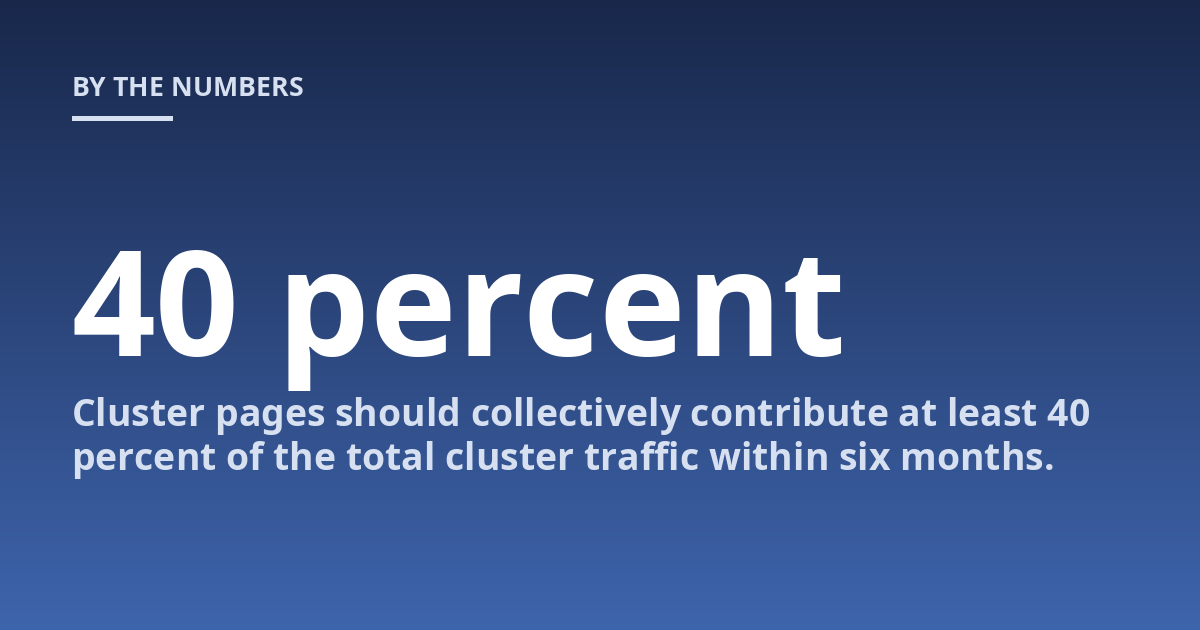
A practical threshold: for a healthy cluster, the pillar page should receive at least 30 percent of its organic traffic from queries that include variations of the core topic, not just the exact keyword. Cluster pages should collectively contribute at least 40 percent of the total cluster traffic within six months. Lower percentages suggest the cluster pages are not getting indexed or ranked effectively.
When to Expand a Topic Cluster and When to Start a New One
Knowing when to add more cluster pages versus launching a new topic cluster prevents content sprawl. A single cluster with twenty cluster pages may be too broad if those pages cover loosely related subtopics that dilute the pillar’s focus.
Expand the current cluster when you can identify at least three new subtopics that are directly relevant to the pillar, have genuine search demand, and are not already covered by existing cluster pages. For example, if your pillar on “local SEO for plumbers” already covers Google Business Profile optimization, review generation, and citation building, you could expand into “plumber service area pages” or “local SEO for emergency plumbing services.”
Start a new cluster when you have exhausted the meaningful subtopics under the current pillar or when a new business offering demands its own topic authority. A content marketing agency with one pillar on “B2B content strategy” might add a second pillar on “SaaS content marketing” if both topics have sufficient search volume and audience demand. Do not start a second cluster until the first one shows measurable ranking progress, usually after three to six months of consistent content production and performance tracking.
Adapting Topic Clusters for AI Overviews and Voice Search
AI Overviews and voice search rely on structured, authoritative content that answers questions directly. Topic clusters naturally support this because each cluster page targets a specific question. The pillar page provides the broader context that AI systems use to verify your expertise on the subject.
To optimize your cluster for AI-driven search features, include a clear question-and-answer format in each cluster page. Use the exact question as an H2 heading, then answer it in one to three paragraphs directly below. This increases the chance that an AI system extracts your content for a featured snippet or AI Overview. The pillar page should include a FAQ section at the bottom that links to the most relevant cluster pages for each question.
Voice search success depends on concise answers. Each cluster page should include a one-sentence answer at the top of its content, followed by deeper details. This sentence serves as the voice response candidate. For example, a cluster page on “how many cluster pages do I need” might open with “Start with four to six cluster pages per pillar and add more over time as you identify new subtopics with search demand.”
Frequently Asked Questions About Topic Clusters
Can I use existing blog posts as cluster pages?
Yes, if the existing post covers a specific subtopic completely and aligns with the pillar’s scope. Update the post to include a contextual link back to the new pillar page. Do not use thin or outdated posts without rewriting them first. Each cluster page must meet current quality standards for word count, depth, and freshness.
Should each cluster page target a separate keyword?
Yes. Each cluster page should target one primary keyword or question. Avoid targeting multiple competing keywords on the same cluster page. If two subtopics are distinct enough to warrant separate keywords, they warrant separate cluster pages. This keeps the information architecture clean and helps search engines understand each page’s specific focus.
How many cluster pages should a pillar have?
Start with four to eight cluster pages. The exact number depends on the topic’s breadth. Monitor rankings and traffic after publishing the initial set. If the pillar page moves up but the cluster pages underperform, produce more cluster pages for subtopics that show search demand. A mature cluster may have 10 to 20 pages, but avoid going beyond 25 unless the topic genuinely requires that depth.
Do I need a separate pillar page for each service line?
Not necessarily. A single pillar can cover a broad service category if the subtopics are closely related. For instance, one pillar on “content marketing strategy” can support cluster pages on blog writing, LinkedIn content, email newsletters, and case studies. If service lines are distinct enough to have separate audiences and search intents, separate pillars make more sense.
Next Steps for Building Topic Clusters and Pillar Pages That Rank
Building topic clusters and pillar pages that rank starts with choosing the right broad topic, producing a comprehensive pillar page, and methodically adding cluster pages over time. Avoid rushing the process. A single well-executed cluster that targets a high-value business topic outperforms ten shallow clusters scattered across unrelated subjects.
Begin with an audit of your existing content. Identify pages that could serve as cluster pages for a new pillar. Consolidate or redirect duplicate content. Map out the first pillar topic and the initial four to six cluster pages. Write the pillar page first. Then produce cluster pages at a sustainable pace, linking each one back to the pillar contextually.
Review your cluster performance quarterly. If traffic and rankings are trending upward, expand the cluster. If not, investigate whether the pillar page lacks depth, the cluster pages are too thin, or the topic itself has insufficient search demand
Common Pitfalls That Derail Topic Cluster Performance
After working with dozens of content teams on cluster implementation, we have identified three recurring problems that consistently undermine results. The first is keyword cannibalization within the cluster. When two cluster pages target the same or very similar keywords, they compete against each other in search results. This splits click-through rates and confuses search engines about which page should rank for that query. Before publishing any new cluster page, search your site for the target keyword. If an existing page already ranks for it, decide whether to redirect the older page, update it to serve as the cluster page, or choose a different keyword.
The second problem is publishing cluster pages that are too similar to each other in structure and content. If every cluster page follows the same template with the same type of examples and the same call to action, readers perceive them as interchangeable. Each cluster page needs a distinct angle, unique examples, and a specific next step that differs from other pages in the cluster. For instance, if one cluster page covers “on-page SEO techniques” and another covers “technical SEO audit steps,” the first should include concrete markup examples while the second should include a step-by-step audit workflow. They should not both list general SEO tips.
The third pitfall is neglecting cluster page maintenance. As your business evolves and search trends shift, some cluster pages become outdated. A page about “Google My Business optimization for 2022” is no longer authoritative in 2025. Schedule a quarterly review of each cluster page. Update statistics, refresh examples, and remove references to discontinued tools or strategies. Outdated cluster pages damage the credibility of the entire cluster, including the pillar page.
Real-World Example: A Topic Cluster That Delivered Results
To illustrate how this works in practice, consider a mid-sized SEO agency that wanted to rank for “enterprise SEO consulting.” They chose that as their pillar topic and built a comprehensive pillar page covering enterprise SEO strategy, team structure, tool selection, reporting frameworks, and common pitfalls. The page ran approximately 4,200 words with a table of contents and anchor links to each section.
They then produced six cluster pages over three months. The cluster pages targeted “enterprise SEO tool stack,” “enterprise SEO reporting dashboard setup,” “building an enterprise SEO team,” “enterprise SEO vs standard SEO,” “enterprise SEO migration checklist,” and “enterprise content governance processes.” Each cluster page linked back to the pillar page contextually within the body text and included a “return to the full guide” link at the bottom.
Within six months of publishing the pillar page and the initial four cluster pages, the agency saw the following measurable outcomes. Organic traffic to the pillar page increased by 340 percent. The pillar page moved from position 35 to position 7 for “enterprise SEO consulting.” Three cluster pages landed in the top five positions for their target long-tail keywords. The cluster collectively generated over 120 qualified leads through content downloads and consultation requests over the next quarter. The agency achieved these results without building any new backlinks to the cluster pages, relying entirely on internal linking and content quality.
If your cluster pages are not driving traffic after three months, check whether they target questions that people actually search for. A common mistake is creating cluster pages for questions you think are important rather than questions that have verified search volume. Use keyword research tools to validate demand for each cluster page topic before writing.
Final Checklist for Launching Your First Topic Cluster
Before you publish your first pillar and cluster pages, run through this checklist to confirm everything is in place.
Conduct thorough keyword research for both the pillar topic and each cluster page topic. Confirm that the pillar topic has sufficient search volume and business relevance. Write the pillar page first as a standalone reference document with a table of contents, anchor links, and internal links to each planned cluster page. Publish the pillar page and at least three cluster pages within the first month. This gives search engines enough content to understand the cluster structure from the start.
Verify that every cluster page contains at least two contextual links back to the pillar page. Confirm that the pillar page links to every cluster page using descriptive anchor text. Submit the pillar page URL and all cluster page URLs to Google Search Console for indexing. Create a topic cluster spreadsheet or map to track all pages, their target keywords, and their linking status. Schedule a quarterly review to update cluster pages and assess performance.
Building topic clusters and pillar pages that rank is not a one-time project. It is an ongoing process of content development, internal linking optimization, and performance monitoring. Start with one cluster, execute it well, and expand only when you see evidence that the structure is working. That measured approach consistently outperforms rushed, large-scale content initiatives that lack strategic coherence.
Other posts from the category
There are no posts for the selected category.

Latest posts from the category
-

What makes an effective Category Page for AI
June 5, 2026
-

What Influences the cost of AI Optimisation
June 1, 2026
-

Organisation Schema: how to help AI understand your brand
May 27, 2026