
How Do I Measure the ROI of SEO? A Strategic Framework
July 3, 2026
Category:
Uncategorized
You measure the ROI of SEO by comparing the net profit generated from organic search traffic against the total cost of your SEO activities over a specific period. This calculation involves subtracting all expenses, such as agency fees, software subscriptions, and content production costs, from the revenue directly attributed to organic conversions, then dividing that figure by your total investment.
Many stakeholders view SEO as an nebulous overhead rather than a measurable driver of growth. This friction occurs because marketing teams often report on vanity metrics like keyword rankings or impressions instead of business-critical financial outcomes. To move beyond surface-level statistics, you must align organic performance with your actual sales funnel and bottom-line revenue. Success requires shifting the conversation from “how high are we ranking” to “how much revenue did that ranking generate.” In this guide, we outline the precise methodologies for linking search visibility to measurable financial health in an era of both traditional engines and generative AI.
- Calculate net profit from organic channels by subtracting all SEO costs from attributed sales.
- Track conversions through GA4 rather than relying solely on traffic or keyword positions.
- Incorporate Customer Lifetime Value (LTV) to understand the long-term impact of organic acquisitions.
- Monitor visibility in AI Overviews and LLMs as a new component of total market share.
How Do You Calculate SEO ROI Mathematically?
The standard formula for calculating Return on Investment (ROI) is net profit from organic channels divided by the total cost of your SEO program. To arrive at an accurate number, you first need to determine your monthly or quarterly SEO expenditure. This includes internal payroll costs, external agency retainers, technical audit fees, and the direct cost of producing high-quality content. Once you have this investment figure, you must attribute revenue to those organic sessions using a multi-touch attribution model in your analytics platform.
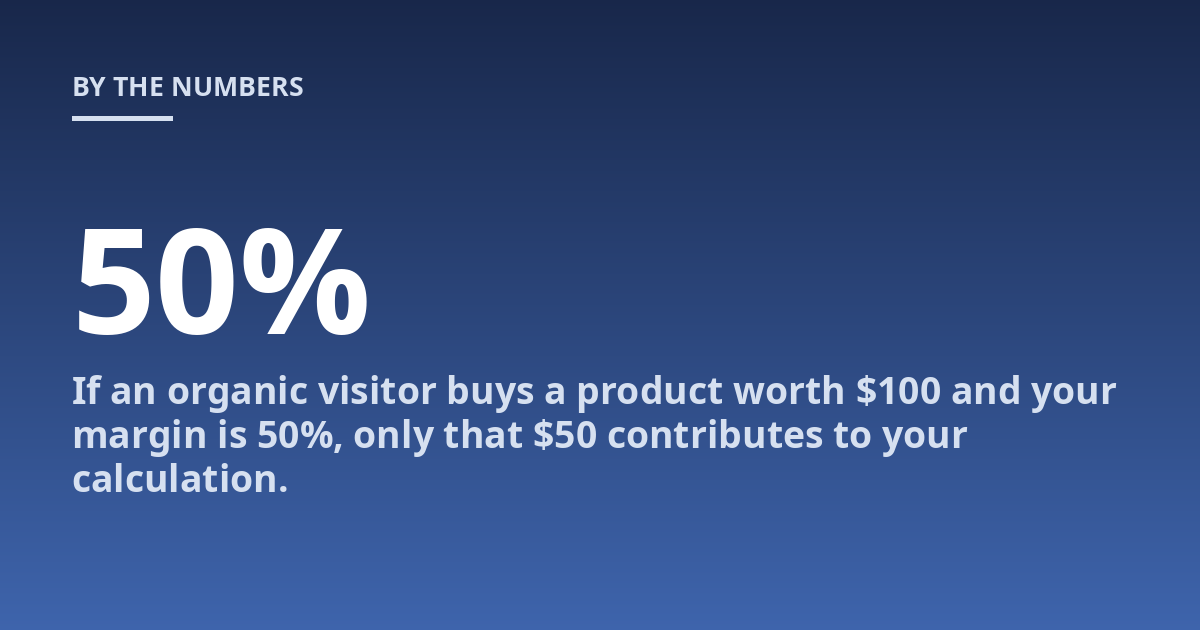
In practice, calculating this is rarely a simple subtraction. You must decide if you are looking at gross revenue or net profit after the cost of goods sold (COGS) for the customers acquired via SEO. If an organic visitor buys a product worth $100 and your margin is 50%, only that $50 contributes to your calculation. Many organizations fail because they use top-line revenue, which artificially inflates their perceived success. A more conservative approach focuses on gross profit per channel to ensure the data remains actionable for finance departments.
| Metric Type | Organic Search (Long-term) | Paid Search (Short-term) |
|---|---|---|
| Primary Cost | Content and Technical Labor | Direct Ad Spend (CPC) |
| Revenue Velocity | Delayed: 3 to 12 months | Immediate: Within days |
| ROI Scalability | Exponential as authority builds | Linear based on budget increases |
Why You Must Move Beyond Vanity Metrics for Real ROI
Moving beyond vanity metrics is the most important step in proving SEO value to leadership. High rankings for high-volume keywords do not generate profit if those users lack commercial intent. A company might rank number one for “what is an infographic,” but if that traffic never converts into a lead, your SEO ROI remains zero. You must focus on “money keywords” and the conversion rate of the pages they land on.
To do this effectively, you should integrate your analytics with your CRM (Customer Relationship Management) system. This integration allows you to trace an organic visitor through their entire journey, from the first landing page click to the final invoice payment. Without this connection, you are essentially guessing at the value of your content. To get started with data collection, you should first learn how do I set up Google Search Console to ensure your baseline search data is accurate.
The Relationship Between SEO and Customer Lifetime Value
SEO ROI should be viewed through the lens of Customer Lifetime Value (LTV) rather than a single transaction. Unlike paid advertising, where traffic ceases the moment you stop paying for clicks, organic rankings provide a compounding effect. An organic lead may have a higher LTV because they found your brand through an educational content piece, building trust before the first interaction occurs.
When evaluating the success of a long-term SEO strategy, compare the Customer Acquisition Cost (CAC) of organic search against other channels. Often, while the initial cost to rank for a competitive term is high, the per-customer acquisition cost drops significantly over time as your domain authority grows. This makes SEO one of the most efficient channels for sustainable growth when measured against the 12-month or 24-month horizon. Effective tracking also depends on your ability to answer what is GA4 and how do I track organic traffic.
The most reliable way to prove SEO value is to track individual
Other posts from the category
There are no posts for the selected category.

Latest posts from the category
-

What makes an effective Category Page for AI
June 5, 2026
-

What Influences the cost of AI Optimisation
June 1, 2026
-

Organisation Schema: how to help AI understand your brand
May 27, 2026