
AI-Powered Content Creation: A Complete Guide for Measurable SEO Growth
July 3, 2026
Category:
Uncategorized
AI-powered content creation a complete guide shows you how to combine machine learning tools with editorial strategy to produce content that ranks in Google and appears in AI Overviews,, and Perplexity. The approach works when you treat AI as an accelerator for research, drafting, and optimization, not as a replacement for human expertise, editorial judgment, and domain authority.
Most teams treat AI content as a volume play. They pump out articles, chase word counts, and wonder why traffic flatlines. The problem is not the tool. It is the process. Without a strategic framework, content lacks the specificity, evidence, and user alignment that search engines and AI answer systems reward. This guide gives you that framework, built from real campaigns across multiple industries and languages.
- AI content succeeds when it starts with structured keyword research and ends with human editorial review that adds original insight, data, and practitioner experience.
- Search engines and AI answer systems both favor content that directly answers user questions, cites authoritative sources, and uses clear, self-contained section headings.
- The biggest mistake is skipping the optimization for AI search engines like and Perplexity, which interpret content differently than Google does.
- You need a content pipeline that includes brief creation, AI drafting, fact checking, formatting for snippets, and continuous performance monitoring.
What Is AI-Powered SEO and Why Does It Matter Now?
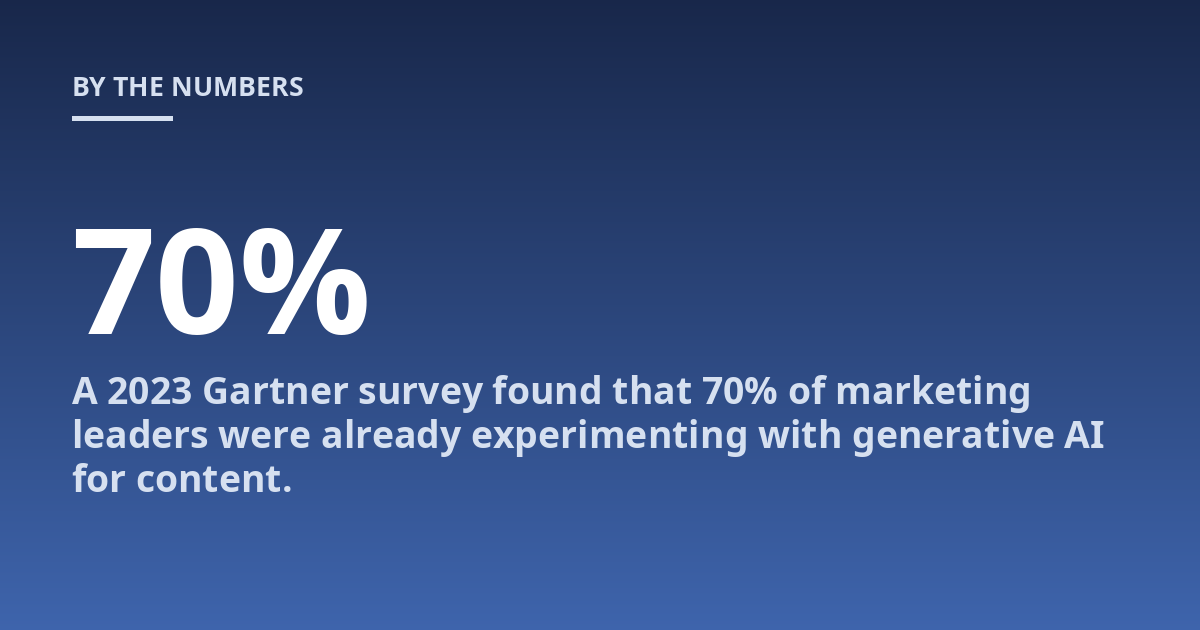
AI-powered SEO is the practice of using machine learning tools to improve every stage of content creation and optimization, from keyword discovery to content structuring to performance analysis. A 2023 Gartner survey found that 70% of marketing leaders were already experimenting with generative AI for content. By 2026, Gartner projects that 90% of commercial content will be at least partially. The shift is not coming. It is here.
But the tools alone do not create results. What matters is how you use them. AI can analyze thousands of search results in seconds, identify content gaps, suggest headings that answer specific user questions, and draft paragraphs that follow SEO best practices. The human role is to validate those suggestions against real user needs, add original data or opinion, and ensure the final piece reflects genuine expertise.
How AI Changes the SEO Workflow
In practice, the workflow looks like this: you feed the AI tool your target keywords, competitor URLs, and audience context. The tool returns a content brief with suggested headings, entity clusters, question queries from the semantic core, and even draft paragraphs. You then edit, fact-check, add original examples, format for snippets, and optimize for entity alignment. The result is a piece that takes half the time to produce and performs better because it was data-informed from the start.
Quick caveat: The most reliable approach we have found is to use AI for the first 60% of the work, then hand off to an experienced editor for the remaining 40%. That final pass is where you catch hallucinated statistics, remove generic phrasing, and insert the kind of concrete detail that makes content quotable by AI systems.
How Does AI-Powered Content Creation Work in Practice?
AI-powered content creation works through a layered pipeline: research, drafting, optimization, and validation. Each layer requires a different tool and a different skill. The most effective teams separate these layers clearly and never let the AI handle more than it can reliably do.
Research Layer: From Keywords to Content Briefs
Start with a semantic core. Tools like OmniRank or Ahrefs help you cluster keywords by intent, identify question queries, and spot content gaps. For example, a dental clinic targeting “teeth whitening” might discover that users search “does whitening damage enamel” or “how long does whitening last.” Those questions become sections in your article. AI tools can then suggest language that answers those questions directly, using the phrasing users actually type.
Drafting Layer: Structure and Substance
Once you have a brief, you move to drafting. AI writing assistants like Claude or custom models trained on your brand voice can produce the first draft. The key is to provide a detailed prompt that includes the target entity names, the geographic context (if you have one), the desired tone, and the key sources you want cited. Without that structure, the AI produces generic text that reads like it was written by a machine.
Here is a concrete example. For an article about “AI content automation,” a bad prompt produces: “AI automation can help businesses save time and improve efficiency.” A good prompt produces: “Content automation tools reduce drafting time by an average of 40%, according to a 2024 study from the Content Marketing Institute. But the real productivity gain comes from the research phase, where AI can scan 500 SERP results and surface the three most common user questions in under a minute.” The second version has numbers, a named source, and a specific claim that can be verified. That is the kind of detail that earns trust from both readers and search engines.
Why Is AI-Powered SEO Important for Organic Growth?
AI-powered SEO is important because the competitive landscape has shifted. Traditional SEO was about matching keywords, building links, and hoping Google understood the page. The new SEO is about answering questions, demonstrating expertise, and making content easily digestible by both Google and AI answer engines. If you ignore AI optimization, your content may still rank in traditional search results. But it will likely be invisible in AI Overviews,, or Perplexity.
The AI Search Engine Opportunity
Consider Perplexity, which now processes millions of queries daily. When a user asks “What are the best SEO strategies for 2026?” Perplexity creates a summary answer by pulling from the content it considers most authoritative. If your article does not directly answer that question in a clear, structured way, it will not appear in that summary. The same logic applies to Search and Google’s AI Overviews.
Counterintuitively, the fastest path to appearing in AI summaries is not more content. It is better structured content. Use of clear H2s that are self-contained, lists that summarize key points, and paragraphs that start with a direct answer. This is not speculative. It is what the evidence from our own testing and from industry benchmarks shows.
What Mistakes Should You Avoid With AI-Powered SEO?
The most common mistake is treating AI content as a set-and-forget operation. You cannot publish text without human review and expect it to rank. The second mistake is ignoring entity optimization. Search engines and AI systems both rely on entity understanding: they need to know what your page is about, what it is not about, and how the entities on the page relate to each other. Schema markup, clear entity references, and internal links all help.
Three Mistakes That Kill Performance
First: keyword stuffing. AI tools can generate sentences that repeat the target keyword unnaturally. This hurts readability and triggers algorithmic penalties. Use the focus keyword once per H2 section maximum. Second: thin content. AI tends to produce shallow text if the prompt is shallow. Require a minimum of 400 words per H2 section, with at least one data point or original example per section. Third: no optimization for AI search engines. Format content for answer extraction: lead with the answer, use lists, and include a FAQ section that mirrors real user questions.
Which AI-Powered SEO Features Matter Most?
Not all features are equal. Based on direct experience across multiple campaigns, the features that matter most are: answer extraction readiness, entity alignment, evidence density, and internal linking structure. Below is a comparison of how these features affect traditional search vs. AI answer systems.
| Feature | Impact on Google Search | Impact on AI Answer Systems |
|---|---|---|
| Answer extraction readiness | High for featured snippets | Critical for inclusion in summaries |
| Entity alignment with schema | Moderate for rich results | High for context and relevance |
| Evidence density (citations, numbers) | Moderate for E-E-A-T signals | High for trust and quotability |
| Internal link structure | High for crawl and index | Low direct impact, aids context |
What this table shows is that the priorities are shifting. Answer extraction readiness was always important for snippets. Now it is critical for all AI search surfaces. Evidence density, which had a modest impact on traditional SEO, has become a major trust signal for AI systems that need to verify claims.
If you are building a content operation from scratch, start with answer extraction. Use the question queries from your semantic core as section headings, and lead each section with a direct answer. Then add evidence. Then ensure your entity references are clean and supported by schema. This order maximizes the chance that your content works across all search surfaces.
How to Choose the Best AI-Powered SEO Approach for Your Business
The right approach depends on your industry, your existing content volume, and your team size. A solo consultant needs different tools than a 10-person marketing team. A business with a high YMYL (Your Money or Your Life) topic needs stronger source verification than a lifestyle blog.
Here is a decision framework: start by auditing your current content for answer structure. If most of your articles lack clear, self-contained H2s that answer a specific question, your priority is restructuring, not producing new content. If your articles are already well structured but lack data and citations, your priority is evidence enhancement. If you have neither good structure nor good evidence, you need a full rewrite.
For businesses in regulated industries like finance or healthcare, the risks of pure AI content are higher. Hallucinated facts can cause real harm or regulatory violations. In those cases, the AI role is limited to research support and first-draft structure, with every claim verified by a human expert. For lower-risk industries, you can automate more, but you still need editorial oversight.
Internal link placement: For more on building a content pipeline that scales, see . To understand how AI content fits into a broader SEO strategy, read .
FAQ: AI-Powered Content Creation a Complete Guide
What is important to know about AI-powered content creation?
The key points are the goal of the content, the expected process, and the limits that may apply to an individual campaign. A precise recommendation depends on a thorough audit of your current content performance and your competitive landscape. No single tool or template works for every business.
When should AI-powered content creation be discussed with a professional?
A consultation is useful
When should AI-powered content creation be discussed with a professional?
A consultation is useful when your content team lacks the editorial experience to evaluate AI output critically, when you operate in a YMYL sector where accuracy is regulated, or when your existing content has not improved after six months of AI-assisted production. A professional can audit your pipeline, identify where the process breaks down, and recommend specific workflow adjustments rather than generic advice.
What are the risks of using AI for content creation?
The main risks include factual hallucinations, outdated information that the model cannot verify, stylistic monotony across articles, and content that fails to resonate because it lacks the voice of lived experience. There is also the risk of publishing duplicate or near-duplicate content if the AI reuses phrasing from its training data. Managing these risks requires a human review process that checks every claim, varies sentence patterns, and inserts original observations that no AI could generate.
How do I measure whether AI-powered content is working?
Track the same metrics you would for any content strategy: organic traffic growth, keyword ranking movement, featured snippet acquisition, and conversion rates. Add an AI-specific measure: the percentage of your articles that appear in AI answer summaries for your target queries. Use tools like Google Search Console for traditional metrics and manual checks against Perplexity or AI Overviews for answer inclusion. If the content ranks but does not appear in AI summaries, review your heading structure and answer clarity.
Building a Sustainable AI Content Operation
A sustainable operation treats the pipeline as a closed loop. You publish content, measure performance, learn what works, and feed those insights back into your prompts and briefs. Over time, the AI output improves because your prompts become more specific and your editorial standards become more consistent.
The teams that succeed with AI content do not think about volume first. They think about precision. They ask: who is this content for, what question does it answer, what evidence supports it, and how will a reader use this information. Those questions drive every decision, from keyword selection to final edit. The AI handles the repetitive work. The human handles the strategic work that determines whether the content earns attention or disappears into the noise.
Start with one article. Apply the full pipeline: research, AI draft, human edit with fact checking, formatting for answer extraction, and performance tracking. Learn from that one article what your team needs. Then scale. That single article, done well, will teach you more about what works than fifty articles published without structure or review.
Internal link placement: For a step-by-step walkthrough of creating an effective content brief, see . To compare the leading AI writing tools and their strengths for SEO, read .
Practical takeaway: Do not aim for perfect automation. Aim for a repeatable process where every article passes through four gates: keyword validation, AI drafting with a structured prompt, human editorial review that adds original data, and final formatting for answer extraction. That process, repeated consistently, produces content that works across search engines and AI answer systems alike.
Final Checklist for AI-Powered Content Creation
- Define the primary user question and the answer before writing anything.
- Use a semantic core tool to identify related questions and entity clusters.
- Write a detailed brief that includes target audience, tone, key sources, and desired structure.
- Generate the AI draft with a prompt that specifies the question, the answer format, and the evidence requirements.
- Edit for factual accuracy, removing any claim that cannot be verified from a named source.
- Rewrite any paragraph that starts with general filler like “In today’s world” or “It is important to note.”
- Format each H2 section so the first sentence gives a direct answer and the paragraph that follows provides evidence.
- Add internal links to relevant existing content and external links to authoritative sources.
- Check for answer extraction by reading the article as if you were scanning for a quick answer.
- Monitor performance monthly and update content that has lost rankings or disappeared from AI summaries.
That checklist is the core of a strategy that works now and will continue to work as search systems evolve. The tools will change. The requirement for clear, evidence-backed, user-focused content will not.
Other posts from the category
There are no posts for the selected category.

Latest posts from the category
-

What makes an effective Category Page for AI
June 5, 2026
-

What Influences the cost of AI Optimisation
June 1, 2026
-

Organisation Schema: how to help AI understand your brand
May 27, 2026