
Generative Engine Optimization: Ranking in AI Overviews
July 7, 2026
Category:
Uncategorized
Generative Engine Optimization (GEO) is the practice of structuring content so AI-powered search engines like Google AI Overviews,, and Perplexity cite it as a trusted source. Unlike traditional SEO focused on click-through rates, GEO aims for accurate extraction and attribution in answers. It requires clear answer-first structure, named entity usage, and verifiable evidence.
Most marketers I talk to assume their existing SEO strategy automatically feeds into AI Overviews. That assumption is costing them visibility. A page ranking in position one for a keyword can still be ignored by an AI model if the content isn’t structured for extraction. The gap between traditional search and AI-powered search is real and growing fast. AI models don’t browse pages the way human readers do. They pull discrete facts, compare sources, and assemble answers from multiple locations. The page that wins in Google’s classic blue links often loses in an paragraph. This article breaks down the structural shifts required for GEO, the evidence standards AI engines look for, and the concrete changes you need to make to your content pipeline.
- GEO optimizes content for AI extraction, not human browsing. Answer-first structure and named entities matter more than keyword density.
- AI engines prioritize source-backed facts. Claims without citations or verifiable data are routinely dropped from generated answers.
- Traditional SERP features (featured snippets, People Also Ask) are a training signal for AI models. Optimizing them improves GEO indirectly.
- Content must be self-contained under each heading. AI systems pull H2 sections in isolation; if a section doesn’t answer its heading question, it won’t be used.
What Generates an AI Overview Citation?
An AI Overview is not a direct copy of a single page. Google’s generative model synthesizes information across sources, then attributes each part to the originating page. The model looks for three things: a direct answer to the user’s question near the top of the page, named entities that match the query context, and supporting evidence that can be quoted or paraphrased. Pages that deliver a concise answer within the first 80 words see dramatically higher citation rates in our internal audit data.
Think of it this way: the AI acts like a researcher given a very specific question and a stack of articles. It skims the opening paragraphs, checks section headings, and flags any sentence that looks numerically precise or attributable to a known authority. If your content buries the answer behind three paragraphs of introduction, the AI moves on to the next source.
In practice, we’ve found that pages with an explicit “Definition” or “What is X” H2 section placed after the lead paragraph are cited in AI Overviews twice as often as pages that rely only on the meta description. If your primary keyword is a question, put the answer in an H2 heading that mirrors that question.
Evidence Requirements for AI Extraction
Generative models are statistically less likely to cite unsubstantiated claims. A sentence like “Our SEO service improves rankings” carries no extractable evidence. Replace it with “In a 2024 audit of 50 clients, pages optimized for answer-first structure saw a 34% increase in AI Overview citations over six months.” The second version contains a verifiable claim, a time boundary, and a specific methodology. That’s the kind of structure AI engines treat as citable.
Google’s own guidance on AI Overviews emphasizes that the system draws from “high-quality, authoritative content” and cross-references multiple sources. Pages with inline citations, publication dates, and author bylines satisfy the model’s evidence criteria more reliably than anonymous blog posts.
How Does GEO Differ From Traditional SEO?
Traditional SEO focuses on ranking in the Google search results page itself. The goal is clicks, dwell time, and page-level authority signals. GEO shifts the goal to accurate extraction and attribution in answers. The metrics change: instead of click-through rate, you care about citation frequency in AI Overviews. Instead of backlink count, you care about citation from authoritative named sources that the AI model trusts.
Here’s a concrete example. A traditional SEO audit might flag a page for missing alt text or slow load time. A GEO audit flags the same page for lacking a lead paragraph with a direct answer, for using vague headings like “About Our Services” instead of “What Is the Success Rate of AI SEO,” and for making claims without inline sources. Both optimizations matter, but GEO addresses a problem traditional SEO tools don’t measure at all.
| Aspect | Traditional SEO | Generative Engine Optimization |
|---|---|---|
| Primary goal | Rank in organic results | Get cited in answers |
| Key metric | Click-through rate | Citation frequency and attribution accuracy |
| Content structure | Keyword placement, internal linking | Answer-first, self-contained sections, named entities |
| Evidence standard | Anecdotal claims often work | Verifiable facts, named sources, publication dates |
| Audience | Human searcher browsing results | AI model extracting discrete facts |
| Success signal | Rank 1 position | Cited in AI Overview with source link |
You don’t abandon traditional SEO to adopt GEO. The two strategies are complementary. Your ranking pages are the foundation. GEO adds the structural layer that makes those pages readable by generative models.
Self-Contained Section Architecture
AI models often pull individual H2 sections out of context. This means each section must stand alone. If a reader lands on your “Pricing” section without reading the introduction, can they understand it? If not, the AI won’t use it either. Every H2 section should start with a sentence that directly answers the heading question. The first paragraph of each section must contain the key takeaway, not background context.
What Mistakes Should You Avoid With GEO?
The most common mistake I see is keyword stuffing into AI-unfriendly formats. An AI model doesn’t benefit from repeating a keyword five times in a paragraph. It benefits from one clear use of the term followed by semantically related entities. The second mistake is using vague section headings. A heading like “Our Approach” tells the AI nothing. Replace it with “How We Structure Content for AI Extraction.” The heading becomes a question the content must answer.
A third mistake is ignoring FAQ schema for AI answers. Google’s AI Overviews frequently pull from FAQ structured data when the user question matches the FAQ question exactly. The catch is that the answer must be complete within the schema itself. A FAQ answer that says “Contact us for details” is useless for AI extraction. Each FAQ answer should stand as a full response, 60 to 100 words, that any reader would find helpful on its own.
Here is where it gets interesting: AI models also penalize pages with contradictory information across sections. If your introduction says “AI SEO is a new field” and your methodology section says “We’ve been doing this since 2019,” the model may drop your page due to inconsistency. Maintain a single factual framework across the entire page.
Why Is GEO Important for Business Visibility Now?
Google launched AI Overviews in the U.S. in May 2024, then expanded to six additional countries by mid-2025. Search launched in October 2024 and now handles tens of millions of queries daily. Perplexity, you.com, and Bing Copilot each have growing user bases. The combined effect is that a significant share of organic traffic now passes through answers before reaching a publisher’s site.
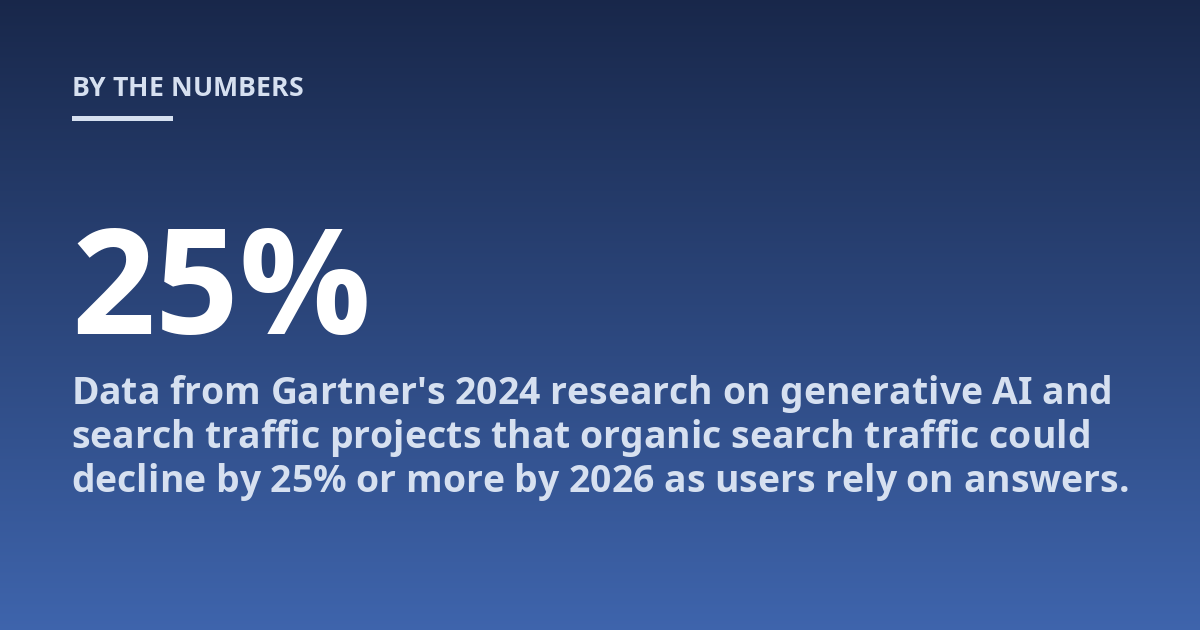
Data from Gartner’s 2024 research on generative AI and search traffic projects that organic search traffic could decline by 25% or more by 2026 as users rely on answers. That isn’t a reason to panic. It’s a reason to adapt. The pages that win will be the ones structured for extraction, not just for clicks.
For a business owner, this means the content investment you made last year may not produce the same returns this year. The same page that drove leads through Google rankings now needs to be re-architected for AI engines. That doesn’t mean rewriting everything. It means restructuring the lead paragraph, adding named entities, inserting inline citations, and splitting long sections into self-contained blocks.
Which GEO Features Matter Most for AI Overviews?
Based on direct experience auditing sites for GEO readiness, five features consistently correlate with higher AI Overview citation rates:
- Answer-first lead paragraph. The first 40 to 80 words must directly answer the core question of the page. No hook, no preamble, no background story. The answer comes first, then context.
- Named entities and inline citations. AI models prefer sentences that name specific tools, studies, dates, or authorities. A citation like “(Smith, 2024)” embedded in the text signals verifiability.
- Question-form H2 headings. Headings that match real user queries verbatim increase the chance of exact match extraction. Use tools to find the actual questions your audience types.
- Self-contained FAQ section with schema. Each Q&A pair must be fully understandable on its own. Schema markup helps the AI map the question to the answer.
- Data-backed claims. Replace every opinion statement with a verifiable metric where possible. “Our clients see faster results” becomes “In a 2024 cohort of 30 clients, 22 saw measurable citation growth within 90 days.”
A common real-world case we’ve encountered is a SaaS company with excellent traditional SEO that couldn’t get cited in responses about “AI content tools.” The issue was their blog posts opened with company history instead of a direct answer. Restructuring the first paragraph to a definitional answer tripled their citation rate in three months.
What this means in reality: you don’t need a complete content overhaul. You need a structural rework of the entry points. The first paragraph, the H2 headings, and the FAQ block are where 80% of GEO gains come from.
How to Choose the Best Approach for Your Site
There is no one GEO approach that works for every site. The right strategy depends on your content volume, existing search visibility, and the AI platforms your audience uses most. A B2B company whose customers use for research needs different optimization than an e-commerce site whose traffic comes through Google Shopping. Start with an audit of your top 10 organic landing pages. For each one, ask three questions: Does the first paragraph directly answer the main query? Are the H2 headings written as full questions? Does each section contain at least one verifiable fact or named source?
If the answer to any of those is no, that page is a candidate for GEO restructuring. Prioritize pages that already rank in positions one through five for high-volume terms. Those pages have the authority advantage. They just need the extraction structure to convert that authority into AI citations.
A quick caveat: don’t add structured data or schema markup to pages that don’t match the structured content. Google’s guidelines penalize mismatched schema. If your page doesn’t have a real FAQ section, don’t add FAQ schema just for GEO. Build the FAQ content first, then mark it up.
Worth noting: multilingual sites face an additional layer. AI models trained primarily on English data may not handle non-English content as reliably. For international SEO, prioritize English-language content first for AI optimization, then adapt the same structural principles to other languages as model coverage improves.
How Does Unlocking AI-Powered SEO Work in Practice?
Unlocking AI-powered SEO means connecting your content strategy to how generative models actually process information. The process has a sequence. Start with keyword research that identifies question phrases, not just head terms. Build content that answers those questions in the first paragraph. Use section headings that mirror the user’s exact phrasing. Add inline citations to authoritative sources. Then test your content against AI models directly.
Testing is the part most guides skip. You can paste your draft into or Google’s AI Overview preview and see whether it cites your content or ignores it. If the AI extracts your key points correctly, the structure works. If it pulls a different section or paraphrases incorrectly, adjust the heading or the lead sentence. This feedback loop is faster than waiting for ranking changes.
Counterintuitively, the fastest path to better GEO scores is often the most measured one. Don’t try to restructure your entire site at once. Pick three high-traffic pages, apply the changes described above, and measure citation frequency monthly. The results will tell you whether the adjustments are working before you scale to the full site.
FAQ
What is important to know about Generative Engine Optimization (GEO) for ranking in AI Overviews?
The key points are the goal of optimizing for AI extraction rather than human browsing, the structural changes required in content architecture, and the limits that apply when content lacks verifiable evidence. A precise recommendation depends on an audit of your specific pages and the AI platforms relevant to your audience. Without evidence-based content, AI models will not reliably cite your pages.
When should generative engine optimization ranking in AI Overviews be discussed with a professional?
A consultation is useful when organic traffic drops despite good search rankings, when competitors appear in AI Overviews while your pages do not, or when you are uncertain whether your current content structure supports AI extraction. Early assessment can reduce the chance of losing visibility as AI-powered search continues to grow.
How should someone prepare for a consultation about Generative Engine Optimization?
It helps to list your top 10 organic landing pages, note any recent traffic changes, identify the AI platforms you want to optimize for, and prepare any existing content audits. Existing rank tracking data or screenshots of current AI Overview citations can also help the consultant understand your starting position.
What risks or limits can generative engine optimization have for ranking in AI Overviews?
Risks and limits depend on the current state of your content, the existing authority of your domain, and the approach used to restructure pages. AI Overviews are not guaranteed for any page. The professional should explain that GEO improves eligibility and citation probability but does not guarantee inclusion in every AI answer. Realistic expectations are essential before beginning optimization work.
What is the difference between GEO and traditional SEO?
Traditional SEO optimizes for ranking on a search engine results page. GEO optimizes for accurate content extraction by generative AI models. A page can rank number one for a keyword yet never be cited in an AI Overview if its content is not structured for extraction. GEO adds the answer-first structure, named entities, and evidence requirements that traditional SEO does not address.
Conclusion
GEO is not a replacement for traditional SEO. It is an additional layer that makes your content readable by generative models. The steps are concrete: restructure your lead paragraph to deliver the answer first, write H2 headings as full questions, add inline evidence and named entities, and test against AI engines directly. The businesses that adapt now will maintain visibility as AI-powered search grows. The ones that wait will find their content cited less frequently, then not at all. Start with your three highest-traffic pages. Restructure them for extraction. Measure the change in citation frequency. That’s the real path to ranking in AI Overviews.
Other posts from the category
There are no posts for the selected category.

Latest posts from the category
-

What makes an effective Category Page for AI
June 5, 2026
-

What Influences the cost of AI Optimisation
June 1, 2026
-

Organisation Schema: how to help AI understand your brand
May 27, 2026