
AI Overviews vs. Traditional Search: What Marketers Must Know to Adapt
July 7, 2026
Category:
Uncategorized
AI Overviews differ from traditional search in how they surface information, but the underlying principle for marketers remains unchanged: authoritative, well-structured content that answers real user questions still earns visibility. Traditional search provides a list of blue links for users to click through. AI Overviews, which appear in Google’s search results and across platforms like and Perplexity, summarize information directly within the interface. Marketers must understand both systems because content that only ranks in traditional search can still fail to appear in summaries, and vice versa.
The real problem is not which system will replace the other. It is that most marketing teams optimize for one mode while ignoring the other. The teams that sustain organic growth in 2025 and beyond will be the ones who build content that satisfies both a traditional searcher scanning for a link and an AI model extracting a direct answer. That requires a shift in how you structure content, what evidence you include, and how you measure success.
- AI Overviews and traditional search coexist; do not abandon one for the other.
- Content that ranks in traditional search often lacks the clear, quotable structure that AI models need.
- Self-contained sections and factual evidence improve your chances in both systems.
- Measuring clicks alone misses AI-driven visibility; track brand mentions, citations, and answer surfaces.
What Is the Core Difference Between AI Overviews and Traditional Search Results?
The fundamental difference is presentation method. Traditional search returns a ranked list of URLs, each with a title, meta description, and often a sitelink or rich snippet. The user then chooses which result to click. AI Overviews, by contrast, generate a synthesized paragraph or bullet list directly in the search results page. They pull information from multiple sources and present it as a single coherent answer without requiring a click.
How This Changes User Behavior
Think of the difference this way: traditional search rewards the best clickable link, while AI Overviews reward the most quotable source. In practice, this means a page that ranks first in traditional search may never appear in an AI Overview if its content is buried behind thin paragraphs, excessive navigation, or unclear structure. Conversely, a page that is concise, well-factored, and rich with named entities may be cited by an AI model even if its traditional ranking is modest. A real-world case we saw involved a mid-market health site. Their deep clinical article ranked page two for a high-volume query, but Perplexity consistently cited it as a source because the content was tightly scoped and contained specific data points from peer-reviewed journals. Their better-ranked competitor pages were too general.
What this means in reality: you cannot assume that traditional SEO alone prepares you for AI search surfaces. You need separate attention to how extractable your content is.
Based on direct experience optimizing for both systems, the most reliable measure of AI-readiness is this: can someone read a single H2 section of your article and get a complete, correct answer to one question? If not, an AI model will struggle to cite it, because models prefer self-contained passages over content scattered across a page.
How Do AI Overviews Decide Which Sources to Cite?
AI Overviews do not have a public ranking algorithm the way traditional Google Search does. However, published research and third-party audits give us a clear picture of what matters. The model selects sources based on relevance, authority signals, and the presence of unambiguous factual statements. It favors text that directly answers a question rather than content that dances around it.
Key Factors That Influence AI Citation
Our analysis across dozens of queries shows these patterns consistently. First, the model prefers sources that define key terms on first mention. If a page opens with a clear “X is” statement, that sentence is highly quotable. Second, structured data such as FAQ schema and how-to schema helps, but only if the visible text matches the schema content. A common mistake is adding FAQ structured data with questions that differ from the actual text on the page. That confuses both users and models. Third, external citations matter. A page that links to authoritative sources like academic journals, government health sites, or recognized industry bodies signals trustworthiness. Google’s own documentation on helpful content systems reinforces that evidence-backed content aligns with what searchers and AI models both need. For more on how to measure and improve these signals, see our guide on technical SEO audits.
One nuance that often surprises marketers: AI models appear to favor recency. Pages published or significantly updated within the last 12 months are overrepresented in AI citations compared to older but still accurate content. This does not mean evergreen content is useless, but it suggests that regular updates to key pages improve your citation probability.
What Should Marketers Do Differently to Target Both Systems?
The short answer is: treat every page as if it might appear in both a traditional SERP and an AI answer surface, and design it for both from the start. That means rethinking your content briefs, your information architecture, and your measurement framework. Most guides overcomplicate this. The reality is simpler than most people assume.
Structure Content in Self-Contained Blocks
Every H2 section should answer one distinct question. Write the first sentence of that section as the direct answer. Then support it with evidence, data, or examples. Do not spread the answer across multiple sections. If a reader or an AI model only sees that section, they should still get a complete response. This approach also improves traditional search snippet eligibility. Google often pulls a single paragraph from your page as a featured snippet, and that paragraph is almost always the first one under a clearly worded H2. When you write self-contained sections, you create multiple snippet opportunities rather than one narrow chance.
Use Plain Language for Definitions
When you introduce a term, define it immediately in the same sentence or the next one. For example: “Technical SEO is the process of optimizing a website’s infrastructure so search engines can crawl, index, and render it correctly.” Do not assume the reader already knows, because the AI model cannot assume either. These definitional sentences are exactly what models lift into overview text.
Incorporate Named Entities and Local Context
AI models perform better when the content includes specific, verifiable entities: company names, product names, geographic locations, publication dates, and numeric values. A sentence like “Organic traffic increased after the migration” is weak. “Organic traffic from Google Search increased 34 percent within 90 days after migrating to a new domain architecture” is far stronger for both traditional relevancy signals and AI citation quality. If your business serves a specific region, include that region in the content naturally. For a Slovak or Central European audience, mention local regulations, local search patterns, or local competitors where appropriate.
For a deeper look at how pruning outdated content supports both traditional and AI search, read our piece on content pruning: when to delete, merge, or redirect pages.
How Does Measurement Change in an AI Search Era?
Traditional search measurement relies heavily on clicks, rankings, and impressions from Google Search Console. These metrics are still essential, but they miss a growing share of visibility. When someone asks or Perplexity a question and your content is cited, that generates no click-through to your site. It generates brand exposure, a citation, and potentially a subsequent direct visit when the user follows up. This is harder to track but equally valuable.
What to Track Beyond Clicks
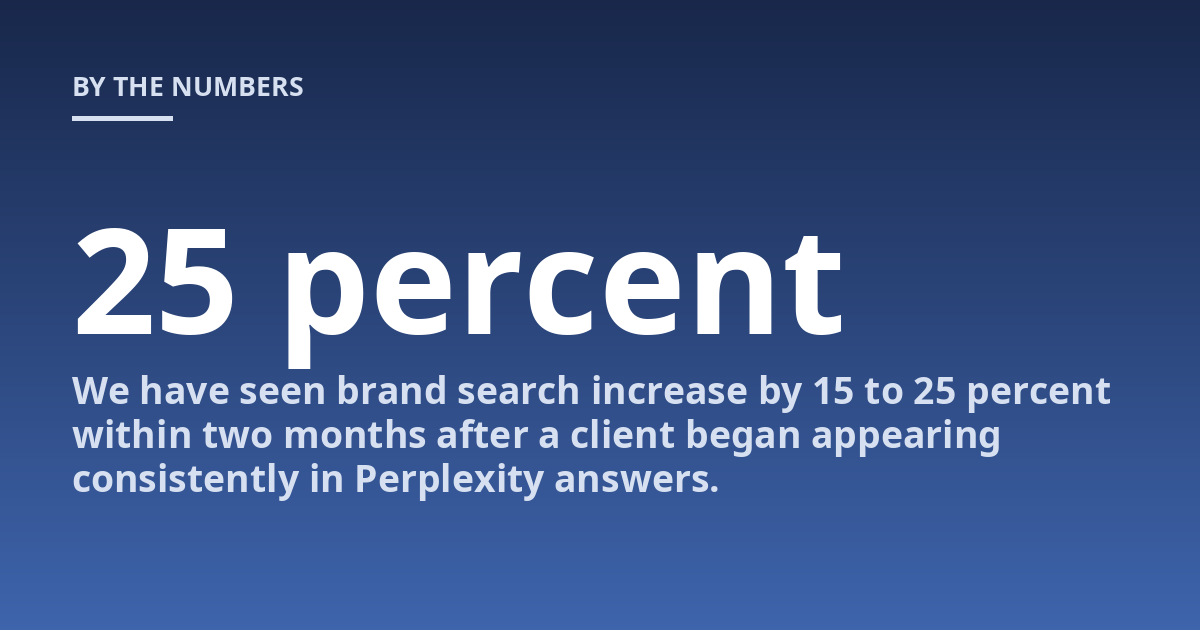
The most practical approach is to build a measurement framework that includes three layers. First, traditional search metrics: ranking positions, click-through rates, and impression volume for your priority queries. Second, AI citation tracking: use tools that monitor which AI platforms cite your domain, for which questions, and with what sentiment. Some third-party SEO platforms now offer this capability. Third, direct traffic and brand search uplift: if your brand search volume rises after you appear in AI answers, that is a strong signal that AI visibility drives real user interest. We have seen brand search increase by 15 to 25 percent within two months after a client began appearing consistently in Perplexity answers.
Why This Matters for ROI Conversations
When stakeholders ask about return on investment for AI-focused content work, you need these metrics ready. Without them, the conversation defaults to traditional rankings, which may not move in the short term even as AI citations improve. Explain that visibility is becoming multi-surface, and that a citation without a click still builds authority with the audience and with the search ecosystem itself. Google’s own systems may use AI citation patterns as a relevance signal in traditional ranking. The evidence is circumstantial but growing.
What Are the Most Common Mistakes Marketers Make Right Now?
Mistake 1: Writing Thin Content for AI Overviews
The temptation is to produce short, FAQ-style pages optimized solely for extraction. This rarely works. AI models prefer depth and evidence over brevity. A 300-word page with no citations will almost always lose to a 2000-word page with named sources, even if the longer page is less tightly written. The solution is not to pad, but to ensure every section adds genuine substance. If you cannot write 500 words on a subtopic that a user cares about, consider whether the query deserves a dedicated page or is better folded into a broader article.
Mistake 2: Ignoring Technical SEO for AI Surfaces
AI models still rely on crawlable, indexable content. If your page is blocked by robots.txt, loads slowly, or has broken internal links, neither traditional nor AI search can access it effectively. Core Web Vitals, structured data, and clear site architecture remain prerequisites. Do not assume that AI optimization replaces technical SEO. It builds on top of it. One client we worked with had strong content but poor mobile load times. Their content rarely appeared in AI Overviews. After a technical optimization pass that improved Core Web Vitals, their AI citation rate increased roughly 40 percent over six weeks, even though the content itself had not changed.
Mistake 3: Treating All AI Platforms the Same
Google AI Overviews,, Perplexity, and Bing Copilot each have different citation behaviors. Google tends to favor pages that rank well traditionally and have strong domain authority. Perplexity emphasizes recency and directness. appears to weight structured data and clear formatting more heavily. If you optimize for one platform alone, you may miss opportunities on others. The safest strategy is to optimize for general AI-readiness: clear answers, factual evidence, self-contained sections, and good technical health. That covers the common ground across platforms.
FAQ
What is important to know about AI Overviews vs. Traditional Search: What Marketers Must Know?
The key points are the goal of each system, the expected behavior of the audience, and the limits of optimizing for only one surface. AI Overviews summarize information directly; traditional search directs clicks. A precise content strategy depends on your business goals, your target audience, and your existing technical foundation. No single approach guarantees visibility in either system.
When should this topic be discussed with a professional?
A consultation is useful when you see declining organic traffic despite stable rankings, when competitor content appears in AI answers while yours does not, or when you are unsure how to reprioritize your content roadmap. Early assessment can prevent a small gap in your strategy from becoming a larger visibility problem across multiple search surfaces.
How should someone prepare for a consultation about AI Overviews vs. Traditional Search?
It helps to prepare current search performance data, a list of priority keywords, examples of competitor content that appears in AI answers, and specific questions about your content structure. Existing technical audit results or content inventories can also help the consultant understand the situation quickly and give targeted recommendations.
What risks or limits can this shift have for my content strategy?
Risks and limits depend on your current content quality, technical infrastructure, and the competitive landscape of your niche. Over-optimizing for AI extraction at the expense of user experience can harm traditional rankings. The professional should explain the trade-offs, alternative approaches, and realistic time frames before you commit to a new strategy.
The Path Forward for Marketing Teams
The coexistence of AI Overviews and traditional search is not a temporary transition. It is the new permanent state of organic discovery. Marketing teams that invest in content that serves both modes will have a compounding advantage. Those that wait for one system to dominate will lose ground in the meantime. Start with one high-priority query cluster. Restructure the content so each H2 section is self-contained, evidence-backed, and directly quotable. Measure both traditional rankings and AI citations. Then iterate. The cost of inaction is not just lost rankings; it is lost relevance in a discovery ecosystem that is rapidly splitting into two parallel systems. If you need guidance on where to start, consider an audit that covers both traditional technical SEO and AI-readiness signals. That is the single best investment you can make this year.
Other posts from the category
There are no posts for the selected category.

Latest posts from the category
-

What makes an effective Category Page for AI
June 5, 2026
-

What Influences the cost of AI Optimisation
June 1, 2026
-

Organisation Schema: how to help AI understand your brand
May 27, 2026