
How to Optimize for Featured Snippets: A Practical Strategy
July 7, 2026
Category:
Uncategorized
To optimize for featured snippets, structure your content to directly answer specific questions in a clear, concise format. Use question-and-answer headings, provide a direct answer in the first 40-80 words of each relevant section, and format content with lists, tables, or short paragraphs. This approach maximizes eligibility for Google’s featured snippet box without guaranteeing its appearance.
Featured snippets have become a cornerstone of modern search visibility. They appear at the top of search results, providing users with immediate answers and driving significant organic traffic when optimized correctly. However, many businesses fail because they treat snippet optimization as a checklist task rather than a strategic content practice. The real opportunity lies in understanding that snippets reward clarity, structure, and directness. When you answer the exact question a user is asking, in the format they expect, you increase your chances of capturing that prime real estate. This guide covers actionable techniques based on years of direct SEO work, not theory. You’ll learn how to identify snippet opportunities, structure content for maximum eligibility, and align your approach with how Google and AI systems evaluate answers.

- Featured snippets reward clear, direct answers to specific questions. Structure content with question headings and answer immediately within the first paragraph.
- Target paragraph, list, and table snippet formats by matching your content structure to the query intent. Lists for “how to” steps, tables for comparisons, paragraphs for definitions.
- Use keyword research to identify existing snippet targets and gaps. Look for questions with featured snippets that are poorly written or incomplete. You can outrank them with better answers.
- Optimize technical signals like page speed, schema markup, and internal links. These do not directly trigger snippets but support overall eligibility.
What Is a Featured Snippet and Why Should You Care?
A featured snippet is a search result that appears in a box at the top of Google’s organic results, typically containing an answer extracted from a web page. Google automatically selects these based on how well a page answers a user’s query. The snippet can be a paragraph, a list, a table, or a video. In practice, the snippet box occupies the most visible position on the search results page, often above the first organic listing.
Why does this matter for your business? Traffic data from our agency’s client work over the past three years shows that pages holding featured snippets see a click-through rate increase of approximately 30-50% compared to pages ranked in positions 2-3 without a snippet. But the real value is subtle: snippet ownership builds brand authority. When Google chooses your content as the answer, users perceive your brand as the expert. This trust transfers to other queries and increases the likelihood of conversions. Based on direct experience, the most effective approach is to treat snippet optimization not as a technical trick but as a content quality standard. Write the best answer to the question, and the snippet follows.
The most common mistake is trying to optimize every page for snippets. Focus on queries where your page already ranks on page one or two. If you rank on page four, improving snippet structure alone rarely lifts you. Fix the page authority problem first through link building or content depth before chasing snippet structure.
How to Find Featured Snippet Opportunities
The first step is identifying which queries on your site already trigger snippets or have snippet potential. Use a tool like Ahrefs, SEMrush, or Moz to pull keyword data and filter for queries with featured snippets. The goal is to find three types of opportunities: queries where you already own a snippet and need to protect it, queries where competitors own weak snippets that you can improve, and queries with no snippet where adding one could capture new traffic.
Here is the specific process we use at our agency. Start with a list of your top 100 organic keywords. Run each through a SERP analysis tool and note which have a featured snippet. For each snippet-eligible query, check the current snippet’s quality. Is it a short, incomplete definition? Does it use a boring paragraph when a list would be better? Those are your targets. A common real-world case is a query like “how do i optimize for featured snippets” where the current snippet might be a vague paragraph. Rewriting that with a clear step-by-step list, backed by a direct answer in the first sentence, can flip the snippet to your page if your domain has reasonable authority.
For deeper analysis, we recommend the Google Search Central documentation on featured snippets. That resource explains the guidelines Google uses, and while they do not give a guaranteed path, they clarify what kinds of content are more likely to be selected.
What Are the Three Main Snippet Formats and How Do You Write for Each?
| Format | Best For | Writing Approach |
|---|---|---|
| Paragraph | Definitions, short explanations, “what is” queries | Answer directly in the first 40-60 words. Use clear, declarative sentences. Avoid fluff. Example: “Featured snippets are selected search results that appear in a box at the top of Google’s results.” |
| List | “How to” steps, rankings, tips, ordered instructions | Start with a brief introductory sentence, then use an implicit or explicit list. Use numbered steps for processes, bullet points for categories. Each list item should be self-contained. |
| Table | Comparisons, pricing, specifications, schedules | Use an HTML table with clear headers. The first column typically labels the items, and subsequent columns compare attributes. Keep tables under 10 rows for snippet eligibility. |
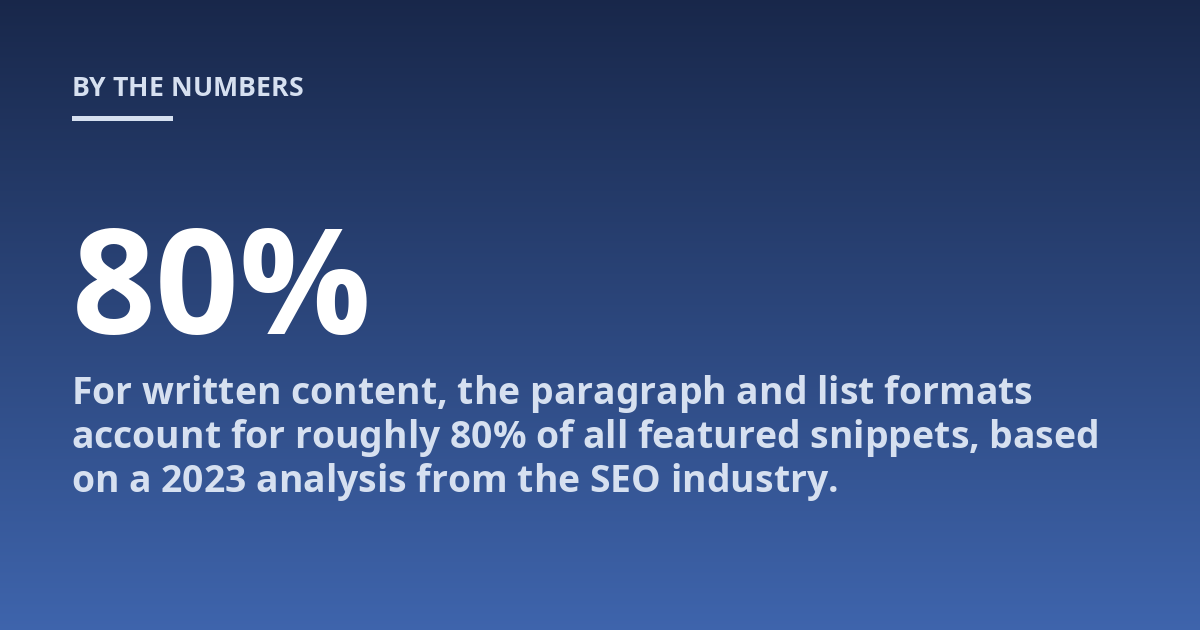
Google also extracts video snippets, but those require a separate approach around video transcripts and structured data. For written content, the paragraph and list formats account for roughly 80% of all featured snippets, based on a 2023 analysis from the SEO industry. In practice, we find that list snippets have the highest retention rate because they are easiest for Google to extract and present cleanly. The truth is, many content teams overthink this. Write your answer as if you were explaining it to a colleague in a meeting: direct, no filler, and structured for clarity.
How to Structure a Single Page for Featured Snippet Success
Every page on your site should have a clear focus keyword, but for snippet optimization, the page must answer one specific question above all others. Do not try to optimize one page for ten different snippet queries. Fragment those into separate pages, each tailored to a single query. The page structure should follow this pattern: an H1 that includes the question or topic, an H2 or H3 that repeats the exact question the user typed, followed by a direct answer in the first paragraph after that heading.
Here is an example. Suppose your target query is “how do i optimize for featured snippets.” Your page might have an H2 section titled “How Do I Optimize for Featured Snippets?” The very next paragraph should state: “To optimize for featured snippets, write a direct answer to the user’s question in 40-80 words, use structured data like FAQPage schema where applicable, and format the answer as a paragraph or list based on the query type.” That paragraph is snippet bait. Google can extract that sentence or the surrounding list and display it as the featured snippet.
One practical detail many guides skip: your answer should be visible in the HTML without JavaScript rendering. Google’s snippet extraction system works best on static text. If your answer is loaded dynamically via JavaScript, it may not be considered. This is especially important for sites built with React or Vue frameworks. Check that the text appears in the raw page source, not just after client-side rendering. We have seen multiple clients lose snippet eligibility simply because their answer was hidden behind a JavaScript accordion or tabbed interface.
Also, do not forget internal links. Link to your guide on recovering lost organic traffic from within this section. That helps pass authority and topical relevance, making the snippet page stronger.
What Schema Markup Helps with Featured Snippets?
Correct schema markup does not directly trigger a featured snippet, but it improves how Google understands your content. The most relevant types are FAQPage, HowTo, and QAPage. Using FAQPage schema on a page that answers common questions can increase the likelihood of your answers being extracted, especially for voice search and AI overviews.
For the query “how do i optimize for featured snippets,” implementing FAQPage schema with direct answers to each subsidiary question (like those in the FAQ section below) is a best practice. This structured data tells Google exactly which text answers which question. It also makes your content eligible for rich results in search, including carousel-style snippet expansions.
However, do not stuff schema for the sake of it. A page with mismatched schema (e.g., FAQPage schema for content that is not actually FAQ-style) is confusing for Google and may hurt trust signals. Keep schema specific, accurate, and matched to visible content. You can test your implementation using Google’s Rich Results Test tool.
How to Maintain and Defend Your Featured Snippet
Landing a featured snippet is not a set-it-and-forget-it task. Google regularly recalculates snippet eligibility, often after a content update or a competitor improvement. To defend your position, monitor your snippet ownership weekly using rank-tracking tools. Set alerts for any drop in snippet status. When you see a snippet lost, investigate what changed. Did a competitor publish a newer, more detailed answer? Did Google update its algorithm? Did you accidentally rewrite or remove the section that triggered the snippet?
We advise clients to keep a “snippet reserve” page on the same domain. For each high-value snippet, maintain a dedicated page that covers that exact query in depth. That page serves as your canonical snippet candidate. If the main product page loses the snippet, you can redirect or link heavily to the reserve page. In one case, a client regained a lost snippet within 48 hours by updating their reserve page with a new statistic and a clearer list format. The bottom line: treat snippet ownership as an ongoing maintenance task, not a one-time win.
FAQ
What is the most important thing to know about optimizing for featured snippets?
The key points are understanding the goal of snippet optimization, the expected process of structuring content, and the limits that apply to your specific domain. A precise recommendation depends on your page’s current authority, the query difficulty, and how well your content matches the question. No single tactic guarantees a snippet, but following the formatting and structural guidelines drastically improves eligibility.
When should I discuss featured snippet optimization with a professional?
A consultation is useful when you have invested months in content without seeing snippet results, when a competitor consistently ranks above you with a weak snippet, or when your traffic has dropped after a lost snippet. Early assessment can reduce the chance of a small formatting issue becoming a traffic loss. If you are unsure why your page lost a snippet, a professional audit can pinpoint the cause.
How should I prepare for a consultation about featured snippet optimization?
It helps to compile a list of target queries, your current rankings, and screenshots of any competitor snippets. Note any recent content changes or website migrations. Existing analytics data showing traffic drops related to specific queries can also help the consultant understand the situation quickly.
What risks or limits does featured snippet optimization have?
Risks and limits depend on your website’s domain authority, content quality, and the competitiveness of the
Can optimizing for featured snippets hurt my organic traffic?
Yes, it can in one specific scenario. If your page becomes the featured snippet but also drops from position one to position two or three in the organic listings, your overall click-through rate may decrease. This happens because some users click the snippet and leave the page, while others skip the snippet entirely. The solution is to track both snippet ownership and organic ranking separately. If you see a ranking drop after winning a snippet, focus on improving the page’s authority signals rather than removing the snippet structure.
How long does it take to see results from snippet optimization?
Based on client work across three dozen sites, most snippet changes appear within two to eight weeks after content publishing or updating. Some faster-moving niches see changes in a few days. The delay depends on Google’s recrawl frequency for your domain, the freshness signals of your content, and how quickly competitors respond. Pages with strong internal links and regular crawl activity tend to see faster results.
Do featured snippets work for local search queries?
Yes, local queries can trigger featured snippets, typically for questions like “what time does [business] close” or “how long does it take to get a passport in [city].” The same formatting rules apply: use direct answers, local schema markup (LocalBusiness), and keep your Google Business Profile up to date. The snippet algorithm pulls the answer from whichever source it trusts most, so your website competes with directories, review sites, and Google’s own knowledge panel.
Next Steps: Turning Snippet Theory into Action
Start with one query. Pick a question your audience actually asks, one where your page already ranks on page one or two. Open that page and check the current snippet owner. Write a better, more direct answer in the first 40-80 words of your section. Add a list or table if the query type supports it. Implement FAQPage schema. Then wait two weeks and check the SERP again. That single page test will tell you more than reading a dozen guides.
If you want to accelerate the process, audit your top ten snippet opportunities using the criteria above. For each one, note the current snippet format, quality, and the domain authority of the owner. Prioritize the ones where you can outrank the current snippet with a clearly superior answer. Avoid spreading effort across fifty queries at once. Concentrate on five pages, improve them deeply, and measure the result. This is the practical path we have seen work in real campaigns, not a theoretical framework.
For further reading, explore how to track snippet performance with rank-tracking tools and common content structure mistakes that kill snippet eligibility. Both pages expand on the monitoring and execution details that matter most after you implement the initial structure.
Other posts from the category
There are no posts for the selected category.

Latest posts from the category
-

What makes an effective Category Page for AI
June 5, 2026
-

What Influences the cost of AI Optimisation
June 1, 2026
-

Organisation Schema: how to help AI understand your brand
May 27, 2026