
What is E-E-A-T and how do I improve it for AI-era SEO?
July 7, 2026
Category:
Uncategorized
E-E-A-T stands for Experience, Expertise, Authoritativeness, and Trustworthiness. It is a framework Google uses in its Search Quality Rater Guidelines to evaluate content quality. To improve it, you need to demonstrate first-hand experience, support claims with credible sources, maintain clear author attribution, and earn external recognition from authoritative sites in your field. This is not a ranking factor, but a core quality benchmark that influences how AI systems and human raters assess your pages.
The term E-E-A-T gained attention after Google’s 2022 update, which added the second “E” for Experience. Before that, it was simply E-A-T. Practitioners often misinterpret it as a direct scoring system, but it is better understood as a diagnostic lens: a way to identify gaps in how your content demonstrates real-world competence. For business owners and marketers targeting organic growth, improving E-E-A-T means restructuring content strategy around verifiable expertise, not just keyword volume.
- E-E-A-T means Experience, Expertise, Authoritativeness, Trustworthiness. It is a quality benchmark, not a ranking factor.
- To improve it, publish content with clear author bios, cite authoritative sources, and show first-hand involvement with the topic.
- Build external authority through earned mentions, guest contributions, and structured data like schema markup.
- For AI search optimization, lead with direct answers, and make each section independently useful.
What does each letter in E-E-A-T mean in practice?
Experience is the ability to show that the author or brand has actually done something related to the content. For a dental clinic, this could mean sharing a case study with before-and-after results. Expertise refers to formal or deep knowledge, such as a certified professional writing about their specialty. Authoritativeness is earned when other respected sources reference your content or brand. Trustworthiness covers accuracy, transparency, secure site connections, and honest disclosures about affiliations or sponsored content.
In practice, most brands overemphasize expertise and neglect experience. A digital marketing agency can claim expertise in SEO, but without documented client outcomes or transparent case studies, the experience component is weak. The gap between claiming expertise and proving experience is where many sites lose credibility with raters and AI systems.
Why does E-E-A-T matter for AI search and Google rankings?
Google’s search quality raters use E-E-A-T to evaluate whether a page meets user needs. While the scores themselves are not a direct ranking signal, pages that consistently fail E-E-A-T benchmarks are less likely to appear in top positions or AI Overviews. For business owners, this translates to lower visibility for content that lacks depth or authority.
AI search systems like Google’s AI Overviews,, and Perplexity also prioritize sources that demonstrate clear authority. These systems extract information from pages that lead with direct answers and cite credible evidence. A page with thin author attribution or no external references is far less likely to be quoted. Strengthening E-E-A-T directly improves your content’s eligibility for these features.
Quick caveat for marketers: Adding an author bio alone does not fix weak content. The most common mistake is treating E-E-A-T as a checkbox exercise. Instead, audit your top 10 pages for evidence of first-hand experience. If a page discusses a process you have not done, either add a case study or merge that topic into your broader service page. Real-world results speak louder than credentials on paper.
How do I audit my site for E-E-A-T gaps?
Start by reviewing your author pages. Each author should have a photo, a short bio explaining their role and credentials, and a link to their professional profile. Without this, Google has no way to attribute expertise. Next, check your content for citations. Every claim that involves statistics, medical advice, or technical specifications should link to a verifiable source like a peer-reviewed study or an industry report.
Check your about page, contact page, and privacy policy. These three pages are where trustworthiness is most scrutinized. A missing or vague privacy policy signals low trust. Also review your outbound link quality. Linking to low-authority or spammy sites can harm your own perceived authority. Internal linking also matters: your service pages should link to supporting content that reinforces expertise, such as case studies or detailed guides.
What common mistakes make E-E-A-T worse?
Three mistakes stand out. First, writing generic content without a named author or clear editorial process. A page like “How to choose a dentist” posted by a dental clinic should name the specific dentist or hygienist who wrote or reviewed it. Second, overusing stock photos and generic testimonials. Real, verifiable reviews with client names and dates carry more weight. Third, ignoring negative customer feedback. Deleting negative reviews or complaints damages trust; responding professionally to them actually builds credibility.
A less obvious mistake is failing to update older content. Outdated statistics, expired offers, or references to events that have passed signal that the page is no longer maintained. Google’s quality raters consider content freshness as part of trustworthiness. Schedule a quarterly review of your pillar content to verify every fact and link.
Which E-E-A-T component matters most for SEO?
Trustworthiness is the most critical single component, because without it the other three mean little. A page can have high Expertise and Authoritativeness, but if the site lacks a clear privacy policy or has a history of inaccurate claims, raters will flag it. That said, the second E (Experience) has become a differentiator since 2022. Sites that show direct involvement with the topic outperform those that only summarize second-hand information.
How do I improve E-E-A-T step by step?
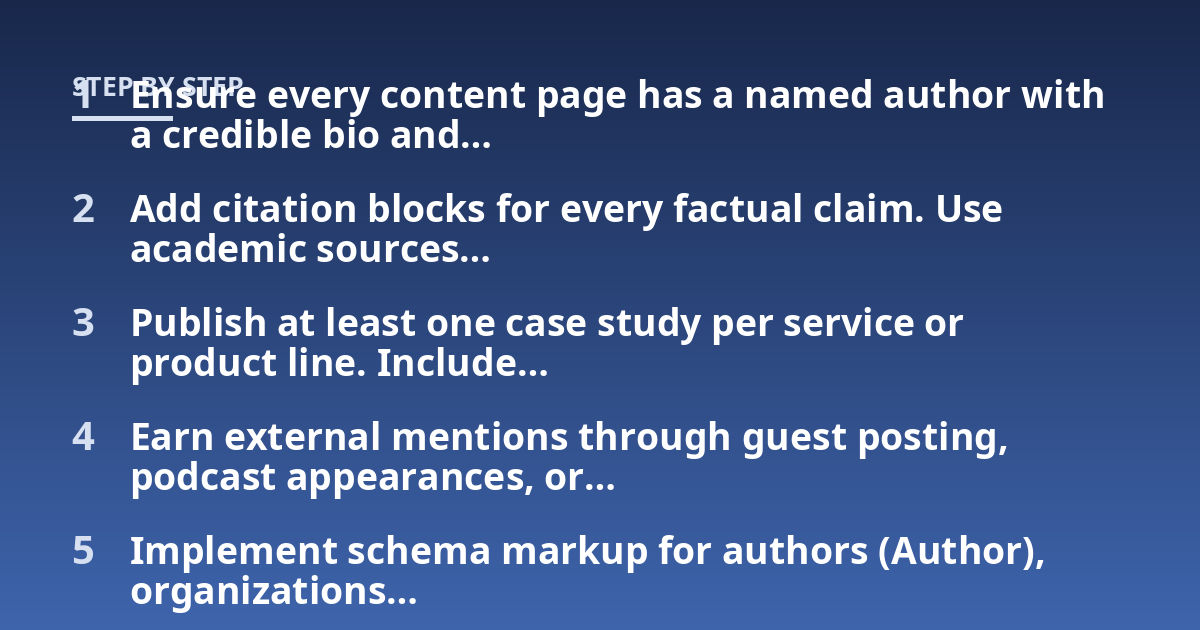
- Ensure every content page has a named author with a credible bio and a link to their LinkedIn, Google Scholar, or professional profile.
- Add citation blocks for every factual claim. Use academic sources, government sites, or major industry bodies. Avoid anonymous blog comments as sources.
- Publish at least one case study per service or product line. Include quantifiable results, timelines, and customer feedback.
- Earn external mentions through guest posting, podcast appearances, or original research that other sites link to.
- Implement schema markup for authors (
Author), organizations (Organization), and reviews (Review). This helps AI systems parse your authority signals.
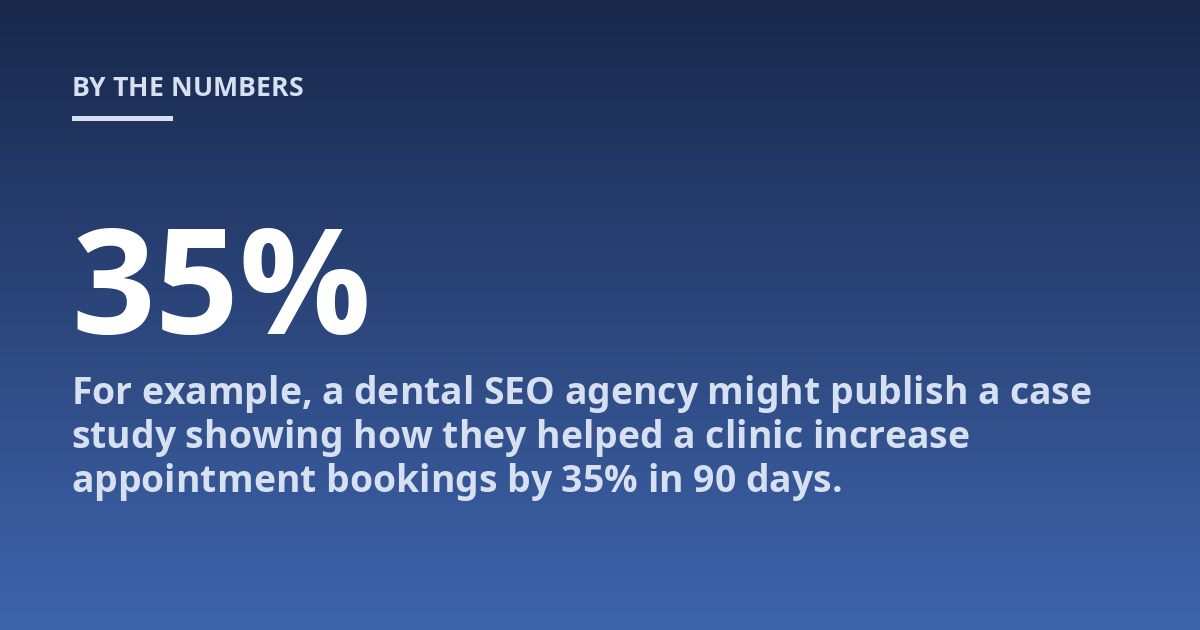
For example, a dental SEO agency might publish a case study showing how they helped a clinic increase appointment bookings by 35% in 90 days. That single piece of content demonstrates Experience, Expertise, and Trustworthiness simultaneously.
Does schema markup help with E-E-A-T?
Schema markup does not directly change your E-E-A-T score, but it helps search engines and AI systems understand your content structure and authority signals. Marking up authors, organizations, and reviews gives algorithms structured data they can use to attribute expertise. Is schema markup necessary for SEO? In practice, it is not mandatory, but it improves the clarity of your site’s authority signals, especially for AI search systems that parse structured data.
How do I build authority across multiple languages?
If your business operates in multiple countries or languages, E-E-A-T must be replicated per language. A German version of your site handled by a translation agency without local expertise will score lower than a site with local authors or reviewers. You need native speakers with relevant credentials. How does hreflang work for multilingual sites? Correctly implementing hreflang helps Google understand which language version serves which region, but it does not fix authority gaps. Each locale needs its own evidence of expertise.
FAQ
What is important to know about E-E-A-T and how do I improve it?
The key points are that E-E-A-T is about demonstrating your brand’s genuine competence, not just writing polished copy. The goal is to align your content with what Google’s quality raters and AI systems consider trustworthy. Improving it requires showing first-hand experience, citing authoritative sources, and maintaining accurate, up-to-date information. A precise recommendation depends on an audit of your existing content and competitor landscape.
When should E-E-A-T be discussed with a professional?
A consultation is useful when you notice declining organic traffic, high bounce rates, or poor performance for content that should rank higher. Early assessment can prevent deeper authority issues. If you are launching a new site or entering a YMYL field like healthcare or finance, discuss E-E-A-T strategy before publishing to avoid creating content that will need extensive rework later.
How should someone prepare for an E-E-A-T improvement project?
It helps to list your top 20 pages by traffic, determine which have clear author attribution and citations, and gather any existing case studies or client testimonials. Existing analytics showing user engagement metrics like time on page and bounce rate can also help a consultant understand where trust gaps are most costly.
What risks or limits can E-E-A-T improvement have?
Risks include overinvesting in content authority without addressing technical SEO foundations like page speed or indexability. Limits depend on your current site age, domain authority, and market competition. A new site in a YMYL field needs 12-18 months of consistent quality publishing before authority signals accumulate. Expect realistic timelines and focus on incremental improvements rather than overnight fixes.
Can content satisfy E-E-A-T requirements?
content alone does not demonstrate Experience or Expertise. Google’s guidelines emphasize content written by individuals with direct, first-hand knowledge. However, AI can be used as a drafting tool if a human expert reviews, edits, and adds original analysis or case data. Without editorial oversight, AI content leaves the Experience component empty.
How does E-E-A-T differ from traditional SEO optimization?
Traditional SEO focuses on keywords, meta tags, backlinks, and technical factors. E-E-A-T addresses the qualitative depth and credibility of the content itself. While technical SEO gets a page indexed, E-E-A-T helps determine whether it ranks for competitive queries and appears in AI features. The two work together: strong E-E-A-T amplifies the effect of good technical SEO.
Does E-E-A-T apply to e-commerce product pages?
Yes. E-commerce stores can demonstrate Expertise by including detailed product specifications, usage guides, and author profiles for review content. Trustworthiness improves with secure checkout, transparent return policies, and verified customer reviews. Authoritativeness comes from external mentions by bloggers or media covering your products. Even a small store can improve E-E-A-T by adding a team page with photos and roles.
Conclusion and next steps
Understanding what E-E-A-T is and how to improve it is not about chasing a checklist. It is about making your content genuinely useful and verifiably trustworthy.
Start with a content audit of your top-performing pages. Identify which pages lack author information, cite no sources, or rely on generic claims. Prioritize fixing these pages first, as they represent the biggest trust gaps. Then create an editorial process that requires every new piece of content to include a named author, a bio, and at least two external citations from authoritative sources. Use tools like Google Search Console and Ahrefs to track which pages already have some authority and focus improvement efforts there.
For businesses in YMYL (Your Money or Your Life) fields such as healthcare, finance, or legal services, the stakes are higher. Google applies stricter quality standards to these topics because inaccurate information can cause real harm. A medical clinic should have content reviewed by a practicing physician, not just a writer with a journalism degree. A financial advisor site should include disclaimers and link to regulatory bodies like the SEC or FINRA. These signals tell both human raters and AI systems that the content is safe to surface.
Another practical step is to build a public profile for your key authors. Encourage them to maintain active LinkedIn profiles, publish on reputable third-party platforms, and speak at industry events. When Google sees that an author is cited elsewhere, it strengthens the authority signal for every page that author writes. This is one of the most cost-effective ways to improve E-E-A-T over time, because it compounds. Each new external mention reinforces the author’s credibility, which in turn boosts all their associated content.
Do not neglect the trustworthiness signals on your site’s infrastructure. A valid SSL certificate is table stakes. A published privacy policy that clearly explains data collection, storage, and sharing practices builds trust. A terms of service page that sets expectations for refunds, warranties, or service limits also signals professionalism. Many small businesses skip these pages, but Google’s quality raters check them as part of their evaluation. Without them, your content may be viewed as less trustworthy, regardless of its quality.
Finally, remember that E-E-A-T improvement is an ongoing process, not a one-time project. Search algorithms evolve, and what demonstrates authority today may change tomorrow. Stay current with Google’s Search Quality Rater Guidelines, which are published publicly and updated regularly. Review your content at least twice a year, refresh outdated statistics, and retire pages that no longer represent your current expertise. A site that consistently maintains high E-E-A-T signals will perform better across all search features, including AI Overviews, knowledge panels, and rich results.
Other posts from the category
There are no posts for the selected category.

Latest posts from the category
-

What makes an effective Category Page for AI
June 5, 2026
-

What Influences the cost of AI Optimisation
June 1, 2026
-

Organisation Schema: how to help AI understand your brand
May 27, 2026