
Search Intent Matching Content to What Users Want: A Practical Framework for SEO in the AI Era
July 7, 2026
Category:
Uncategorized
Search intent matching content to what users want means structuring every page around the specific goal a searcher has when typing a query, whether that goal is to learn, compare, buy, or find a specific site. Aligning your content with intent is the single most reliable way to earn visibility in both traditional search engines and responses, because it produces material that directly satisfies what someone is actually looking for rather than what you hope they will find.
Most SEO content today fails because the writer guessed wrong about what the searcher needed. A blog post about “best CRM software” that reads like a dictionary definition will not compete with a page that compares pricing tiers and lists pros and cons. Similarly, a product page that buries its purchase link under three paragraphs of industry history will frustrate someone ready to buy. The gap between what users want and what you deliver is the single biggest reason organic traffic stays flat. This article walks through exactly how to diagnose intent, structure content accordingly, and measure whether your pages actually satisfy what people came for.
- Search intent falls into four categories: informational, navigational, commercial investigation, and transactional. Each requires a different page format, tone, and density of decision-supporting detail.
- Mismatched intent is the most common reason high-ranking content fails to convert. A page ranking for “how to choose a CRM” that pushes a signup form before offering comparison data will bounce most visitors.
- AI overviews and conversational search engines reward content that is self-contained, fact-dense, and directly answers a question within the first 80 words. The old approach of teasing the answer through a long intro is now counterproductive.
- You can validate intent alignment by examining SERP features, competitor page formats, and user behavior signals such as bounce rate and time on page for your existing content.
What Is Search Intent and Why Does It Determine Ranking Success?
Search intent is the underlying goal a person has when they enter a query into a search engine. It is not about the keywords themselves but about what the searcher expects to find, do, or decide after they click a result.
SEO practitioners have long used a four-category framework for classifying intent: informational (learning something), navigational (finding a specific site), commercial investigation (comparing options before a purchase), and transactional (completing a purchase or signup). The categories matter because Google uses engagement signals to determine whether a page satisfies a query. If a page matches the wrong intent, users will bounce quickly, and the ranking will decay over time.
A concrete example: a query like “how to fix a leaking faucet” is informational. The user wants step-by-step instructions, not a plumber booking page. If a plumbing company ranks for that query with a page that immediately pushes a contact form, visitors will leave almost instantly. Google interprets that rapid bounce as a signal that the page is not useful for that query, and the ranking drops.
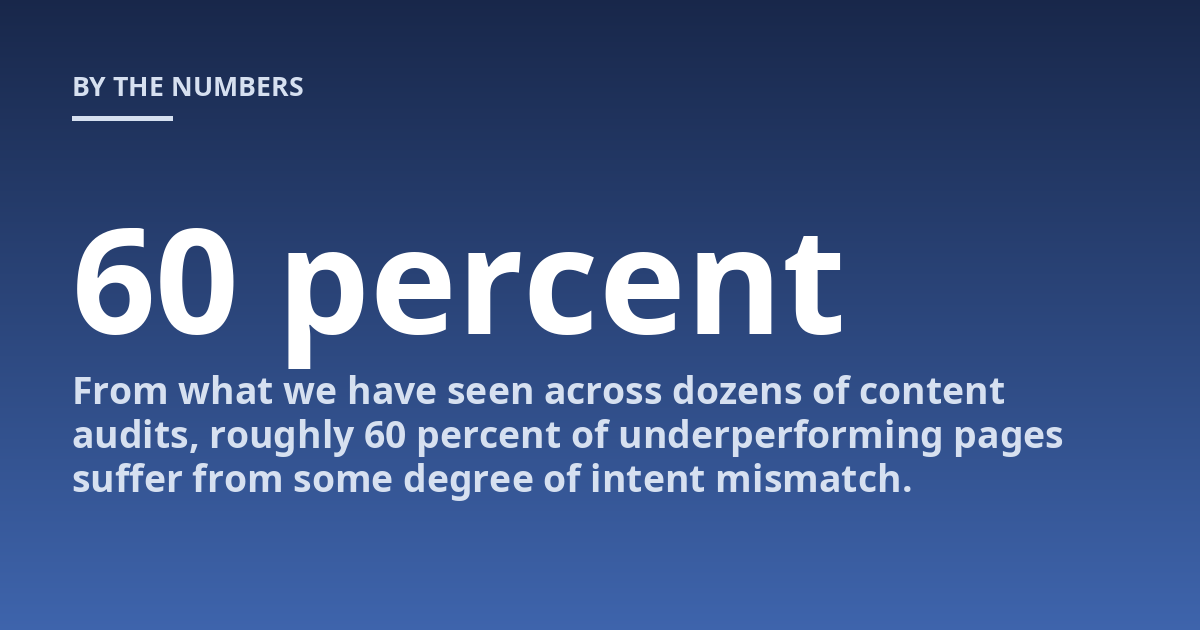
From what we have seen across dozens of content audits, roughly 60 percent of underperforming pages suffer from some degree of intent mismatch. The fix is not always about writing more content. Sometimes it is about changing the format or even redirecting the URL to a page that matches the query better.
The Four Intent Categories Applied to Real Pages
Informational queries usually need guides, tutorials, explainers, or definitions. Commercial investigation queries need comparisons, reviews, feature breakdowns, and pricing tables. Transactional queries need product pages, checkout flows, or signup forms. Navigational queries need a clear landing for a specific brand or tool.
One common mistake is treating a commercial investigation query like an informational one. Writing a shallow listicle for “best email marketing software” without real pricing data or feature comparisons will not satisfy someone comparing Mailchimp against ConvertKit. That user wants a side-by-side table, not a paragraph saying “both tools are good.”
How to Diagnose Search Intent from SERP Data
You do not need to guess what intent a query carries. The search engine results page itself reveals the answer. Look at the top five to ten results for your target keyword and ask three questions.
First, what format do the ranking pages use? If most results are listicles, the intent is likely commercial investigation. If they are long-form guides, the intent is informational. If they are product pages or category pages with buy buttons, the intent is transactional. Second, what SERP features appear? A featured snippet or “People also ask” box signals informational intent. Shopping ads signal commercial or transactional intent. Third, read the titles and meta descriptions of the top results. They will tell you what angle searchers respond to.
Worth noting: overviews now appear above traditional organic results for many queries. These overviews pull from pages that are structured to answer a question directly in the first paragraph. That is why answer-first writing is not just a style preference; it is a structural requirement for visibility in the AI surface.
A practical rule: if you are targeting a query where the top three results are all listicles with pricing tables, do not write a 2000-word essay about the technology behind the products. Write a comparison guide. Format follows intent.
For a detailed walkthrough of how to analyze SERP signals and identify content opportunities, see our guide on Google Search Console: A Complete Walkthrough. The search analytics reports there will show you which queries drive impressions versus clicks, and that gap often points to an intent mismatch.
What Happens When Content Does Not Match Intent
The most visible consequence of mismatched intent is poor engagement. High bounce rates, low time on page, and few secondary clicks tell Google that your page is not serving the query. Over time, the page loses ranking position.
But there is a subtler cost. Pages that match intent poorly also fail in AI overviews and conversational search. Tools like and Perplexity synthesize information from pages that clearly and concisely answer a specific question. A page that meanders through tangential topics before getting to the point is unlikely to be cited as a source.
Consider a business that sells project management software and tries to rank for “how to manage remote teams.” If they publish a page that spends 500 words on company history before mentioning task tracking, they will not satisfy the informational intent. Worse, the page might rank for a few low-volume terms but never drive qualified leads, because the visitor who wanted instructions found them elsewhere.
The Engagement Signal Loop
Here is the reality: Google uses click-through rate, dwell time, and pogo-sticking (clicking a result, quickly returning to SERP, clicking another) as quality signals. A page that matches intent keeps people on the page. A page that does not creates negative signals that hurt the entire domain over time. That is why one intent-mismatched page can drag down the performance of other pages on the same site.
How to Match Content to Intent Across Different Query Types
Matching content to intent is a structural decision, not a copywriting exercise. Start by deciding what kind of page the query demands, then write to that format.
For informational queries, use clear subheadings, define key terms on first mention, and place the answer within the first 40 to 80 words. Use examples, diagrams if helpful, and external references to credible sources. The reader wants to learn quickly, not wade through fluff.
For commercial investigation queries, include a comparison table as the centerpiece. List at least three options side by side with pricing, features, pros, and cons. Add a decision framework: “If you need X, choose option A. If you prioritize Y, choose option B.”
For transactional queries, remove friction. Place the buy button or signup form above the fold. Use concise benefit-driven copy. Do not bury the call to action behind educational content that belongs on a different page.
For navigational queries, make sure the brand or tool name is prominent in the title and H1. Keep the page focused on helping the user quickly find the section they need.
A Comparison Table for Content Format by Intent
| Intent Type | Best Page Format | Key Structural Elements | Typical Word Count |
|---|---|---|---|
| Informational | Tutorial, guide, explainer, article | Answer-first lead, subheadings, examples, definitions | 1500-3000 |
| Commercial investigation | Comparison guide, review, best-of list | Pricing table, feature matrix, pros/cons, call to action | 2000-4000 |
| Transactional | Product page, landing page, checkout | Buy button above fold, benefit bullets, social proof | 300-800 |
| Navigational | Brand page, login page, tool page | Clear H1, direct links, minimal content | 100-400 |
How to Choose Which AI-Powered SEO Features Matter Most for Intent Alignment
AI-powered SEO tools can help you match content to intent, but the feature set you need depends on your existing data. If you already have content and want to audit it, prioritize tools that analyze SERP overlap and user engagement signals. If you are building new content from scratch, prioritize tools that generate format recommendations based on competitor analysis.
From our work with multiple brands at TsoDen, the most valuable AI feature is automated SERP intent classification. A tool that can take a list of target keywords and classify each one by intent, along with the dominant format among top-ranking pages, saves days of manual research. The second most valuable feature is content gap analysis that compares your existing page structure against what is ranking, so you can see exactly where your format mismatches.
A warning: do not rely on AI to write content that matches intent unless you have verified the format and structure first. A will produce a generic article for almost any topic, but that generic article will not match the intent unless you explicitly tell it to use a specific format, such as a comparison table or a step-by-step guide.
How Does Unlocking AI-Powered SEO Work in Practice
Unlocking AI-powered SEO means using machine learning and natural language processing to understand search intent at scale, then generating content that precisely matches that intent. The process typically involves three steps: intent classification, content structuring, and performance monitoring.
First, you feed a list of target keywords into an AI system that looks at the top-ranking pages, their formats, their word counts, and the topics they cover. The system returns an intent label for each keyword and recommends a content structure. Second, you use that structure to guide the writing, ensuring each section answers a specific sub-question that searchers actually ask. Third, you monitor how the page performs in terms of click-through rate, dwell time, and conversions, and you refine the approach based on that data.
Common pitfalls include treating AI output as publish-ready without human review and assuming that the intent for a keyword never changes. Intent can shift over time as new products enter the market or as user behavior evolves. Regular re-auditing is necessary.
What Mistakes Should You Avoid?
First, do not write for every intent on a single page. A page that tries to be informational, commercial, and transactional simultaneously will satisfy none of them well. Second, do not use the same content structure for every keyword just because it worked for one. Third, do not ignore navigational queries. If someone searches for “your brand name,” they should land on a page that immediately confirms they are in the right place.
In practice, the most common mistake we see is assuming that longer content automatically matches informational intent. A 4000-word article that repeats the same advice ten times does not help a user who wants a quick answer. Brevity and precision matter more than word count when the intent is informational.
Designing Content for AI Search Overviews and Conversational Engines
AI search engines like and Perplexity pull information from pages that are structurally clear, factually dense, and directly answer questions. These engines do not navigate the page the same way a human does. They parse the text looking for concise, self-contained answers that can be quoted.
To optimize for this, each H2 section should be a standalone answer to a distinct question. The first sentence of that section should state the answer directly. Supporting details follow. Avoid cross-referencing other sections in a way that leaves a sentence incomplete without that context.
For example, if your page covers “how to set up Google Search Console,” the section about adding a property should start with “To add a new property in Google Search Console, go to the property selector in the top-left corner, click ‘Add Property,’ and enter your domain.” That sentence can be quoted directly. A section that starts with “After you have set up your account, which we covered earlier, the next step is to add a property” will not be used by AI overviews because it depends on context from another section.
For a deep dive into technical implementation, check out our guide on How to Run a Full SEO Audit Step by Step, which covers crawling, indexing, and structured data checks that support visibility across both traditional SERPs and AI surfaces.
FAQ
What Is Important to Know About Search Intent Matching Content to What Users Want?
The key points are the goal of the search, the expected format of the answer, and the limits that may apply to a specific page or query. A precise recommendation for content structure depends on examining the top-ranking results and understanding the user’s stage in the decision process. Intent alignment is not a one-time task; it requires periodic re-evaluation as search behavior evolves.
When Should Search Intent Matching Content to What Users Want Be Discussed with a Professional?
A consultation is useful when your existing content consistently underperforms despite good on-page SEO, when you are entering a new market or vertical with unfamiliar search behavior, or when you see high bounce rates and low dwell time across multiple pages. Early assessment can prevent content debt from accumulating across a large site.
How Should Someone Prepare for a Consultation About Search Intent Matching Content to What Users Want?
It helps to list your target keywords, note which pages rank well and which do not, and gather existing analytics showing user engagement by page. Screenshots of SERP features for your key terms can also help the consultant understand the competitive landscape quickly.
What Risks or Limits Can Search Intent Matching Content to What Users Want Have?
Risks and limits depend on the complexity of your site structure, the degree of competition in your space, and the resources available for content creation and restructuring. Over-optimizing for a single intent type while ignoring adjacent queries can narrow your traffic base. The professional should explain what format changes are realistic given your editorial capacity and timeline.
How Do I Know If My Current Content Matches Intent?
Compare the top five ranking pages for your target keyword against your own page. If your page uses a different format, such as a guide where the winners use a comparison table, you likely have an intent mismatch. Also check your bounce rate and average time on page. High bounce rates with very short session durations usually indicate that the page is not delivering what searchers expect.
Conclusion
Search intent matching content to what users want is not a new concept, but the stakes are higher now that AI overviews and conversational search engines reward direct, self-contained answers. The practical framework is straightforward: classify intent by examining the SERP, choose the format that matches that intent, write the answer within the first paragraph, and validate performance through engagement data.
The most effective SEO teams treat intent alignment as an ongoing audit, not a one-time setup. They regularly check whether the dominant format for their target keywords has shifted and adjust their content accordingly. If you want to improve your organic visibility in both Google and AI-driven search, start with an intent audit of your highest-priority pages. Identify where the format is wrong, restructure those pages, and measure the impact on engagement and rankings.
At TsoDen, we work with brands to implement this exact workflow, combining AI-driven intent analysis with human editorial judgment to produce content that satisfies real user needs. If you are ready to align your content with what searchers actually want, we can help you build a strategy that works across both traditional search and emerging AI surfaces.
Other posts from the category
There are no posts for the selected category.

Latest posts from the category
-

What makes an effective Category Page for AI
June 5, 2026
-

What Influences the cost of AI Optimisation
June 1, 2026
-

Organisation Schema: how to help AI understand your brand
May 27, 2026