
How Do I Approach International SEO for Measurable Global Growth
July 7, 2026
Category:
Uncategorized
How do I approach international SEO? Start with a clear hreflang implementation, country-specific domains or subdirectories, localized content that goes beyond translation, and a technical audit to confirm search engines can crawl and understand each language version. Prioritize markets by business potential, not search volume alone.
International SEO is not a single optimization task. It is an ongoing structural and content strategy that decides which country or language version of your site ranks in which Google search results. Get it wrong and you compete against yourself. Get it right and you capture demand across markets without cannibalizing your own pages. The standard approach has three layers: technical setup, content localization, and performance monitoring. Each layer requires decisions that lock in for months or years. TsoDen has built and audited international SEO programs for brands moving into multilingual search, and the patterns that fail are nearly always the same: no hreflang, translated instead of localized content, and no country-specific link building.
- Choose a URL structure (ccTLD, subdomain, or subdirectory) and stick to it. ccTLDs signal strongest geo-targeting but demand more resources.
- Implement hreflang tags correctly on every localized page. A single syntax error can break your entire international footprint.
- Localize content meaningfully: adapt pricing, units, cultural references, and keyword research per market.
- Monitor performance per country in Google Search Console and adjust your content roadmap based on real data, not assumptions.
What Is the First Step in International SEO?
The first step is a market-selection audit. List potential countries or language regions and rank them by business criteria: existing demand, logistics, legal requirements, competition density, and projected revenue. Do not rely on global search volume alone. A market with moderate search volume but low competition often delivers faster returns than a high-volume market dominated by established players.
Once you have a ranked list, decide your URL structure. There are three standard options:
| URL Structure | Geo-Targeting Signal | Maintenance Load | Best For |
|---|---|---|---|
| Country-code top-level domain (ccTLD), e.g., example.de | Strongest | High (separate infrastructure, link equity does not pass across ccTLDs easily) | Large markets with local hosting and legal entity |
| Subdomain, e.g., de.example.com | Moderate | Medium | Testing a market or where ccTLD registration is impractical |
| Subdirectory, e.g., example.com/de/ | Weakest (Google uses hreflang and other signals) | Lowest (shared domain authority) | Smaller markets or multilingual sites within one country |
Based on audits TsoDen has conducted across e-commerce and SaaS clients, the most common international SEO failure is inconsistent hreflang markup. A site with 20 language versions but a single hreflang error on the default page can cause Google to ignore all tags for that language cluster. Validate your hreflang with a dedicated checker before launch.
How Does Hreflang Actually Work in Practice?
Hreflang is an HTML attribute that tells Google which language and regional version of a page to show in search results. It goes in the <head> of each page and points to all alternate versions. The format is <link rel="alternate" hreflang="de" href="https://example.de/" />. Google uses it as a strong signal, not a directive. If your hreflang points to a page that returns a 404 or redirects, Google may ignore the entire set.
A real-world case: a European cosmetics brand had English, German, and French content. Their German page linked back to the English page with hreflang=”en”, but the English page did not include a reciprocal link to the German version. Google interpreted this as a broken relationship and sometimes served the wrong language in German search results. The fix was simple: every page in the hreflang cluster must contain self-referential tags and tags for every other version. No orphaned alternates.
Should You Translate or Localize Content?
Translation alone is dangerous for international SEO. If you run German keywords targeting a German audience, the content must use German search terms, address German customer concerns, and reference local pricing, measurements, and legal requirements. Direct translation of English copy will rank poorly because it misses query intent.
Concrete example: a U.S. software company targeting the French market translated their pricing page word-for-word. The French version listed prices in dollars, used decimal formatting unfamiliar to French users, and did not mention French VAT requirements. The page had zero organic traffic after six months. After a full localization pass using French keyword research, local pricing in euros with correct decimal separation, and country-specific testimonials, organic traffic from France grew steadily over the next quarter.
The bottom line: allocate budget for native-language copywriters and local keyword research per market. Machine translation with post-editing can work for lower-priority content, but your money pages need human localization.
What Technical Checks Matter Most for International SEO?
A technical audit for international SEO covers five critical areas:
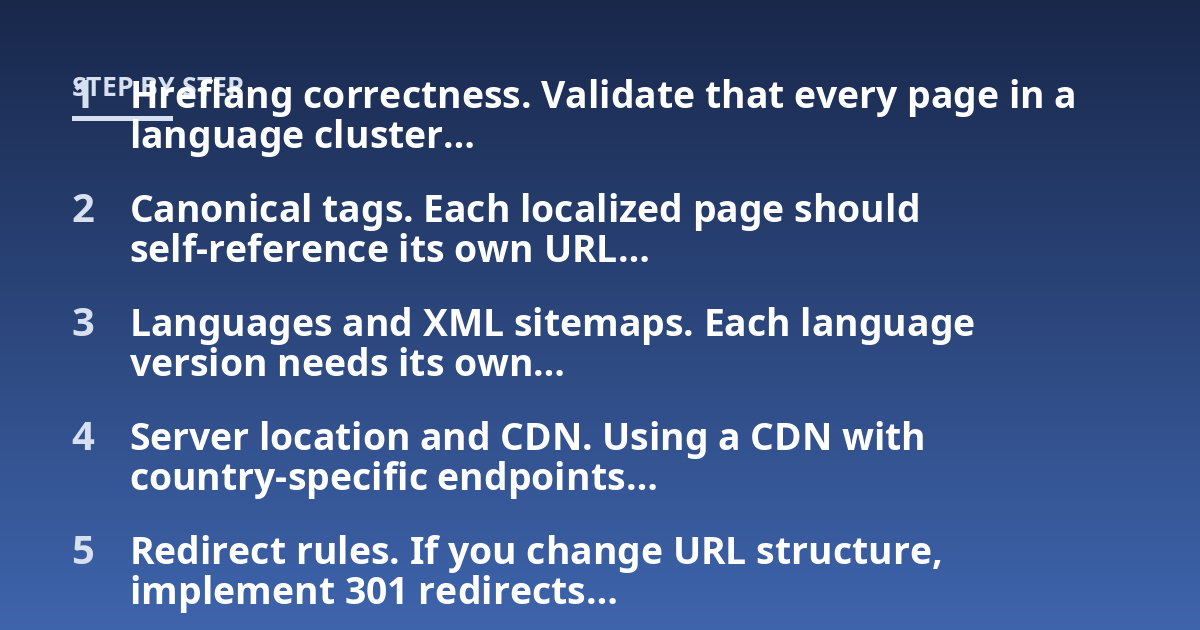
- Hreflang correctness. Validate that every page in a language cluster has reciprocal tags and no dead ends.
- Canonical tags. Each localized page should self-reference its own URL as the canonical. Do not canonicalize the German page to the English original.
- Languages and XML sitemaps. Each language version needs its own sitemap listed in your
robots.txtand submitted to Search Console. The main sitemap can reference language-specific sitemaps. - Server location and CDN. Using a CDN with country-specific endpoints helps Google associate your pages with the correct geographic region.
- Redirect rules. If you change URL structure, implement 301 redirects from old language URLs to new ones. Do not redirect all languages to a single homepage.
One mistake that appears repeatedly: sites using geotargeting via Google Search Console’s International Targeting report without hreflang tags. That report alone does not replace markup. Both signals together are the strongest combination.
For a related issue, read what is keyword cannibalization to avoid overlapping content across language versions competing for the same queries.
How Do You Build Links for International Sites?
International SEO needs market-specific backlinks. A link from a German news site to your German subdirectory signals relevance to Google for German search results far more strongly than a link from a U.S. site to your main domain. Build relationships with local publishers, bloggers, and industry directories in each target market. Use a separate outreach strategy per country rather than bulk emailing international prospects with the same pitch.
The approach TsoDen uses with clients: identify the top 10 content gaps in each market, create localized assets that fill those gaps, then pitch those assets to local publications. The assets can be original research with market-specific data, a visual resource, or a practical guide. Generic guest posts rarely earn links. Specific, useful, locally relevant content does.
Common International SEO Mistakes to Avoid
From direct experience with dozens of multilingual site audits, the most damaging mistakes are:
- Ignoring language variants. Portuguese from Portugal and Portuguese from Brazil differ in vocabulary, spelling, and local search behavior. Using one version for both regions usually fails.
- Using browser-based redirects. Redirecting users based on browser language setting can confuse Googlebot and lead to wrong indexing. Let users choose their language version, or use a clear landing page with language selection.
- Not monitoring per-market performance. Many brands set up international SEO and check only total organic traffic. If German traffic drops but French traffic increases, you may miss a problem in Germany until it becomes a crisis.
If you notice a sudden traffic decline in one market, learn how do I recover lost organic traffic with steps that apply to individual language versions.
FAQ
What is important to know about how do I approach international SEO?
The key points are your URL structure choice, hreflang implementation, content localization depth, and a commitment to market-specific link building. A precise setup depends on your budget, target markets, and existing technical infrastructure. Google’s own documentation on managing multi-regional sites is a reliable starting point for technical requirements.
When should international SEO be discussed with a professional?
A consultation is useful when you plan to enter a new country, have existing international pages that are not ranking despite good content, or notice language version cannibalization in Search Console. Early assessment can reduce the chance of a small implementation error becoming a complex cleanup project across dozens of pages.
How should someone prepare for a consultation about international SEO?
It helps to list target markets, current URL structure, existing hreflang tags (if any), analytics showing per-country traffic, and any known issues such as duplicate content penalties or poor rankings in specific languages. Existing sitemaps and Search Console data can also help the consultant understand the current situation quickly.
What risks or limits can international SEO have?
Risks include hreflang errors that make Google ignore your language targeting, content that is translated but not localized and therefore ranks poorly, and the higher maintenance cost of managing multiple sites or subdirectories. The consultant should explain the trade-offs between ccTLD, subdomain, and subdirectory approaches and set realistic timelines for ranking in competitive markets.
International SEO is a long-term investment with compounding returns. Start with one market, prove the model, and expand methodically. Do not launch ten language versions at once without testing your technical setup first. Get the foundation right, then scale.
Ready to build an international SEO strategy that performs across languages, countries, and AI search surfaces? Contact TsoDen for a technical audit and a market-by-market roadmap grounded in real data.
Other posts from the category
There are no posts for the selected category.

Latest posts from the category
-

What makes an effective Category Page for AI
June 5, 2026
-

What Influences the cost of AI Optimisation
June 1, 2026
-

Organisation Schema: how to help AI understand your brand
May 27, 2026