
Generative Engine Optimization Ranking in ChatGPT and Perplexity
July 27, 2026
Category:
Uncategorized
To achieve generative engine optimization ranking in chatgpt and perplexity, you must build citation-ready assets that answer queries directly using structured data and declarative prose. Models prioritize unambiguous text over marketing language. Agencies now optimize entities and semantic context to trigger model citations rather than chasing traditional click-through traffic.
The search landscape has shifted from keyword matching to entity resolution. When AI tools pull answers, they scan your site for authoritative references that fit their retrieval pipelines. If your content lacks explicit context or structured markers, the models will skip it entirely. We see this daily while managing multilingual SEO campaigns and automating WordPress workflows. The rules of visibility have changed fundamentally.
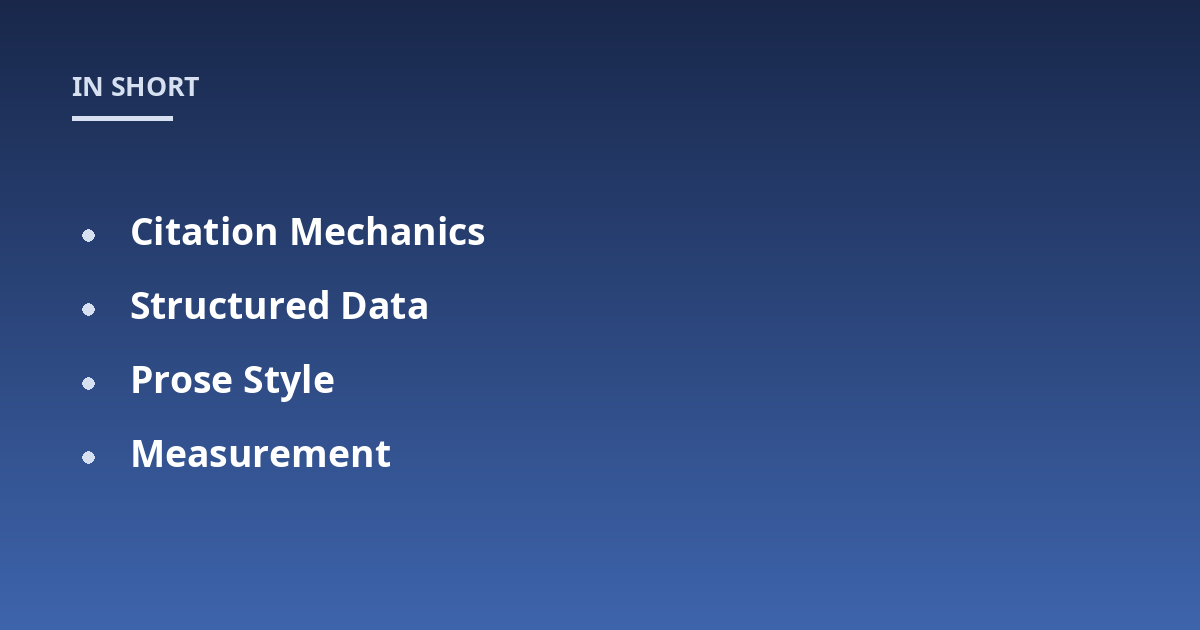
- Citation Mechanics: Models cite authoritative entities, not just pages.
- Structured Data: Schema markup is the primary signal for AI parsers.
- Prose Style: Write declarative facts first to avoid summarization filters.
- Measurement: Track brand mentions in responses instead of just clicks.
What Generative Engine Optimization Actually Changes About Ranking
The core shift is moving from serving human readers to serving model retrieval systems. Traditional SEO focused on click-through rates and dwell time. Generative engine optimization ranking in chatgpt and perplexity focuses on citation probability. When you ask an AI tool a question, it does not browse the web like a user. It queries a database of indexed knowledge graphs and real-time search results to construct a synthesis.
If your content appears as a direct, unambiguous answer to that query, the model cites you. If your content is buried under fluff or hidden behind interactive elements, the model ignores it. The goal is to make your domain the default source for specific topics in the models knowledge base. This requires treating your site as a data feed rather than a brochure.
From Clicks to Citations
Historically, you won one point for every click. Now you win influence for every model citation. A single mention inside an AI response can drive significant brand authority without delivering a direct link click. We have observed that domains with high entity density see stronger visibility in synthetic answers, even when their traditional organic rankings remain flat. The value has migrated from the bottom of the funnel to the top.
This transition forces agencies to abandon vanity metrics. You need to measure how often your brand appears as a source. That is the new KPI for search visibility. Focus on building deep topical authority rather than chasing broad keyword coverage. The models reward depth and factual density over length and marketing language.
How ChatGPT and Perplexity Pull Information Differently
ChatGPT and Perplexity operate on fundamentally different architectures, which changes how you must optimize for each platform. Understanding these mechanics is essential for any technical strategy aimed at answer engine visibility.
ChatGPT uses a hybrid approach. It combines its pre-trained base model with real-time search data depending on the user settings and subscription tier. When the web search plugin activates, it acts as a sophisticated aggregator. It pulls top-ranking results and synthesizes them into a single response. Your content needs to align with the most commonly cited sources in that specific vertical.
Perplexity is built entirely around retrieval-augmented generation. Every response is generated by pulling fresh data from its index and search partners. It functions like a highly aggressive search engine for AI workflows. Perplexity favors concise, direct answers that it can instantly extract and quote. Sites with clear headers, FAQ sections, and minimal JavaScript load much faster in its pipeline.
The Crawl Gap Between Platforms
Different models have different crawl budgets and parsing capabilities. Some ignore complex SPAs (Single Page Applications). Others rely heavily on JSON-LD schema to understand context. You cannot optimize for one platform by guessing the other. Test your content visibility across both platforms using their native search tools or API endpoints. Validate that your structured data parses correctly for each specific engine.
Structured Data and the Shift Toward Direct Answers
Schema markup is no longer optional for generative engines. It acts as the Rosetta Stone that allows AI models to parse your content accurately. Without explicit context, the model must guess your topic, which often leads to incorrect citations or total invisibility.
The most effective schema types for citation visibility include Article, Q&A Page, HowTo, and Product markup. These types explicitly define entities, relationships, and steps within your content. When a model parses a Q&A schema, it can extract the question and answer pair directly for use in its own response.
You must also implement authoritative entity associations. Use sameAs links to connect your page to known Wikipedia or Wikidata entries. This validates your organization’s standing in the global knowledge graph. The goal is to leave zero ambiguity about who owns the information on your page. Models avoid citing sources that appear ambiguous or low-trust.
Testing and Validation
Do not assume your schema works because it exists in the source code. Validate every critical page using Google’s Rich Results Test or the OpenGraph parser. Fix all errors before publishing. Broken schema can cause models to skip your content entirely during synthesis. For more technical details on implementation, review resources from industry leaders like Moz on the fundamentals of structured data.
Why Your Content Gets Summarized Instead of Cited
A common failure mode is writing content that serves human engagement but fails machine parsing. Models are trained to detect and bypass marketing-heavy language, clickbait headlines, and generic introductions.
If your opening paragraph contains long narratives or promotional fluff, the model considers it low-signal noise. It moves on until it finds a declarative sentence that directly answers the query. If that answer appears on page two of your site, it will not cite page one. You lose the citation.
The Bridge Paragraph Failure
We see this constantly in agency work. Clients write beautiful, engaging intros to hook readers. The AI models ignore those hooks completely. Instead, they scan for raw facts and clear definitions. Your first H2 or dedicated FAQ section must contain the direct answer without any preamble.
Write for extraction first, engagement second. Use short paragraphs. Place bold keywords in natural contexts. Ensure your entity references are unambiguous. The model rewards clarity over creativity. If you force it to read past five hundred words to find the core fact, you have already lost the ranking opportunity.
The Real Workflow for Building Citation-Ready Assets
Building a scalable generative engine optimization strategy requires a specific technical workflow. It is not enough to fix individual pages. You need an operational process that treats content as structured data.
Most teams waste months chasing backlinks while models ignore their unstructured content. Map your core entities first and test schema validity daily using automated crawlers. If the parser fails the page, the model cannot cite it. Focus on declarative sentences that answer specific user intents directly.
Entity Mapping and Content Clusters
Start by mapping your primary entities. List the core concepts your brand owns. Create content clusters around these entities using explicit semantic relationships. Avoid generic keyword stuffing. Instead, use variations of entity names and related attributes throughout your copy.
Your internal linking structure must reinforce these connections. Link new articles to established authority pages using descriptive anchor text that matches known entity types. This guides the model through your knowledge graph. For agencies managing large sites, automating this process is essential. Learn how to automate WordPress SEO with AI tools to keep your entity maps synchronized with your content inventory.
What Happens to Traditional SERP Tactics in a GEO World
Traditional tactics are becoming liabilities. Long-tail keyword targeting loses value if the model does not recognize the entity behind the query. Image optimization matters less, as models rely on text and metadata. Page speed remains important, but only for ensuring your content parses correctly before synthesis begins.
E-E-A-T signals matter more than ever. Models are explicitly trained to suppress low-quality or unverified claims. If your site lacks author bios, clear contact information, and references to authoritative sources, the model considers you a high-risk citation source. The algorithm penalizes ambiguity and punishes domains with poor trust profiles.
The Decline of Thin Content
Sites relying on mass-produced or near-duplicate content will face rapid decline. Models detect low-signal text and deprioritize it across all their outputs. You must produce distinct, high-density content that adds genuine value to the models knowledge base. Quality is not just a ranking factor. It is the only survival mechanism in this new environment.
Measuring Success When Clicks Drop but Citations Rise
As traffic patterns shift, your analytics must evolve. A drop in direct organic clicks does not mean your strategy is failing. It may mean the model is capturing the click for you.
Track brand mentions and domain references within AI responses. Use monitoring tools to search for your exact URL or brand name inside synthetic answers. If your citations are rising while clicks fall, your authority is growing. The value of those citations will eventually convert into direct traffic as users seek out the sources they trust.
Global Visibility and International GEO
For agencies targeting global markets, citation visibility depends heavily on language signals. Models prioritize native-language content for specific queries. You must ensure your site uses correct hreflang tags and localized schema markup to compete in different regions. If your international pages lack proper geographic signaling, the model will default to competitors with stronger local authority. Understand why hreflang tags matter more than ever for global SEO when expanding your generative optimization strategy across borders.
Evaluating Citation Quality
Not all citations are
Not all citations are equal; the credibility of the source, the relevance of the context, and the prominence of the mention determine how much influence they exert on model ranking. High-quality citations come from authoritative domains with strong E-E-A-T signals, while low-value mentions appear in spammy or unrelated content.
measuring geo performance
Success is best evaluated by monitoring how often your brand appears in model responses rather than raw click counts. Tools that scrape AI answer APIs or use browser extensions can capture citations across platforms. Set a baseline for mentions per month and track growth as you refine schema and content. Correlate citation spikes with changes in structured data implementation to prove impact.
Quality trumps quantity; a single well-placed citation from a recognized authority can outweigh dozens of generic mentions, so prioritize relevance over volume.
Practical steps for agencies
Begin by auditing your site’s schema for errors and confirming that each page includes the appropriate entity markup. Then map core entities to content clusters and align headings with the exact phrasing users are likely to query. Implement hreflang tags for every language version and verify that localized schema reflects regional authority signals. Finally, establish a regular validation routine using automated crawlers to ensure models can parse your pages without interruption.
Learn how to automate schema validation to keep your entity maps synchronized with your content inventory.
faqs
What is the difference between citation and ranking in generative engines? Citation refers to being named as a source within an AI response, while ranking describes position in traditional search results; GEO aims to increase citation frequency even when organic rankings stay steady.
Do I need separate content for ChatGPT and Perplexity? No distinct content is required, but structuring pages with clear headings and minimal JavaScript improves extraction speed for both platforms.
How often should I update schema markup? Review schema quarterly or whenever you publish major content changes; automated tools can flag outdated entities automatically.
Other posts from the category
There are no posts for the selected category.

Latest posts from the category
-

What makes an effective Category Page for AI
June 5, 2026
-

What Influences the cost of AI Optimisation
June 1, 2026
-

Organisation Schema: how to help AI understand your brand
May 27, 2026