
EEAT for content: Building trust with search engines
July 29, 2026
Category:
Uncategorized
EEAT for content building trust with search engines requires a strategic layer of human expertise, verified data, and technical transparency. Simply scaling raw AI output results in low-quality signals that fail modern search requirements. To succeed, you must audit automated drafts to ensure they reflect genuine experience, provide unique insights, and adhere to strict fact-checking protocols to satisfy both users and algorithms.
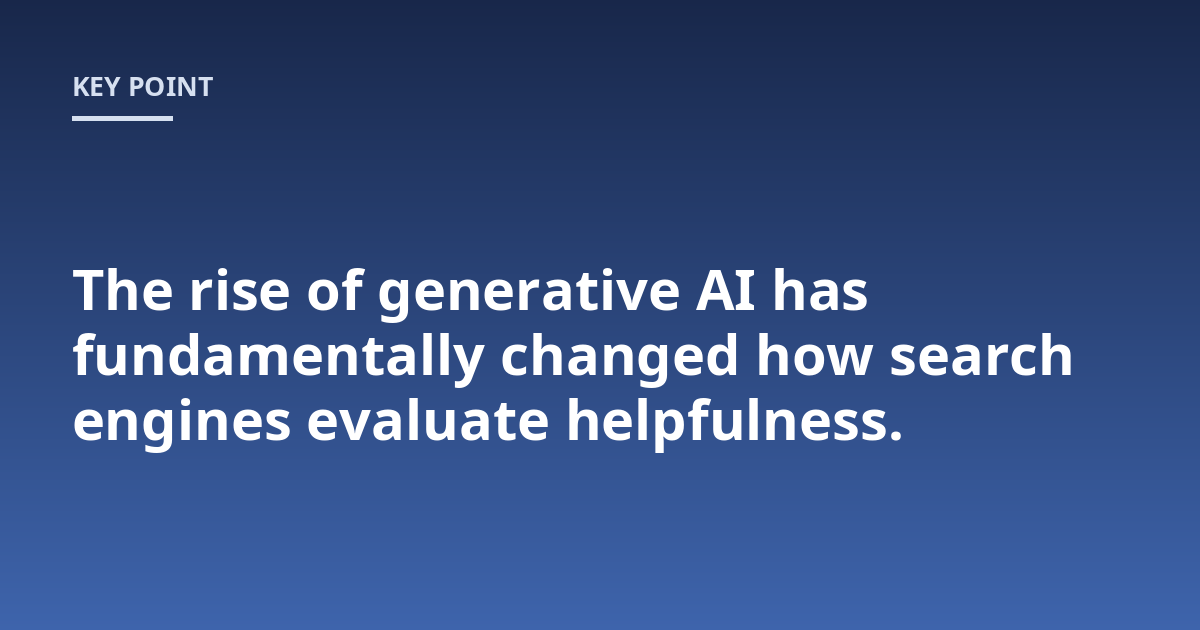
The rise of generative AI has fundamentally changed how search engines evaluate helpfulness. While automation allows for unprecedented scale, it also lowers the barrier to entry for low-quality, generic content that lacks substance. Search engines like Google have responded by refining their evaluation frameworks to prioritize signals that prove a creator actually knows what they are talking about. This is where E-E-A-T comes into play. It is no longer enough to produce text that sounds human; you must provide evidence of actual expertise and real-world experience to maintain visibility.
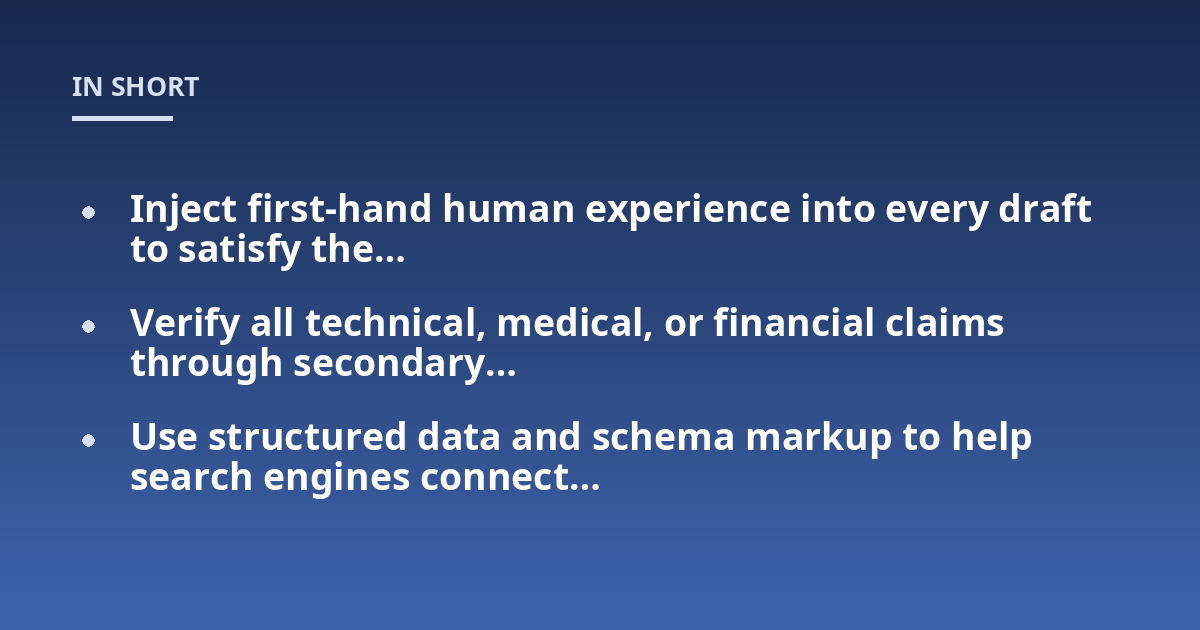
- Inject first-hand human experience into every draft to satisfy the “Experience” component of E-E-A-T.
- Verify all technical, medical, or financial claims through secondary authoritative sources to build Trustworthiness.
- Use structured data and schema markup to help search engines connect your content to established entities.
Modern SEO has shifted from mere keyword matching to entity-based understanding. Search engines are looking for the “who” behind the information, not just the “what.” If you rely solely on Large Language Models (LLMs) without intervention, you risk producing content that is technically correct but experientially empty. This creates a massive opportunity for agencies and marketers who can implement high-quality human-in-the-loop workflows to validate and enhance automated output.
Why is eeat for content building trust with search engines critical today?
The primary reason why eeat for content building trust with search engines matters so much right now is the surge in “information pollution” caused by unmonitored AI automation. As search engines refine their ability to distinguish between generic generative text and high-value editorial content, sites that fail to demonstrate true authority are seeing significant volatility in rankings. A lack of topical depth or factual errors can lead to a site being categorized as low-effort content, which directly impacts your visibility in both traditional SERPs and new answer engines.
In practice, search engines analyze the relationship between an entity (the author or brand) and the topic being discussed. If a travel blog suddenly starts writing technical medical advice without any established authority in healthcare, it will fail the E-E-A-T assessment regardless of how well-written the AI output is. This concept is particularly relevant for high-stakes industries where information accuracy is non-negotiable. For marketers, this means that scaling content through authoritative SEO frameworks requires more than just better prompts; it requires a structured approach to verification.
We have seen many brands experience sudden traffic drops following core updates when they shift entirely to automated content without human oversight. The algorithms are increasingly adept at recognizing the linguistic patterns of unedited LLMs, which often lack specific details, nuanced opinions, or recent data points. To mitigate this risk, your workflow must treat AI as a starting point rather than a finished product.
Always perform a “human-in-the-loop” audit on all technical, legal, or medical claims before publishing, regardless of the model used. A single hallucination in a high-stakes article can compromise your site’s entire trust profile.
How do you demonstrate experience and expertise in automated workflows?
Demonstrating experience and expertise requires moving beyond generic descriptions and into the specific, verifiable details. While an AI can explain how to perform a task, it cannot easily describe the feeling of doing it or the unexpected challenges encountered during the process. To bridge this gap, you must intentionally insert human-centric elements into your ai-powered content automation: a step-by-step guide for agencies to ensure they stand out from generic competition.
First, focus on the “Experience” part of E-E-A-T by adding personal anecdotes or case studies. If you are writing about SEO, do not just list tips; explain how a specific tactic worked (or failed) in a recent campaign for a client. Second, deepen the expertise by including proprietary data or internal research. Search engines value information that cannot be found elsewhere on the web. This unique data is one of the strongest signals you can provide to establish topical authority.
A common mistake is allowing AI to write entire articles from start to finish without a subject matter expert (SME) review. The most reliable approach here is usually simple: use AI to build the structure and draft the basic components, then have an SME refine the tone, add specific nuances, and verify accuracy. This process maintains scale while ensuring the final output has the “soul” of human expertise.
What role does authoritativeness play in generative engine optimization?
Authoritativeness is about how the web perceives your credibility as a source for a specific topic. In the era of Generative Engine Optimization (GEO), this becomes even more critical because AI-powered search tools like ChatGPT or Perplexity rely heavily on being able to cite reliable sources. If your content is not viewed as an authoritative node in the knowledge graph, it will likely be ignored by these new answer engines.
To build authoritativeness through automation, you must focus on entity connection and structured data. You can use structured data for ai overviews: schema types that drive clicks to explicitly tell search engines who the author is, what their credentials are, and what other topics they have covered. By using Author and Organization Schema, you create a verifiable digital footprint that links your content to established expertise.
Consider the following comparison between standard AI output and E-E-A-T optimized content:
| Feature | Raw AI Output | E-E-A-T Optimized Content |
|---|---|---|
| Factual Accuracy | Likely to contain hallucinations or outdated data | Verified against current, authoritative sources |
| First-hand Experience | Impossible; relies on patterns in training data | Includes specific case studies and personal observations |
| Technical Signals | Often missing deep schema or entity links | Rich with structured data and entity associations |
| Tone and Voice | Predictable, generic, and often “polite” | Authoritative, specific, and unique to the brand |
Building this level of authority is a long-term play. It requires consistent output in your niche and an active effort to build high-quality backlinks from other authoritative sites in that same vertical. You cannot simply automate your way into being a thought leader; you must use automation to amplify the expertise you already possess.
How can transparency strengthen trustworthiness in AI content?
Trustworthiness is often considered the most important component of E-E-A-T because it underpins everything else. When users (and search engines) suspect that a site is pumping out low-effort, deceptive, or factually incorrect content, trust collapses. In an era of mass AI generation, transparency about your use of AI can actually be a powerful way to build credibility rather than lose it.
You should consider implementing clear disclosure statements where appropriate. If a piece of content was heavily assisted by AI, stating that so clearly and emphasizing the human review process shows honesty. More importantly, you must ensure that your technical trustworthiness is impeccable. This includes maintaining accurate site performance, respecting user privacy, and providing clear pathways for contact and verification of authorship.
When scaling via generative engine optimization: ranking in chatgpt and perplexity, the way you structure your facts becomes vital. These engines look for clear, concise answers to specific questions. By providing structured, high-density information that is easy to parse, you increase the likelihood that an AI will cite your content as a definitive source of truth.
What this means in reality: every piece of content must survive a “truth test.” If you cannot back up a claim with a real-world fact or a credible citation, it should not be published. Trust is built through consistent accuracy and lost through a single significant error.
Common pitfalls when scaling AI content for search visibility
Many organizations attempt to automate their SEO strategy without understanding the nuances of quality control. They focus on quantity over depth, which leads to “content decay” where the site’s overall authority begins to erode. To avoid this, you need to implement rigorous auditing processes that
Other posts from the category
There are no posts for the selected category.

Latest posts from the category
-

What makes an effective Category Page for AI
June 5, 2026
-

What Influences the cost of AI Optimisation
June 1, 2026
-

Organisation Schema: how to help AI understand your brand
May 27, 2026