
How Do I Build Topical Authority With AI-Assisted Content?
August 1, 2026
Category:
Uncategorized
You build topical authority with AI-assisted content by using artificial intelligence to map your niche comprehensively and generate structured drafts at scale. You must then apply rigorous human editorial oversight to ensure factual accuracy, first-hand experience, and genuine depth. This combination allows you to create a dense network of interlinked pages that demonstrate expertise to search engines faster than manual processes alone.
The traditional path to authority was slow and linear. Today, agencies like TsoDen AI Bureau leverage automation to accelerate the creation of these networks. However, speed introduces risk. Search algorithms penalize content that is merely voluminous but shallow. The challenge lies in maintaining a high signal-to-noise ratio when production scales.
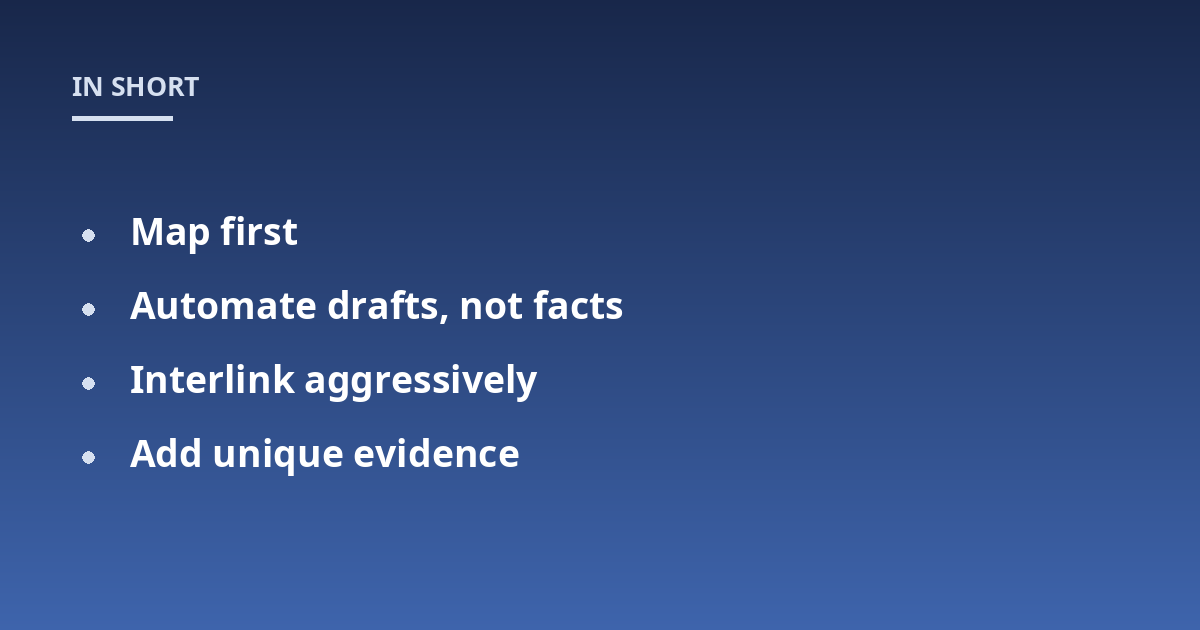
- Map first: Use AI to identify every subtopic and question within your niche before writing a single word.
- Automate drafts, not facts: Let AI handle structure and initial text, but keep humans in the loop for data verification.
- Interlink aggressively: Connect pillar pages to cluster content using descriptive anchor text to pass equity.
- Add unique evidence: Include proprietary data, original images, or expert quotes that AI cannot fabricate.
## Why do search engines prioritize topical authority over individual keywords? Search engines have shifted from matching isolated keywords to evaluating the overall expertise of a domain. A single well-optimized page rarely ranks for highly competitive terms anymore. Instead, algorithms look for a cluster of pages that collectively answer every aspect of a subject. This signals to Google that your site is a reliable source of truth. When you build topical authority, you create internal pathways that guide crawlers through your content ecosystem. Each new page reinforces the relevance of its neighbors. This structural cohesion reduces bounce rates and increases time on site because users find related answers without leaving. The goal is not just to rank for “best running shoes.” The goal is to rank for “running shoe maintenance,” “how to tie laces,” “marathon training plans,” and “shoe size guides” simultaneously. AI tools excel at generating these surrounding pages quickly. They help you cover the long tail of queries that human writers might overlook due to time constraints. You must remember that quality still trumps quantity. One thousand low-effort articles will not build authority. One hundred deeply researched, well-interlinked pieces will. The focus keyword “how do i build topical authority with ai-assisted content” points to this exact balance: automation for scale, human insight for trust. ## How does content automation affect SEO performance in practice? Content automation fundamentally changes the velocity of your content production. It allows you to move from a monthly output cycle to a weekly or daily cadence. This speed is valuable for capturing trending topics and answering new user questions quickly. Faster publishing means faster indexing and earlier visibility. However, automation introduces specific SEO risks. If you deploy AI tools without strict constraints, you risk generating generic text that lacks unique value. Search engines are increasingly adept at detecting this “flat” writing style. It reads well but offers no actionable insight or original perspective. This is where human oversight becomes critical. In practice, the most effective workflow uses AI for research and outlining. You ask the tool to identify content gaps in your niche. Then, a subject matter expert writes the core insights. The AI helps format these insights into SEO-friendly structures with proper headers and meta tags. This hybrid approach maintains quality while boosting efficiency. You should also consider technical SEO benefits. Automation can standardize on-page elements like schema markup, image alt text, and internal linking. Consistency in these technical details helps search engines understand your content better. It reduces the manual workload for your SEO team, allowing them to focus on strategy rather than repetitive tasks. ## What are the key steps to creating a topical map with AI? Creating a topical map requires a systematic approach. You cannot simply ask an AI tool to “write about fitness” and expect authority. You must define the boundaries of your niche precisely. Start by entering your core topic into an AI research tool. Ask it to generate a comprehensive list of subtopics, questions, and related entities. Review this output critically. Remove generic items that overlap too much with major competitors. Add specific angles that reflect your unique business perspective. For example, if you sell software, include case studies, implementation guides, and troubleshooting tips that only an insider would know. This adds the “Experience” element of E-E-A-T. Structure the map hierarchically. The top level consists of pillar pages covering broad themes. Below them are cluster pages addressing specific questions or use cases. Use AI to analyze search intent for each topic. Some queries want quick answers, while others require long-form explanations. Match your content format to the user’s need. This process ensures you cover the entire subject space without leaving gaps. It also reveals opportunities for internal linking. You can plan anchor text strategies in advance, ensuring that related pages connect logically. This structural clarity helps search engines crawl and index your site more efficiently. ## How do I ensure content meets EEAT standards? E-E-A-T stands for Experience, Expertise, Authoritativeness, and Trust. It is the benchmark Google uses to evaluate YMYL (Your Money Your Life) content and increasingly all content types. AI lacks personal experience. It has never used a product or treated a patient. Therefore, it cannot provide genuine first-hand accounts. To meet these standards, you must inject human experience into every piece. Add personal anecdotes, case studies, or expert interviews. If the article is about a financial product, include your team’s actual analysis of its fees and terms. These details are impossible for AI to fabricate authentically. They signal to readers and algorithms that real people stand behind the information. Authoritativeness comes from citing reliable sources. Link to academic studies, government data, or industry reports. Do not rely on other blogs as sources. This practice builds a web of trust around your content. It shows that your claims are grounded in established facts rather than opinion. Trust is built through accuracy and transparency. Fact-check every statistic provided by the AI tool. Correct any hallucinations immediately. Be clear about what is original analysis and what is industry consensus. Avoid absolute claims unless you can prove them. A transparent, error-free approach builds long-term credibility with your audience. ## Which mistakes should you avoid when scaling with AI? Many teams fail at topical authority because they prioritize volume over cohesion. They publish hundreds of disjointed articles without interlinking or thematic focus. This scatters your site’s relevance and confuses search engines. Instead, build a focused cluster around one core topic before expanding to another. Stay narrow and deep initially. Another common mistake is relying on AI for data. Large language models are prone to hallucination. They may invent statistics, dates, or citations that look plausible but are false. Always verify factual claims against primary sources. A single incorrect statistic can damage your site’s reputation and lead to deindexing. Do not ignore user intent. AI tools often default to a generic informational tone. If a user searches for a specific product review, they want pros, cons, and pricing, not a history lesson. Customize the output to match the search query’s intent. Use AI to draft, but edit heavily to align with what users actually want to know. Finally, avoid neglecting technical performance. Heavy media and poor site structure can slow down your site, hurting rankings. Ensure your automation workflow includes image optimization and clean code generation. A fast, accessible site supports your content authority rather than undermining it. The focus keyword “how do i build topical authority with ai-assisted content” requires a balanced approach that respects both technology and user experience. ## What tools are best for building a content ecosystem? Several categories of tools support this strategy. First, use AI research platforms to identify keywords and map topics. These tools analyze search volume and difficulty to help you prioritize high-impact pages. They also generate content outlines based on top-ranking competitors. Second, utilize writing assistants to draft articles. Look for tools that allow custom prompts and tone adjustments. This helps you maintain a consistent brand voice across hundreds of pages. Some platforms also offer grammar checking and readability scoring to improve quality. Third, integrate SEO management software to track performance and manage internal links. These tools monitor your rankings and alert you to changes in SERP features. They can also suggest internal linking opportunities based on semantic relevance. This ensures your topical map remains active and optimized over time. Consider using WordPress automation plugins to streamline deployment. If you run a content-heavy site, manual publishing is unsustainable. Automation can push approved drafts to your CMS with proper formatting and metadata. This reduces the friction between creation and publication. For more on technical implementation, see How do I implement hreflang tags correctly on WordPress?. ## How does topic clustering compare to keyword silos? Topic clustering is a modern evolution of the keyword silo strategy. Silos focused on grouping pages by exact match keywords. Clusters focus on semantic relationships and user intent. A cluster centers around a broad pillar topic and expands into detailed subtopics that answer specific questions. This approach aligns better with how search engines understand language today. Algorithms use natural language processing to recognize context and meaning. They prefer content that covers a subject comprehensively rather than pages stuffed with repetitive keywords. Clustering encourages this comprehensive coverage. Within a cluster, every page links back to the pillar. This concentrates link equity on the main topic while distributing it to subpages. It creates a logical navigation path for users and crawlers. Visitors can explore related topics easily, increasing engagement metrics that signal quality. Implementing clusters requires disciplined planning. Map out your core pillars first. Then identify the supporting articles needed to cover each pillar fully. Use AI to find gaps in existing content or opportunities for new angles. Ensure each piece adds unique value rather than repeating the same information. This strategy strengthens your domain’s overall authority structure. ## What is the role of human editing in this process? Human editing is the filter that separates authoritative content from noise. AI provides the raw material, but humans provide the judgment. Editors verify facts, check for consistency, and ensure the tone matches brand guidelines. They also add creative elements that machines cannot replicate, such as humor or personal insight. A skilled editor knows when to rewrite an AI paragraph entirely. If the language feels stiff or generic, it gets replaced with clearer, more direct prose. Editing also involves strategic decisions about placement and formatting. Which sections deserve emphasis? Where should images go to break up text? These choices improve readability and engagement. humans ensure ethical compliance. They check for bias, sensitive topics, and potential misinformation. In regulated industries like health or finance, this step is non-negotiable. It protects your brand from legal risks and reputational damage. The investment in editing pays off in higher trust scores and better long-term rankings. ## What mistakes should you avoid with how does content automation affect seo performance? Reusing the same AI template for every article creates identical structures. Search engines detect this pattern and may flag your site for duplicate content issues. Vary your formats. Use lists, tables, FAQs, and narrative sections interchangeably. This keeps the user experience fresh and signals originality to crawlers. Another trap is ignoring updates. Content decays over time as information changes. An article accurate today may be outdated next year. Set up a schedule for periodic reviews. Use AI to scan your content library for stale data or broken links. Refresh these pages regularly to maintain their ranking potential. Stale content harms the perception of your topical authority. ## How does generative engine optimization fit into this strategy? Generative Engine Optimization (GEO) focuses on making your content quotable and citable by AI systems. This is different from traditional SEO, which targets click-throughs. GEO aims to have your data or insights included in responses. This requires clear definitions, concise summaries, and authoritative citations. Structure your content for easy extraction. Use “X is Y” sentences to define terms clearly. Place key takeaways at the beginning of sections. Provide direct answers to common questions without fluff. This format helps both search engines and generative models understand and retrieve your information quickly. Link to primary sources where possible. AI systems prefer citing original studies over secondary reports. By linking to reputable data, you position your content as a trusted intermediary. This builds authority and increases the likelihood of being referenced in answer engines. See What is generative engine optimization and how does it work? for more details on these specific techniques. ## When should I start building this type of topical authority? Start immediately upon defining your niche. Do not wait for perfect content or unlimited resources. Begin with a few high-quality pillar pages to establish the core structure. Then, use automation to populate the surrounding cluster content gradually. Consistency is more important than speed in the early stages. Early efforts compound over time. As search engines crawl and index your interconnected pages, they begin to recognize the thematic depth of your site. This leads to incremental ranking improvements across multiple keywords. The longer you maintain this strategy, the stronger your authority becomes. Monitor your progress using analytics tools. Track rankings for cluster topics, not just primary keywords. Observe user behavior on cluster pages. Are they reading deeply or bouncing? Use this data to refine your content strategy. Adjust based on what works rather than sticking to a rigid plan. ## Is AI-assisted content safe for my brand reputation? AI is safe if used as a tool, not a replacement for judgment. Brands that rely solely on automated text risk publishing inaccuracies or generic advice. This erodes trust quickly. Users can sense when content lacks genuine insight. They will leave and likely return to sources that offer better value. Safety comes from control. Implement strict approval workflows. Require human sign-off before any page goes live. Use AI for brainstorming and drafting, but keep the final decision in human hands. This hybrid model maximizes efficiency while minimizing risk. Transparency also plays a role. While you do not need to label every AI-assisted article, maintaining high standards is essential. If your content helps users solve problems accurately, your reputation grows. If it misleads them, your brand suffers. The goal is to use technology to enhance human expertise, not obscure it.
The most reliable approach to scaling content is treating AI as a research and drafting assistant, while keeping editorial control firmly in human hands. This ensures every piece meets your quality standards before publication.
## How do I measure the success of my topical authority efforts? Measure success by tracking visibility across your entire topic cluster, not just single keywords. Monitor the number of pages ranking on page one for related terms. Look for growth in impressions and clicks for long-tail queries. This indicates that search engines are recognizing your broader expertise. Analyze internal traffic flow. Are users moving from pillar pages to cluster content? High internal click rates signal good site structure and engaging content. Use tools like Google Search Console to identify which topics drive the most engagement. Double down on these areas in future planning. Watch your domain rating and backlink profile. Authority sites attract links naturally. If your cluster content begins to earn references from other reputable sites, it is a strong signal that your topical authority is building. Track these metrics monthly to see trends over time. ## Can content pass Google’s EEAT standards? Yes, it can, provided you integrate human expertise effectively. Google evaluates the final output, not the creation process. If your article contains accurate facts, original insights, and authoritative citations, it meets E-E-A-T criteria regardless of how much AI assistance was used. The key is to add unique value that AI alone cannot provide. Include author bios with relevant credentials. Link to external profiles or other verified content by the same expert. This connects the page to a real person with established expertise. It also provides users with context about why they should trust the information presented. Focus on clarity and helpfulness. Avoid overly complex language that hides a lack of substance. Direct, useful answers perform best. Use AI to ensure grammatical correctness and logical flow, but rely on your team for the substantive knowledge. This combination creates content that satisfies both algorithms and readers. ## What structured data types help rank in AI overviews? Structured data helps search engines understand the context of your content. For topical authority, use FAQ schema on pages with common questions. Use Article or BlogPosting schema to identify news or commentary. Product schema is useful if you review physical items. These tags provide explicit signals about your content type and purpose. JSON-LD format is the standard for implementing these marks. It allows you to define entities, relationships, and key facts clearly. AI systems parse this data easily, increasing the chance of your content being cited in generated responses. Ensure your structured data matches the visible content on the page exactly. Mismatches can lead to penalties or reduced visibility. Test your markup using Google’s Rich Results Test tool. Fix any errors before publishing. Regular audits can catch issues as you scale your production. Properly implemented schema enhances the appearance of your results in search, making them more attractive to users and easier for AI systems to interpret. See What structured data types help rank in AI overviews? for a technical breakdown. ## How do I optimize content for answer engines like ChatGPT? Optimize by writing clear, direct answers to specific questions. Start paragraphs with the main point. Avoid vague introductions or fluff. Use bullet points and numbered lists to organize information logically. This structure makes it easier for AI models to extract relevant snippets from your text. Cite authoritative sources within the body of your content. AI systems prefer to attribute information to known, reputable entities. If you link to government sites, academic journals, or major industry publications, your content becomes a trusted source in their training data. This increases the likelihood of your insights appearing in future responses. Include definitions and explanations for key terms. Answer engines often pull direct definitions from web pages. By clearly defining niche concepts using “X is Y” formats, you position your site as the reference point. This builds authority over time as more users encounter your definitions in AI outputs. ## What internal links should I prioritize? Prioritize links that create a logical path from broad topics to specific details. Link pillar pages to cluster content using descriptive anchor text that includes relevant keywords. This helps search engines understand the relationship between pages. It also distributes authority evenly across your site rather than concentrating it on high-traffic pages. Use internal links to address related questions. If a user reads about “beginner SEO tips,” link to a more advanced guide for those ready to deepen their knowledge. This keeps users engaged and signals content progression to crawlers. Avoid linking to irrelevant or outdated pages just to boost numbers. Regularly audit your internal linking structure. Broken links hurt user experience and crawl efficiency Use descriptive anchor text that includes relevant keywords. This helps search engines understand the relationship between pages. It also distributes authority evenly across your site rather than concentrating it on high-traffic pages. Use internal links to address related questions. If a user reads about “beginner SEO tips,” link to a more advanced guide for those ready to deepen their knowledge. This keeps users engaged and signals content progression to crawlers. Avoid linking to irrelevant or outdated pages just to boost numbers. Regularly audit your internal linking structure. Broken links hurt user experience and crawl efficiency, undermining the very authority you are trying to build. ## How do I maintain consistency across hundreds of pages? Consistency requires strict guidelines for tone, style, and factual accuracy. Create a comprehensive style guide that dictates sentence length, vocabulary choices, and formatting rules. Input this guide into your AI prompts before generating any content. This ensures that even though multiple pieces are created by different tools or at different times, they all sound like they come from the same source. Use content operations software to manage these guidelines. Such platforms allow you to set global standards for headings, meta descriptions, and image alt text. When you deploy new pages, they automatically adhere to these rules. This reduces the burden on your editorial team. They can focus on quality control rather than fixing basic formatting errors or stylistic inconsistencies. Regular training for your team is also essential. As AI models update their capabilities, your prompts and guidelines must evolve. Hold monthly reviews of published content to identify any drift in style or accuracy. Correct these issues immediately to preserve the professional image of your brand. ## What is the impact of user engagement metrics on topical authority? User engagement signals tell search engines whether your content actually satisfies visitor needs. High bounce rates and low dwell times suggest that users found the information lacking or irrelevant. This can negatively affect your rankings for target keywords. To improve these metrics, focus on readability and structure. Use short paragraphs, clear headings, and bullet points to make information easy to scan. Include relevant images, charts, and videos to break up text and provide additional context. These elements keep users on the page longer. Implement interactive elements where appropriate. Quizzes, calculators, or downloadable checklists encourage deeper engagement. They signal to algorithms that your content provides unique value beyond static text. Monitor these metrics in Google Analytics. Identify pages with high exit rates and analyze why users leave. Is the content too dense? Is the call to action unclear? Adjust these pages based on data rather than assumptions. Improving user experience directly supports your topical authority by demonstrating that your site is a reliable resource for your audience. ## How do I handle negative feedback on AI-assisted content? Negative comments or reviews provide valuable insights into gaps in your coverage. If users point out errors, address them promptly and transparently. Update the article with corrected information and note the change at the top of the page. This shows commitment to accuracy. Engage with users by responding to thoughtful comments. This builds community and trust. It also provides additional keyword-rich content for search engines to index. Do not delete critical feedback unless it violates community guidelines. Ignoring valid concerns damages your reputation. Use negative feedback to identify topics that need expansion. If many users ask about a specific aspect of a topic, create a new detailed page addressing that question. This iterative process improves the depth and relevance of your content over time. It transforms your topical authority from a static state into a dynamic, evolving asset that grows with audience needs. ## Frequently Asked Questions ### Can I build topical authority without writing every word myself?
Yes. You can use AI for drafting, outlining, and research. However, you must provide the strategic direction, fact-checking, and final editing. The combination of human oversight and AI efficiency is the most effective way to scale content production while maintaining quality standards. ### How long does it take to see results in search rankings?
Typical timelines range from three to six months for initial visibility improvements. Full topical authority takes longer, often exceeding a year of consistent effort. Patience and consistency are critical during the indexing and evaluation phases. ### Is it necessary to update old content?
Yes. Search engines favor fresh, accurate information. Regularly review older articles to verify statistics, links, and claims. Update outdated sections and republish with a new date to signal ongoing relevance. This practice helps maintain or improve existing rankings. ### What is the best way to link pillar pages to cluster content?
Use contextual natural language within the body text. Avoid generic phrases like “click here.” Instead, use descriptive anchor text that summarizes the linked topic. Place links where they add value to the reader’s understanding of the current subject.
Other posts from the category
There are no posts for the selected category.

Latest posts from the category
-

What makes an effective Category Page for AI
June 5, 2026
-

What Influences the cost of AI Optimisation
June 1, 2026
-

Organisation Schema: how to help AI understand your brand
May 27, 2026