Multilingual SEO Automation: Scaling Content Across 10 Languages
August 7, 2026
Category:
Uncategorized
Multilingual SEO automation scaling content across 10 languages involves deploying structured AI workflows to generate, translate, and localize high-quality pages at scale. It relies on precise technical foundations, such as hreflang implementation and language-specific schema markup, alongside centralized content management systems to maintain quality while expanding search visibility globally.
Table of Contents
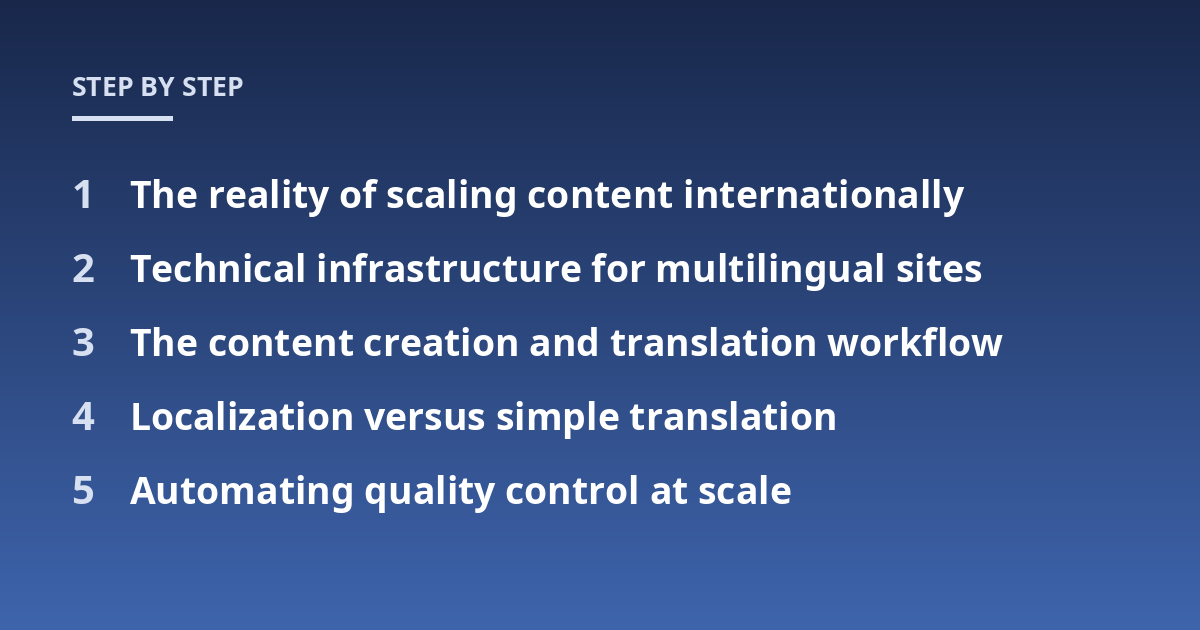
- The reality of scaling content internationally
- Technical infrastructure for multilingual sites
- The content creation and translation workflow
- Localization versus simple translation
- Automating quality control at scale
- WordPress and AI tooling integration
- Measuring performance across markets
- Frequently Asked Questions
The reality of scaling content internationally
Scaling content across ten or more languages requires a shift from manual translation to automated, yet controlled, production pipelines. You are not simply publishing text; you are building an engine that handles linguistic variation, cultural context, and technical compliance simultaneously. Many agencies fail because they treat multilingual SEO as a marketing afterthought rather than a structural engineering problem. The goal is efficiency without sacrificing relevance. When you expand your footprint into ten languages, manual processes become bottlenecks. You cannot hire enough translators to keep up with the volume of content required to compete in each region. Automation fills this gap, but it introduces new risks like duplicate content, incorrect canonicalization, and poor user experience if not managed correctly. Most guides overcomplicate this process. The reality is simpler: you need a centralized repository for your source content, a robust translation management system, and a strict quality assurance layer. This approach allows you to publish consistently across all target markets without burning out your team or compromising your brand voice. You must decide early whether you will prioritize speed or depth of local cultural adaptation for each specific language group.
Technical infrastructure for multilingual sites
A multilingual website fails before it starts if the technical foundation is weak. Search engines need clear signals to understand which version of a page serves which user. Without these signals, you risk cannibalizing your own rankings or confusing crawlers entirely. The first step is implementing hreflang tags correctly across every single page. Hreflang attributes tell search engines that a specific URL is intended for users in a particular geographic location or language. Incorrect implementation can lead to indexing errors where pages appear in the wrong markets. You must ensure that your HTML head includes reciprocal links between all language variants of a page. If you have versions in English, German, French, Spanish, and five other languages, every link must point back to the others. Canonical tags also play a critical role. Each language version should point to itself as the canonical URL. Do not force multiple language versions to share a single canonical tag unless they are truly identical, which is rare in translation work. You should also structure your URLs clearly, using either subdirectories (example.com/de/), subdomains (de.example.com), or country codes (example.de). Subdirectories are generally preferred for SEO authority consolidation, while subdomains can offer more flexibility for completely separate brand strategies. Google Search Central’s guide on international targeting provides the definitive technical standards you must follow to avoid penalties.
The content creation and translation workflow
Efficient multilingual content production begins with your source language. You create high-quality, well-researched content in English first, then distribute it for localization. This reverse-engineering approach ensures that your core messaging is consistent before any translation begins. You should avoid creating content directly in secondary languages unless you have native-speaking subject matter experts involved from the drafting stage. Automating this workflow requires a Content Management System (CMS) that supports multi-language architectures out of the box. Platforms like WordPress, paired with robust multilingual plugins or headless CMS solutions, allow you to manage content variants in one place. You then connect these systems to translation management platforms using APIs. This integration allows content to flow automatically from your draft stage into professional translation queues, and back into your CMS for publishing. The quality of your source content dictates the quality of your translations. Ambiguous sentences or industry-specific jargon often break in automated translation tools. By refining your source material first, you reduce the cognitive load on translators and AI models alike. You save time by fixing errors in English rather than correcting awkward phrasing across ten languages later in the pipeline.
Localization versus simple translation
Translation converts words from one language to another. Localization adapts content for a specific culture, market, or region. You cannot scale successfully with translation alone. Words that carry no weight in English might be highly charged in other cultures, while idioms rarely translate directly and often sound robotic or nonsensical. Consider dates, currencies, units of measurement, and even color symbolism. A metric-focused audience in Europe expects kilograms and meters, not pounds and inches. Financial content requires currency conversion and regulatory compliance checks specific to that country. Your automated systems should flag these elements for human review before publication. You should also adapt your tone of voice. Directness works well in German or Dutch markets, while indirectness and formality might be preferred in Japanese or Korean contexts. An AI-driven SEO automation strategy allows you to create style guides for each language pair. These guides instruct both human translators and language models on how to adjust tone, formality levels, and cultural references to match local expectations.
Automating quality control at scale
When publishing hundreds of pages across ten languages, manual proofreading becomes impossible. You need automated checks to catch technical errors, keyword stuffing, or basic linguistic glitches before they hit the live site. This is where AI-powered auditing tools come into play. They can scan new pages for readability scores, keyword density anomalies, and broken links in real time. However, automation has limits. AI models struggle with context-dependent nuances and local slang. You must establish a human-in-the-loop process for high-stakes content. Automated checks handle the volume; humans handle the nuance. You should prioritize reviewing financial advice, medical information, or any regulated content manually to ensure compliance and accuracy. How to Build a Multilingual SEO Strategy with AI in 2026 outlines a more detailed roadmap for integrating these quality control layers into your existing workflows. The key is to automate the boring stuff so you can focus on strategic oversight rather than checking commas.
WordPress and AI tooling integration
WordPress remains a dominant platform for multilingual sites due to its flexibility and vast ecosystem of plugins. For agencies managing multiple client accounts, automation within WordPress is essential. You can use custom post types and field groups to structure content consistently across languages. When combined with page builder automation, you ensure that layout and design elements remain consistent regardless of text expansion or contraction in translation. AI tools integrated directly into the WordPress editor can assist writers by suggesting translations for key phrases, checking grammar, or identifying missing local keywords. These tools do not replace professional editing but accelerate the drafting phase significantly. You must configure these tools to respect your brand voice and avoid generating generic, repetitive content that search engines penalize as low-quality. AI-Powered Content Automation: A Step-by-Step Guide for Agencies demonstrates how to connect these disparate tools into a seamless pipeline. The goal is to reduce the time from concept to live publication by at least fifty percent while maintaining high editorial standards.
Measuring performance across markets
Tracking SEO performance in ten languages requires segmenting your analytics correctly. You cannot treat global traffic as a single metric. You need to analyze organic search performance, bounce rates, and conversion data by language and geographic region separately. Search Console allows you to filter data by country and page, providing granular insights into how each market responds to your content. You should also monitor crawl errors specific to each subdirectory or subdomain. Technical issues like 404s, redirect chains, or broken hreflang tags will disproportionately affect smaller markets if left unchecked. Automated monitoring tools can alert you when a specific language version starts losing rankings or crawling status changes unexpectedly. Finally, track your content production metrics. Measure the turnaround time for translations, the cost per localized page, and the quality score of published assets. These operational metrics help you refine your automation pipeline over time. You will likely find that certain languages are more expensive or time-consuming to produce than others, allowing you to adjust resource allocation accordingly.
Frequently Asked Questions
What is important to know about multilingual SEO automation?
The key points are the goal of care, the expected process, and the limits that may apply to an individual case. A precise recommendation depends on an examination and professional consultation.
When should you discuss scaling content across ten languages with a professional?
A consultation is useful when there is pain, sensitivity, visible change, damage, or uncertainty about the right next step. Early assessment can reduce the chance of a small issue becoming more complex.
How should someone prepare for a consultation about multilingual SEO automation?
It helps to note symptoms, previous treatment, medications, and specific questions. Existing records or images can also help the clinician understand the situation.
What risks does multilingual SEO automation scaling content across 10 languages have?
Risks and limits depend on health status, the extent of the problem, hygiene, and the selected approach. The professional should explain benefits, alternatives, and realistic expectations before care begins.
How often should you review multilingual SEO automation workflows?
The right interval is individual and depends on risk, history, current findings, and symptoms. The safest approach is to follow the recommendation given after examination.
The most reliable approach here is usually simple: automate the technical infrastructure completely, but keep a human expert in the loop for every final localized publish. You cannot outsource nuance.
Moving forward with confidence
Multilingual SEO automation scaling content across 10 languages is not just about publishing more pages; it is about building a resilient, scalable system that respects local nuances while maintaining global consistency. The technology exists to make this efficient, but success depends on your willingness to invest in proper technical setup and quality control workflows. Start by auditing your current hreflang implementation and URL structure. Ensure your CMS can handle the volume of content you plan to generate. Then, integrate AI tools that support your specific localization needs rather than forcing generic translation pipelines onto complex markets. The competitive advantage will belong to those who can publish high-quality, culturally relevant content faster than their rivals. If you are ready to scale your global presence, you must treat every language variant as a distinct market requiring distinct attention. The foundation is technical, but the growth is strategic.
Other posts from the category
There are no posts for the selected category.

Latest posts from the category
-

What makes an effective Category Page for AI
June 5, 2026
-

What Influences the cost of AI Optimisation
June 1, 2026
-

Organisation Schema: how to help AI understand your brand
May 27, 2026