
How to Create a Content Cluster That Ranks in AI Search Results
August 10, 2026
Category:
Uncategorized
Creating a content cluster that ranks in AI search results involves building topical authority around a core subject, proving comprehensive knowledge through interconnected pillar and supporting content. You must shift focus from optimizing for individual keywords to modeling genuine expertise for generative engines. This means ensuring clear topic hierarchy, deep entity coverage, and establishing demonstrable relationships between all your published pieces.
The challenge facing modern SEO professionals is that traditional link-building or keyword stuffing approaches no longer satisfy the sophisticated context recognition of large language models (LLMs). AI search experiences favor definitive answers derived from multiple, authoritative sources rather than mere rankings. As experienced SEO specialists, we know that structuring content to teach an AI model, by providing crystal clear evidence and deep topical coverage, is the primary modern strategy for visibility.
- Establish a definitive pillar page covering the core topic entirely.
- Support the pillar with multiple, specific cluster articles that tackle subtopics from different user angles (e.g., process, comparison, guide).
- Structure content using clear entities, question/answer formats, and source citation patterns to satisfy generative models.
- Build internal topical relevance signals by linking systematically between all related pieces of content.
What is content clustering for AI search results?
Content clustering is an established SEO practice, but when optimized for AI search results, like those found in generative AI summaries or direct answer boxes, it takes on new dimensions. For LLMs, a content cluster signals that your entire domain possesses comprehensive subject matter expertise on one core theme. It’s not just linking articles; it’s architecting an educational resource hub around a central concept.
The pillar page acts as the authoritative overview, while supporting “cluster” pages dive deep into specific facets of that topic. If your goal is visibility within AI answer engines, you must treat these clusters less like linked blog posts and more like interconnected chapters in an industry textbook. The goal is to make it impossible for an LLM processing information your subject without referencing multiple pieces, thus signaling breadth.
When structuring content for AI consumption, prioritize the ‘entity’ relationship over just keyword density. If your pillar discusses “remote software development,” ensure supporting articles cover specific entities like “Zigbee protocols,” “React framework constraints,” or “GDPR compliance in Vietnam” to build a granular knowledge graph for the reader and the machine alike.
A major mistake we see practitioners make is assuming that simply having many related posts is enough. The connections must be deliberate. Think of the connection not as a hyperlink, but as an intellectual necessity; one piece cannot exist fully without referencing or expanding upon another.
How should I structure the pillar page for generative AI?
The pillar page must function as a comprehensive, self-contained summary that naturally guides the user toward deeper exploration while satisfying immediate informational needs. You need to aim for ultimate comprehensiveness without becoming unreadable or superficial.
Optimizing entity density on the main hub
The pillar page needs broad coverage across the entire topic space. Use H3s and H4s not just for structure, but to map out every logical sub-topic related to your main query. For instance, if your pillar is about “Digital Marketing Strategy,” use subheadings like “Budget Allocation Models,” “Client Onboarding Checklists,” and “Measuring Cross-Channel ROI.” These act as topical signposts.
Integrating schemas for maximum machine readability
Implementing proper structured data remains a foundational element. Focus heavily on Schema markup that delineates facts, processes, definitions, and comparisons (e.g., using HowToSchema or FAQSchema where applicable). For instance, when defining key terms, use schema vocabulary to explicitly state, “Definition: X is Y.” This machine-readable format helps AI interpret your factual claims accurately.
Because the pillar needs to anchor authority, you must include foundational educational content. Consider using placeholders for advanced guides that require deeper technical writing, like Structured Data for AI Overviews: Schema Types That Drive Clicks, linking out to the specific data implementation details rather than trying to explain schema syntax within the pillar itself.
What are the best supporting cluster topics to target?
The most effective supporting articles do not repeat the pillar; they answer specific, narrow questions that a user would ask *after* reading the pillar and feeling slightly stuck on one facet. You’re solving problems at the edge of knowledge.
Creating content based on user intent gaps
Think about the common points of confusion your audience expresses in forums or during calls with you. If many people read about content clusters but get confused about multilingual implementation, that specific friction point becomes an ideal cluster topic (e.g., “Navigating Hreflang Tags for Global Content Clusters”). This demonstrates empathy and practical knowledge.
The comparison vs. deep dive model
A useful pairing involves comparing two approaches or tools within your niche. For example, if the pillar covers “Website Speed Optimization,” a cluster article could compare “Core Web Vitals Checklist: Google vs. Lighthouse Metrics.” This structured comparison provides excellent fodder for AI summarization because it offers clear dichotomies.
| Content Type | Purpose in Cluster | Example Focus (General) |
|---|---|---|
| The Guide | Defines process step-by-step. | Step-by-step guide to content auditing using local SEO tools. |
| The Comparison | Pits two methods or technologies against each other. | Comparing JavaScript frameworks for front-end builds in 2025. |
| The Deep Dive | Explores a single, highly technical entity. | Understanding the mechanics of advanced image compression formats. |
Remember that this depth supports your overall topical coverage and improves eligibility for complex search features. For further context on scaling your content efforts globally, review best practices related to building a multilingual SEO strategy with AI in 2026.
What is the role of technical SEO automation in this process?
Technical SEO automation plays a support role, not a creative one. Automation tools help maintain the structural integrity and scale the necessary technical elements across your massive cluster network. These tools manage complexity, freeing up strategists to focus on unique, expert insights.
Where human expertise is irreplaceable is in defining the *topical gap*, knowing what the AI hasn’t been trained on yet regarding your specific niche implementation. Automation excels at applying best practices uniformly; you must supply the novel, proprietary viewpoint that justifies ranking highly.
Automating content scaffolding and structure
When implementing systems like How to Automate WordPress SEO with AI Tools, you automate the necessary boilerplate: consistent internal linking patterns, standardized FAQ inclusion, and uniform meta description treatments across 50 supporting posts.
Structuring data for machine consumption
This goes beyond just adding schema. It means using tooling to ensure that every time a core entity, say, “B2B Lead Generation”, is mentioned, it’s accompanied by canonical structured data outlining its components (steps, examples, associated costs). This systematic repetition of perfect structure is what builds authority signals.
The bottom line here is: automation handles compliance; human strategy dictates authority.
How should I map the user journey using content clusters?
Mapping the user journey ensures that your cluster doesn’t just organize topics, but organizes *intent*. A single query rarely settles for a single article answer. By mapping the typical path, from initial awareness to consideration and finally to decision, you structure multiple touchpoints within your site’s content map.
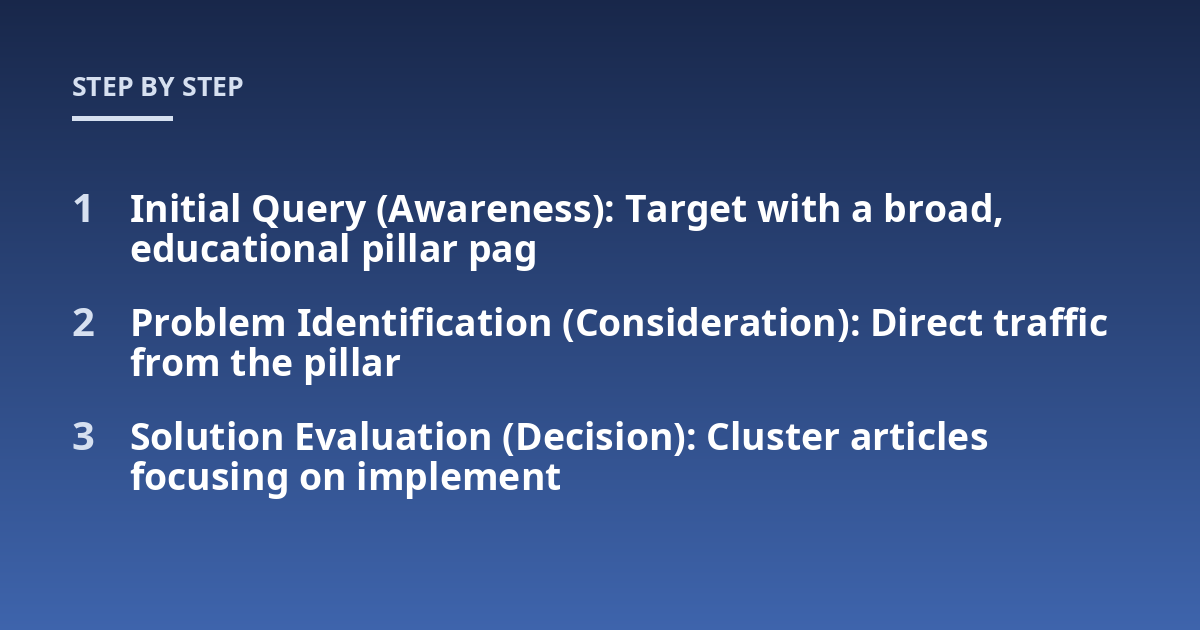
- Initial Query (Awareness): Target with a broad, educational pillar page answering “What is X?”
- Problem Identification (Consideration): Direct traffic from the pillar to comparison/diagnostic cluster pieces like, “When should I consider alternative Y?”
- Solution Evaluation (Decision): Cluster articles focusing on implementation mechanics, such as those detailing specific workflows or platform requirements. This is where you can strategically introduce your own service framework, making sure to cover the technical details people search for online.
This process forces natural internal linking. A user reading about initial assessment on one page naturally flows, via a contextual link, to a piece detailing precise diagnostic criteria. This pathing builds both user engagement signals and topical relevance scores for AI crawlers.
For deeper technical audiences needing constant updates on global structure, understanding why hreflang tags matter more than ever for global SEO and adapting content strategy based on that adds another necessary layer of complexity to prove domain mastery.
What mistakes should I avoid when building a topical cluster?
The biggest mistake is treating the content like an assembly line. Another frequent error is creating orphaned articles, pieces that are excellent on their own but fail to link back conceptually or physically to the main pillar structure. These weak links dilute the authority flow.
Avoid topic scattershotting
Do not create dozens of small, tangentially related pieces just because they use related keywords. Every article must contribute directly to building out a defined conceptual boundary around your primary topic cluster. If an article only superficially touches on the main theme, cut it or rewrite it to make its direct, undeniable connection apparent.
Don’t neglect internal linking quality
Avoid simply sprinkling anchor text across pages. Instead, write natural transitions that force the reader through a logical intellectual progression. This is much more persuasive for both users and machine indexers than bulk link insertion.
We find that addressing content intent gaps, like those found in Generative Engine Optimization: Ranking in ChatGPT and Perplexity, helps avoid the pitfalls of making superficial connections.
Frequently Asked Questions About Content Clustering
What is important to know about how to create a content cluster that ranks in AI search results?
You must build topical authority by structuring your site like an educational resource center. The goal involves creating one comprehensive pillar supported by specific, deep-dive articles. Success requires proving expertise through interconnected facts, not just keyword mentions. Always ensure the foundational topic is covered exhaustively across several pieces.
When should creating a content cluster be discussed with a professional?
Consultation proves useful when your existing content structure feels disjointed or if you aren’t sure which technical elements need integration, like advanced schema markup. An early assessment can confirm whether your current linking model is strong enough to signal topical depth to modern AI search engines.
How should someone prepare for a consultation regarding content cluster strategy?
Gather examples of your top three performing pillar pages and, more importantly, gather the five most confusing questions your audience asks you about the overall topic. Noting these points of friction allows a specialist to advise where your existing cluster coverage is weakest.
What risks or limitations can content clustering have?
The main risk involves over-clustering, leading to content dilution, or building links that are purely cosmetic. Another limit is relying only on established theory; you must weave in unique operational constraints specific to your niche to signal genuine practitioner experience.
How often should a content cluster strategy be reviewed?
You should review the strategic map every six months, or immediately following any major platform update from search providers. Search intent shifts quickly, especially with AI advancements. Consistent auditing keeps your topical relevance signal fresh and accurate for new model versions.
Start treating content creation as architectural drafting rather than article writing. Your entire site structure needs to support the single, overarching expertise you want Google’s AI models to recognize about your brand.
To implement this strategic overhaul effectively, evaluate how automation can enforce consistency across multiple language versions or service areas; learning AI-Powered Content Automation: A Step-by-Step Guide for Agencies often reveals process efficiencies that support your editorial focus.
Other posts from the category
There are no posts for the selected category.

Latest posts from the category
-

What makes an effective Category Page for AI
June 5, 2026
-

What Influences the cost of AI Optimisation
June 1, 2026
-

Organisation Schema: how to help AI understand your brand
May 27, 2026