
What is AEO and how does it differ from traditional SEO

October 31, 2026
Category:
Uncategorized
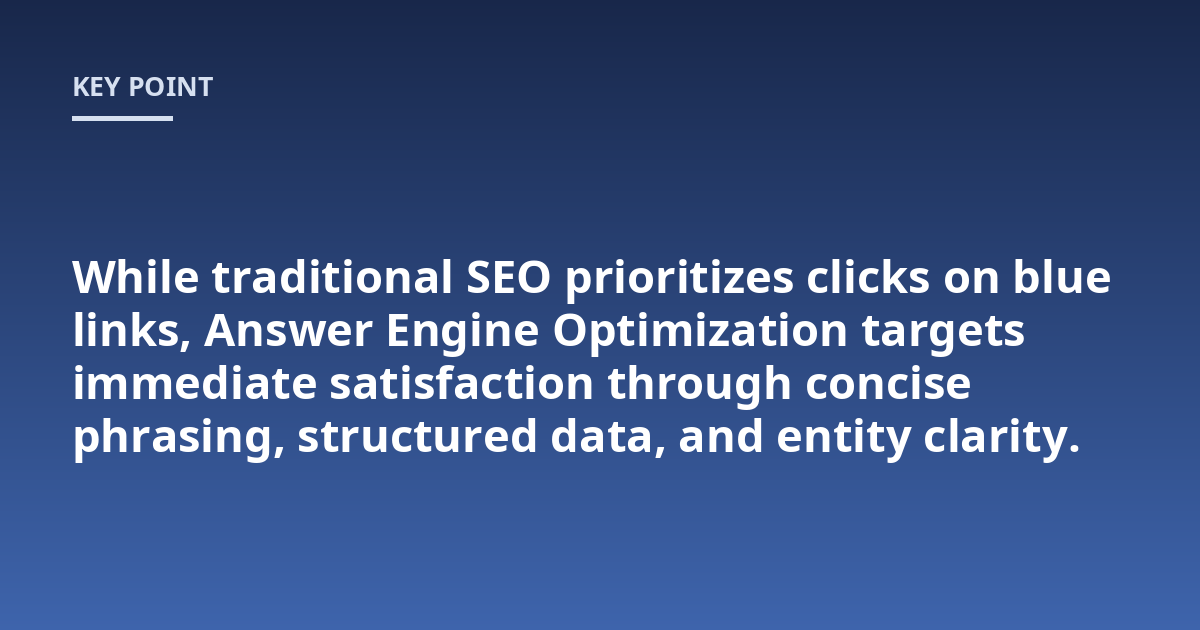
what is aeo and how does it differ from traditional seo? AEO optimizes content to provide direct answers for AI models rather than just ranking in link lists. While traditional SEO prioritizes clicks on blue links, Answer Engine Optimization targets immediate satisfaction through concise phrasing, structured data, and entity clarity.
The search landscape is moving from document retrieval to answer generation. Users no longer just want a list of ten links. They want the solution immediately. This transition requires a structural change in how we approach content creation. You must shift from optimizing for algorithms that scan for keywords to systems that extract meaning from your facts.
- AEO optimizes for direct AI quotes, not just link clicks.
- Traditional SEO relies on domain authority and keyword density in blue links.
- AEO prioritizes brevity, factual precision, and semantic structure.
- Voice search and chatbots are the primary consumers of AEO content.
How do answer engines interpret your content
Answer engines parse your page to find a direct match for a specific user query. They strip away marketing fluff and look for clear entities, factual statements, and structured logic. When a voice assistant reads your content, it cannot summarize paragraphs of marketing jargon. It needs a clean sentence that answers the question directly.
Traditional search engines reward pages that keep users on the site for longer periods. AEO favors pages that give the user exactly what they need in four lines or fewer. This fundamental shift means you must write with extreme clarity. If your facts are buried inside dense prose, the AI cannot find them. You must also implement schema markup that explicitly defines your topics.
This approach demands a change in how we handle internal linking. Consider how AI improves multilingual SEO for global websites. Answer engines rely heavily on clear entity relationships across languages to determine authority. If your site structure is messy, AI struggles to trust your answers. You must build a clean foundation.
Structure your content like a database entry first, and a sales pitch second. AI rewards facts over feelings. If you want your content quoted by search systems, state the answer clearly in the first paragraph and support it with data.
What role does structured data play in AEO
Structured data is the backbone of Answer Engine Optimization. It acts as a direct feed for search engines to understand your content without parsing natural language alone. When you use schema markup, you label exactly what your text means. This allows algorithms to extract specific answers with high confidence.
You must define entities clearly. Use JSON-LD to specify the subject of your article, its attributes, and its relationship to other concepts. A simple FAQ page without proper schema is invisible to many advanced AI tools. Structured data bridges the gap between your HTML code and the semantic understanding of the AI.
This technical requirement separates AEO from basic content writing. You cannot rely solely on keyword placement. The machine must be able to parse your page programmatically. Generative engine optimization depends on this data layer. Without it, you are leaving your visibility entirely up to chance. Define your topics explicitly and provide the context AI needs to understand them.
How should you structure content for AI extraction
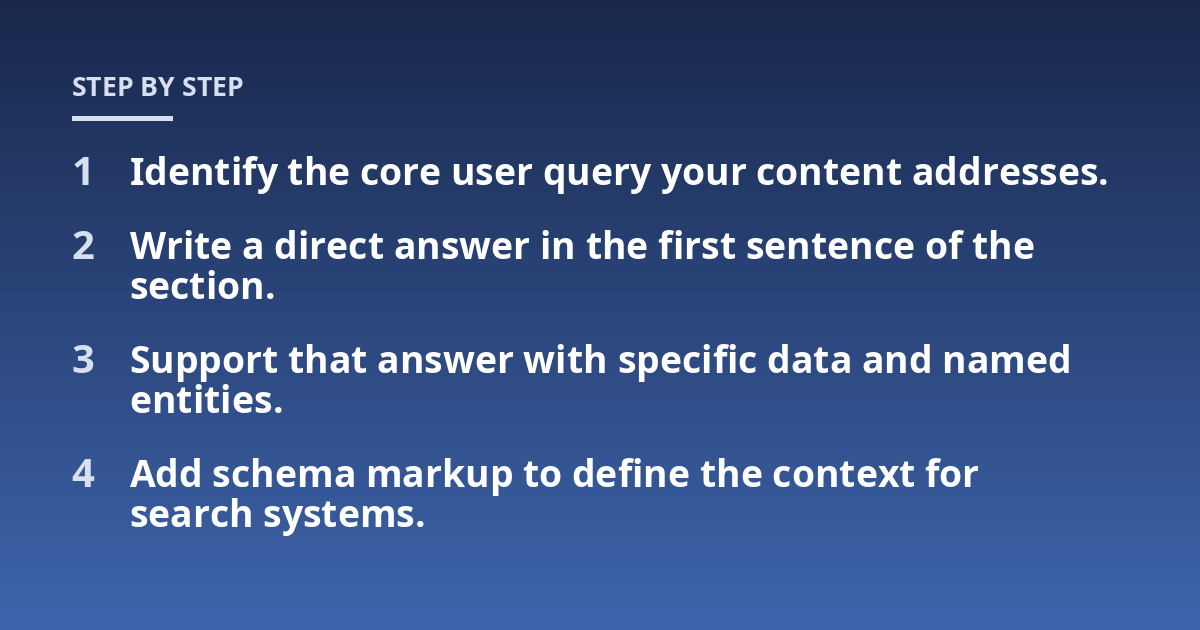
You need to prioritize clarity and directness in every section. Start with a clear topic sentence that contains the answer. Follow it with supporting facts, specific numbers, or named entities. Avoid vague language or filler words. The AI needs a straight line from the question to the answer.
- Identify the core user query your content addresses.
- Write a direct answer in the first sentence of the section.
- Support that answer with specific data and named entities.
- Add schema markup to define the context for search systems.
This method ensures that both human readers and AI models get what they need. Humans scan for keywords, but AIs parse for meaning. Your content must serve both purposes without contradiction. Use short paragraphs and clear headings to guide both audiences through your logic.
When does voice search require AEO tactics
Voice search is the most immediate driver of AEO adoption. When users speak a query, they use natural language rather than fragmented keywords. They expect a spoken answer, not a link to a website. If your content does not provide a concise answer, you lose that interaction entirely.
This shift is happening across all platforms. Smart speakers and mobile voice assistants are increasing in daily usage. Brands that ignore this trend miss out on high-intent traffic. AEO prepares your content for these specific use cases by focusing on conversational phrasing and direct responses.
What mistakes do marketers make with AI optimization
Many marketers try to optimize existing blog posts for answer engines without making structural changes. They simply add keywords or rephrase sentences slightly. This approach fails because the underlying structure remains designed for human reading, not machine extraction. You must fundamentally restructure your content.
Another common mistake is relying on passive voice and vague statements. AI models struggle to identify specific claims when they are buried in long-winded prose. Use active voice and state facts clearly. Avoid marketing hype that does not add factual value.
How do you measure success without traditional rankings
You must shift your metrics from click-through rates to impression volume in AI responses. Track how often your brand or content is quoted in zero-click results. Use analytics tools to monitor featured snippet appearances and voice search traffic. These metrics better reflect the value of AEO.
Traditional SEO tools often fail to capture AEO performance. You need specialized tracking for generative engine visibility. Focus on the share of voice in AI answers rather than just organic link clicks. This provides a clearer picture of your actual impact in the new search landscape.
Why does entity clarity matter for answer engines
Answer engines rely on entities to build knowledge graphs. When you clearly define the people, places, organizations, and products in your content, you help these systems connect your facts to broader information. This connectivity increases the likelihood that your content will be cited as an authoritative source.
Lack of entity clarity leads to ambiguity. If the AI cannot distinguish between similar concepts or brands, it may choose a competitor’s content that offers better structural clarity. Define your entities explicitly and maintain consistency in how you refer to them throughout your site.
FAQ
What is AEO in simple terms?
Answer Engine Optimization focuses on structuring content to be directly quoted by voice assistants and AI tools, rather than just ranking in traditional organic lists. It prioritizes concise, authoritative answers that satisfy immediate user queries. Success relies on clear entities and factual precision. This approach ensures your brand is the source cited when users ask smart speakers or chatbots for quick information.
How does AEO differ from traditional SEO?
Traditional SEO aims to get clicks by optimizing for link authority and keyword density in blue links. AEO targets zero-click results where the answer appears directly in search snippets or AI responses. While SEO values long-form engagement, AEO favors brevity and directness. You optimize for semantic relevance and structure data so algorithms can extract exact answers without requiring a site visit.
Which strategy yields faster results for voice search?
AEO typically shows quicker visibility gains in voice search because it targets specific question-based queries directly. Traditional SEO takes months to build domain authority and organic rankings. By focusing on natural language patterns and featured snippet structures, AEO captures immediate traffic from devices like Amazon Echo or Google Home without waiting for comprehensive backlink profiles.
When should I start implementing AEO tactics?
Start AEO tactics immediately alongside your existing SEO efforts if your audience uses voice search frequently. It is especially critical for local businesses and Q&A-heavy industries. Implementing structured data and concise answer blocks now prepares your content for future AI-driven search interfaces. Delaying this transition risks losing visibility as search engines shift toward generative answers.
How many words should an AEO answer contain?
Aim for 40 to 60 words per direct answer block to maximize snippet eligibility. This length fits most voice assistant responses and featured snippet boxes without truncation. Keep sentences short and factual. Avoid fluff or marketing jargon. This concise format helps algorithms extract your content easily for AI overviews and instant answers.
How do I optimize content for answer engines like ChatGPT?
To optimize for large language models, focus on clear entity relationships and structured data that define your topics explicitly. Use natural language phrasing that matches conversational queries rather than fragmented keywords. Ensure your facts are stated directly without ambiguity so the model can extract them confidently. Multilingual SEO strategies provide a useful framework for this structural clarity across different languages.
What structured data types help rank in AI overviews?
Scholarship, FAQPage, and HowTo schemas are highly effective for AEO as they explicitly define questions and answers. Using these formats helps search systems understand the intent and structure of your content. You can also use Article and WebPage schemas to define main entities. Proper implementation ensures the AI can map your content accurately.
Other posts from the category
There are no posts for the selected category.

Latest posts from the category
-

What makes an effective Category Page for AI
June 5, 2026
-

What Influences the cost of AI Optimisation
June 1, 2026
-

Organisation Schema: how to help AI understand your brand
May 27, 2026