
The Future of Search: Navigating AI, SGE, and Zero-Click Results
July 3, 2026
Category:
Uncategorized
The future of search involves a fundamental shift from traditional link-based clicks to an ecosystem dominated by generative AI summaries and zero-click answers. To maintain visibility, brands must optimize for direct answers within AI Overviews (SGE) while focusing on being cited as authoritative sources within LLM responses rather than just chasing organic traffic through blue links alone.
The transition from a library of links to an engine of answers is the most significant change in search technology since the introduction of mobile. As Google integrates Generative Search Experience (SGE) and other models like Perplexity or become more pervasive, the traditional SEO playbook, based heavily on keyword density and blue-link rankings, is becoming obsolete. Marketers now face a paradox: while users may click fewer links because they find answers directly on the SERP, the value of being that cited “answer” has never been higher.
- Prioritize brand citations and entity recognition over mere keyword rankings to survive AI Overviews.
- Optimize for information gain by providing unique data, personal experience, or proprietary insights that LLMs cannot replicate.
- Shift measurement frameworks from traditional CTR toward “Share of Voice” within generative summaries and LLM responses.
How is Generative AI fundamentally changing search intent?
Generative AI shifts the focus of search from information retrieval to information synthesis. In a traditional search, a user asks for a list of options; in an AI-driven search, they ask for a synthesized conclusion based on those options. This means that your content must do more than just exist; it must provide the specific “building blocks” of logic and data that an AI needs to build its answer.
Historically, SEO was built around matching a user’s query to a specific webpage. Now, users are engaging in multi-turn conversations with search engines. They might start by asking, “What is the best way to grow a B2B SaaS company?” and follow up with, “How much does that cost per month?” This conversational depth requires content that maps to entire topical clusters rather than isolated keywords. You can no longer rely on single-page optimization; you must own the topic through a complex web of interrelated entities.
From querying to conversing
In practice, we have observed that users are increasingly treating search engines like assistants. They want nuances, comparisons, and immediate conclusions. This transition means your content needs to be structured in a way that is “digestible” for both humans and machines. If you only provide high-level overviews without the granular data points required for an AI to synthesize a specific answer, you will likely lose visibility to competitors who do.
The rise of long-tail conversational queries
As voice search and mobile usage continue to evolve alongside LLMs, the “long tail” is becoming the main event. Users are not just typing “SEO services”; they are asking, “What are the best SEO services for a mid-sized healthcare provider in New York?” The complexity of these queries increases significantly. This shift rewards companies that have deep, niche authority and a high degree of topical coverage.
Why are zero-click results becoming more common?
Zero-click searches occur when the search engine provides a definitive answer directly on the result page, satisfying the user’s intent without requiring a single click to a website. This trend is accelerating because AI models can now pull fragments of information from various sources and combine them into a single, coherent paragraph. For informational queries, this effectively removes the need for a “next step” in the user journey.
The reality is that Google is attempting to keep users within its ecosystem by providing instant gratification. While this reduces total organic traffic for many websites, it creates a new opportunity for those who can position their brand as the source of that instant answer. Understanding which types of queries are most susceptible to zero-click results is essential for any marketing budget allocation.
| Feature | Traditional Search (Blue Links) | AI-Powered Search (SGE/LLM) |
|---|---|---|
| Primary User Intent | Navigation and exploration of links | Direct answer and synthesis |
| Top Performing Content | Synthesized summaries and entity-rich facts | |
| Core SEO Metric | Click-Through Rate (CTR) | Brand Mentions and Citation Frequency |
| Optimization Focus | Keywords and Backlinks | Information Gain and Entity Association |
What are the best strategies for ranking in SGE?
Ranking in Google’s Search Generative Experience (SGE) requires a shift from “optimizing for words” to “optimizing for entities.” An entity is a well-defined concept, person, place, or thing that search engines understand through relationships. If your brand is not clearly defined as an authority within its specific entity cluster, the AI will likely skip over you when generating summaries.
Technical precision is non-negotiable in this new era. It is no longer enough to have a good blog; you must have structured data that explains exactly what your content represents. If you want Google’s AI to recommend your product or service, your schema markup must be flawless. For example, if you are discussing software, your SoftwareApplication schema needs to clearly define features, pricing models, and user reviews so the AI can extract these specific data points for a comparison table.
In practice, focus on “Information Gain.” This is the principle that search engines will prioritize content that provides something new or different from what already exists in their training set. If your article simply rewords what is already at the top of page one, you are effectively providing zero value to an AI model and will be ignored.
To maximize visibility, ensure your site’s technical foundation is solid. Managing index bloat is critical; if your crawl budget is being wasted on low-value pages, search engines may fail to discover the deep, authoritative content that actually drives SGE citations. You should regularly check for issues such as canonical tags explained avoiding index bloat to ensure that your most valuable assets are prioritized.
Is “Information Gain” the new SEO gold standard?
Information gain refers to the added value a piece of content provides beyond what is already available in the existing search landscape. In an era where AI can generate decent-quality, generic articles in seconds, being “good” is no longer enough to win. To rank in an AI-driven world, you must be “unique.”
What does this look like in a real-world scenario? It means including original research, unique case studies, expert interviews, or proprietary data that cannot be found elsewhere. If an LLM can synthesize your entire article by just looking at three other competitors, it has no reason to cite you. However, if you provide a specific, measured outcome, such as “We increased organic traffic by 22% using this specific technical audit approach”, that becomes a unique data point the AI can reference.
One common mistake is producing content that is essentially a rewrite of existing high-ranking pages. This is often referred to as “SEO fluff.” While it may help with keyword density, it fails the information gain test. To avoid this, ask your editorial team: “If someone reads this article, will they know something they couldn’t have found in two other articles?” If the answer is no, you are not ready to publish.
Optimizing for LLMs and Generative Engine Optimization (GEO)
Beyond Google’s SGE, we must also consider “Generative Engine Optimization” (GEO). This refers to optimizing your digital presence so that models like, Perplexity, and Claude mention your brand when users ask them questions. Unlike traditional SEO, which is heavily focused on structure and crawling, GEO is about being part of the training data or the retrieval-augmented generation (RAG) process.
LLMs don’t “crawl” in the same way Google does; they rely on patterns and statistical associations. To be cited by an LLM, your brand needs to be mentioned frequently alongside specific high-intent keywords across a variety of authoritative platforms, not just your own website. This is why PR and off-site authority are becoming even more critical. Your presence in industry news, niche forums (like Reddit or specialized professional boards), and major publications acts as the “evidence” these models use to verify your brand’s legitimacy.
During a site audit, it is vital to ensure that you aren’t creating internal conflicts that confuse these models. For instance, if you have significant duplicate content how to find and fix it issues across different regional subdomains, an AI model might fail to associate your brand with the correct service area or niche authority.
How should we measure success in a zero-click world?
The death of the traditional click does not mean the death of organic growth; it means the evolution of marketing metrics. If users get their answers on the SERP, your “Total Organic Clicks” may drop even as your brand’s influence increases. To understand if your SEO strategy is working in the AI era, you need to look at new indicators of success.
First, monitor “Brand Mentions” and “Share of Voice” within generative responses. While this is more difficult to track with standard tools, emerging platforms are beginning to offer insights into how often your brand appears as a cited source in AI-driven summaries. Second, pay close attention to the quality of traffic that *does* click through. If users arrive at your site after seeing an AI summary, they have already had their initial question answered. This “high-intent” traffic should theoretically convert at a much higher rate than traditional top-of-funnel visitors.
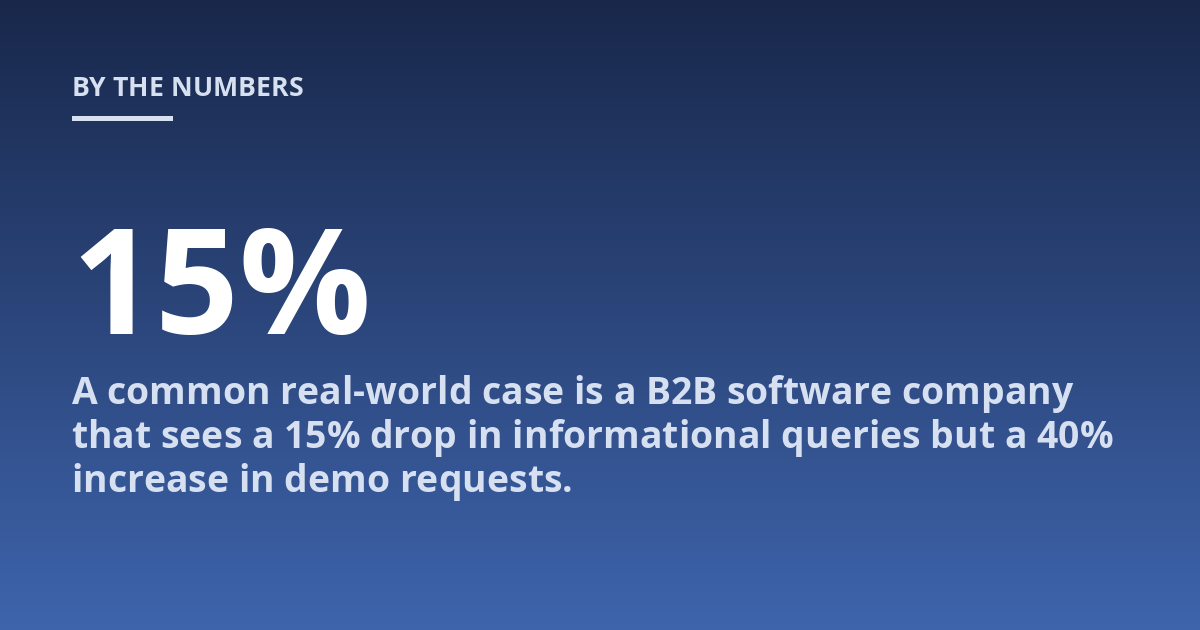
A common real-world case is a B2B software company that sees a 15% drop in informational queries but a 40% increase in demo requests. This occurs because the AI handles the “what is” and “how to” questions, leaving only the high-value, decision-oriented users to click through to the website.
FAQ
What is important to know about The Future of Search: AI, SGE, and Zero-Click Results?
The most critical aspect is that visibility is shifting from a list of links to a battle for citations within generative summaries. Brands must transition from simply targeting keywords to building high authority through entity association. You should prepare for a world where being the “source” mentioned by an AI assistant is just as valuable, if not more so, than earning a blue-link click.
When should you consult with an SEO expert about AI search changes?
You should seek professional consultation when your organic traffic shows a sudden decline in high-intent pages or when your brand’s presence in generative summaries seems non-existent despite strong traditional rankings. Early assessment of how AI is interpreting your site’s entities can prevent significant loss in visibility as Google rolls out more aggressive SGE features across different regions.
How should you prepare for a strategic review of your search performance?
Preparation involves gathering data on your current brand mentions, measuring the “Share of Voice” for your core keywords in generative engines, and auditing your technical schema markup. Having a clear view of which queries are currently resulting in zero-click answers versus clicks will help you determine whether to pivot toward informational or transactional content strategies.
What risks or limitations can AI-driven search results have?
The primary risks include the “hallucination” of information if your site’s data is not clearly structured, and the potential for zero-click results to cannibalize your top-of-funnel traffic. depending on how an LLM synthesizes information, it may misattribute facts or present outdated data if your most authoritative content isn’t indexed effectively by real-time search engines.
Moving toward a new era of visibility
The future of search is not about fighting the rise of AI, but about becoming the engine that powers it. As zero-click results become the norm for informational queries, your strategy must pivot toward providing high-value, unique data and structured entities that AI models can easily digest and cite. This requires a move away from generic content production toward deep, authoritative journalism and technical precision in schema markup.
The most successful brands will be those that view SEO not as a way to drive clicks, but as a way to build a verifiable, unassailable authority within the knowledge graphs of the digital world. If you can provide the “information gain” that search engines crave, you won’t just survive the AI era, you will lead it.
Other posts from the category
There are no posts for the selected category.

Latest posts from the category
-

What makes an effective Category Page for AI
June 5, 2026
-

What Influences the cost of AI Optimisation
June 1, 2026
-

Organisation Schema: how to help AI understand your brand
May 27, 2026