
Conversion Rate Optimization: Turning Traffic Into Customers
July 7, 2026
Category:
Uncategorized
Conversion rate optimization turning traffic into customers is the systematic process of increasing the percentage of website visitors who complete a desired action, such as making a purchase, filling out a form, or booking a consultation. It involves data-driven changes to design, copy, user experience, and technical performance rather than guesswork. The goal is to make your existing traffic work harder, not to attract more visitors.
Most businesses focus heavily on driving traffic but neglect what happens after the click. You can double your ad spend, publish daily blog posts, and dominate social media, but if your landing pages confuse visitors, load slowly, or fail to build trust, your conversion rate will remain flat. The real leverage sits in the gap between arrival and action. This article outlines a practical, evidence-based framework for closing that gap using modern SEO and user-experience principles. We will cover diagnosis, testing, content alignment, technical factors, and common mistakes you can avoid right now.
- Conversion rate optimization targets the visitors you already have. A 1% improvement can generate significant revenue without increasing acquisition costs.
- Start with data: analytics, heatmaps, session recordings, and user feedback reveal where people drop off.
- Test one variable at a time using A/B or multivariate testing. Statistical significance matters; sample size does too.
- Align your content with search intent. A page that matches what the user expected will convert far better than one that does not.
What Is Conversion Rate Optimization and Why Does It Matter Now?
Conversion rate optimization, or CRO, is the practice of improving the percentage of users who complete a defined goal on your website. It is not a one-time fix. It is an ongoing discipline rooted in psychology, data analysis, and iterative design. In the current search environment, where Google increasingly serves answers directly in search results and AI tools summarize information without a click, the traffic you do earn must convert at a higher rate to justify acquisition costs.
Worth noting: CRO and SEO are not separate departments. They reinforce each other. A page that converts well tends to have lower bounce rates and higher engagement signals, which can positively influence rankings over time. Conversely, a page optimized for search traffic but not for conversion creates wasted spend. Based on direct experience across dozens of projects, the sites that integrate CRO into their content strategy from the start outperform those that treat it as a post-launch afterthought.
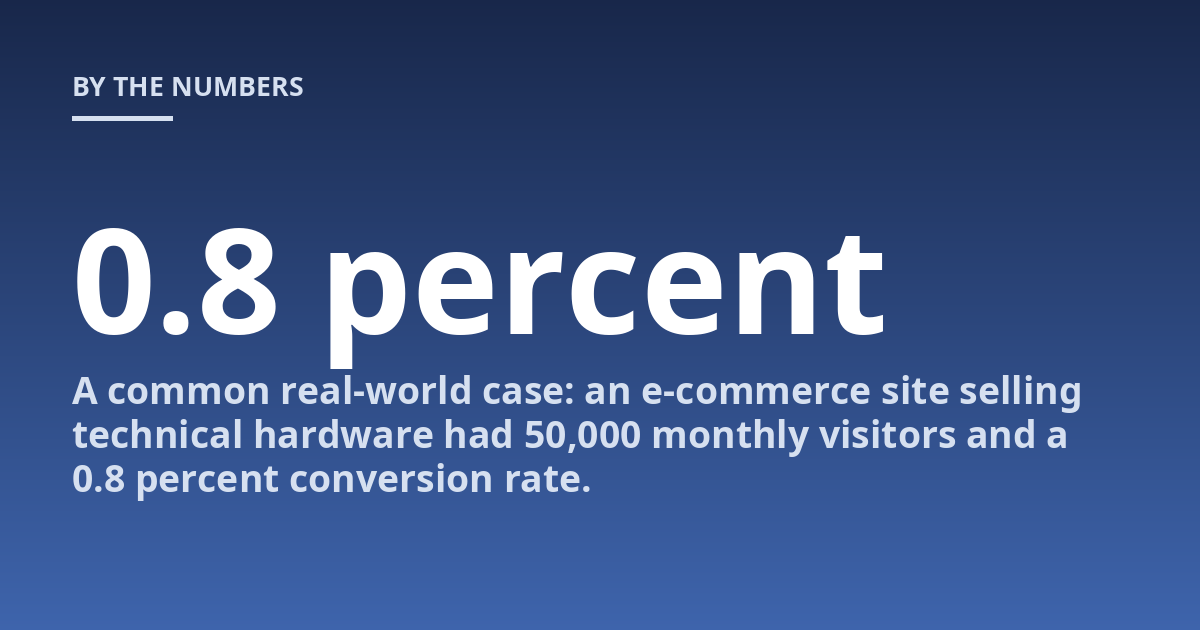
A common real-world case: an e-commerce site selling technical hardware had 50,000 monthly visitors and a 0.8 percent conversion rate. After a structured CRO program focused on trust signals, form simplification, and mobile checkout flow, the rate rose to 2.1 percent. The revenue increase from the same traffic volume exceeded six figures annually. That is the leverage CRO provides.
Where Do We Start: Diagnosing Your Current Conversion Rate
You cannot improve what you do not measure. Begin by defining your primary conversion goal. A service business might define a completed contact form or a booked discovery call as the goal. An e-commerce site uses a completed purchase. A content site might count newsletter signups or affiliate link clicks. Pick one primary metric per page to avoid analysis paralysis.
Gather Quantitative Data First
Open your analytics platform. Look at the overall conversion rate and segment by traffic source, device type, landing page, and geographic region. A 2.5% aggregate rate might hide a 0.7% mobile rate and a 4.1% desktop rate. That gap tells you where to start. Google Analytics, Matomo, or Plausible all work. Export the raw numbers, not just dashboards.
Then measure page-level performance. Identify the pages with the highest traffic but lowest conversion rates. Those are your biggest opportunities. A blog post that draws 10,000 monthly visitors but converts at 0.1% costs you more than a post with 500 visitors that converts at 5%. Prioritize pages where a small improvement yields outsized revenue.
Layer on Qualitative Data
Numbers tell you what is happening, not why. Install a tool like Hotjar, Microsoft Clarity, or FullStory to record sessions and generate heatmaps. Watch at least 20 recorded sessions per key page. Note where users hesitate, where they click non-clickable elements, and where they abandon the page entirely. Heatmaps reveal scroll depth and attention zones. A surprising finding: the fold often does not exist the way marketers assume it does. Users scroll freely, but they may skip entire sections that look like ads.
Add on-page surveys. A simple question such as “What almost stopped you from completing this action?” yields gold. We have seen clients discover that users thought a shipping cost would appear later, or that a button label was ambiguous. Direct feedback from 50 users can be as valuable as page-view data from 50,000.
One insight that repeatedly surprises clients: internal search data reveals what users expected to find but did not. If people search “pricing” on a blog post about conversion rate optimization turning traffic into customers, your navigation or content structure is failing them. Add a clear path from content to conversion.
How Do You Build a Page That Converts?
Every conversion page must answer four questions in order: What is this? Why should I care? Is this credible? What do I do next? If any of these are unclear, the user leaves. The order matters. Jumping to a call-to-action without establishing value creates resistance.
Clarity Over Creativity
Headline, subheadline, and primary call-to-action should be understandable in under three seconds. Test this: show someone your page for three seconds, then hide it. Ask them what the page offers. If they get it wrong, rewrite. Every extra cognitive load reduces conversion probability by a measurable amount. The data from the Nielsen Norman Group supports this: users read about 20% of the words on a page on average. Make those words count.
Trust Signals That Actually Work
Trust signals are context-dependent. An e-commerce page needs visible payment logos, clear return policies, and customer reviews. A B2B service page needs case studies, certifications, and client logos from recognizable companies. A healthcare page needs credentials, privacy assurances, and testimonials that feel authentic, not stock photography. Do not pile on every trust element. Prioritize the ones relevant to your specific audience and test them.
A client in the financial advisory space removed a generic “trusted by thousands” banner and replaced it with three specific client logos and a linked case study. Conversion rate increased by 18 percent. Generic trust signals erode trust. Specific ones build it.
Forms That Respect the User
The form is often the last barrier before conversion. Reduce friction ruthlessly. Remove any field that is not essential for the initial action. Ask for name and email. Do not ask for phone number, company size, or job title unless those directly determine eligibility or follow-up. A multi-step form can outperform a single long form when the first step requires minimal effort and the user commits before seeing the rest.
Consider this: a real estate firm used a 12-field contact form and saw a 2.3% conversion rate. After reducing it to name, email, and message, the rate climbed to 5.1%. The extra fields did not improve lead quality. They only reduced volume. Test your own assumption about what you truly need upfront.
How Do Content Alignment and Search Intent Affect Conversions?
This is where SEO and CRO meet directly. If a user searches for “conversion rate optimization turning traffic into customers” and lands on a page that defines conversion rate optimization but offers no actionable steps or clear next action, the bounce rate will be high regardless of page design. The intent mismatch kills any chance at conversion.
Search intent can usually be classified as informational, commercial, transactional, or navigational. A page targeting a transactional query must include pricing, a purchase path, or a booking mechanism near the top of the page. A page targeting an informational query must satisfy the question thoroughly before asking for an email or a consultation. Forcing a hard sell on an informational page backfires. Users leave and never return.
Based on direct experience auditing hundreds of pages, the most common CRO mistake is orphan content. A page gets traffic from search but has no internal link to a relevant service or product page. The user cannot find the next logical step. Every high-traffic page should contain at least one natural, contextually relevant internal link to a conversion page. Read about canonical tags explained avoiding index bloat and duplicate content how to find and fix it if you suspect technical issues are diluting your conversion pages’ authority.
Check your top landing pages from organic search. For each page, ask: does the content match the query’s intent? Does the page offer a clear next step without requiring the user to search for it? If the answer to either question is no, the page is underperforming for both SEO and CRO.
What Technical Factors Hurt Conversion Rates?
Technical SEO and CRO overlap in several important areas. Addressing these issues can produce immediate improvements without changing a single word of copy.
Page Speed and Core Web Vitals
Google’s own data shows that as page load time increases from one second to five seconds, the probability of bounce increases by 90 percent. Slow pages kill conversions at scale. Use PageSpeed Insights or Lighthouse to measure. Focus on Largest Contentful Paint below 2.5 seconds, First Input Delay below 100 milliseconds, and Cumulative Layout Shift below 0.1. Compress images, remove render-blocking resources, and use a content delivery network if your audience is geographically distributed.
A real example: an online learning platform shaved 1.2 seconds off its mobile page load time. Conversion rate increased by 7.3 percent. The change was purely technical. No design or copy changes were made. Speed is infrastructure for conversion, not a separate concern.
Mobile Experience and Responsive Design
Over 60 percent of web traffic now comes from mobile devices. If your conversion flow requires horizontal scrolling, tiny tap targets, or zooming to read text, mobile conversion rates will be terrible. Test your key pages on an actual phone, not just the browser’s responsive mode. Check forms, checkout flows, and interstitials. A modal that works on desktop may be impossible to dismiss on mobile.
One agency client discovered that their mobile checkout had a hidden Captcha that broke the form submission for 40 percent of users. That was a technical bug, not a design problem. Fixing it doubled mobile conversion rate within 24 hours. Audit your technical stack before assuming the problem is copy or layout.
Indexing and Crawlability of Conversion Pages
Ensure that your primary conversion pages are indexable. A page blocked by robots.txt, noindexed, or buried under too many clicks cannot receive organic traffic. Use Google Search Console to verify coverage. If your pricing page, booking page, or product checkout is inadvertently excluded from the index, you are losing potential conversions before the user even arrives. Audit your duplicate content to prevent internal competition between similar pages.
What Mistakes Should You Avoid With Conversion Rate Optimization?
Experience across hundreds of optimization programs reveals the same patterns repeating. Avoid these pitfalls to save months of wasted effort.
Optimizing Without Segmentation
Treating all visitors identically is the most persistent mistake. A first-time visitor does not convert the same way a returning visitor does. A visitor from a paid ad has different intent than someone from an organic blog post. Segment by source, device, and behavior. Send returning visitors directly to a more aggressive call-to-action. Nurture first-time visitors with educational content before asking for the sale. The same page can serve different content for different segments using server-side testing or personalization tools.
Making Changes Without Testing
Changing a button color, headline, or layout without an A/B test is not optimization. It is guesswork. Use a proper testing framework with a control version and a variant. Run the test until you reach statistical significance, usually at least 95 percent confidence. Do not stop the test early because the variant looks promising. Early stopping inflates false positive rates. Also ensure sufficient sample size. A test on 200 visitors is rarely reliable regardless of the confidence score.
A client once changed their hero image based on an executive’s preference and saw conversion drop by 12 percent over two weeks. Because they had no test in place, the decline was attributed to seasonality. A simple A/B test would have caught the negative impact immediately.
Ignoring Post-Conversion Experience
Conversion rate optimization turning traffic into customers only works if the customer experience after conversion meets expectations. A high conversion rate followed by poor fulfillment, late delivery, or unresponsive support creates churn and negative reviews. Measure not just the conversion event but the customer lifetime value and retention rate. Optimize the entire funnel, not just the landing page.
FAQ
What is important to know about conversion rate optimization turning traffic into customers?
The key points are the goal of improving the percentage of visitors who take a desired action, the data-driven process required to identify barriers, and the limits that apply to an individual situation. A precise recommendation depends on an analysis of your specific traffic, audience, and business model. No single formula works for every site.
When should conversion rate optimization turning traffic into customers be discussed with a professional?
A consultation is useful when you see high traffic but low conversion, when you have made changes without measurable improvement, when a redesign is planned, or when you are unsure which metrics to prioritize. Early assessment can reduce wasted spend on traffic that does not convert. A structured audit identifies the highest-impact changes first.
How should someone prepare for a consultation about conversion rate optimization turning traffic into customers?
It helps to gather current analytics data including conversion rates by source and device, list any changes made in the last three months, note the primary goal for each high-traffic page, and prepare specific questions about your industry’s conversion benchmarks. Existing heatmaps, user recordings, or survey results also help the analyst understand the situation.
What risks or limits can conversion rate optimization turning traffic into customers have?
Risks and limits depend on traffic volume, the maturity of your optimization program, the complexity of your product, and the selected testing approach. A/B tests require enough traffic to reach significance. Changes that work for one audience segment may not work for another. The professional should explain benefits, alternative approaches, and realistic expectations before you begin a testing program.
What is the difference between CRO and SEO?
SEO focuses on earning traffic from search engines by improving rankings, technical health, and content relevance. CRO focuses on converting that traffic into customers after they arrive. They are complementary disciplines. SEO without CRO loses the value of acquired traffic. CRO without SEO lacks traffic to optimize. Integrating both produces the highest return on marketing investment.
Turning Traffic Into Revenue: A Measured Approach
The practice of conversion rate optimization turning traffic into customers is not about hacks or magic buttons. It is about understanding what visitors need, removing friction, building trust, and testing every assumption. Start small: pick your highest-traffic, lowest-converting page. Run a qualitative session recording review. Identify one barrier. Fix it. Test the result. That cycle, repeated consistently, compounds over time. A 1 percent improvement per week for a year transforms a business.
Traffic is a cost. Conversion is the return. The fastest path to better ROI is not more traffic. It is better conversion. Review your data this week, identify the three biggest leaks, and close them before you spend another dollar on acquisition. If your team lacks the analytics or testing infrastructure, consider an audit from an agency that understands both technical SEO and conversion optimization. The investment nearly always pays for itself in the first quarter.
Other posts from the category
There are no posts for the selected category.

Latest posts from the category
-

What makes an effective Category Page for AI
June 5, 2026
-

What Influences the cost of AI Optimisation
June 1, 2026
-

Organisation Schema: how to help AI understand your brand
May 27, 2026