
SEO Content Briefs: How to Brief Writers for Rankings
July 7, 2026
Category:
Uncategorized
SEO content briefs are structured documents that tell writers exactly what to cover, who to cite, how to structure an article, and which keywords to target so the final piece has a strong chance of ranking in Google and appearing in AI-driven search features like AI Overviews. A good brief is the difference between content that drifts and content that earns visibility.
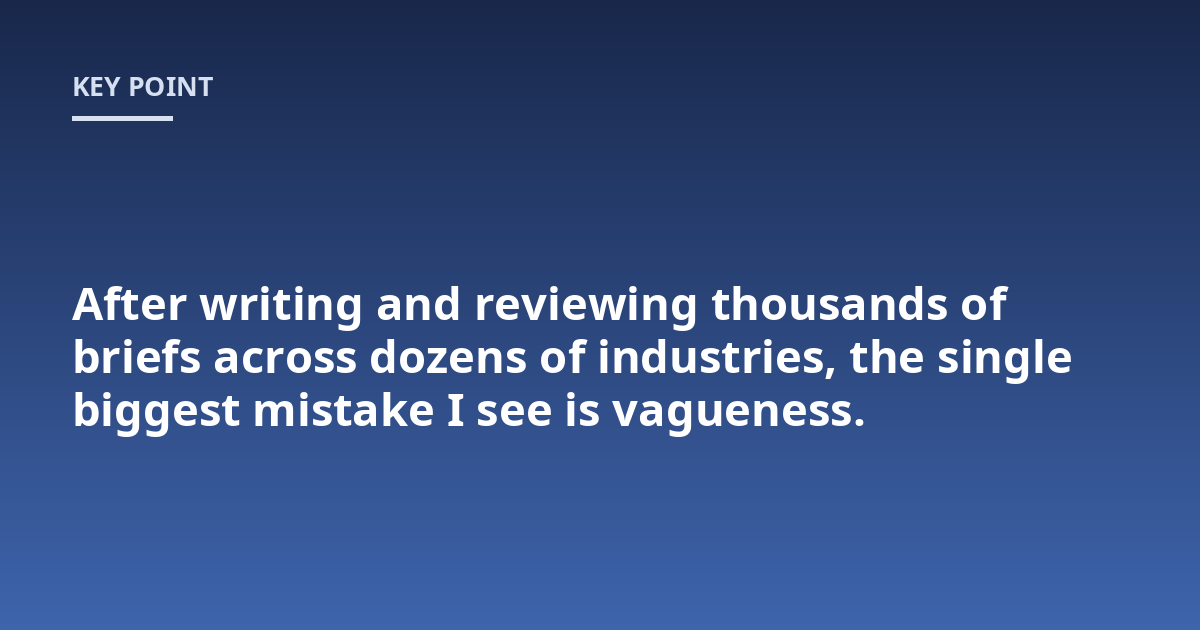
After writing and reviewing thousands of briefs across dozens of industries, the single biggest mistake I see is vagueness. Telling a writer to “write about keyword research” or “cover the basics of SEO” produces generic fluff that search engines have no reason to surface. The most effective briefs treat the writer as a capable partner who needs constraints, not inspiration. You provide the research, the angle, the sources, and the structure. The writer fills in the prose. That division of labor is what scales content production without sacrificing quality.
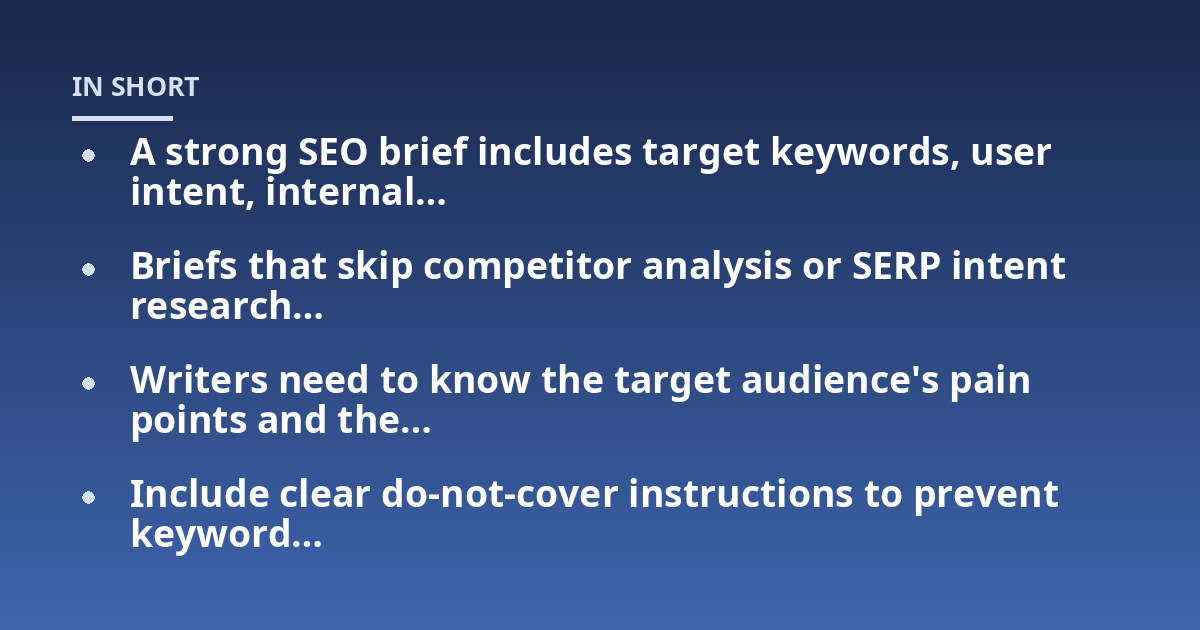
- A strong SEO brief includes target keywords, user intent, internal linking candidates, a recommended structure with word counts per section, and at least one authoritative source the writer must cite.
- Briefs that skip competitor analysis or SERP intent research typically produce content that ranks on page three or lower.
- Writers need to know the target audience’s pain points and the specific question each section answers, not just a topic title.
- Include clear do-not-cover instructions to prevent keyword cannibalization and content drift.
What Must an SEO Content Brief Include for Rankings?
A brief that produces ranking content must contain seven core elements. Without any one of them, the quality of the final piece degrades noticeably.
Keyword Universe and Intent Classification
List the primary keyword, secondary keywords, and long-tail variations. More importantly, classify each keyword by search intent. Informational keywords like “how to check duplicate content” need explanatory sections with step-by-step instructions. Commercial keywords like “best SEO content automation agency” need comparison tables and trust signals. Transactional keywords go near the call-to-action. A writer who does not know the intent will choose the wrong tone and structure.
Target Audience Definition
State who the reader is and what they already know. For a piece targeting business owners, the brief should note that the reader cares about ROI and timelines, not algorithm technicalities. For a piece targeting technical SEOs, the brief should specify that the reader understands canonical tags, redirect chains, and index bloat. I have seen briefs fail because the writer wrote for beginners while the search results all assumed intermediate knowledge.
The single most effective addition to any brief is a link to the top three ranking pages with a note on what they cover well and what they miss. This tells the writer exactly where to add original value that can push your page above the competition.
How Do You Research Competitor Gaps for a Content Brief?
Open the SERP for your target keyword. Look at the top five organic results. Note the format of each result. Are they listicles, guides, opinion pieces, or data-heavy reports? Note the word count range. Note the sources they cite. Then look for what none of them cover. A common gap is missing practical examples, missing alternative approaches, or missing a decision framework that helps the reader choose between options.
For example, if you are briefing an article on duplicate content how to find and fix it, the top results may explain what duplicate content is and how to use canonical tags. But they rarely explain how to prioritize which duplicate pages to fix first based on traffic impact. That gap becomes the unique value of your article.
Build the Structure from the Gap
Take the gap and turn it into a dedicated H2 or H3 section. That section should appear earlier in the article than the competitor content suggests. Google’s ranking systems reward pages that answer user questions more directly and more completely than other pages. A section that fills a clear information gap signals relevance and thoroughness.
What Is the Right Level of Detail in a Brief?
The brief should be specific enough that two different writers could produce similar articles, but not so prescriptive that the writer has no room for judgment. A good rule of thumb is to include an outline with suggested word counts per section, three to five sources the writer must cite, and the specific question each section must answer. Do not write the section text yourself. That defeats the purpose of a brief.
Bad example: “Write about on-page SEO.”
Good example: “H2: How to Optimize Title Tags for Clicks and Rankings. Word count: 300-400 words. Key points: title tag length, placement of primary keyword, differentiation from H1. Must cite Moz or Google Search Central. Answer this question: ‘What is the right title tag format for a blog post targeting commercial intent?’ Include a table comparing CTR data for different title formats.”
Based on direct experience, briefs that include a single data point per section, such as a statistic or a benchmark, consistently produce articles with higher factual density. Writers use that number as a hook and build context around it. That creates natural relevance signals.
How Do You Handle Internal and External Links in a Brief?
Every brief should specify the anchor text and target URL for at least two internal links. This prevents the writer from guessing which pages to link to and ensures the article supports your site’s topic clusters. For example, if your article covers content briefs, you might include Voice Search Optimization in the Age of AI Assistants: A Strategic Guide with anchor text “duplicate content how to find and fix it” linking to your article on that subject. You might also include Conversion Rate Optimization: Turning Traffic Into Customers with anchor text “canonical tags explained avoiding index bloat” linking to your pillar page on canonicalization.
External links are equally important for E-E-A-T signals. Specify one to three authoritative domains the writer must cite. Government health sites, academic publishers, and industry bodies like the Search Engine Land or Google’s own documentation work well. Avoid instructing the writer to link to random blogs or low-authority sources. That damages trust.
What Mistakes Do Most Briefs Make?
The most common mistake is writing a brief that reads like a content outline rather than a strategic document. A brief is not just a list of headings. It is a decision document that captures the research, the intent analysis, and the competitive positioning. Without that strategic layer, the writer has no reason to choose one angle over another.
A close second is skipping the do-not-cover section. If your site already has a strong article on a subtopic, tell the writer not to cover that subtopic in detail. Otherwise you create keyword cannibalization. For example, if you already rank well for canonical tags explained avoiding index bloat, your brief for a new article should say: “Do not explain canonical tags in depth. Link to Conversion Rate Optimization: Turning Traffic Into Customers instead and only summarize the concept in two sentences.”
Word Count as a Constraint, Not a Target
Setting a word count without analyzing the SERP is another recurring mistake. If the top-ranking pages average 2,000 words, your brief should target 2,200 to 2,500 words. But the extra words must add value, not fluff. The brief should specify where the extra coverage goes. That might be a longer comparison table, a step-by-step walkthrough, or a dedicated FAQ section.
FAQ
What is important to know about SEO Content Briefs: How to Brief Writers for Rankings?
The key points are the goal of the brief, the expected output quality, and the limits that may apply to an individual project. A precise brief depends on thorough SERP analysis and a clear understanding of the target audience. Without those two inputs, the brief cannot reliably produce ranking content. The best briefs also include specific do-not-cover instructions to prevent cannibalization.
When should SEO content briefs be discussed with a professional?
A consultation is useful when you are launching a new topic cluster, expanding into a competitive niche, or seeing declining rankings on previously strong articles. Early brief review can reduce the chance of publishing content that competes with your own pages or misses critical ranking factors. If your team has no experience with SERP analysis or keyword intent, a professional review is strongly recommended.
How should someone prepare for a consultation about SEO Content Briefs?
It helps to have the target keyword list, the current ranking positions of your existing content, and the top five competitor URLs for each primary keyword. Bring examples of briefs your team has used before, even if they produced weak results. That gives the consultant a concrete basis for improvement recommendations. Existing Google Search Console data is also valuable.
What risks or limits can SEO content briefs have?
Risks include keyword cannibalization when briefs lack do-not-cover instructions, low-quality output when briefs are too vague, and missed ranking opportunities when briefs skip competitor gap analysis. The professional should explain how to validate a brief before handing it to a writer, including a quick check of the SERP to confirm the intended angle still matches current ranking patterns.
How do you measure if a brief produced ranking content?
Track the published article’s position for the primary keyword at week 2, week 4, and week 8. If the article does not appear in the top 20 results by week 4, the brief likely missed the intent or the gap analysis was weak. Compare the article’s structure and depth against the top-ranking pages. The difference in coverage is usually visible within the first 1,000 words.
Conclusion
An SEO content brief is not a luxury. It is the single most cost-effective investment you can make in your content operation. A well-researched brief turns a good writer into a great one and prevents the expensive cycle of publish, underperform, revise. Start each brief with the SERP gap, define the audience, specify the internal links, and include a do-not-cover list. That framework alone will lift your content above most of what is published today. If you want to accelerate the process, consider automated brief generation tools that ingest SERP data and produce structured outlines. But never skip the human review step. A machine can find gaps. Only an experienced strategist can decide which gap is worth filling. The most reliable approach here is usually simple: invest more time in the brief than in the editing pass. That shift in effort changes everything.
Other posts from the category
There are no posts for the selected category.

Latest posts from the category
-

What makes an effective Category Page for AI
June 5, 2026
-

What Influences the cost of AI Optimisation
June 1, 2026
-

Organisation Schema: how to help AI understand your brand
May 27, 2026