
How to Structure Data for FAQ and How-To Rich Results

August 18, 2026
Category:
Uncategorized
You structure data for faq and how-to rich results by implementing JSON-LD with specific Schema.org types on your website pages. You add FAQPage schema for question-answer pairs and HowTo schema for step-by-step guides. This structured markup allows search engines to display interactive answer panels directly in the search listings.
The landscape of organic search is shifting rapidly toward direct answers and automated content summaries. If your pages do not provide clear, machine-readable instructions, you miss visibility in these prime positions. Most SEO professionals fail because they treat structured data as a technical afterthought rather than a core content strategy element. We have managed hundreds of multilingual campaigns where precise markup drove measurable increases in click-through rates.
- Use FAQPage schema for lists of questions to capture featured snippets and expandable search listings.
- Apply HowTo schema when your content offers sequential instructions, including duration and tools used.
- Always use JSON-LD format; it is the standard recommended by Google for structured data implementation.
- Validate every script using Google’s Rich Results Test tool before you publish any page to ensure error-free markup.
The Critical Difference Between FAQ and How-To Schema Types
Selecting the correct schema type depends entirely on the content structure on your target page. FAQPage is designed for pages that answer specific user questions with direct, concise responses. This markup appears as expandable accordions in search results or as a dedicated list below the title. You should use this format when users are looking for quick facts, definitions, or troubleshooting steps.
HowTo schema is strictly for instructional content. It requires you to define clear steps, an estimated total time, and the tools or ingredients needed to complete a task. Search engines use this data to generate visual checklists in their listings. If you are writing a tutorial on how to install a plugin or bake a cake, you must use HowTo markup. Using FAQ schema for instructional content confuses the algorithm and typically results in ignored warnings.
The user intent behind these two types is also distinct. FAQ queries usually end with a question mark and seek immediate knowledge resolution. How-To queries indicate a desire to perform an action. Your content strategy must align with this behavioral difference. You cannot simply duplicate the same text for both schema types on a single page and expect dual eligibility. Google treats these as separate entity categories.
Stop guessing which type to use. If your content explains “what” or “why,” use FAQPage. If your content explains “how” with sequential steps, use HowTo. Mixing them up is the single most common error we see in agency audits.
How JSON-LD Structures Data for Search Engines
You must implement structured data using the <script type="application/ld+json"> tag. This format keeps your machine-readable data separate from your visible HTML content, which makes it easier to maintain and less prone to breaking your page layout. JSON-LD allows you to nest complex objects cleanly while maintaining readability for developers.
A standard FAQPage script contains a mainEntity array. Each item in this array represents a single Question with an Answer. The system expects the text to match your visible content exactly. If your structured data claims information that is not present on the page, Google will mark it as inaccurate and remove the rich result eligibility. You must keep your visible FAQ section synchronized with your script.
For How-To implementations, you define a step property. Each step must be an object containing a name (the heading of the step) and sometimes a URL pointing to a specific image or video illustrating that part of the process. Including media assets significantly increases engagement in the search results. Google prioritizes How-To blocks that include clear visual aids for each action.
Mapping Properties Correctly
The technical implementation requires precision. A single missing property, such as a duration in a HowTo script, can prevent the entire block from rendering. You need to map every requirement carefully against your content. Here is a look at the standard properties required for each.
| Property | FAQPage Requirement | HowTo Requirement |
|---|---|---|
| @type | Must be FAQPage | Must be HowTo |
| mainEntity | Required. Array of Question objects. | Optional. Used for nested lists or additional context. |
| question | Required within FAQPage items. | Not used. |
| text | Required within the Answer object. | N/A for Questions; required for Step content. |
| step | Not used. | Required. Must be an array of text or URL strings. |
| totalTime | Not used. | Strongly recommended to include ISO 8601 duration format. |
| tool | Not used. | Optional. List of items needed for the task. |
Mistakes to Avoid When Implementing Markup
Crawlers are programmed to detect manipulation, and they penalize sites that violate their quality guidelines. One of the most common violations is adding FAQ markup to text that does not belong in the visible body content. If you hide questions in a white font behind an image or place them in a footer, the script will fail validation. You must display your questions and answers clearly on the page for both users and bots.
Another frequent error involves duplicate or generic questions. You should not list identical questions across multiple pages if they do not offer distinct value. using FAQ schema to trick search engines into ranking for unrelated keywords is a guaranteed way to get de-indexed from rich results. Your structured data must accurately reflect the actual page content.
Finally, ensure you are not nesting other types of schemas inside your FAQ or How-To objects incorrectly. While JSON-LD supports complex hierarchies, placing incompatible data structures within these specific blocks can confuse the parser. Keep your scripts focused on the primary purpose of the section. If you are listing multiple products, do not try to squeeze product pricing into a FAQ block.
Automation Note: When you scale content creation, automated pipelines often inject schema blindly. You must build a validation step into your deployment workflow to catch missing properties before they go live. See our guide on multilingual seo strategy with ai in 2026 for automation insights.
How to Optimize Content for AI Answer Engines
Your structured data efforts now feed directly into Generative Engine Optimization (GEO). AI models scrape structured data to understand context faster and more accurately than they do with unstructured HTML. When you provide a clean JSON-LD block, you reduce the chance that an AI will hallucinate or misinterpret your content.
For FAQPage, ensure your answers are direct and definitive. Avoid vague language like “it depends” unless you provide specific scenarios in the answer. AI engines prefer clear, declarative sentences when pulling information for summaries. This approach increases the likelihood that your page is cited as a source in AI Overviews.
In How-To scripts, clarity of action verbs is critical. Each step should start with an imperative verb (e.g., “Click,” “Select,” “Type”). AI models parse these instructions logically. By structuring your steps sequentially and clearly defining prerequisites, you make it easier for automated systems to extract the procedural logic from your page. This visibility is essential in a search environment dominated by chat interfaces.
The Role of Content Automation
Large teams manage thousands of product pages and help articles. Doing this manually is impossible at scale. Content automation allows agencies to generate these structured data blocks automatically. You can write templates that map your CMS fields directly to JSON-LD properties, ensuring every new page has valid markup from day one. This consistency is vital for maintaining technical health.
A Practical Checklist for Implementation
Before you push any updates to your live site, run through this validation process. We recommend auditing your pages based on these specific criteria to ensure eligibility and stability.
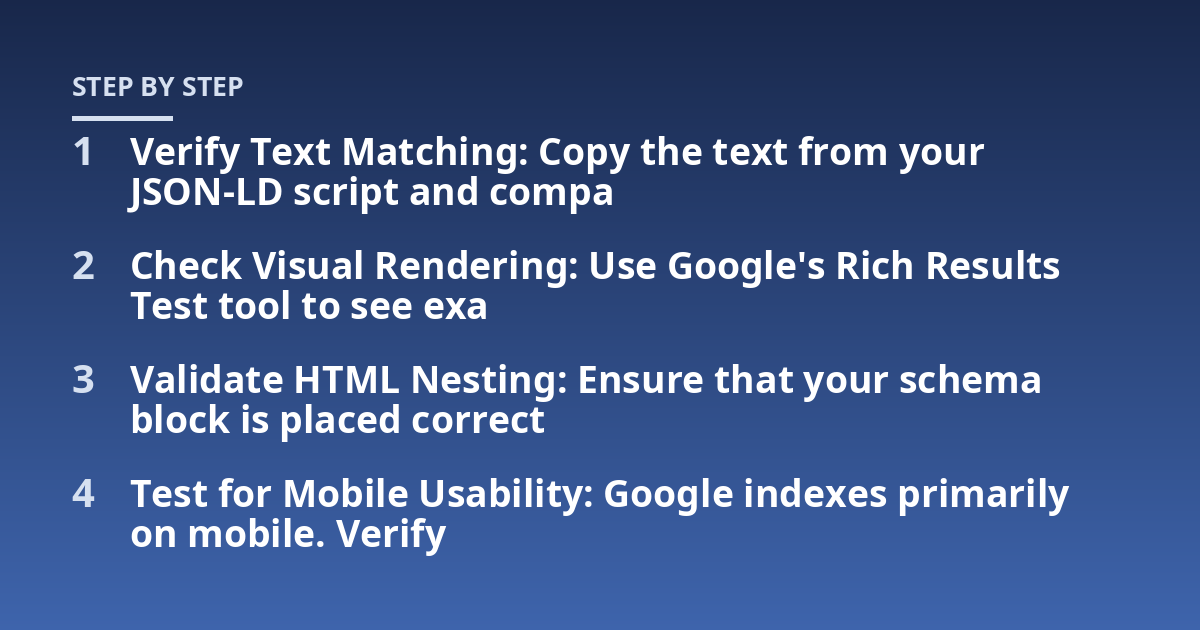
- Verify Text Matching: Copy the text from your JSON-LD script and compare it character-by-character with the visible HTML. They must match exactly, including punctuation and capitalization in many cases.
- Check Visual Rendering: Use Google’s Rich Results Test tool to see exactly how Googlebot views your page. Confirm that the FAQ accordions or How-To steps appear as expected without console errors.
- Validate HTML Nesting: Ensure that your schema block is placed correctly within the
<head>or body section, but does not wrap or break any visible HTML elements like divs or paragraphs. - Test for Mobile Usability: Google indexes primarily on mobile. Verify that the structured data triggers correctly on a small screen layout, as this is where rich results have the highest impact.
Your CMS is the source of truth, not your script. If you edit the visible text in your editor but forget to update the underlying JSON-LD variable, your page will break search eligibility. Automate this connection if possible. Check our guide on schema types that drive clicks for advanced optimization techniques.
How to Handle Dynamic or User-Generated Content
Sometimes your FAQ content is generated by users, such as in a forum or a review site with a Q&A section. Google generally advises against using FAQPage schema for user-generated content unless the quality is strictly moderated. If you do use it, you must ensure that the questions and answers are displayed clearly on the page.
Do not hide dynamic content behind lazy-loaded JavaScript blocks without providing server-side rendering or initial HTML state. Search engines may miss the content if they rely solely on executing scripts after a delay. The safest approach is to include the structured data on the page load, even if the visual accordions are hidden initially.
This complexity requires careful testing. When your site architecture changes, or you migrate platforms, verify that your automated schema generators still map correctly. Data integrity over time is more important than initial setup. You need a process to audit your schemas periodically to catch any drift caused by template updates.
Frequently Asked Questions
What is the difference between FAQ and How-To schema types?
How do you structure JSON-LD for FAQ rich results?
Which FAQ format is best for mobile users?
When should you add How-To schema to a page?
How many questions are ideal for an FAQ section?
Does structured data guarantee a featured snippet?
Next Steps for Your SEO Automation Strategy
You now have the framework to structure data for faq and how-to rich results accurately. The immediate next step is to audit your current top-performing pages. Identify which ones contain instructional content or common questions, and apply the correct JSON-LD markup. Monitor their performance in Search Console over the following weeks to measure any impact on click-through rates.
If you are managing a large portfolio of sites, do not rely on manual checks. Integrate automated schema validation into your continuous integration pipeline. This prevents errors from propagating across thousands of pages. For agencies looking to scale this efficiently, exploring comprehensive wordpress seo automation is a critical move for long-term success.
Focus on clarity and user intent above all else. Your structured data should serve the reader by making information faster to find, not just the algorithm. When your users find what they need quickly, you earn their trust and improve your organic visibility simultaneously.
Other posts from the category
There are no posts for the selected category.

Latest posts from the category
-

What makes an effective Category Page for AI
June 5, 2026
-

What Influences the cost of AI Optimisation
June 1, 2026
-

Organisation Schema: how to help AI understand your brand
May 27, 2026