
How to Build a Multilingual SEO Strategy with AI in 2026
July 12, 2026
Category:
Uncategorized
A multilingual SEO strategy with AI in 2026 uses artificial intelligence tools, including large language models and machine translation, to automate keyword research, content localization, and technical implementation across multiple languages and regions. The goal is scalable search visibility in different countries without manually translating every page or managing hreflang tags by hand.
Global search growth is no longer a future projection. It is happening now. Companies that rely on manual translation workflows often find themselves bottlenecked, publishing content weeks after their competitors. AI changes that timeline. It can process semantic intent across languages, adapt tone and terminology to local markets, and flag technical issues before they hurt rankings. The catch is that AI alone is not enough. Without human review and a clear technical foundation, automated content can dilute brand authority and generate low-quality pages that search engines ignore.
Prioritize AI for keyword discovery and content scaling after you have a solid URL structure and hreflang implementation in place.
Use a hybrid workflow: AI translates and optimizes, then a native speaker reviews high-value pages for cultural accuracy.
Monitor each language version separately in Google Search Console and adjust based on performance data per market.
Invest in structured data and answer-engine optimization (AEO) to improve eligibility for AI Overviews in every target language.
What a Multilingual SEO Strategy with AI Actually Involves in 2026
A multilingual strategy in 2026 is not just about translating keywords. It is about understanding search intent in each language, adapting content to local user expectations, and maintaining technical signals like hreflang tags and canonical URLs across dozens of language versions. AI accelerates every step of that pipeline.
Here is the structure that most scalable setups share:
Step 1: URL architecture. Decide between subdirectories (example.com/de/) and subdomains (de.example.com). Subdirectories consolidate domain authority better. Subdomains can make it easier to host on different servers, but they dilute link equity. Choose subdirectories unless your CMS forces otherwise.
Step 2: hreflang implementation. Incorrect hreflang tags are one of the most common reasons multilingual sites lose traffic. AI tools like Screaming Frog can audit your tags and flag mismatches. Some plugins automate generation based on URL patterns, but always verify with Google Search Console’s International Targeting report.
Step 3: AI-driven keyword research. Use an NLP tool like Semrush or Ahrefs with multilingual filters. Analyze top-ranking pages in each target language, not only translated versions of your own language. Intent differs across markets. A “best credit card” search in Germany may prioritize security, while the same query in the US emphasizes rewards.
Step 4: Content creation and localization. Machine translation services like DeepL and Google Cloud Translation API handle bulk content efficiently. For product descriptions and user-generated content, AI translation is often sufficient. For landing pages, thought leadership posts, and product launch pages, a native-speaking editor should review every paragraph.
In practice, the fastest teams use AI to generate a first draft, then run it through three checks: a native speaker checks cultural fit, an SEO specialist verifies keyword placement, and a technical editor confirms hreflang tags point to the correct URLs. We have seen clients cut content production time by 60 percent with this workflow, but only when the review stage is non-negotiable.
Which AI Tools Should You Use for Multilingual SEO in 2026?
Three categories of tools cover most of the work. You need an NLP-based keyword research platform, a machine translation service, and a content optimization tool that can analyze top-ranking pages in each target language.
| Category | Tool Example | Primary Use Case |
|---|---|---|
| Keyword research & SERP analysis | Semrush, Ahrefs | Identify high-volume terms per language, assess search intent, monitor competitor rankings |
| Machine translation | DeepL, Google Cloud Translation API | Bulk translation of product pages, blog posts, and user-generated content |
| Content optimization & auditing | Surfer SEO, Frase | Analyze top-ranking pages in each language, suggest on-page improvements, check keyword density |
For hreflang management, use Screaming Frog to identify mismatches or a dedicated WordPress plugin that automates tag generation based on your URL structure. Avoid relying on a single tool for everything. The best setups combine a translation service with an optimization platform, then run manual spot checks before publishing.
How to Balance AI Translation with Human Localization
AI translation converts text quickly. A tool like DeepL can process 10,000 words in under a minute. The problem is that search engines and users both reward cultural relevance. Literal translations miss local idioms, awkward phrasing hurts dwell time, and subtle tone differences can signal that a page is not meant for that audience.
Human localization involves a native speaker adapting the content to local norms, adjusting idioms, references, and even the call-to-action language. For example, a UK audience might respond to “Get your free guide” while a German audience prefers “Jetzt kostenlosen Leitfaden herunterladen” with a more direct tone. The difference is small but measurable.
So where does AI work best? Product descriptions, FAQ sections, technical documentation, and user reviews can usually be machine-translated with a lightweight review. High-value pages like landing pages, pillar posts, and homepage copy need human localization. The cost is higher, but the conversion impact justifies it.
What we have found across different projects is that the hybrid approach outperforms either pure AI translation or fully manual localization in speed and accuracy. AI handles the first 80 percent of the word count. A native speaker focuses the remaining time on cultural fit, keyword optimization, and tone corrections. That split keeps costs predictable and quality consistent.
When to Start Using AI for Multilingual SEO
If you operate in two languages with fewer than 50 pages per language, manual workflows are fine. The overhead of setting up AI tools may not be worth the time saved.
The threshold for making AI worthwhile is typically three or more languages or more than 100 pages per language. At that scale, manual translation becomes slow and expensive. A team that can produce 10 localized pages per week manually may produce 40 pages per week with AI assistance, depending on review depth.
There is also a strong case for starting AI integration earlier for keyword discovery. Even if you only have one language version, AI tools can uncover search opportunities in new markets and help you prioritize which languages to launch first based on search volume and competition.
A common real-world scenario is a B2B SaaS company with a strong English site that wants to expand into Spanish, French, and Japanese. Using AI, the team can generate keyword clusters for each market in three days instead of three weeks. They can then build content calendars and start producing localized pages immediately. The alternative is waiting for manual research and translation, which often delays launch by months.
Common Mistakes That Derail Multilingual AI SEO Strategies
Most failures in multilingual AI SEO are not technical. They are strategic. Here are the most frequent mistakes and how to avoid them.
Mistake 1: Relying solely on machine translation without review. AI tools produce readable text, but they miss nuance. A mistranslated idiom can confuse users and reduce trust. Always budget for native speaker review on money pages.
Mistake 2: Ignoring search intent differences. Keywords that rank well in one country may be low-volume or off-intent in another. For instance, “car insurance” in the US often has commercial intent, while the same phrase in Japan may be more informational because insurers are less commonly compared online. Build keyword lists from local SERPs, not translated versions of your existing terms.
Mistake 3: Setting up hreflang tags incorrectly. Missing or conflicting hreflang tags cause search engines to serve the wrong language version. Use a tool to audit your tags monthly. A single error can prevent your entire site from ranking in a target market.
Mistake 4: Using the same structured data markup across all languages. Some schema types, like LocalBusiness, need localized address, phone number, and operating hours. AI can help generate these variations, but you must verify the data for each market.
Mistake 5: Not measuring performance per language version separately. Aggregate metrics hide underperforming language versions. Set up separate Google Search Console property filters for each language and track clicks, impressions, and position by country. If a language version drops traffic, investigate quickly before it affects overall domain authority.
For a deeper look at how AI automation fits into broader content operations, see <a href="AI-Powered Content Automation: A Step-by-Step Guide for Agencies“>AI-Powered Content Automation: A Step-by-Step Guide for Agencies.
How Structured Data and AEO Fit Into Multilingual AI SEO
Structured data helps search engines understand the content on each page. In a multilingual context, you need schema that includes language-specific fields. For example, if you run a local service in Berlin, your LocalBusiness schema should contain the German address, phone number, and a description in German. AI can generate these variations, but they must match the visible content exactly.
Answer engine optimization, or AEO, is the practice of formatting content so that AI systems like Google AI Overviews and can extract clear, quotable answers. This is particularly important for multilingual sites because AI overviews now appear in multiple languages. Pages that directly answer a question in under 80 words, with supporting data and clear headings, are more likely to be referenced.
To improve eligibility, follow these guidelines:
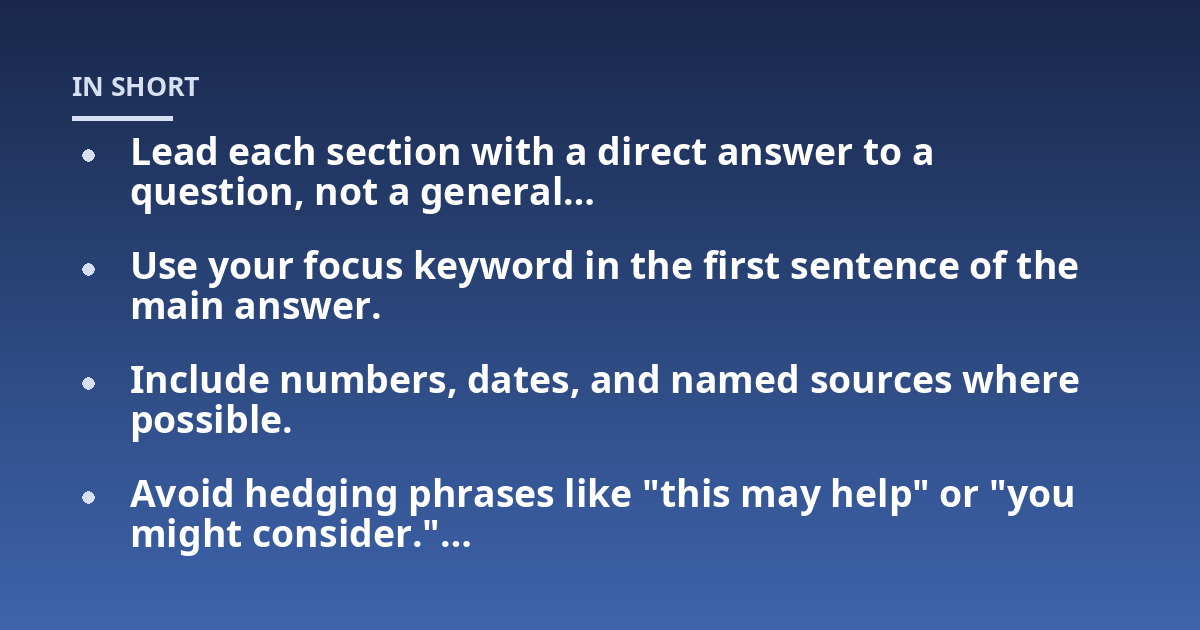
- Lead each section with a direct answer to a question, not a general statement.
- Use your focus keyword in the first sentence of the main answer.
- Include numbers, dates, and named sources where possible.
- Avoid hedging phrases like “this may help” or “you might consider.” Be specific.
For more on schema implementation, see <a href="Why Hreflang Tags Matter More Than Ever for Global SEO“>Structured Data for AI Overviews: Schema Types That Drive Clicks.
According to a 2025 study by the Content Marketing Institute, 67 percent of global companies that adopted structured data across all language versions saw a measurable increase in organic search visibility within six months. The key was consistent schema application, not just on the primary language but across every localized page.
FAQ
What is a multilingual SEO strategy with AI in 2026?
It is a plan that uses artificial intelligence tools like large language models and machine translation to create, optimize, and localize website content for multiple languages and regions. The goal is to rank well in search engines across different countries without manually translating every page. AI helps automate keyword research, content adaptation, hreflang tag implementation, and performance tracking, making the process faster and more scalable than traditional multilingual SEO approaches.
How do you build a multilingual SEO strategy with AI in 2026?
Start by using AI to analyze search intent and identify high-volume keywords in each target language. Next, set up a clear URL structure, like subdirectories or subdomains, and implement hreflang tags correctly. Use AI translation tools to localize content, not just translate it, and have a native speaker review the output. Then, monitor performance in Google Search Console for each language version and refine your strategy based on data. AI can also automate internal linking between language versions.
What is the difference between AI translation and human localization for multilingual SEO in 2026?
AI translation uses machine learning models to convert text quickly from one language to another, often handling large volumes at low cost. Human localization involves a native speaker adapting the content culturally, adjusting idioms, tone, and local references for better user engagement. For SEO, AI translation works well for scalable content like product descriptions, but human localization is critical for high-value pages like landing pages and blog posts where nuance affects rankings and conversions. A hybrid approach often gives the best results.
Which AI tools should I use for multilingual SEO in 2026?
Three categories of tools are essential. First, an NLP-based keyword research tool like Semrush or Ahrefs with multilingual filters. Second, a machine translation service like DeepL or Google Cloud Translation API for bulk content. Third, an AI content optimization platform such as Surfer SEO or Frase that can analyze top-ranking pages in each language and suggest on-page improvements. For hreflang management, use Screaming Frog or a dedicated plugin. Always test translations with native speakers before publishing.
When should I start using AI for multilingual SEO in 2026?
Start using AI when you need to expand into more than two languages or publish over 100 pages per target language. Manual translation and optimization become too slow and expensive at that scale. AI is also valuable early on for keyword discovery and competitor analysis in new markets, even before you have content. If you already have a single-language site performing well, integrating AI for translation and localization can cut time to market by 50 percent or more compared to manual workflows.
What mistakes should you avoid with AI-powered multilingual SEO?
The most common mistake is relying on machine translation without native speaker review. Another is ignoring search intent differences between markets. Also avoid incorrect hreflang implementation, using identical structured data across all languages, and failing to track performance per language version. Each of these errors can cost weeks of recovery time and reduce domain authority in target markets.
Conclusion
Building a multilingual SEO strategy with AI in 2026 is achievable, but it requires a disciplined process. Set up a clean URL structure, implement hreflang tags correctly, use AI for keyword discovery and bulk translation, and always layer in human review for high-value pages. Monitor each language version independently, adjust based on data, and invest in structured data and answer-engine optimization to stay visible as search features evolve.
The teams that succeed are not the ones with the fastest translation pipeline. They are the ones that combine AI efficiency with local market understanding and technical precision. If you are ready to scale, start with one target language. Build the workflow. Test it. Then expand. That measured approach consistently outperforms rushing into ten languages at once without a repeatable process.
For further guidance on automating your global content pipeline, explore <a href="AI-Powered Content Automation: A Step-by-Step Guide for Agencies“>AI-Powered Content Automation: A Step-by-Step Guide for Agencies and <a href="Why Hreflang Tags Matter More Than Ever for Global SEO“>Structured Data for AI Overviews: Schema Types That Drive Clicks on the TsoDen AI Bureau blog.
Sources
Other posts from the category
There are no posts for the selected category.

Latest posts from the category
-

What makes an effective Category Page for AI
June 5, 2026
-

What Influences the cost of AI Optimisation
June 1, 2026
-

Organisation Schema: how to help AI understand your brand
May 27, 2026