
What is the future of search with generative AI

October 31, 2026
Category:
Uncategorized
The future of search with generative AI shifts discovery from traditional link lists to synthesized, conversational answers. Search engines now generate direct responses by interpreting user intent and pulling from structured web content. Marketers must adapt by optimizing for answer engines, using precise schema markup, and building authoritative, citation-ready pages that AI systems can parse and reference accurately.
Search behavior has changed permanently. Users no longer scan ten blue links. They expect a direct answer immediately. Generative AI models read your pages, extract claims, and synthesize them into a single response. If your content lacks clear structure or verifiable evidence, these systems ignore it entirely. This shift demands a different approach to publishing. You need pages built for machines to parse and humans to trust. Content automation affects SEO performance directly when you use it to scale structured, fact-dense pages rather than thin filler. Unlocking AI-powered SEO requires treating every page as a potential source document for an answer engine. We work daily with multilingual campaigns and WordPress automation at TsoDen AI Bureau, and we see exactly how raw text fails while properly marked-up content gets cited. The teams that win are those who stop writing for crawlers and start writing for parsers. Your content needs explicit entities, defined terms, and clear attribution. Without those elements, your pages become invisible in generated responses.

- Generative AI transforms search from link directories into direct, synthesized answers.
- Structured data and clear entity definitions determine whether AI systems cite your content.
- Content automation improves output only when paired with strict editorial quality gates.
- Multilingual campaigns require precise technical implementation to surface in regional AI results.
How does generative AI change search behavior?
Generative AI changes search by replacing manual link evaluation with immediate, synthesized answers. Users type complex questions and receive a complete paragraph instead of a list of URLs. This means the click-through dynamic shifts completely. Answer Engine Optimization (AEO) focuses on making your content the exact source these models select when generating their responses. You must write declarative sentences that define concepts clearly. Ambiguity causes AI models to skip your page in favor of a more definitive source. Think about how you train a new employee. You give them clear facts, not vague suggestions. AI models operate the same way. They need explicit statements they can extract without interpretation. What is generative engine optimization and how does it work? addresses this transition directly, showing how GEO frameworks structure information so language models can parse it reliably. If your paragraphs meander, the model discards them. Directness wins here.
Why does structured data matter for AI search?
Structured data provides the explicit context AI models need to understand your content. Without schema markup, a language model has to guess the relationship between entities on your page. Guessing leads to omissions. When you implement FAQ schema, HowTo schema, or Organization markup, you hand the parser a labeled map of your information. What structured data types help rank in AI overviews? breaks down which specific schemas trigger citations in generated responses. Most guides overcomplicate this. The reality is simpler: use the schema type that matches your visible content exactly. Do not hide text inside JSON-LD that contradicts the visible page. AI systems cross-reference visible text with structured data. Mismatches destroy trust signals. Consistency across your HTML and your schema is the baseline requirement for eligibility in search features.
| Optimization focus | Traditional search approach | Generative AI approach |
|---|---|---|
| Keyword placement | Density and exact match in headers | Natural semantic coverage and entity definition |
| Content structure | Long-form text for dwell time | Direct answers followed by supporting detail |
| Link building | Volume of external backlinks | Citation readiness and factual authority |
| Schema markup | Optional enhancement for rich snippets | Mandatory context layer for AI parsing |
How does content automation affect SEO performance?
Content automation affects SEO performance based entirely on the quality controls you apply before publishing. Generating text without human review produces generic pages that fail to demonstrate expertise. However, using automation to handle repetitive structural tasks, like generating localized meta tags or formatting schema across thousands of product pages, frees your team to focus on original analysis. The mistake most agencies make is automating the insight rather than the assembly. Automation should handle the scaffolding. Humans must supply the judgment. If you automate multilingual campaigns, you need rigorous validation. Machine translation often misses local search intent. A phrase that works in English might map to a completely different query structure in German or Japanese. Proper workflow automation ensures that translated pages carry the correct hreflang attributes and localized entities, preventing duplicate content issues across regions. Speed matters, but accuracy prevents penalties.
Always pair automated content generation with a structured data validation step. AI models prioritize pages where the visible text aligns perfectly with the underlying schema. Run a script that checks your JSON-LD against your H2 tags before any page goes live. This single check prevents most parsing failures.
What mistakes should you avoid with AI-powered SEO?
The most common mistake in AI-powered SEO is publishing unverified claims. Language models hallucinate, and if you push their raw output directly to your site, you inherit those errors. Another frequent error is ignoring entity relationships. AI search relies on knowledge graphs. If your content mentions a concept without defining its relationship to other known entities, the model cannot place your page within its understanding of the topic. Avoid keyword stuffing entirely. Generative models do not count keywords. They evaluate semantic completeness. Does your page cover the subtopics a user would logically ask about next? If not, the model considers your content incomplete. Finally, never separate your technical setup from your editorial process. Implementing hreflang tags correctly on WordPress requires coordination between developers and content teams. If the tags point to the wrong language variants, your multilingual strategy collapses.
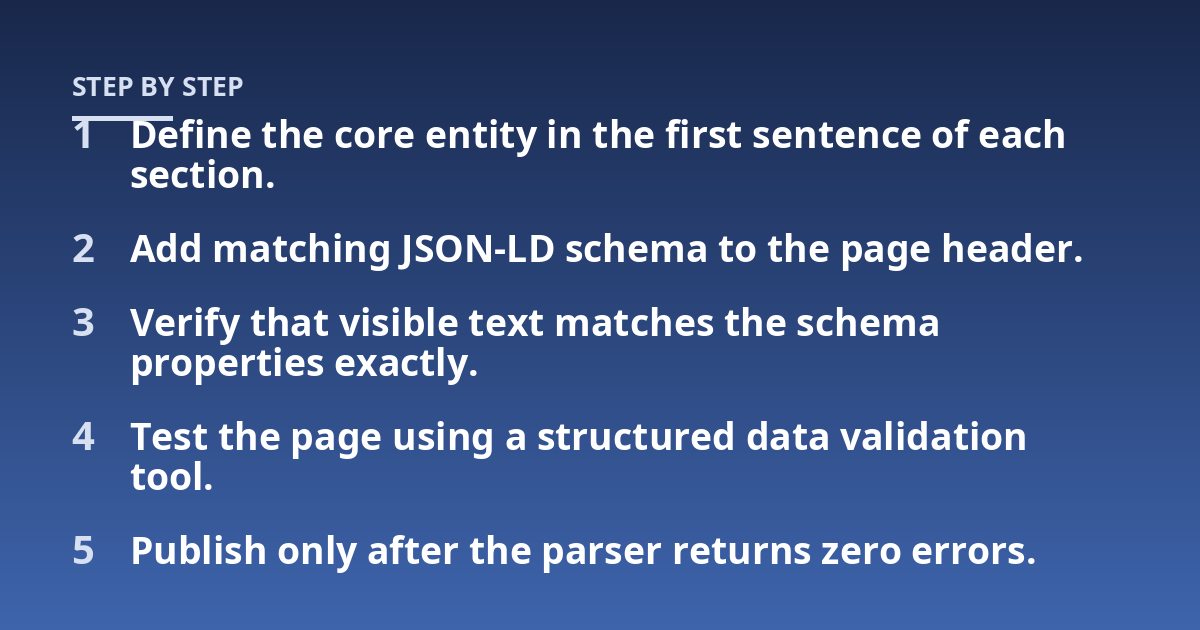
Structure your pages so machines can read them instantly.
- Define the core entity in the first sentence of each section.
- Add matching JSON-LD schema to the page header.
- Verify that visible text matches the schema properties exactly.
- Test the page using a structured data validation tool.
- Publish only after the parser returns zero errors.
Which features matter most for unlocking AI-powered SEO?
The features that matter most for unlocking AI-powered SEO revolve around clarity, speed, and verifiability. Page experience remains foundational. If your site loads slowly or shifts layout during rendering, parsers may time out or misread the DOM tree. Beyond technical health, your content architecture dictates success. Siloed topic clusters help AI models understand your topical depth. When you link related pages using descriptive anchor text, you build a semantic map that language models can traverse. Can content pass Google’s EEAT standards? explores how experience and expertise signals must be embedded directly into the text, not just implied. You need author credentials, cited methodologies, and clear boundaries around what your content claims to know. Vague assertions get filtered out. Specific, bounded claims get referenced.
Frequently asked questions
What is important to know about the future of search with generative AI?
The critical factor is that search engines now synthesize answers rather than simply listing links. Your primary goal is to format content so AI models can easily extract and cite your claims. Precise recommendations depend on your specific industry, audience, and current site architecture. There is no universal template. You must audit your existing pages to identify where your content lacks the structural clarity required for machine parsing. Professional assessment of your current technical setup usually reveals immediate gaps in schema implementation or entity definition that prevent AI systems from reading your pages correctly.
When should you consult a professional about generative AI search strategy?
A consultation becomes necessary when your organic visibility drops unexpectedly, or when you notice competitors appearing in summaries while your brand remains absent. Early assessment prevents minor structural issues from compounding into significant traffic losses. If you are planning a site migration, expanding into new languages, or launching a large-scale content automation project, bring in technical expertise before execution begins. Waiting until after deployment makes fixing architectural errors significantly harder and more expensive.
How should you prepare for an AI search optimization audit?
Gather your current analytics data, noting any recent shifts in traffic patterns or query types. Document your existing structured data implementations, including any custom schema types you use. Compile a list of your primary target queries and the current landing pages associated with them. Having your server logs accessible helps identify how frequently AI crawlers visit your site compared to traditional bots. Existing records of past algorithm updates and your corresponding site changes also provide necessary context for the auditor.
What risks or limits exist with generative AI search optimization?
Risks include over-reliance on automated content generation without editorial oversight, which can lead to publishing inaccurate information. AI models evolve constantly, meaning an optimization tactic that works today might become irrelevant tomorrow. Limits depend on your domain authority, the competitiveness of your niche, and the technical constraints of your content management system. No strategy guarantees placement in responses. Professionals should explain realistic expectations, focusing on improving eligibility and content clarity rather than promising specific placements.
How often should you review your AI search strategy?
The right interval depends on how quickly your industry changes and how frequently search platforms update their generative models. For most active businesses, a quarterly review of schema markup, entity definitions, and content freshness is appropriate. If you operate in a highly regulated or fast-moving sector, monthly checks might be necessary. Monitor your server logs for changes in AI crawler behavior. The safest approach is to follow the schedule recommended after a comprehensive technical audit of your current infrastructure.
Understanding what is the future of search with generative AI requires moving beyond traditional keyword tactics. You must build pages that function as reliable data sources for language models. This means prioritizing structured data, enforcing strict editorial standards on automated workflows, and defining entities explicitly within your text. Teams that treat their websites as structured databases rather than digital brochures position themselves for sustained visibility. Evaluate your current schema implementation today. Identify three pages where your visible text lacks corresponding structured data, and fix them. That is where your work begins.
Other posts from the category
There are no posts for the selected category.

Latest posts from the category
-

What makes an effective Category Page for AI
June 5, 2026
-

What Influences the cost of AI Optimisation
June 1, 2026
-

Organisation Schema: how to help AI understand your brand
May 27, 2026