
AI Content Quality Assurance: Avoiding Penalties in 2026
August 12, 2026
Category:
Uncategorized
To effectively handle AI content quality assurance avoiding penalties in 2026, marketers must move beyond simply publishing generated text; instead, focus on proving unique human expertise, implementing verifiable E-E-A-T signals, and optimizing for true informational depth. The core principle shifts from outputting volume to establishing demonstrable value that search engines can trust.
The sheer speed of AI content generation presents marketers with a significant challenge: how do you maintain originality and authority when creation is automated? Many experts view the struggle as keeping pace with generative technology without appearing purely machine-written. Successfully navigating this environment requires process overhaul, not just tool adoption. We need structured workflows that integrate human editorial judgment at every stage of the content lifecycle.

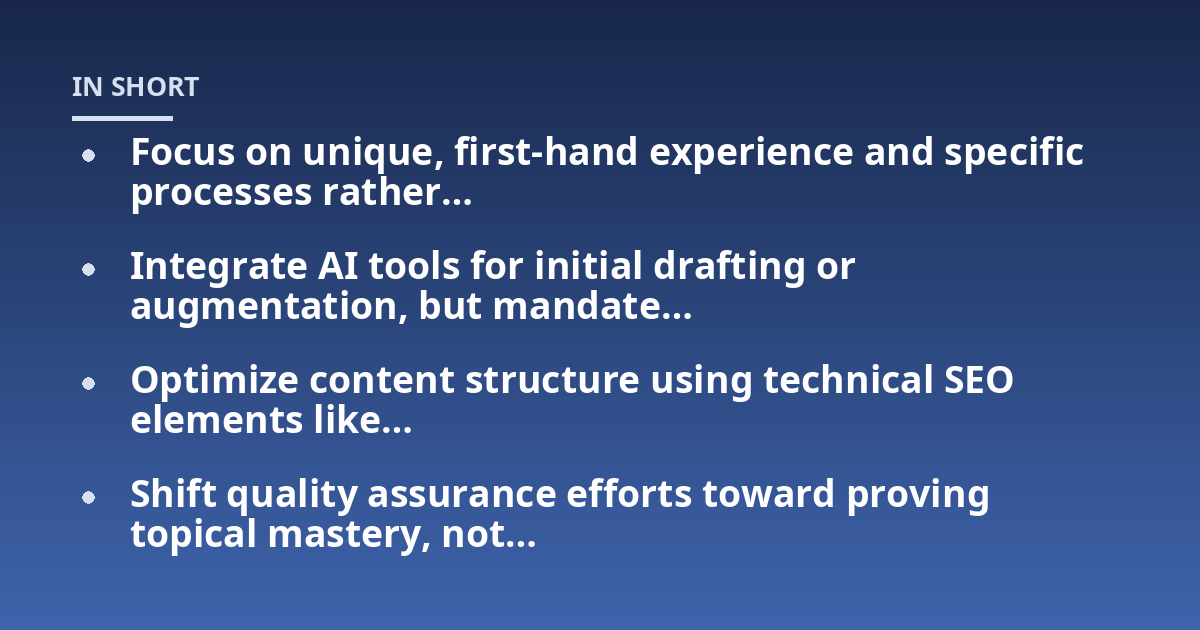
- Focus on unique, first-hand experience and specific processes rather than broad topics.
- Integrate AI tools for initial drafting or augmentation, but mandate rigorous human editing for voice and accuracy.
- Optimize content structure using technical SEO elements like structured data and clear entity relationships to signal authority.
- Shift quality assurance efforts toward proving topical mastery, not just keyword inclusion.
What is the shift in search engine evaluation for AI content?
Search engine evaluation fundamentally shifts focus from mere textual matching to assessing demonstrated user intent fulfillment and established topical authority. In essence, Google’s algorithms are becoming more sophisticated at determining if machine generation masks a lack of genuine knowledge or original investigation.
Previously, simply creating unique variations of content often sufficed for visibility gains. Now, the engine looks past surface-level novelty. If an article aggregates common knowledge without adding any specific insight, perhaps drawing from established industry practices like those seen in multilingual campaigns How to Create a Content Cluster That Ranks in AI Search Results, it risks being flagged as low utility content.
The emphasis is now on demonstrated experience signals, which includes citing primary sources or detailing complex processes that require hands-on knowledge. Think of it this way: does the article explain how to execute a specific technical SEO fix, or does it just list five things one should know about technical SEO fixes? The difference matters greatly.
When auditing AI output, check for “knowledge decay.” This occurs when generic text makes accurate claims but fails to cite the originating principle or process. Always prompt your internal review teams to map every claim back to an explicit source of verifiable knowledge, even if that source is an established industry standard.
To counter this reliance on surface-level generation, content strategy must pivot toward demonstrating deep topic coverage across multiple facets. Consider implementing structured data not just for visible elements, but for the relationships between entities within your subject matter. This methodical approach strengthens topical authority significantly.
How can marketers prove human expertise beyond writing style?
Marketers prove human expertise by embedding signals of genuine, lived experience into the content structure itself, rather than relying on vague claims about authority. Showing *how* you know something is far more effective than just stating that you know it.
One actionable method involves creating specialized, gated diagnostic tools or case study deep dives that require user input reflecting real-world problem sets. This moves the reader from a passive consumption model to an active engagement model. For instance, instead of writing generally about optimizing WordPress sites Hreflang implementation guide for large multilingual sites, demonstrate it by having users run a specific audit checklist against their existing site structure.
incorporating proprietary methodologies is highly effective. If your agency uses a unique five-step process for content automation, detail those five steps with accompanying graphics or technical deep dives on each one. This level of specificity cannot be easily replicated by general AI models without extensive prompting and vetting.
You must treat your process like product documentation. Document the decision criteria: why did you choose Google’s guidelines over an alternative framework? What trade-offs did you accept regarding multilingual implementation when maximizing local relevance? These answers are inherently human expertise.
| Signal Type | Low Signal (AI Risk) | High Signal (Authority Proof) |
|---|---|---|
| Process Detail | “Use structured data for visibility.” | “Implement Schema.org markup specifically for ArticleBody elements, ensuring every
tag referencing a legal jurisdiction is explicitly marked with the relevant Geo code.” |
| Example Usage | “Good content requires original research.” | “We benchmarked initial content performance against data gathered from manual audits across three major metro areas, noting an average crawl delay of 72 hours for non-schema marked pages in those regions.” |
What are the mistakes to avoid when using AI for content?
The most common mistake is treating AI output as a final draft requiring only light proofreading. This approach leaves behind detectable structural inconsistencies, unsubstantiated generalizations, and repetitive phrasing that modern search engines recognize as low signal.
Another major pitfall concerns topic drift during automation. You might instruct the AI to write about “AI SEO,” and it produces excellent general content. But what happens when you need it to pivot specifically to how structured data affects localized mobile indexing in, say, Chicago versus Seattle? Without granular guardrails, the output becomes a composite average of knowledge, which reads as shallow.
Remember that AI is proficient at pattern matching; it struggles with novelty outside its training set or deeply constrained niche application. If you ask for an analysis based on 2026 regulatory changes in data privacy, a field constantly evolving beyond current models’ cutoff, the resulting content will sound plausible but factually weak.
Do not use AI to generate foundational research or initial hypotheses. Use it instead for mechanical tasks: outlining based on provided source material, rewriting jargon into plain language summaries, or generating five distinct ways to structure a complex comparison table using varying levels of technical depth for different reader personas.
When deploying automated content workflows, always plan for necessary human intervention points. These checkpoints should target factual verification and the infusion of unique anecdotes or primary data sets. Ignoring these checkpoints keeps your content at risk of perceived mediocrity.
How does optimizing for generative search change SEO strategy?
Optimizing for generative search means prioritizing direct, actionable answers over exhaustive informational breadth. Search engines are becoming interlocutors; they want a concise, authoritative response delivered immediately, making “snippet optimization” feel too limiting.
Your strategy must accommodate multiple consumption formats simultaneously: the traditional 10-blue-link result, the featured snippet box, and the direct answer provided by AI overviews. To achieve this balance, you build highly structured content that answers discrete questions within a larger article framework. Think of it like creating mini-landing pages inside one pillar piece.
A good tactic is to use dedicated H3 headings that are phrased as direct, low-query-intent questions. This signals to the algorithm: “This section directly addresses this query with clear facts.” For example, instead of a heading like “Advanced Schema Implementations,” use “Which structured data types improve eligibility for AI Overviews?”
ensuring your content can be digested both by humans skimming fast and by machines parsing discrete facts is paramount. This requires excellent internal linking, not just linking to other articles, but structuring the links contextually so they pass clear topical relevance signals between adjacent ideas.
What are advanced technical details for AI content assurance?
Advanced technical aspects involve implementing on-page elements that explicitly guide search bots and users toward understanding the article’s core value. This goes beyond standard schema additions.
One powerful technique is to use specialized, multi-layered structured data. While basic Article schema helps, adding custom properties or using `sameAs` links to anchor verifiable author profiles (even if those profiles are internal team pages) builds a credible network around the content piece. You need to prove institutional knowledge.
When dealing with global reach, a necessity for modern marketers, understanding hreflang tag implementation becomes an insurance policy against cannibalization or geographic misinterpretation by AI crawlers. This speaks to the need for a coherent, globally aware content foundation.
This process requires diligent use of tools designed for automation and optimization across multiple systems. Successfully managing these technical layers often involves dedicated tooling for automating WordPress SEO with AI tools to maintain consistency across hundreds of assets.
Frequently Asked Questions
What is important to know about AI content quality assurance avoiding penalties in 2026?
The key focus must be proving unique, first-hand experience and demonstrating verifiable topical mastery, rather than simply generating high word counts. Effective assurance means embedding process details and expert decision criteria throughout the piece. A precise assessment requires evaluating your current workflow against these standards.
When should AI content quality assurance avoiding penalties in 2026 be discussed with a professional?
You should consult an SEO or content strategist when you observe visible drops in organic performance, struggle to incorporate proprietary insights into automated workflows, or if the search engine results page structure seems inconsistent across different query types. Early assessment prevents minor procedural gaps from becoming major ranking vulnerabilities.
How should someone prepare for a consultation about AI content quality assurance avoiding penalties in 2026?
Gather three specific examples of your current content output: one that performed well, one that failed to connect with the audience, and one that feels overly automated. Bring documentation detailing the prompt engineering process used for each piece. This shows expertise in the methodology, not just the outcome.
What risks or limits can AI content quality assurance avoiding penalties in 2026 have?
The primary risk is over-reliance on automation tools without human verification layers. Limits appear when content mimics generic patterns instead of solving a niche problem with specific context. Always anticipate the need to verify any statistic or process claim against its original documentation.
What mistakes should you avoid with AI content quality assurance avoiding penalties in 2026?
Avoid treating AI output as gospel truth, especially regarding evolving technical guidelines like those governing structured data or international targeting. Never publish foundational strategic documents generated entirely by the AI; they need a seasoned practitioner’s framing and proofreading touch.
To take your content efforts to the next level, consider analyzing how to build a multilingual SEO strategy with AI in 2026, which addresses the complex scaling issues associated with global authority signals.
Other posts from the category
There are no posts for the selected category.

Latest posts from the category
-

What makes an effective Category Page for AI
June 5, 2026
-

What Influences the cost of AI Optimisation
June 1, 2026
-

Organisation Schema: how to help AI understand your brand
May 27, 2026