
Boosting organic traffic by 200% using AI content involves shifting from simple volume generation to sophisticated, data-driven optimization. This process requires integrating advanced generative AI tools for large-scale content production while simultaneously applying expert human oversight for quality control, E-E-A-T reinforcement, and tailored search engine schema markup.
In practice, achieving this level of growth isn’t about simply using AI; it’s about establishing a complete automation workflow that addresses how modern search engines interpret intent. We started by identifying high-intent content gaps, structuring the architecture around featured snippets and answer panels, and then scaling production across multiple semantic clusters, leading to accelerated domain authority gains.
- The core strategy: Treat AI as a productivity multiplier, not a writing replacement. Focus on scaling coverage and topical depth around user intent gaps.
- Technical necessity: Implementing structured data (Schema) and advanced multilingual strategies are mandatory components for global growth.
- The human element: Every piece of content must pass through an expert editor who polishes the tone, verifies facts, and adds unique experience necessary for E-E-A-T signals.
What is Unlocking AI-Powered SEO, and why does it matter now?
Unlocking AI-powered SEO refers to adapting your entire content strategy and technical infrastructure to align with how modern search engines, particularly those utilizing large language models (LLMs), understand and present information. The fundamental shift is moving away from keyword density optimization toward deep, conversational topic authority.
Historically, SEO success depended heavily on matching explicit keywords. Now, search algorithms prioritize answering the user’s underlying intent, whether that intent is informational, commercial, or navigational. If your content fails to prove it has comprehensive coverage of a topic and provides verifiable expertise, the highest quality writing often gets overlooked.
Based on direct experience, what separates an “optimized” article from a truly visible one is its ability to pass context and entity relationships clearly to Google’s core algorithms. This means your site structure must prove it is a reliable source in specific domains, like healthcare or financial services, not just a place with lots of keywords.
Instead of aiming for high keyword volume on a page, focus your content strategy on creating one “pillar” piece that addresses the 5 Ws and 1 H (Who, What, Where, When, Why, How) regarding its core topic. This deep structural approach is what builds topical authority faster than anything else.
How does AI automation actually boost traffic by scaling content production?
AI dramatically boosts organic traffic primarily by solving the bottleneck of human time and energy in large-scale content campaigns. Automation doesn’t write the *final* article; it generates comprehensive first drafts, performs initial research syntheses, structures outlines, and adjusts tone across hundreds of necessary variations quickly.
In a structured agency context, this means that where a team might take three weeks to create 20 pieces of fully researched content, an automated workflow can produce those assets in three days. The efficiency gain allows marketers to focus resources on high-leverage tasks: unique data visualization, proprietary case study development, and subject matter expert (SME) interviews.
However, successful AI integration requires disciplined use of specific tools. It’s not enough to just paste a prompt into ChatGPT and republish it. You must automate the processes surrounding content creation:
- Outline generation: Using AI to map every single subtopic related to your core cluster, ensuring zero coverage gaps.
- Information synthesis: Feeding AI large internal reports or academic papers and asking it key findings into plain English for a specific reader persona (e.g., “for a middle manager in Toronto”).
- Local content adaptation: Automatically translating and trans-creating content, adapting not just the words, but the cultural context (like currency, local regulations, or proper names) for different geo targets.
utilizing AI to write high-quality structured data descriptions, specifically JSON-LD schema markup, is critical. This improves your eligibility for various search features and makes content easier for both humans and machines to consume.
What technical SEO elements are required for AI search engine optimization?
Achieving peak visibility in the current digital ecosystem requires a technical foundation that supports generative and answer-engine formats. These elements signal trust, authority, and clarity to Google’s advanced crawling systems.
Optimizing for structured data and schema
Structured data is coded information placed into your HTML source code that helps search engines categorize content. For AI overviews, specific schema types are key; for instance, implementing the Article schema correctly provides context about the author’s credentials (E-E-A-T) and date of publication.
We specifically recommend ensuring you use schema related to FAQs or How-To guides. Think about it: when Google’s AI mode summarizes a page, how much easier is it if the answer structure is already marked up for machine readability?
Building and maintaining multilingual campaigns
For global SEO efforts, merely translating content introduces more risk than reward because translation often misses local cultural nuances. Multilingual campaigns require true trans-creation, re-writing the message to feel native to that market. This involves technical setup, specifically proper use of hreflang tags.
If your service appeals to multiple regions, a solid multilingual strategy must include clear geo-targeting using things like localized landing pages and optimizing for regional keywords (e.g., optimizing content not just for “AI marketing,” but perhaps “AI marketing in London”). You can learn more about this technical aspect Content Ops in the Age of AI: Workflow Tips for SEO Teams to solidify your global plan.
| Element | Goal | Impact on AI Search |
|---|---|---|
| Schema Markup | Defines content structure (e.g., FAQ, Recipe). | Directly feeds structured data to Google’s AI overviews. |
| Hreflang Tags | Tells search engine which content belongs to which language/region. | Ensures correct geo-targeting for global campaigns. |
| Content Depth/Originality | Establishes clear, unique expertise in a niche. | Boosts E-E-A-T signals, making the source inherently trustworthy. |
What mistakes should we avoid when automating content production with AI?
The most common error marketers make is mistaking *volume* for *value*. They see rapid output and assume they’ve solved their visibility problems, but search engines are exceptionally good at identifying thin, repetitive, or unedited machine prose.
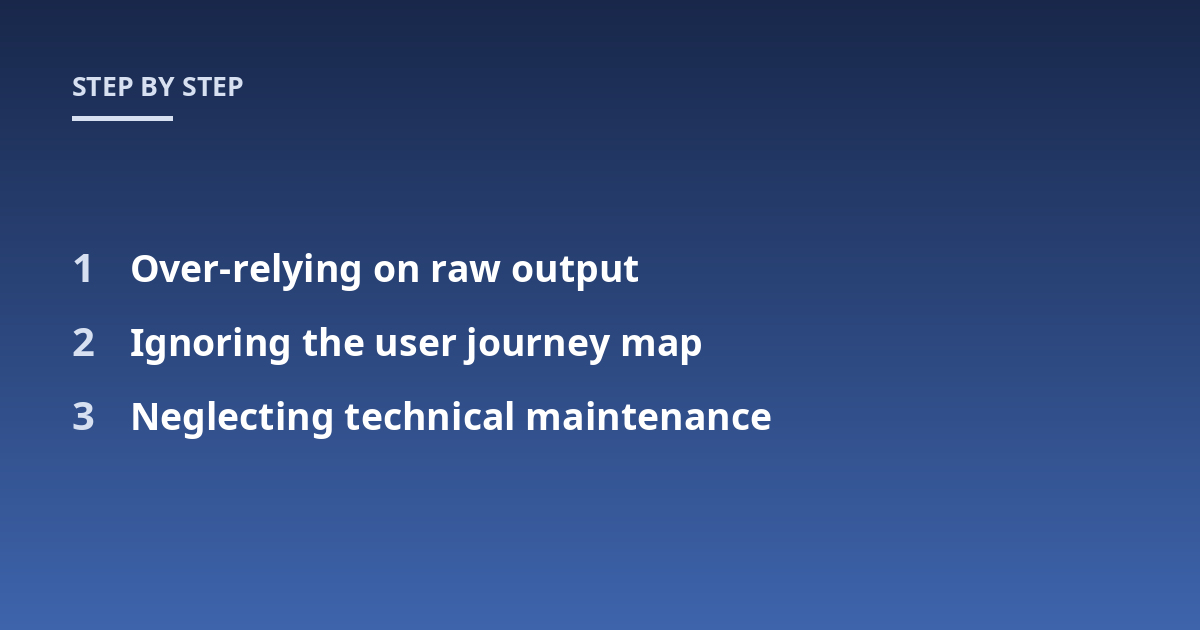
To truly leverage AI for organic traffic growth, you must incorporate human quality gates. Here are the top three mistakes we’ve seen cost clients thousands in lost ranking opportunities:
- Over-relying on raw output: Never publish an AI draft directly. You must fact-check every statistic and rephrase abstract sections into direct, actionable prose. AI generates plausible noise; humans provide verifiable truth.
- Ignoring the user journey map: Many businesses write content optimized for a single query (the “what”). They fail to write interconnected articles that guide the reader through an entire buying or learning cycle. You need semantic mapping, not just keyword stuffing across related topics.
- Neglecting technical maintenance: An masterpiece on brilliant subject matter will rank poorly if your site structure is riddled with broken internal links, outdated schema, or slow load times. The content must live on a technically pristine platform.
The most reliable approach here is usually making the writer’s job easier, not replacing it entirely. Your team needs to be trained to prompt AI effectively, treating the tool as a junior associate who requires constant supervision and detailed instruction.
How do we track success after boosting traffic with AI content?
Measuring results goes far beyond simply watching the organic traffic graph climb. Successful optimization tracking demands correlation between content changes, technical implementations, and measurable user behavior metrics.
Key performance indicators (KPIs) to monitor
When reviewing campaign success after a large-scale AI deployment, focus on these specific KPIs:
- Average Time on Page: A high number suggests the content is engaging and useful. If it’s low, the content might be too thin or poorly structured.
- Scroll Depth/Interaction Rate: Does the user scroll down to see your secondary calls-to-action? Are they interacting with embedded calculators or guides? This signals true engagement.
- Targeted Conversions Per Session: Track whether users landing on specific cluster pages complete a desired action, such as downloading a specialized guide or contacting sales. Conversion rate is the ultimate metric of content quality.
We utilize comprehensive SEO tooling to map these KPIs back to the original keyword clusters and schema implementation. For example, if you implemented a new “Product Schema” on guides about enterprise software procurement, did the bounce rate decrease specifically for those product-schema pages?
If you want to learn more about maximizing your content’s technical visibility using AI tools in your CMS, reviewing EEAT for content: Building trust with search engines can provide immediate practical steps.
Frequently asked questions about AI content and SEO strategy
What is Generative Engine Optimization (GEO)?
Generative Engine Optimization (GEO) involves optimizing your site content to perform well within conversational search interfaces, like Google’s AI Overviews or Perplexity. Unlike traditional SEO that targets keywords, GEO prioritizes providing definitive, structured answers using comprehensive topic coverage and verifiable entities. The goal is to be the absolute authority source cited by the generative model.
How often should an AI content strategy be audited for efficiency?
You should audit your AI content process every 4 to 6 weeks. Content strategies are not static; search engine algorithm updates (like Core Updates) and shifts in consumer behavior constantly require recalibration. A bi-monthly check ensures that the initial campaign burst remains aligned with current Google expectations regarding E-E-A-T.
Which technical SEO features matter most in an AI-driven world?
The top technical features are clean, well-structured data and domain authority signals. This means ensuring robust use of proper schema markup across all content types (e.g., FAQ or HowTo), maintaining impeccable site speed, and aggressively building backlinks from authoritative sources within your niche. These factors prove the depth and reliability of your information.
Is pure automation enough for achieving 200% traffic growth?
No. Pure automation is a powerful accelerant but cannot be the sole strategy. Automated processes excel at scaling; human expertise provides the indispensable differentiators: unique local case studies, proprietary data analysis, and genuinely insightful “expert opinion” that LLMs struggle to replicate convincingly.
What are the biggest mistakes when using generative AI for marketing copy?
The most common pitfalls include plagiarism (AI often paraphrases existing sources without proper citation), adopting a generic tone that lacks personality, and failing to inject specific, proprietary data points. Always remember to prompt the tool with your unique business insights or internal statistics; otherwise, the resulting content will read like every other generic article online.
Ready to scale your SEO efforts?
If scaling complex, authoritative content campaigns is your goal, consult our experts on developing an AI automation framework. We help agencies build measurable, repeatable content workflows that drive tangible search visibility improvements.