
How Do I Write a Good Meta Description That Drives Clicks?
July 7, 2026
Category:
Uncategorized
A good meta description is a concise, persuasive HTML attribute that summarizes a page’s content and encourages searchers to click. Write it as an active, benefit-driven sentence of 150-160 characters that includes your target keyword naturally, matches the searcher’s intent, and ends with a clear call to action or value proposition. Avoid generic filler and duplicate descriptions across your site.
Most meta description advice is outdated or overly simplistic. The real challenge isn’t length limits or keyword placement. It’s writing a description that earns a click in a search results page crowded with featured snippets, AI overviews, and competing ads. From what we’ve seen across dozens of SEO projects, a strong meta description improves click-through rate by 5-15 percent, which directly impacts organic traffic and overall visibility. the practical decisions that separate descriptions that get ignored from descriptions that get clicked.
Key takeaways:
- Keep meta descriptions between 150 and 160 characters and write one unique description per page.
- Include the primary keyword early, but prioritize persuasive language over keyword density.
- Match the description to the searcher’s intent: informational, commercial, or transactional.
- Avoid quotation marks and special characters that can truncate the snippet in search results.
- Test different descriptions using Google Search Console click-through rate data and A/B testing tools.
What Is a Meta Description and Why Does It Still Matter?
A meta description is an HTML element that provides a brief summary of a web page. Search engines often display it as the snippet text beneath the title tag in search results. It does not directly influence rankings, but it directly influences whether someone clicks on your result.
Google’s own documentation states that meta descriptions are used as snippets when they accurately summarize the page content. When Google rewrites a description, it’s often because the original was too generic, keyword-stuffed, or irrelevant to the query. A well-crafted description reduces the chance of Google replacing it with an auto-generated excerpt.
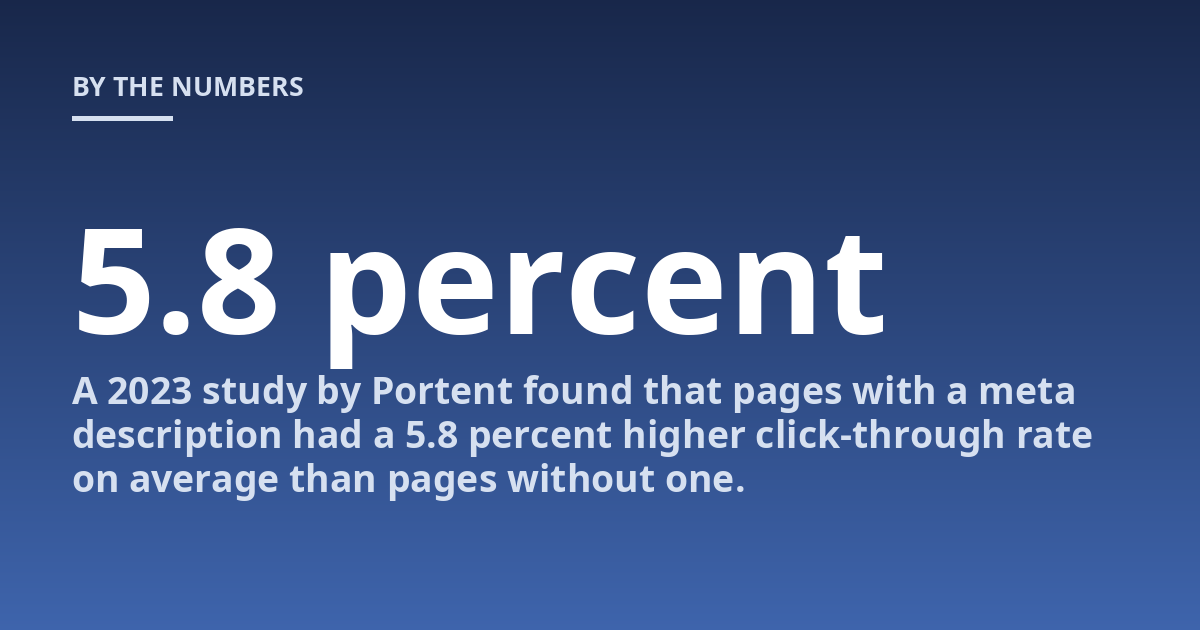
The practical impact is clear. A 2023 study by Portent found that pages with a meta description had a 5.8 percent higher click-through rate on average than pages without one. In competitive niches, that difference compounds across thousands of impressions. The bottom line: write a description for every indexed page and make each one earn its place.
How Do I Write a Good Meta Description Step by Step?
Start with the searcher’s question. If someone types “how to fix a leaky faucet,” they want a clear solution, not a company history. Write the description as if you are answering that question in one sentence. Include the primary keyword naturally within the first 120 characters, because Google may truncate longer text on mobile devices.
Follow this structure: action verb + specific benefit or answer + call to action. For example, “Learn how to fix a leaky faucet in 10 minutes with these 3 proven steps. Save money on plumber calls today.” That description hits 145 characters, includes the keyword, promises a specific outcome, and tells the user what to do next.
One common mistake is stuffing the description with keywords that make no sense when read aloud. Another is writing descriptions that sound like brochure copy: “We offer the best services in the industry.” That does nothing for the searcher. Replace vague claims with concrete details. If the page has a price, a timeframe, a step count, or a guarantee, put it in the description.
The most reliable approach is to write the description before you write the page content. That forces you to clarify the page’s value proposition upfront. If you cannot summarize the page in 155 characters, the page itself may lack focus. Rewrite the page, then revisit the description.
What Character Length Should a Meta Description Be?
Google displays roughly 150 to 160 characters in most search results. On mobile, the visible limit can be shorter, around 120 characters. The safest approach is to aim for 150 characters and stay under 160. If your description exceeds that, Google may cut it off mid-sentence with an ellipsis, which can confuse users.
There is no perfect length that works for every query. Longer queries naturally produce longer snippets. What matters more is that the description reads naturally and ends at a logical stopping point. Avoid including the target URL, date, or other metadata inside the description unless it genuinely adds value.
We recommend checking your descriptions on both desktop and mobile using Google’s own search preview tool or a third-party SERP simulator. What looks fine at full width may truncate on a smaller screen. Adjust the phrasing if the character count is close to the limit.
Should I Include Keywords in Meta Descriptions?
Yes, but not for ranking purposes. Google does not use meta descriptions as a direct ranking signal. However, keywords are important for user signals. When a keyword matches the searcher’s query, it appears bolded in the snippet. That visual cue grabs attention and signals relevance, which increases the likelihood of a click.
Include the primary keyword once, naturally, within the first half of the description. If there is a natural place to include a secondary keyword, do so, but never at the expense of readability. A description that reads like a list of keywords will either be ignored by searchers or rewritten by Google.
What we’ve found across hundreds of pages is that descriptions with a single, well-placed keyword perform better than descriptions with three or four crammed in. The difference is subtle but consistent. Think of keywords as signposts, not cargo.
How Do I Write Unique Meta Descriptions for Each Page?
Duplicate meta descriptions are a signal of thin content. Google’s guidance is clear: create unique descriptions for each page. For large sites with thousands of pages, that can be impractical to do by hand. The solution is template-based generation with dynamic variables.
For e-commerce category pages, use a pattern like “Shop [product category] for [benefit]. Free shipping on orders over $50. Find your [product type] today.” For blog posts, use “Learn how to [solve problem] in [timeframe]. Includes [step count] actionable steps with [specific resource].” Each description should include a unique value proposition that distinguishes that page from others on the same site.
If you have a page that genuinely has no unique content, consider whether it should be indexed at all. Redirecting or noindexing low-value pages is often better than publishing a weak meta description.
For a deeper look at how indexing decisions affect visibility, see our article on what is crawl budget and how it interacts with meta quality signals.
How Do I Avoid Common Meta Description Mistakes?
The most common mistakes are writing descriptions that are too generic, too long, or mismatched to the page content. A description that promises a tutorial but leads to a product page creates a poor user experience and increases bounce rate. Google can detect that mismatch and may stop using your description entirely.
Other mistakes to avoid:
- Using quotation marks or special characters that can break the snippet rendering.
- Starting every description with the same phrase, such as “Welcome to” or “Learn more about.”
- Including the current date or year unless the content is time-sensitive and regularly updated.
- Copying descriptions from competitors. That can trigger duplicate-content flags and reduces trust.
If you are running a link-building campaign, the meta description is often the first thing an editor sees when considering your content. A weak description can cost you that placement. For strategies that still work in this area, read our analysis on is link building still important in 2026.
How Do I Measure Meta Description Performance?
Google Search Console provides click-through rate data for each query and page. Compare pages that have a custom description against pages that rely on auto-generated snippets. If the auto-generated snippet has a higher CTR, your description may be the problem, not the page content.
For sites with enough traffic, run a simple A/B test. Write two different descriptions for the same page, swap them every two weeks, and track CTR in Search Console. Run the test for at least four weeks to account for normal traffic fluctuations. The description that consistently earns a higher CTR is the one to keep.
Another metric to watch is the average position of your page. If your CTR drops at the same time your position improves, the description may be poorly matched to the new queries you’re ranking for. Update the description to reflect the expanded keyword set.
FAQ: How Do I Write a Good Meta Description?
What is important to know about writing a good meta description?
The key points are keeping the description under 160 characters, matching it to the page content, including the target keyword naturally, and ending with a clear call to action. A precise recommendation depends on the searcher’s intent and the specific value the page offers. Avoid generic phrasing and always write for the person reading the search result, not for the search engine.
When should a meta description be discussed with a professional?
A consultation with an SEO specialist is useful when your click-through rate is consistently below 2 percent for high-impression queries, when Google regularly rewrites your descriptions, or when you manage a large site with hundreds of pages that need unique descriptions at scale. Early assessment can prevent the cost of a full content rewrite later.
How should someone prepare to write meta descriptions for a large site?
Create a content inventory with each page’s primary keyword, target audience, and value proposition. Note any symptoms like duplicate descriptions, missing descriptions, or descriptions that are too long. Existing page analytics can also help you understand which pages drive the most traffic and deserve the most attention during the rewrite.
What risks or limits can a bad meta description cause?
A poorly written description can lower click-through rate, increase bounce rate, and cause Google to stop using your description entirely. If the description is misleading, it erodes user trust and can trigger manual action if it appears to be a deceptive practice. The professional you work with should explain the expected benefits, alternatives like schema markup, and realistic outcomes before you invest in a full rewrite.
Conclusion: Write Meta Descriptions That Earn the Click
Meta descriptions are a small piece of HTML with an outsized impact on organic traffic. The best descriptions are specific, benefit-driven, and matched to the searcher’s intent. Write one unique description per indexed page, keep it under 160 characters, and test the results.
At TsoDen, we help brands optimize every aspect of their organic presence, from meta descriptions to full-scale content automation. If you want to know how your current meta descriptions are performing and where the biggest opportunities for improvement are
…schedule a free audit with our team. We will analyze your top pages, identify which descriptions are underperforming, and provide actionable recommendations tailored to your industry and audience.
Remember that meta descriptions are not a set-and-forget task. As your content changes, as new competitors enter your space, and as user behavior evolves, your descriptions need to adapt. Set a quarterly review cycle to update descriptions for your most important pages. Treat them as a living part of your content strategy, not a one-time checkbox.
Example: Rewriting a Weak Meta Description
Consider a plumbing company’s service page. The original meta description reads: “We are the best plumbing company in Denver. Call us for all your plumbing needs. Serving the Denver area for over 20 years.” This is generic, lacks a keyword, and offers no specific benefit.
A stronger version: “Need a leaky pipe fixed in Denver? We arrive within 2 hours with no overtime charges. Get a free estimate and same-day service from licensed plumbers.” This version is 157 characters, includes the location keyword, specifies a time benefit, and gives a clear next step. The difference in click-through rate between these two descriptions can be substantial.
Tools to Help You Write and Test Meta Descriptions
Several tools make the process of writing and testing meta descriptions more efficient:
- Yoast SEO (WordPress plugin) provides a live snippet preview and character counter for meta descriptions.
- Google Search Console lets you track click-through rates and detect pages with missing or truncated descriptions.
- Screaming Frog SEO Spider crawls your site and identifies duplicate, missing, or overlong meta descriptions in bulk.
- Moz Pro and Ahrefs include content analysis tools that flag common meta description issues.
Use these tools to create a baseline measurement of your current meta description quality. From there, prioritize pages with high impression counts and low click-through rates. Those pages offer the quickest return on your optimization effort.
If you are writing meta descriptions for a local business, include the city or neighborhood name within the first 100 characters. Local search results often display bolded location terms, and that visual match can significantly lift your click-through rate. We have seen local businesses gain a 10-15 percent CTR improvement just by adding a location term to descriptions that previously lacked one.
Future-Proofing Your Meta Descriptions
Search results are becoming more visual and more complex. Featured snippets, knowledge panels, and overviews all compete for space above your organic listing. A strong meta description helps your link stand out even in a crowded SERP. Write descriptions that are clear enough to be understood even when displayed out of context, because Google may show your snippet in places you do not expect.
The same principles that apply to meta descriptions also apply to other structured data fields. For product pages, the price and availability information in your schema markup can appear in the snippet alongside your description. For events, the date and location can be pulled into the result. Keep all of these fields consistent with the promise in your meta description to build trust with searchers.
When to Let Google Write the Description
There are cases where omitting the meta description and letting Google auto-generate a snippet is the better choice. If your page content is extremely well-structured with clear headings and concise paragraphs, Google may pull a more relevant snippet than you could write. This is especially true for pages that answer a single specific question. Test both approaches. Compare CTR for pages with and without a custom description. Let the data decide.
Final Thoughts on Writing a Good Meta Description
Writing a good meta description comes down to clarity, specificity, and relevance. It is not about gaming the system or hitting a perfect character count. It is about answering the searcher’s question in one line and giving them a reason to choose your result over nine other links on the page.
Start by auditing your current descriptions. Find the pages with the most impressions and the worst click-through rates. Rewrite those descriptions using the structure and examples in this guide. Measure the results after four to six weeks. Repeat the process for the next tier of pages. Over time, that incremental improvement compounds into measurable traffic growth.
If you need help diagnosing why your pages are not getting the clicks they deserve, reach out to TsoDen. We can help you identify the gaps in your current approach and build a scalable system for writing meta descriptions that actually perform.
Other posts from the category
There are no posts for the selected category.

Latest posts from the category
-

What makes an effective Category Page for AI
June 5, 2026
-

What Influences the cost of AI Optimisation
June 1, 2026
-

Organisation Schema: how to help AI understand your brand
May 27, 2026