
What are the common hreflang mistakes in multilingual SEO?
August 7, 2026
Category:
Uncategorized
The most common hreflang mistakes involve incorrect tag syntax, missing self-referential tags, broken URL patterns, mismatched language codes, circular reference chains, and blocked resources via robots.txt. These errors prevent search engines from mapping your international content correctly.
We have audited thousands of multilingual sites and seen these recurring failures repeatedly. A single broken link in an hreflang group can cause all pages in that cluster to drop out of the relevant language search results. You need precise implementation, consistent URL structures, and fully accessible resources for your global strategy to function.
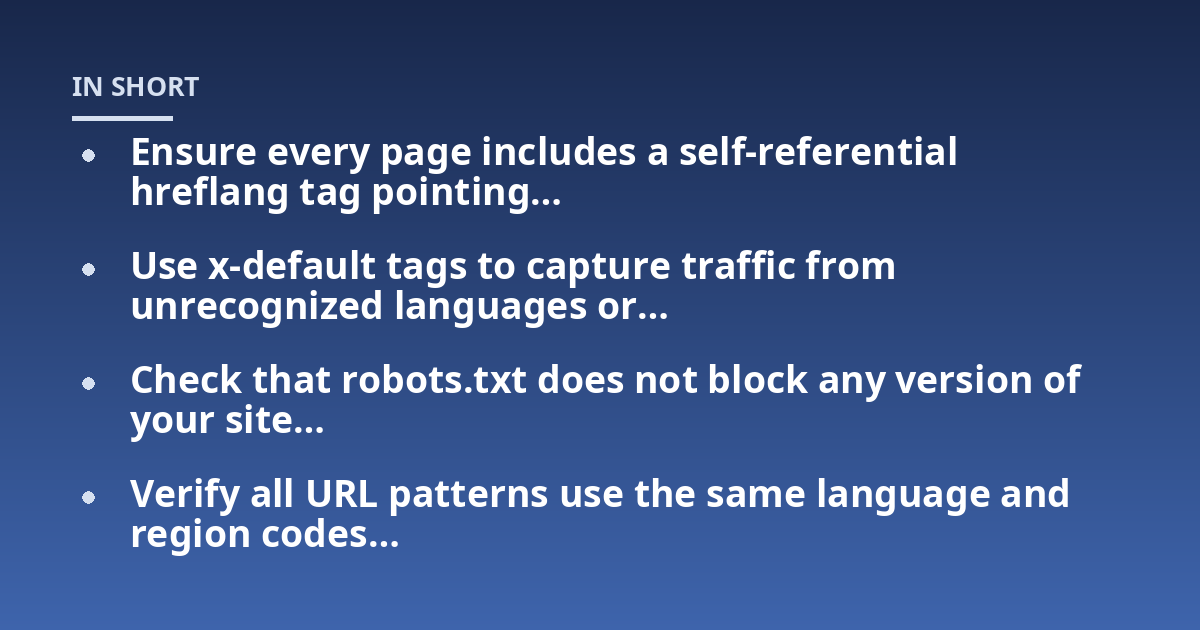
- Ensure every page includes a self-referential hreflang tag pointing back to itself.
- Use x-default tags to capture traffic from unrecognized languages or geographic regions.
- Check that robots.txt does not block any version of your site, including translated pages.
- Verify all URL patterns use the same language and region codes consistently.
Mistakes in syntax and tag placement
The first failure point is often a basic syntax error that breaks the entire parser. You must place hreflang tags accurately where Google can read them. If you use HTML links, they belong in the head section. Every link must be complete and closed properly. A missing closing bracket stops the crawler immediately.
Correct placement and formatting
You should implement tags in three places: the HTTP header, an XML sitemap, or the HTML head. Use one method consistently across your entire site. Mixing methods often confuses the algorithm. If you use the XML sitemap method, ensure your sitemap is submitted to Google Search Console. The links must be valid and resolve without errors.
The syntax requires strict adherence to ISO 639-1 language codes and ISO 3166-1 country codes. You cannot create custom codes. If you use x-default, it must point to a landing page that offers region or language selection. It cannot point to a specific translated product page without the proper fallback logic.
Bots and crawler visibility
Your robots.txt file acts as a gatekeeper. You might block the crawler from accessing the English version of your site while allowing access to the Spanish version. This creates an unbalanced graph. Search engines will ignore the links they cannot see. Check every language variant before publishing changes to your robots.txt file.
The fastest way to audit hreflang is to use a visual mapping tool like Ahrefs or Screaming Frog to export all hreflang tags into a table. You can then quickly spot missing self-references and broken link chains without manually checking every page source code.
Circular references and chain errors
A circular reference is a logic error that causes infinite loops for the parser. Page A points to Page B, and Page B points back to Page A. In some cases, you might have three or four pages forming a closed loop. This prevents Google from establishing a definitive canonical relationship.
The triangle of doom
You often see this in multilingual e-commerce sites. The English category page links to the German page, which links to the French page, which then incorrectly links back to the English page instead of its own version. This breaks the group. Every page must link to every other valid version within the same cluster. A group of three languages requires nine links per page.
Mixed language groups
You must not mix two separate clusters into one. If you have a Canadian French site and a European French site, they form two distinct groups. You should add x-default or specific region codes to distinguish them. Merging them confuses the algorithm about which audience each page serves.
Missing self-referential tags
A self-referencing hreflang tag is a link that points back to the page itself. This is a mandatory requirement for every single page in your cluster. Many site owners forget this step. They only include links to other languages.
Why you need it
The self-referencing tag confirms the current URL as part of the set. Without it, Google may treat the page as an orphan. This often leads to indexing errors where the content is not associated with the correct language or region. Your search performance will drop in that target market.
Auditing your site structure
You should run a full crawl of your website using a specialized tool. Filter for pages that have hreflang tags but lack the self-reference. This is one of the easiest fixes you can implement. It usually takes seconds per page to resolve.
Mismatched language codes and regional variations
Using incorrect codes is a critical error that ruins your targeting accuracy. You must use standard ISO codes. Do not invent your own abbreviations. If you target Spain, you should specify es-ES. If you target Mexico, it is es-MX. Google will ignore non-standard codes.
The Spanish language trap
Spanish is the most common failure point. A global site often treats all Spanish speakers as one audience. This ignores significant regional differences in vocabulary and search behavior. You must create separate groups for each major market if you have distinct content for them.
English variations
The same logic applies to English. An American user searching for “color” expects a different page than an Australian user searching for “colour”. If your tags are too broad, you might show the wrong regional variant to users, which increases bounce rates and reduces trust.
Handling x-default correctly
The x-default tag acts as a fallback. It should only be used when a page does not match any other specific language or region code. A common mistake is using it as the primary landing page for every search result that lacks a direct match.
When to use x-default
You should use x-default for country-specific domains that do not serve other languages, or for a global landing page that acts as a directory. Do not point x-default to a specific product translation unless it is the only available version for that user’s location.
Avoiding keyword stuffing
Your fallback pages should be clean and simple. They should direct users to their correct language or region page. Do not fill them with excessive text or links. This keeps the experience fast and user-friendly.
| Mistake Type | Impact on SEO | Common Cause |
|---|---|---|
| Missing self-reference | Orphaned pages, indexing loss | Template errors in CMS |
| Circular links | Group rejection by Google | Broken logic in bulk updates |
| Incorrect codes | Wrong traffic routing | Manual entry typos |
| Robots.txt blocking | Invisible pages to crawlers | Aggressive crawl budget limits |
Blocking resources with robots.txt
You must not block CSS, JavaScript, or images via robots.txt. This prevents Google from seeing the page as it is rendered in a browser. If you block these files, your hreflang tags might not appear in the renderable HTML.
The rendering gap
Search engines now rely heavily on client-side rendering for complex sites. If your tags are generated by JavaScript, you must ensure the bot can execute that script. Blocking the associated assets breaks this process.
Implementing hreflang via sitemaps vs HTML
You have two primary choices: HTML links or XML sitemap entries. The HTML method is generally more reliable for dynamic content and immediate visibility. The sitemap method is useful for large sites with thousands of pages.
Consistency is key
Choose one method and stick to it. Do not use both simultaneously unless you have a specific reason and a robust validation process. Mixing methods increases the risk of conflicting information. If you use HTML, verify every change in the source code. If you use sitemaps, ensure the file is always up to date.
Auditing your links
You should regularly check your implementation using tools like How do I create a content cluster that ranks in ai results. This helps you stay ahead of issues before they impact your traffic significantly. Regular maintenance prevents decay over time.
Automating hreflang for scalability
As your site grows, manual management becomes impossible. You need automation to keep your links consistent and accurate. This is where How does AI assist keyword research and content gap identification? becomes essential. Automated systems ensure every new page gets the correct tags on launch.
API integrations
You can integrate your content management system with SEO plugins that handle hreflang automatically. These plugins read your language settings and insert the appropriate code. This reduces human error and saves hours of manual work.
Frequently Asked Questions
What is the most critical rule for hreflang tags?
You must include a self-referential tag on every page within your international cluster. This tells Google that the current URL is one of the valid versions in the group. If you miss this, the entire link chain may fail. Without a self-reference, Google cannot map the relationship correctly between your English and translated pages. Always verify your tags point back to themselves.
Why does my hreflang implementation get rejected by Google?
Google rejects implementations when you have circular links or missing references in your chain. If Page A points to Page B, but Page B does not point back to Page A, the loop is broken. You must ensure every page links to every other language version in that specific group. Use a site crawler to find these gaps before publishing changes to live servers.
Can I use two different methods for hreflang on the same site?
You can technically use HTML tags and XML sitemaps together, but it is risky. Conflicts between the two sources often cause confusion in search algorithms. We recommend sticking to one method across your entire website. If you manage a massive site with thousands of pages, XML sitemaps might be more practical, provided they are updated frequently.
How do I handle x-default for a global English site?
You should use x-default to point to a central landing page that allows users to select their specific region. This captures traffic from countries you have not explicitly targeted with a dedicated URL. Ensure this page loads quickly and provides clear navigation to your main language variants.
What happens if I block CSS or images in robots.txt?
Blocking these resources prevents Googlebot from seeing the rendered version of your page. Your hreflang tags will be invisible to the crawler. Search engines rely on seeing the full HTML structure to understand relationships between your global pages. Always allow access to all assets required to render your international content.
How do I verify my current hreflang status?
Use a specialized SEO tool to crawl your site and extract all existing hreflang tags. Look for broken links, missing self-references, and incorrect country codes. You can also check Google Search Console under International Targeting to see if any errors have been flagged directly by Google.
What is the best way to fix a broken hreflang chain?
Map out your full cluster manually using a spreadsheet. List every URL and its target language. Then, compare this map against your live site tags. Fix one group at a time to avoid overwhelming your development team. Test each change in a staging environment before applying it to production servers.
Other posts from the category
There are no posts for the selected category.

Latest posts from the category
-

What makes an effective Category Page for AI
June 5, 2026
-

What Influences the cost of AI Optimisation
June 1, 2026
-

Organisation Schema: how to help AI understand your brand
May 27, 2026