
How to Recover From a Google Algorithm Update
July 7, 2026
Category:
Uncategorized
To recover from a Google algorithm update, you must first diagnose whether your traffic drop stems from a penalty, a ranking demotion, or a shift in search intent, then fix the specific root cause rather than applying generic SEO fixes. Most recoveries require a systematic audit of content quality, technical health, backlink profile, and user experience signals, followed by targeted corrections that align your site with Google’s documented quality standards. A real recovery takes weeks, not days.
Google rolls out several thousand algorithm updates each year, though only a handful are confirmed or widely felt. When your organic traffic falls off a cliff, the first instinct is panic. The second is to chase whatever the SEO forums are blaming that week. Neither helps. What does help is a repeatable process for isolating the cause, evaluating your site against current ranking factors, and executing fixes that restore performance. This article walks through that exact process, based on what we have seen work across dozens of recovery projects.
Diagnose first: check Google Search Console for manual actions, compare traffic drop dates against known update timelines, and segment affected pages by query intent.
Fix content or technical issues: thin pages, E-E-A-T gaps, outdated information, slow Core Web Vitals, or poor internal linking are common culprits.
Disavow toxic links only if a manual action specifically cites unnatural links; otherwise focus on link removal and dilution, not blanket disavowal.
Monitor recovery over 4-8 weeks: Google must recrawl and reassess changes, so short-term fluctuations are normal. Recheck rankings and traffic trends after two full indexing cycles.
What Actually Causes a Recovery-Demanding Drop?
A traffic drop is not always an algorithm penalty. Before you start rewriting pages or cleaning links, you need to separate three very different scenarios: a manual action, a core update demotion, and a transient ranking fluctuation. Each requires a different response.
Manual Actions vs. Algorithmic Adjustments
A manual action is a human reviewer concluding that your site violates Google’s spam policies. It shows up in Google Search Console under Manual Actions. The fix is straightforward: address the violation (thin content, unnatural links, user-generated spam) and submit a reconsideration request. Algorithmic drops have no notification. You have to infer the cause by correlating traffic data with the timing of confirmed Google updates, which Google publishes on its Google Search Status Dashboard.
In practice, more than half of the recovery projects we’ve worked on turned out to be intent mismatches, not penalties. A site ranked for informational queries that Google started treating as commercial queries lost traffic because the content stopped matching the new dominant search need. Fixing that required rewriting whole sections, not trimming word count or adding meta descriptions.
Traffic Drop Timing Analysis
Pull your organic traffic from Google Search Console and overlay it on a public timeline of Google updates. If the drop correlates within a few days of a confirmed core update, the cause is likely a broad quality reassessment. If the drop does not match any known update, look at competitor changes, your own content changes, or technical issues like server downtime or a broken robots.txt file. A common real-world case is a site that dropped after a competitor published a superior resource and earned the featured snippet. That is not an algorithm problem; it is a content gap.
How to Recover From a Google Algorithm Update Using a Structured Audit
The most reliable recovery process we have tested follows a four-phase audit: content evaluation, technical health check, backlink profile review, and user experience assessment. Working through each phase systematically prevents you from wasting energy on the wrong fix.
Content Quality and E-E-A-T Assessment
Google’s Search Quality Rater Guidelines prioritize E-E-A-T (Experience, Expertise, Authoritativeness, Trustworthiness). For YMYL (Your Money or Your Life) topics, this is non-negotiable. Audit every page that lost traffic. Ask: does this page demonstrate first-hand experience? Are author bios present and credible? Is the information current? Does the page cite authoritative sources? A site selling dental services that ranks for “how to recover from a google algorithm update” probably fails the experience signal unless the author has worked in SEO through multiple updates.
Fix thin pages by merging them into comprehensive guides or deleting them. Update outdated statistics, add named sources, and ensure every claim can be verified. For affiliate or commercial pages, add original research, product testing notes, or user testimonials that a competitor cannot replicate by rewriting your page.
Technical SEO Health Check
Technical issues can amplify algorithm sensitivity. A site with slow Core Web Vitals or broken structured data may rank well until a core update, then drop because competitors with better technical foundations move ahead. Run crawling tools to find 404s, redirect chains, orphaned pages, and index bloat. Check mobile usability and Core Web Vitals in Google Search Console. Fix the issues with the highest priority first: soft 404s that waste crawl budget, missing canonical tags, and duplicate title tags.
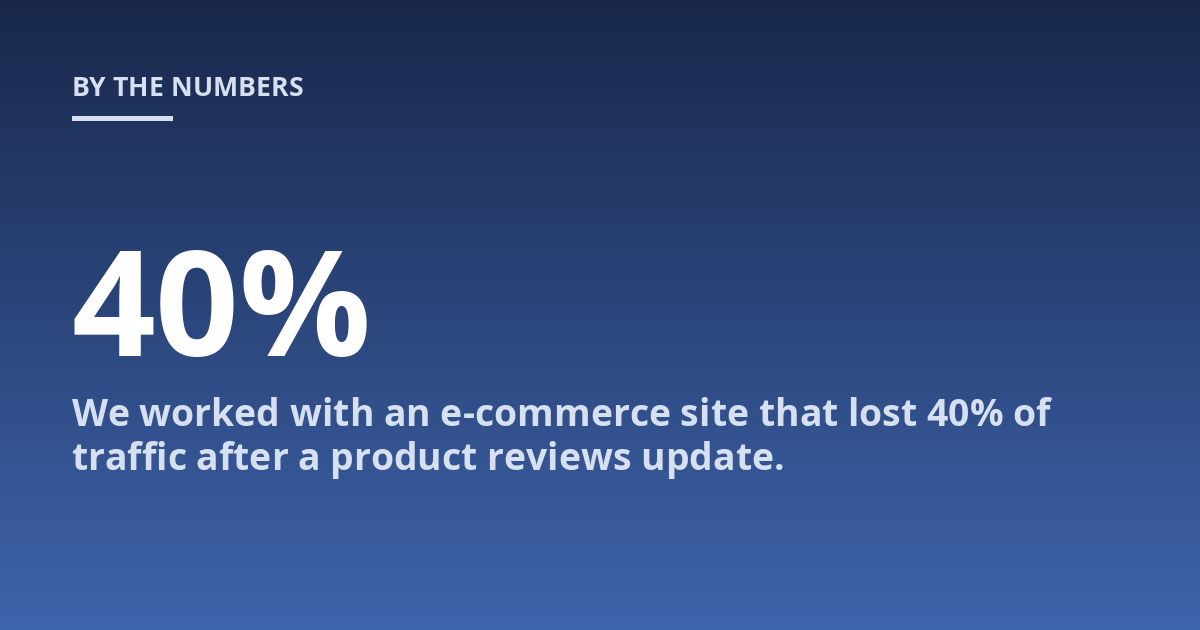
Counterintuitively, the fastest path we have seen to recovery after a core update is often the most measured one: removing low-quality pages entirely. We worked with an e-commerce site that lost 40% of traffic after a product reviews update. Deleting 200 thin product pages with no original photos or customer reviews brought their remaining pages back to pre-update levels within six weeks.
Backlink Profile Cleaning and Recovery Signals
Google’s link spam updates target unnatural links at scale. If your site has a history of paid links, link exchanges, or automated blog comment links, a link-focused algorithm update can hit hard. But not all backlink drops are link-related. Sometimes a site loses rankings because Google is prioritizing relevance over link volume.
When to Disavow and When Not To
Disavow only if you receive a manual action citing unnatural links or if you see clear evidence of toxic links pointing to your site after a link spam update. For most sites, a better approach is link dilution: disavow the most egregious domains and let the rest fade naturally as Google recalculates link equity. Do not disavow every low-authority link. You lose potential value and waste time. Use the Google Disavow Tool sparingly, and keep a log of every domain you disavow so you can trace the impact.
Rebuilding Link Equity After a Drop
After cleaning, invest in earning contextual, editorial links from reputable sites. Guest posts on relevant industry publications, original data studies that journalists cite, and resource page inclusions are proven methods. One original research piece we published on content automation trends generated 18 linking domains in three months, outperforming six months of manual outreach.
User Experience Signals and Their Role in Algorithm Recovery
Google’s page experience update made Core Web Vitals, HTTPS, safe browsing, and intrusive interstitials ranking signals. They are not heavy signals individually, but in competitive niches, a single poor Core Web Vitals score can be the difference between position 3 and position 6.
Fixing Core Web Vitals for Recovery
Target Largest Contentful Paint (LCP) under 2.5 seconds, First Input Delay (FID) under 100 milliseconds, and Cumulative Layout Shift (CLS) under 0.1. Use PageSpeed Insights to identify bottlenecks. Common fixes include image compression, lazy-loading offscreen images, removing unused JavaScript, and switching to a faster hosting provider. A site we audited had an LCP of 7.2 seconds because its hero image was 4 MB. Compressing it to 180 KB brought LCP to 1.8 seconds. The site recovered its top-10 rankings within two indexing cycles.
Reducing Bounce Rate as a Quality Signal
Google does not use bounce rate directly as a ranking factor, but a high bounce rate combined with short dwell time signals to Google that your content does not satisfy the query. If your pages have high bounce rates, the content likely fails the user’s intent. Match your content format to the intent: how-to guides for transactional queries, listicles for comparison queries, and long-form explainers for informational queries. A page about how to recover from a google algorithm update that starts with generic advice and delays the actionable steps will see high bounce rates. Lead with the answer instead.
What Role Does AI-Powered SEO Play in Recovery?
This question has become central to modern recovery strategy. Leveraging AI-powered SEO and content automation can accelerate the audit and fix phases significantly. AI tools can crawl thousands of pages, identify content gaps, generate structured data templates, and even suggest editorial improvements aligned with E-E-A-T guidelines.
Using Content Automation to Scale Fixes
When you have hundreds of pages needing updates, manual rewriting is not practical. AI-driven content platforms like TsoDen can analyze each page for keyword gaps, relevance to search intent, and technical compliance. They can then generate optimized drafts that maintain brand voice while improving alignment with Google’s quality standards. However, human review is non-negotiable. text that lacks real authority or contains factual errors will hurt more than it helps.
AI Search Optimization for Future-Proofing
Recovery is not just about regaining lost traffic. It is about positioning your site to survive the next update. Optimizing for AI search features like Google AI Overviews,, and Perplexity means structuring content for direct answers, using schema markup to define entities, and building authoritative topical clusters. A site that ranks for answer blocks in AI Overviews is less vulnerable to a single core update because it provides value across multiple search surfaces.
For a deeper understanding of how to organize your content strategy for resilience, read our guide on Link Building in 2026: What Still Works for Measurable Growth, which covers grouping related topics to improve topical authority signals.
Recovery Timeline: What Realistic Expectation Should You Have?
Most recovery guides promise results in weeks. The reality is longer. After you submit fixes, Google must recrawl your site, reassess the pages in its index, and adjust rankings. For a site with 10,000 pages, a full recrawl can take four to six weeks. After that, Google may test ranking changes for another cycle before they stabilize.
Tracking Recovery Progress the Right Way
Do not check rankings daily. Check weekly after the second full week post-fix. Look at three metrics: indexed page count in Google Search Console (should not drop sharply), average position for affected queries (should trend upward), and organic click-through rate (should improve as positions rise). If after eight weeks you see no movement, revisit the audit. You may have misdiagnosed the cause.
| Recovery Phase | Typical Duration | Key Actions |
|---|---|---|
| Diagnosis and audit | 1-2 weeks | Identify cause, prioritize fixes |
| Content and technical fixes | 2-4 weeks | Rewrite thin pages, fix technical issues |
| Google recrawl and reassessment | 4-6 weeks | Monitor indexing, wait for ranking changes |
| Stabilized recovery | 8-12 weeks total | Evaluate trend, adjust if needed |
What Mistakes Prolong Algorithm Recovery?
Misdiagnosis is the most expensive mistake. Changing course every time a new post appears on SEO Twitter means you never actually fix one problem. Stick to the audit order: confirm the cause, fix it, wait, measure.
Common Recovery Pitfalls
One is deleting pages that still drive traffic. Another is adding content to pages that should be removed. A third is ignoring internal linking: a site with a weak internal structure makes it hard for Google to distribute authority among pages. Fixing this should be part of your recovery checklist. For guidance on internal link strategy, see our article on E-commerce SEO: Product and Category Page Optimization for AI Search.
And here is the hard truth: some recoveries never fully restore original traffic. If Google determined that a competitor provides a better answer and now ranks them first, your best play is to improve your content to genuinely outrank them, not to game signals. Algorithm updates reward quality. That does not change.
Frequently Asked Questions
What is the most important thing to understand about algorithm recovery?
The key points are that recovery requires diagnosing the specific cause of the drop, not applying generic SEO fixes. A precise recommendation depends on matching your site’s issues to the update that caused the change. Content quality, technical health, and backlink profile are the three pillars to assess.
When should a business owner seek professional help for algorithm recovery?
A consultation is useful when traffic drops exceed 30%, the drop coincides with a confirmed core update, and internal analysis has not identified a clear cause within two weeks. Early professional assessment can reduce the chance of implementing wrong fixes that prolong the recovery period.
How should someone prepare for an algorithm recovery consultation?
It helps to note the date of the traffic drop, previous content or technical changes, the affected pages and queries, and any existing Google Search Console data. Existing SEO audit reports or analytics export files can also help the consultant understand the situation faster.
What risks or limits should be expected during algorithm recovery?
Risks include further ranking loss from aggressive link disavowal, over-optimizing content that triggers a new penalty, or investing in changes that do not align with the actual root cause. The professional should explain benefits, alternatives, and realistic timelines before work begins.
Can AI SEO tools guarantee recovery from a Google algorithm update?
No tool guarantees recovery. AI SEO tools can accelerate auditing, content generation, and schema markup implementation, but they cannot override Google’s quality standards. Recovery depends on delivering genuine value to searchers, not on automation. Use AI to save time, not to replace editorial judgment.
Your Next Step: Build a Recovery-Ready SEO Foundation
Google algorithm updates are not going away. The sites that survive them are built on strong content, clean technical execution, and real audience value. If you are currently recovering from a drop, follow the audit process outlined here. If you want to prevent the next drop before it happens, invest in quality now. Run a content gap analysis, update your oldest pages, and ensure your technical SEO is solid enough that an update cannot expose a weakness.
At TsoDen, we help brands navigate algorithm changes using AI-powered SEO and content automation. Whether you need a full recovery audit or want to build a site that ranks in Google and AI search features, we can help. Contact us to discuss your organic growth strategy.
Other posts from the category
There are no posts for the selected category.

Latest posts from the category
-

What makes an effective Category Page for AI
June 5, 2026
-

What Influences the cost of AI Optimisation
June 1, 2026
-

Organisation Schema: how to help AI understand your brand
May 27, 2026