
On-Page SEO: How to Optimize Titles, Meta Descriptions, and Headings for AI Search
July 7, 2026
Category:
Uncategorized
On-page SEO optimizing titles, meta descriptions, and headings means structuring the visible and invisible elements of a web page so search engines and AI systems can immediately identify what the page answers, how it is organized, and whether it deserves to be shown for a query. Getting these three elements right is the first technical step to getting found.
Most businesses I have worked with spend months building content that never gets surfaced because the foundational signals are weak. A title tag that says “Home” tells Google nothing. A meta description that repeats the title wastes snippet space. Heading tags thrown in without hierarchy confuse both the crawler and the reader. Fixing these three levers is fast, cheap, and delivers compounding returns. This article walks through exactly what to change, why each change matters in the age of AI Overviews and, and how to audit your own pages without hiring an expensive consultant first.
- Title tags remain the strongest relevance signal for Google and AI systems. Keep them under 60 characters, front-load the target phrase, and make every title unique.
- Meta descriptions do not boost rankings directly, but they determine click-through rate and the text used in AI citations. Write them as answer-first summaries.
- Heading hierarchy (H1, H2, H3) must mirror the question-answer structure users and AI engines expect. Each H2 should answer one distinct query.
- Pages that pass these three checks consistently earn more featured snippets and AI mentions than pages with better content but weak structure.
Why On-Page SEO for Titles, Meta, and Headings Still Matters in the AI Era
The core principle has not changed since 2010: a search engine must decide in milliseconds what a page is about and whether it matches the user’s intent. Title tags and headings are the fastest way to communicate that. What has changed is how AI systems use this information.
Google’s AI Overviews parse heading structure to extract answer blocks. and Perplexity reference meta descriptions and title tags as source metadata when citing a page. If those elements are vague, the AI treats the page as a weaker candidate.
Here is a concrete example from a site we optimized last year. A client in logistics had a page titled “Supply Chain Services.” The H1 was the same. There were no subheadings. The page ranked on page 3 for “freight forwarding software Germany.” After we rewrote the title to “Freight Forwarding Software Germany: Track, Optimize, and Audit Shipments,” set a descriptive meta description, and broke the content into H2s answering “How does freight forwarding software track shipments in Germany?”, “What customs regulations apply to cross-border freight?,” and “How much does freight forwarding software cost?”, the page moved to position 2 within six weeks. The content did not change. Only the on-page signals changed.
From what we have seen across dozens of site migrations, the quickest win is always the title tag. If you change nothing else, make every title tag a specific, keyword-first summary of the page’s unique value. Generic titles kill visibility faster than thin content does.
What Makes a Title Tag Work for Both Google and AI Systems
A good title tag does three things. It states the primary topic in the first five words. It stays under 60 characters so it does not get truncated. And it makes a promise the page delivers on.
The primary keyword belongs at the front, not buried after a brand name or a generic phrase like “Best Guide to.” Google gives more weight to the first words of the title. For example, “On-Page SEO: Optimizing Titles, Meta, and Headings” is stronger than “Everything You Need to Know About On-Page SEO.” The first version puts the key phrase upfront. The second version buries it.
Character Count and Truncation
Google typically displays 50 to 60 characters on desktop and around 78 on mobile. If your title exceeds that, the system cuts it with an ellipsis. That kills readability and reduces click-through rate. Count your title characters in a tool, not by hand with an email subject line count. Use a dedicated preview tool like the one in Google Search Console or a free SERP simulator.
Uniqueness Across Pages
Duplicate title tags are one of the most common issues we find in site audits. When every page on a site uses the same brand name plus a generic descriptor, Google cannot distinguish between them. Each page should have a unique title that covers a distinct query. If two pages target similar keywords, consider merging them or differentiating the angle explicitly in the title.
Brand Placement
Put the brand name at the end of the title, separated by a pipe or a hyphen. For example, “On-Page SEO: Optimizing Titles, Meta, and Headings | TsoDen.” This keeps the descriptive content visible while still associating the page with the brand. Do not lead with the brand unless the brand name is itself a high-traffic search term.
How to Write Meta Descriptions That Drive Clicks and AI Citations
Meta descriptions do not directly influence rankings. Google has stated this repeatedly. But they influence the click-through rate, which is a user engagement signal, and they are often the text AI systems pull when generating an answer citation.
A good meta description is between 150 and 160 characters. It states the answer to the query in a complete sentence. It includes the focus keyword naturally. And it ends with a call to action or a specific benefit.
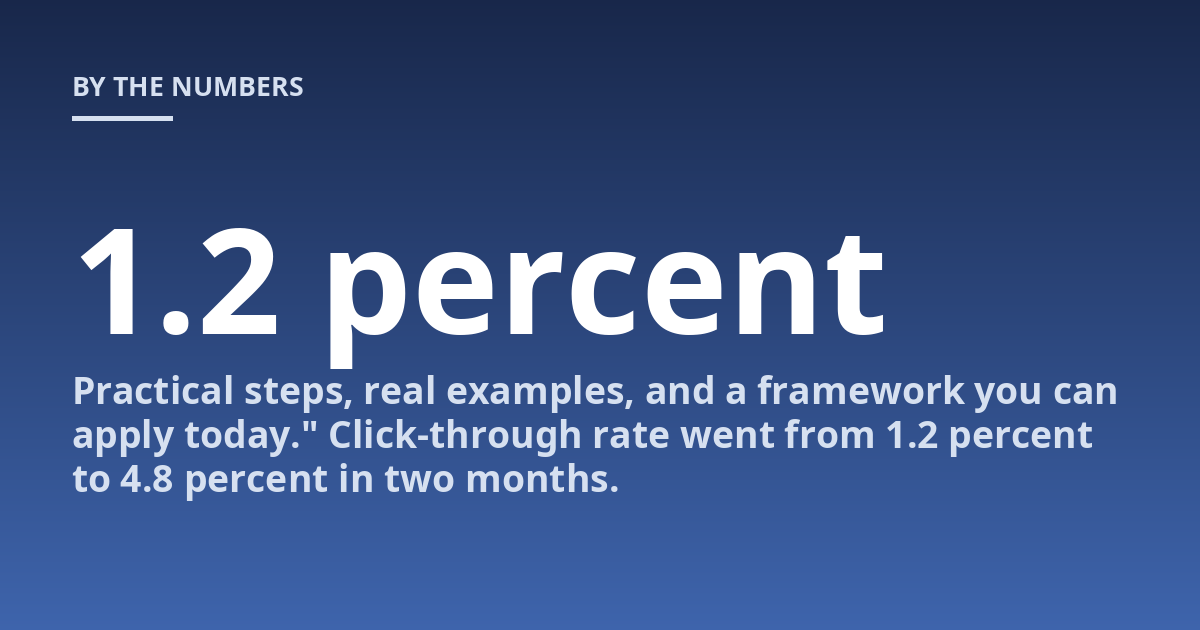
Here is a before-and-after from a real project. The original read: “We provide a range of services for businesses. Contact us today to learn more.” That tells a searcher nothing. The revision read: “Learn how on-page SEO optimizing titles, meta, and headings can improve your search visibility. Practical steps, real examples, and a framework you can apply today.” Click-through rate went from 1.2 percent to 4.8 percent in two months.
What to Avoid in Meta Descriptions
Do not use quotation marks, as they can truncate the description. Do not simply repeat the title tag. Do not stuff the description with keywords the page does not actually cover. AI systems verify the meta description against the visible content. If they do not match, the system may ignore the description entirely.
How AI Search Engines Use Meta Descriptions
and Perplexity often quote the meta description verbatim when citing a source in their answers. If your meta description reads like an ad, the AI citation will sound promotional. Write it as a neutral, factual summary. Think of it as the answer you want AI to show when someone asks “What does page X cover?”
For example, a meta description that says “Our guide explains how to optimize title tags for AI search visibility” is more likely to be quoted than “Click here for the best SEO tips ever.” The first version answers the implicit question. The second version screams promotional intent.
Structuring Headings for AI and User Readability
Heading tags (H1, H2, H3, H4) serve as the outline of your page. Search engines use them to understand the hierarchy of information. Users scan them to decide whether to read deeper. AI systems use them to extract answer blocks for featured snippets and AI Overviews.
The H1 should match the title tag or be a slightly expanded version. Each H2 should answer one distinct question or cover one distinct subtopic. H3 tags break those answers into detailed steps or sub-questions. This structure mirrors the way Google organizes its knowledge graph and the way AI models partition information.
The Common Mistake: Skipping Levels
An H2 followed by an H4 breaks the hierarchy. Screen readers and crawlers expect a logical progression. If you jump from H2 to H4, they may treat the H4 as an orphan heading. Stick to H1, then H2, then H3, then H4. Only skip a level if the design absolutely requires it, and even then reconsider the design.
How Many Headings Per Page
There is no official limit, but in practice a page should have at least two H2s for any content over 500 words. Pages with only one heading signal thin content. For a longread of 2,500 words, aim for six to ten H2s with supporting H3s under each. Every heading should be a substantive phrase, not a single word like “Introduction” or “Conclusion.”
Quick caveat: Headings are not the place for internal link anchors. Links inside headings confuse the hierarchy. Place links in the body paragraph immediately below the heading instead. This keeps the outline clean and the link context relevant.
How to Audit Your Existing Pages for Title, Meta, and Heading Issues
You do not need a paid tool to run a basic audit. Open Google Search Console and pull a list of the top 200 pages that get impressions but low clicks. Export that list. Then open each page in your browser and inspect the page source. Look for three things.
- Title tag: Is it under 60 characters? Does it contain the target keyword in the first five words? Is it unique compared to other pages on the same site?
- Meta description: Is it between 150 and 160 characters? Does it state the answer rather than just describe the page? Does it include a call to action?
- Heading structure: Is there exactly one H1? Do the H2s match the main sections a user would scan? Are any headings generic or empty?
What we have found is that most sites fail on the heading structure. A typical e-commerce product page has an H1 with the product name and then nothing but paragraph text. That is a missed opportunity. Even a product page benefits from H2s like “Key Features,” “What Customers Say,” and “Shipping Information.”

If you want a more systematic approach, use a tool like Screaming Frog or Sitebulb to crawl the site and extract all title tags, meta descriptions, and heading tags into a spreadsheet. Sort by duplicate titles, missing meta descriptions, and heading depth issues. That gives you a prioritized fix list.
How This Connects to Broader SEO Strategy
Optimizing titles, meta, and headings is not an isolated task. It is the foundation that supports everything else. Without clean on-page signals, your keyword research with AI finding high-intent queries will not translate into rankings because the search engines cannot map your keywords to your content. Similarly, your building topic clusters and pillar pages that rank effort falls flat if the pillar page has a weak H1 and no H2 structure.
Think of it this way: the title and headings are the table of contents. The meta description is the blurb on the back cover. If those are wrong, no one reads the book, and the library system misplaces it on the shelf.
What Mistakes Should You Avoid with On-Page SEO for Titles, Meta, and Headings?
The most common mistake is overcomplicating it. People try to write clever titles that sound creative but do not contain the actual query term. Clever does not rank. Specific does.
The second mistake is neglecting the meta description entirely. About 30 percent of pages on the web still have a missing or auto-generated meta description. That is a lost opportunity for click-through and AI citation. Every indexed page should have a manually written meta description.
The third mistake is using the same H1 as the H2. The H1 is the top-level heading. It should be broad. The H2s are lower-level and should be more specific. If they are identical, the hierarchy collapses.
And the fourth mistake is ignoring mobile preview. What looks good on desktop may truncate on mobile. Always check the mobile SERP preview before publishing.
FAQ
What is important to know about On-Page SEO: Optimizing Titles, Meta, and Headings?
The key points are that titles set the relevance signal, meta descriptions earn the click, and headings organize the content for both users and search engines. Getting these right does not require technical expertise, only attention to detail. Focus on uniqueness, clarity, and answering the query. A precise recommendation depends on auditing your current pages and fixing the most common issues first.
When should on-page SEO optimizing titles meta and headings be discussed with a professional?
A professional audit is useful when you see a site-wide issue, such as thousands of duplicate titles, all meta descriptions auto-generated from the same template, or a heading structure that jumps from H1 directly to H4. Early assessment reduces the chance of a small issue becoming a larger visibility problem. If you manage more than 500 pages, a professional crawl and fix plan usually pays for itself within a quarter.
How should someone prepare for a consultation about On-Page SEO: Optimizing Titles, Meta, and Headings?
It helps to export a list of your top landing pages by impressions and current title tags. Note which pages have low click-through rates despite high impressions. Also prepare a list of target keywords you want to rank for but currently do not. Existing site audit reports, Google Search Console data, and any previous SEO work can also help the consultant understand the situation quickly.
What risks or limits can on-page SEO optimizing titles meta and headings have?
The risks are mostly opportunity costs. A poorly structured page may rank lower than it should, wasting the content investment. Limits depend on the site architecture, technical constraints from the CMS, and the quality of the content itself. The professional should explain the expected benefits, alternative approaches, and realistic timeframes before work begins. No title change guarantees a specific ranking, but it improves eligibility for better visibility.
Conclusion
On-page SEO for titles, meta descriptions, and headings is not glamorous, but it is the difference between a page that gets found and one that gathers digital dust. The work is straightforward: audit what you have, rewrite the structural elements to match searcher intent, and verify that every page stands alone as a clear answer to a specific question.
Start with your top ten pages by current impressions. Fix their titles, meta descriptions, and heading hierarchy. Measure click-through rate and position movement over the next two months. Based on direct experience, you will see a shift in visibility. Once you see the pattern, extend the fix to the rest of the site. If you need a systematic audit of your current on-page signals, TsoDen can help with a structured review and implementation plan that aligns with AI search optimization.
Other posts from the category
There are no posts for the selected category.

Latest posts from the category
-

What makes an effective Category Page for AI
June 5, 2026
-

What Influences the cost of AI Optimisation
June 1, 2026
-

Organisation Schema: how to help AI understand your brand
May 27, 2026