
Local AI Search Optimization Strategy for Voice and Map Listings
June 7, 2026
Category:
Uncategorized
A successful local AI search optimization strategy involves focusing on deep topical relevance, absolute data consistency (NAP), and providing explicit, concise answers that satisfy natural language queries. To rank well in voice and map searches, businesses must structure content using definitive headings, manage their Google Business Profile activity consistently, and build local digital authority through high-quality citations.
The shift toward AI search environments requires marketers to think less about keywords and more about structured knowledge. Search engines, particularly those utilizing Generative AI features like SGE (Search Generation Engine), prioritize clear entity relationships, definitive answers, and proven local trust signals over simple keyword density. This deep dive outlines concrete strategies for transforming your digital footprint so that AI models confidently recommend your business to consumers.
- Prioritize Consistency: Maintain absolute Name, Address, Phone (NAP) consistency across all local listings and website content.
- Structure for Voice: Write web content using question-and-answer formats with definitive, concise answers immediately following the heading.
- Local Authority Building: Focus on obtaining high-quality, niche-specific citations (e.g., local chambers of commerce) rather than sheer volume.
- Manage GBP Activity: Treat your Google Business Profile as an active content channel by posting regular updates and responding promptly to reviews.
What Defines a Successful Local AI Search Optimization Strategy?
In practice, modern local SEO moves beyond simple directory listings; it requires demonstrating deep, verifiable expertise in a specific geographic area. A successful local AI search optimization strategy means proving to the algorithm that you are not just *in* an area, but that you are an indispensable and reliable authority *for* that area’s needs.
This success hinges on semantic richness, how well your content answers “why” rather than just listing “what.” Algorithms don’t just match terms; they map intent. You need to guide the search engine using concrete examples, local jargon (while maintaining broad accessibility), and diverse supporting evidence. Consider adding location-specific data points: names of nearby streets, major landmarks like the River Thames or Main Street Park, or even specific municipal regulations your service adheres to. This adds necessary contextual depth.
Many businesses mistakenly believe that simply buying links will solve their local ranking problems. That’s inaccurate. Google weighs genuine community connection, like being cited in a local university’s resource guide or appearing on the Chamber of Commerce website, much more heavily than paid backlinks from unrelated sources. The most reliable approach here is usually simple: Become an unavoidable, quotable source for your niche within that locality.
How Should I Optimize My Google Business Profile for Voice Search?
Optimizing your Google Business Profile (GBP) for voice search centers on maximizing completeness and signaling high activity. Since most modern searches start with a query (“Hey Google, what’s the nearest plumber open now?”), your GBP needs to function as both an authoritative data sheet and a proactive marketing tool.
Voice search users are direct; they ask questions requiring immediate answers. Therefore, every piece of information on your profile must be readily locatable and factually verifiable:
- Hours & Availability: Keep these perfectly updated, especially for seasonal changes or holiday hours in specific neighborhoods like Boston’s Beacon Hill district.
- Services Offered: Use granular service listings, detailing sub-services (e.g., instead of “Electrical Services,” list “Circuit Breaker Replacement” and “Smart Home Wiring”).
- Posts & Offers: Do not treat the GBP posting feature as optional. Treat it like a mini blog that posts weekly updates about local events, new stock arrivals, or seasonal discounts. This signals recent activity, a key trust factor for AI algorithms.
When updating your Google Business Profile, never just post “We are open!” Instead, structure the update around a local context: “Local Artisans Report: We stocked up on imported Italian marble this week, perfect for renovations in the Georgetown area.” This contextual detail provides actionable semantic value that AI models recognize as genuine utility.
Which Content Strategies Support Geographically Targeted SGE Results?
To target geographically specific content for Search Generation Engine (SGE) inclusion, you must structure your website to function as a local knowledge hub, not just a catalog of services. The core principle is providing density and depth across several overlapping topics within one defined service area.
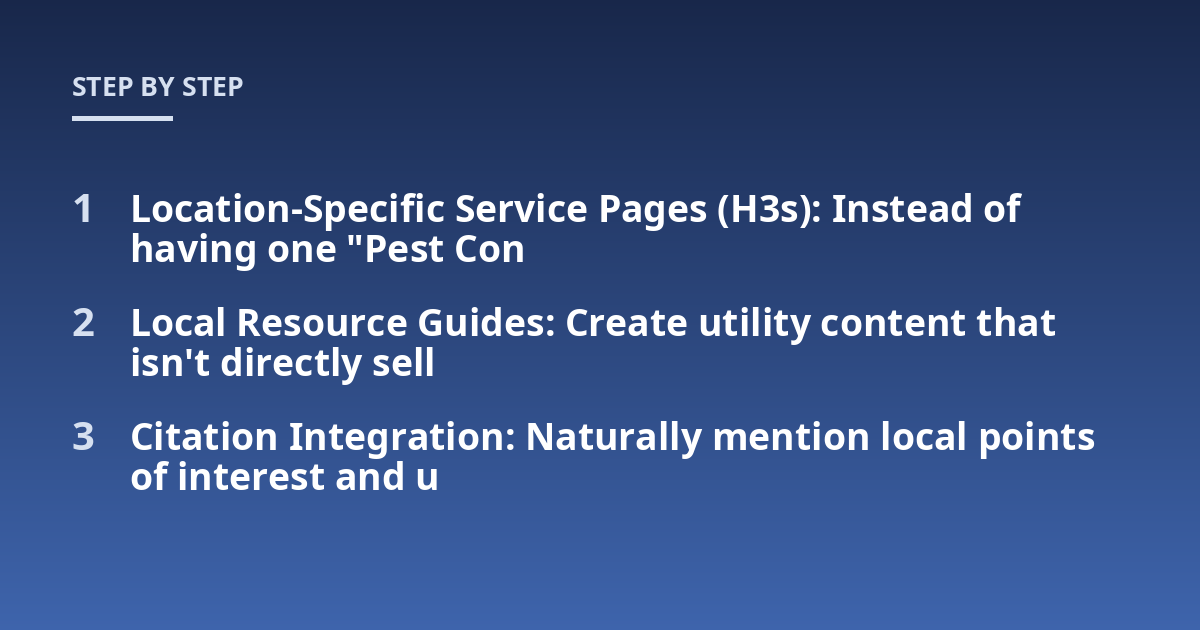
This involves three key strategies:
- Location-Specific Service Pages (H3s): Instead of having one “Pest Control” page, create separate pages for “Pest Control in Downtown Denver,” “Residential Pest Control near Capitol Hill,” and “Commercial Crawling Services, South Metro.” Each page should contain content specific to that neighborhood’s types of pests or construction materials.
- Local Resource Guides: Create utility content that isn’t directly selling a service but is highly relevant locally. For instance, if you are an architectural firm in Chicago, publish a guide on “Historical Building Permit Requirements for Victorian Homes.” This establishes non-commercial authority.
- Citation Integration: Naturally mention local points of interest and use them as anchors. If your content references the Union Station area, embed coordinates or historical facts about it; this grounds your digital presence in physical reality.
If a user searches “best roofing company downtown Denver,” you need to have pages that mention Downtown Denver repeatedly, in headers, subheadings, and body copy, while still maintaining readability. This demonstrates strong relevance alignment.
Beyond Directories: Building Citations for Local AI Ranking
Citation building remains foundational for local SEO, but the strategy must evolve for AI ranking. The focus has shifted entirely from *quantity* to *quality* and *authority*. Citation Building for local AI ranking means ensuring that your Name, Address, Phone (NAP) entity is referenced by sources that possess significant geographical or industry authority.
Consider this comparison:
| Citation Type | AI Value Signal | Goal |
|---|---|---|
| National Directory (Yelp, Yellow Pages) | Basic verification; Volume signal. | Achieve fundamental consistency and basic visibility. |
| Industry-Specific Source (Local Chamber of Commerce, Legal Association Listing) | High Authority; Trust signal. | Establish deep professional legitimacy within the trade. |
| Hyperlocal Media Source (The local newspaper’s business section mention) | Geographical Proof; Timeliness. | Cement physical presence and community integration. |
In practice, the most valuable citations are those that require difficult-to-obtain verification or relate to deep industry knowledge. For example, securing a mention on a local university’s alumni resource list confirms both your expertise and your connection to the area’s educational center. Building these high-authority links is significantly more effort than simply filling out forms.
Structuring Content for Maximum Entity Clarity in AI Overviews
AI models excel at reading structured data; they don’t “read” paragraphs like humans do. Therefore, optimizing your content requires making the core answers visible and explicit. This process of maximizing entity clarity makes your site highly eligible for deep integration into AI search results.
What we’ve found is that simple HTML structure significantly boosts performance. Use definition lists, detailed FAQ schema markup (if technically possible), and structured heading hierarchies. Your content should read like a clear textbook chapter on your service.
- H2/H3 Usage: Every major question the user might ask must be addressed with its own H2 or H3 heading. The subheadings themselves should act as highly natural, long-tail queries (e.g., “What is the required filing paperwork for commercial kitchen retrofits in Seattle?”).
- Definition of Terms: When you introduce a technical term, like “Zoning Variance” or “Load Bearing Wall”, immediately define it using a bolded format or parenthetical explanation. This clarifies the entity relationship for the AI.
- Concrete Evidence: Support every claim with numbers, percentages, names (of relevant laws or official bodies), and dates. For example, instead of saying “The process is fast,” state, “Permitting approval typically takes 4-6 weeks in Washington D.C., as mandated by local ordinance 123-B.”
Remember that search engine authority also depends on your technical setup. To learn more about implementing structured markup, check out Schema.org for implementation guidelines. Following these protocols helps AI models understand the context of your text.
How Brands Get Cited by AI Search Engines in 2024
What Mistakes Should Businesses Avoid When Pursuing Local AI SEO?
While optimizing for generative AI features is exciting, several common pitfalls can undermine even the best local local AI search optimization strategy. The biggest mistake most practitioners make is prioritizing “AI bait” content over genuine user utility. If your page only exists to answer a pattern of keywords but provides zero real value or experience (E-E-A-T), you risk disappointing the system.
Three critical mistakes include:
- Over-Optimization and Keyword Stuffing: Do not force the focus keyword into every paragraph. The goal is natural fluency while hitting high topical depth. AI models penalize robotic, unnatural writing immediately.
- Failing to Localize Depth: Simply listing local services is insufficient. You must prove deep understanding of the *local challenges*. Does your competitor know about unique municipal codes in Miami Beach? Do you?
- Ignoring the Off-Page Signal (Trust): Focusing only on the website structure ignores the signals coming from the real world, the mentions, reviews, and citations provided by trusted third parties. Neglecting consistent NAP management is a huge risk.
A common mistake is citing national guidelines for local projects. The reality is that local success requires referencing specific regional building codes or state regulations (e.g., mentioning the Massachusetts State Building Code, not just “local code”). Always ground your technical advice in geo-specific legal text to build undeniable credibility.
You can strengthen your foundational knowledge across various digital platforms by reviewing How to Write Content That Wins in Generative AI SEO.
FAQ: Mastering Local AI Search Visibility
How often should I update my Google Business Profile for local SEO?
You should aim to update your Google Business Profile (GBP) consistently, at least once a month, to signal relevance and activity to local AI algorithms. Key updates include posting new offers, updating hours, or adding services. Consistency helps establish trust signals; for example, responding promptly to all customer reviews within 24 hours significantly boosts visibility and credibility in localized search results.
What is NAP consistency and why is it crucial for local AI ranking?
NAP (Name, Address, Phone number) consistency means ensuring your business details are identical across every online listing, from GBP to directory sites. It’s absolutely critical because search engines use this uniformity as a foundational trust signal for verifying your physical existence and service area. Inconsistencies confuse crawlers, making it difficult for local AI models to confidently recommend you alongside competitors.
How do I optimize my website for voice search results in 2024?
To optimize for modern voice search and AI summaries, focus on writing clear, concise, question-based content that delivers definitive answers immediately. Structure your pages with well-defined headings (H2s/H3s) and include detailed service FAQs. A useful tactical step is to embed a ‘How-to’ guide format: 1) Identify the key search phrase, 2) Write the answer in bullet points, and 3) Support it with local case studies.
Which citation builders are best for improving local AI SEO?
While no single builder guarantees top rankings, prioritizing high-authority, niche-specific citations is better than sheer volume. Focus on listings that require unique verification, such as industry-specific directories or local chamber of commerce sites. Good strategies include manually securing mentions in the top three local newspapers and ensuring links from educational institutions are built for stronger geographical credibility.
Conclusion: Building a Sustainable Local AI Search Strategy
Achieving strong visibility through voice and map search results requires treating your digital presence as a meticulously maintained, authoritative local resource. A successful local AI search optimization strategy is not a technical trick; it’s an exercise in proving verifiable expertise and unwavering physical consistency within your chosen service radius.
Focus relentlessly on the junction where structured data meets genuine local authority. By consistently providing concise, localized answers to user questions and meticulously managing entity signals across all platforms, you drastically increase the likelihood that AI models will feature your business as a reliable recommendation. Start by auditing your GBP activity today; consistency is your most powerful signal.
Other posts from the category
There are no posts for the selected category.

Latest posts from the category
-

What makes an effective Category Page for AI
June 5, 2026
-

What Influences the cost of AI Optimisation
June 1, 2026
-

Organisation Schema: how to help AI understand your brand
May 27, 2026