
Local SEO: How to Dominate the Google Map Pack in 2026
July 7, 2026
Category:
Uncategorized
The Google Map Pack is the 3-business local results box that appears for queries with local intent. To dominate this space, you must combine Google Business Profile (GBP) optimization, local citations, review management, and structured data that signals relevance, proximity, and prominence to Google’s local search algorithm. There is no shortcut, but the sequence of action matters more than most guides admit.
Most business owners treat local SEO as a set-it-and-forget-it task. They fill out their GBP listing once, wait for phone calls, and wonder why a competitor with a smaller budget ranks above them. The reality is more dynamic. Google’s local search systems update maps data, review signals, and citation patterns continuously. What worked six months ago may now be table stakes. Based on direct experience optimizing local search for brands across service areas, professional services, and retail, the difference between ranking on page one and page four often comes down to a handful of specific, repeatable actions that are easy to miss.
To beat the Map Pack, you need to:
- Optimize your Google Business Profile with exact NAP, correct categories, and service-area settings that match how customers actually search.
- Build local citations on authoritative directories with consistent business name, address, and phone number across every listing.
- Generate a steady flow of genuine reviews and respond to every single one, including negative ones, within 48 hours.
- Implement LocalBusiness structured data on your website and create location-specific landing pages that answer real search queries.
What Exactly Is the Google Map Pack and Why Should You Care?
The Map Pack is the block of three local business listings that Google displays for queries like “dentist near me” or “plumber in Austin.” It typically shows the business name, rating, review count, address, phone number, and hours. For many local businesses, this box is the most visible organic search result on the page, appearing above all traditional blue links.
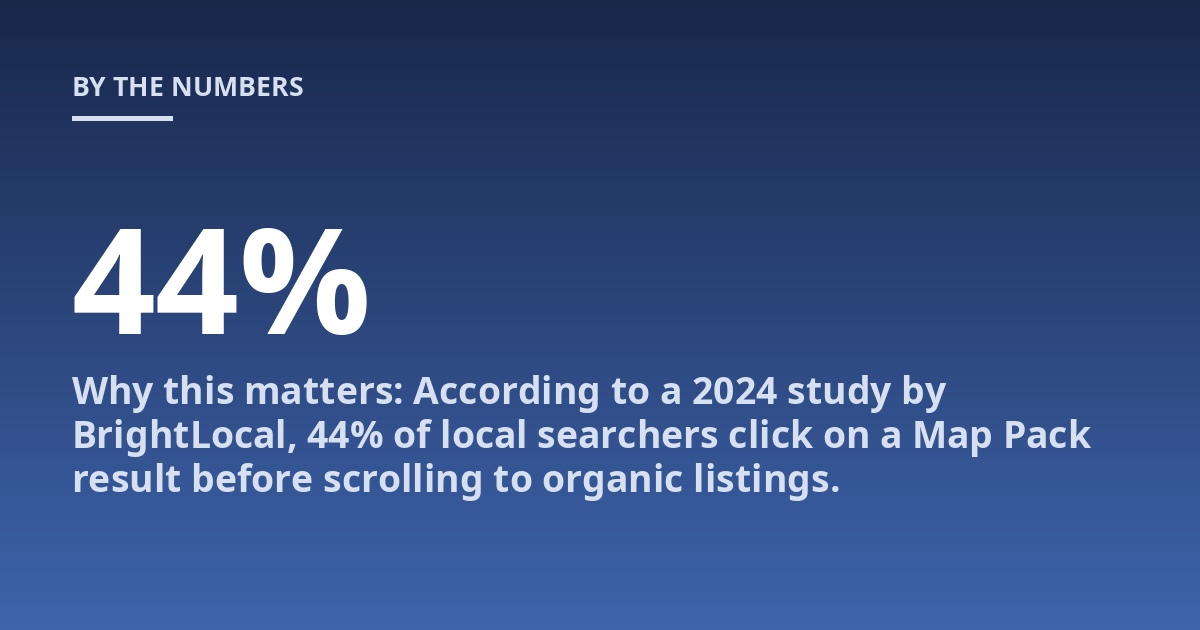
Why this matters: According to a 2024 study by BrightLocal, 44% of local searchers click on a Map Pack result before scrolling to organic listings. The click-through rate on the first Map Pack position is roughly double that of the third position. If your business is not in the top three, you are invisible to nearly half of your local customers at the moment they are ready to purchase.
From what we’ve seen across different projects, the Map Pack is also the single most reliable source of offline conversions. A person searching for a “roof repair company near me” is not browsing. They need a solution today or this week. That urgency makes Map Pack traffic far more valuable than generic organic traffic.
How to Optimize Your Google Business Profile for Map Pack Rankings
Your GBP listing is the foundation. Google pulls the data directly from this profile to populate the Map Pack. Every field you fill out is a ranking signal. Every field you leave blank is a gap your competitor can exploit.
Verify and Claim Your Listing Properly
You cannot rank in the Map Pack without a verified GBP. Verification through postcard, phone, or email confirms to Google that you are the legitimate business owner. Do not skip this step, and do not let a former employee or third party retain ownership. If you have a pending verification, prioritize it above all other local SEO tasks.
Select the Right Primary and Secondary Categories
GBP categories matter more than most people realize. The primary category should be the single most accurate description of your core service. For a dentist, “Dentist” is obvious, but “Cosmetic Dentist” may be better if that is your main draw. Secondary categories can include “Dental Implants Provider” or “Teeth Whitening Service.” Do not stuff irrelevant categories. Google’s algorithm evaluates fit based on category alignment.
Fill Every Service Area and Location Field
For businesses that serve customers at their location rather than at a storefront, set your service area correctly. Use the city names and radius that match where you actually travel. For brick-and-mortar locations, ensure your address is exact and consistent with what appears on your website, your citations, and your structured data. Any discrepancy weakens the local trust signal.
One mistake we see repeatedly is businesses selecting “Serves customers at my location” when they operate from a home address but never see clients there. Google penalizes this when the address appears in citations inconsistently. Use the “Service area” option instead, and hide the physical address. This protects your privacy and avoids a citation mismatch that hurts rankings.
What Role Do Local Citations Play in Map Pack Dominance?
A local citation is any online mention of your business name, address, and phone number (NAP) on a website that is not your own. Directory sites like Yelp, Yellowpages, and industry-specific platforms count. So do chamber of commerce pages, local news articles, and even social media profiles.
Citation consistency is the critical factor here. If your NAP on Yelp reads “123 Main St, Suite 100” but your GBP and website say “123 Main St. Ste 100” the difference in abbreviation signals inconsistency to Google’s algorithm. The system may downgrade your prominence score even if the underlying data is correct.
| Field | Inconsistent Example | Consistent Standard |
|---|---|---|
| Street abbreviation | 123 Main St vs 123 Main Street | Pick one variant and use it everywhere |
| Suite notation | Suite 200 vs Ste 200 vs #200 | Use “Suite” only, no abbreviations |
| Phone format | (512) 555-0100 vs 512-555-0100 | Use parentheses on area code consistently |
| Business name | ABC Plumbing Co vs ABC Plumbing Company | Legal business name, no variations |
Tools like BrightLocal or Moz Local can audit your citation profile and show you where discrepancies exist. Fix them in priority order, starting with the directories that Google trusts most. That list includes Yelp, Facebook, Apple Maps, BBB, and industry-specific directories like Avvo for attorneys or Healthgrades for medical practices.
How to Use Reviews to Boost Your Map Pack Position
Reviews are one of the most direct signals Google uses for local prominence. A higher average rating, a larger volume of reviews, and recent reviews all contribute to your Map Pack score. But the signal is not just about the number. Recency and response rate matter significantly.
Generate Reviews Systematically, Not Sporadically
You cannot buy reviews or incentivize customers to leave positive ones. That violates Google’s policies and can get your listing suspended. What you can do is build a review generation process. After completing a service, send a follow-up email or text with a direct link to your GBP review page. Do this consistently, and you will accumulate reviews faster than competitors who rely on customers stumbling onto the listing themselves.
Respond to Every Review
Google’s algorithm treats review responses as a signal of business engagement. Respond to every review, positive or negative, within 48 hours. For negative reviews, acknowledge the issue, apologize publicly, and offer a resolution offline. Do not argue with the reviewer or blame them. A measured response to a negative review can actually improve your business’s credibility with both Google and future customers.
Worth noting: reviews with long, detailed text and specific keywords tend to be weighted more heavily. Encourage your happy customers to mention the service they received or a specific project you completed. A review that says “John fixed my leaky pipe fast and left the area spotless” is more useful to both searchers and Google than “Great service.”
Why Structured Data Matters for Local Search Visibility
LocalBusiness structured data (schema markup) is code you add to your website that tells search engines exactly what your business is, where it is located, and what services you offer. This markup does not directly determine Map Pack ranking in the way GBP signals do, but it helps Google understand your site and can influence eligibility for rich results like Knowledge Panels.
For multi-location businesses, structured data is even more important. Each location should have its own LocalBusiness markup with unique address, phone number, and opening hours. Use the @type “LocalBusiness” with sub-types like “Dentist” or “Plumber” for precision. Include geo coordinates for each location: latitude and longitude make it trivially easy for Google to associate your site with the correct map pins.
A common real-world case: a chain of HVAC service centers in three cities. If they use only one schema block for the whole company, Google may struggle to assign the correct location to the correct Map Pack query. Each service area needs its own page and its own markup.
What Mistakes Should You Avoid with Local SEO?
Most guides overcomplicate this. The reality is simpler, but the pitfalls are real. Here are the most damaging mistakes we see in practice:
- Duplicate GBP listings. If you have two listings for the same location, Google may suppress both. Regularly search for your business name on Google Maps to check for duplicates created by users or automated systems. Report and remove them.
- Keyword stuffing your business name. Calling your business “Best Plumbing Services Austin TX” violates Google’s guidelines and can result in a suspension. Your legal business name is the only safe option.
- Using a virtual office or PO box as your address. Google requires a physical location where customers can visit during stated hours. Service-area businesses can hide the address, but you must verify a physical presence.
- Ignoring local link signals. Links from local news sites, university domains, or city government pages signal local relevance. A link from the local chamber of commerce carries more weight for Map Pack ranking than a link from a national blog.
Counterintuitively, the fastest path to Map Pack dominance is often the most measured one. Do not try every tactic at once. Fix your GBP first. Then audit citations. Then build a review system. Each step compounds the next.
How AI Search Is Reshaping Local SEO
AI Overviews,, and Perplexity are now part of the local search landscape. When a user asks “What is the best plumber in Austin?” an AI answer may pull from GBP data, review excerpts, and website content to generate a summary. This changes how you should think about content.
Your website needs clear, factual answers to common local questions. A page titled “How much does a roof repair cost in Austin?” with specific pricing ranges and service areas is more likely to be cited by an AI model than a generic “About Us” page. Similarly, structured data about services, hours, and location helps AI systems extract and reuse your information in answers.
For a deeper understanding of how search is evolving, see Search Engine Journal’s analysis of AI and local SEO. The bottom line: treat every page on your site as a potential source for an answer. Write with precision and specificity.
If you are working to adapt your broader SEO strategy, our guide on How AI Is Transforming SEO in 2026 covers the technical shifts you need to prioritize.
Which Local SEO Tools and Techniques Deliver the Best ROI?
You do not need a massive budget to dominate the Map Pack. The tools that matter are affordable, and the techniques are manual but not complex.
| Tool Category | Recommended Tool | Purpose |
|---|---|---|
| Citation audit | BrightLocal | Find NAP inconsistencies across directories |
| Review monitoring | Google Alerts + manual check | Track new reviews and respond quickly |
| Rank tracking | Local Falcon | Check Map Pack positions for specific service areas |
| Structured data testing | Google Rich Results Test | Validate your LocalBusiness schema markup |
The technique that delivers the highest ROI for most businesses is quarterly citation cleanup. Spend two hours every three months auditing your NAP across the top 20 directories. Even small discrepancies compound over time. One client we worked with gained two Map Pack positions simply by fixing “Suite” vs “Ste” across 12 directories.
For a systematic approach to content that supports local rankings, see AI-Powered Content Creation: A Complete Guide.
FAQ
What is important to know about Local SEO: How to Dominate the Google Map Pack?
The key points are the goal of improving local visibility, the expected process of consistent GBP management and citation building, and the limits that may apply to an individual business depending on competition and location. A precise strategy depends on an audit of your current signals and a professional assessment of gaps.
When should local SEO be discussed with a professional?
A consultation is useful when your business sees a decline in Map Pack rankings, a drop in calls or leads from search, or uncertainty about which tactic to prioritize next. Early assessment can reduce the chance of a small citation issue or review problem turning into a larger visibility loss.
How should someone prepare for a consultation about local SEO?
It helps to note current GBP issues, previous optimization attempts, business goals, and specific competitor names you want to track. Existing analytics data showing traffic sources and conversion paths can also help the consultant understand the situation and recommend a focused action plan.
What risks or limits can local SEO have?
Risks and limits depend on business location, the level of local competition, consistency of your existing citations, and the approach you choose. The professional should explain benefits of specific actions, alternatives that might suit your budget, and realistic expectations for timeline before work begins.
How long does it take to dominate the Map Pack?
In most competitive markets, noticeable Map Pack movement appears within 4 to 8 weeks of consistent action. Dominating the top 3 positions for high-volume terms can take 3 to 6 months if you are starting from a poorly optimized listing. This varies depending on location density, review velocity, and the authority of your competitor citations.
Conclusion: The Sequence That Wins
Map Pack dominance is not a single tactic. It is the cumulative effect of five overlapping systems: a flawless GBP listing, consistent citations across authoritative directories, a steady review generation and response process, well-structured LocalBusiness schema, and local content that answers real search queries. Skip any one of these and your ranking ceiling drops significantly.
Start with a clean audit of your current GBP and citation health. Fix the largest inconsistency first. Then build a review system that runs on autopilot. Within 90 days you should see measurable movement. If you want a deeper assessment of where your local SEO stands and what specific actions will move the needle fastest, our team at TsoDen works with businesses to identify and close those gaps efficiently.
Other posts from the category
There are no posts for the selected category.

Latest posts from the category
-

What makes an effective Category Page for AI
June 5, 2026
-

What Influences the cost of AI Optimisation
June 1, 2026
-

Organisation Schema: how to help AI understand your brand
May 27, 2026