
What Is Programmatic SEO and How It Drives Measurable Growth
July 7, 2026
Category:
Uncategorized
Programmatic SEO is the systematic use of data, templates, and automation to create and optimize large numbers of landing pages that target specific search queries at scale, enabling businesses to capture organic traffic from long-tail keywords that would be impossible to cover manually. It moves beyond traditional one-off page creation by building structured content systems that respond to user intent patterns.
Traditional SEO treats each page as a craft project: you research a keyword, write an article, optimize it, and move to the next one. That works fine when you need ten pages. But what if your market has thousands of search intents, each with slight variation by location, product type, or user need? Programmatic SEO solves that by using a data-driven template system, pulling from structured data sources like product catalogs, location databases, or user-generated content, to spin up hundreds or thousands of pages that are individually relevant and search-engine friendly.
The key difference is intent. Traditional SEO pages tend to be broad and educational. Programmatic pages are typically commercial or transactional, answering very specific queries like “best accounting software for freelancers in Berlin” or “affordable concrete contractors near downtown Austin.” These pages exist because the user is close to a decision. If you do programmatic SEO well, you capture that decision point.
The real challenge, and the reason most attempts fail, is execution quality. A programmatic approach that creates thin, duplicate, or poorly structured pages will get hit by Google’s spam algorithm updates. Success requires a solid technical foundation, clean data, distinct page content, and proper canonicalization.
- Programmatic SEO uses data and templates to generate hundreds or thousands of landing pages targeting specific long-tail search queries.
- It works best for commercial and transactional intent: queries like “best [product] for [use case]” or “[service] in [city].”
- Execution quality is critical; thin or duplicate pages will not rank and can harm site-wide authority.
- A successful programmatic system requires clean structured data, unique content per page, proper technical SEO, and ongoing monitoring.
How Does Programmatic SEO Actually Work?
Programmatic SEO rests on three pillars: structured data, a template system, and a scalable content pipeline. Without any one of these, the system breaks.
Start with the data. You need a clean, normalized dataset that contains the variables for each page. For a real estate site, that might be property type, location, price range, bedrooms, and feature tags. For a software directory, it would be tool category, use case, pricing tier, integrations, and user rating. Each variable becomes a content slot in your template.
The template is the core. It contains fixed content common to all pages, plus dynamic slots where the data gets inserted. But here is where most people get it wrong: you cannot just inject the data into a single generic template and call it a day. Each page needs enough distinct content to stand on its own. That means unique introductions, unique summary sections, and unique context paragraphs that use the data variables in different combinatorial patterns.
The pipeline handles generation, deployment, and maintenance. You write a script that takes the data, fills the templates, and outputs HTML files or populates a CMS. Then you add technical SEO: unique title tags, meta descriptions, heading structures, schema markup, internal links, and canonical URLs. From what we have seen across different projects, the most commonly underestimated step is the post-launch monitoring. Pages that were unique at launch can drift toward duplication as content ages or data changes.
The single biggest mistake we see in programmatic SEO is treating the template as finished after launch. You need to audit your generated pages at least quarterly for content overlap, broken data pulls, and shifting search intent. A template that worked six months ago may now produce pages that look thin to Google’s evaluators.
What Types of Queries Does Programmatic SEO Target?
Programmatic SEO is not for broad informational keywords. It shines on long-tail commercial and transactional queries where the user’s intent is specific and measurable. Think of these patterns:
- “Best [product category] for [specific use case]” (e.g., best CRM for real estate agents)
- “[Service] in [city/neighborhood]” (e.g., emergency plumber in Logan Square)
- “[Product] vs [competitor]” (e.g., Slack vs Microsoft Teams 2025)
- “Top [number] [category] [year]” (e.g., top 10 project management tools for startups 2025)
- “[Product] [feature] review” (e.g., HubSpot AI assistant review)
Each of these queries has a clear decision-making intent. The user is comparing options, checking viability in their location, or validating a purchase. Programmatic pages that answer these queries directly, with real data and genuine differentiation, stand a strong chance of ranking because they match the query exactly. A common real-world case is a home services company that generated 2,000 location pages for “emergency plumber in [suburb]” and saw a 300% increase in organic leads within four months. The key was that each page included neighborhood-specific details, pricing ranges, and local reviews, not just a swapped city name.
Why Is Programmatic SEO Important for Growth?
Manual SEO hits a ceiling. Even a dedicated team of writers and SEOs can produce maybe 50 to 100 high-quality pages per month. That is fine for the head terms, but it leaves the entire long-tail surface area uncovered. According to a study by Ahrefs, 92% of all search queries receive fewer than 10 searches per month, yet those queries collectively account for a massive share of total search volume. Programmatic SEO is the only way to capture that traffic at scale.
Here is the thing: programmatic SEO also improves site architecture and internal link density. A network of deeply relevant, interlinked pages strengthens topical authority signals. Google’s systems can recognize that your site covers a topic comprehensively because you have specific pages for every sub-query. That boosts credibility for all your pages in that vertical.
Counterintuitively, the fastest path to growth is often the most measured one. Programmatic SEO is not about spraying pages into the void. It is about systematically building coverage for every query your target customer types when they are ready to buy. That is a shift from volume thinking to coverage thinking.
What Mistakes Should You Avoid With Programmatic SEO?
The most dangerous mistake is creating pages that are identical except for a single keyword swap. Google’s systems, both algorithmic and human evaluators, are very good at detecting this now. It triggers the “thin content” signal and can lead to a manual action or algorithmic de-ranking.
Other common failures include:
- Poor data quality that leads to pages with missing, outdated, or contradictory information.
- Ignoring canonical URLs and self-referencing canonicals, causing duplicate content issues.
- Generating pages for queries with zero search volume or no user intent fit.
- Failing to add unique value beyond what the template provides, such as user reviews, Q&A sections, or curated comparisons.
- Not planning for content freshness. Programmatic pages need update triggers based on data changes or seasonal relevance.
Quick caveat: even a well-built programmatic system will have some pages that do not perform. That is normal. The goal is not 100% of pages in position one. It is capturing the aggregate traffic and conversions from the tail. Based on direct experience, expect 60-70% of your programmatic pages to generate at least some organic traffic within six months, provided the data is solid and the intent match is tight.

Which Programmatic SEO Features Matter Most?
Not all programmatic SEO tools and approaches are equal. Here is a breakdown of the features that separate effective systems from ones that waste resources:
| Feature | Why It Matters | What to Look For |
|---|---|---|
| Data hygiene and deduplication | Duplicate or conflicting data creates pages that compete against each other and confuse search engines. | Automated checks for null values, format consistency, and cross-field logic. |
| Template flexibility | A single rigid template produces indistinguishable pages. Different query intents may need different structures. | Multiple template variants with conditional logic based on data values. |
| Automatic internal linking | Each page needs contextual links to other relevant pages in the set and to pillar content. | Rule-based linking that uses shared categories, attributes, or hierarchical relationships. |
| Schema markup generation | Structured data helps search engines understand the page’s specific role and content type. | Dynamic schema injection for product, local business, FAQ, or comparison schemas based on data fields. |
| Content differentiation scoring | A pre-launch check that measures how distinct each page is from its nearest neighbors. | Cosine similarity or n-gram overlap analysis with configurable thresholds. |
Worth noting: the best feature set is the one that matches your specific vertical. An e-commerce site with 10,000 product SKUs needs different template logic than a law firm network with 200 location pages. Do not buy a one-size-fits-all tool without understanding its data ingestion and template engine limitations.
The most reliable approach here is usually simple: start small. Build a prototype with 20 to 50 pages in a high-value niche. Monitor performance, identify data gaps, refine templates, and only then scale to hundreds or thousands of pages. That iterative process will teach you more about your specific market than any tool feature list.
FAQ
What is important to know about programmatic SEO?
The key points are the goal of capturing long-tail search traffic at scale, the expected process of using structured data and templates, and the limits that apply when data quality or template differentiation is weak. A precise recommendation for your business depends on an audit of your existing content, your technical setup, and your target keywords. Programmatic SEO is not a shortcut; it is a systematic engineering approach to content production.
When should programmatic SEO be discussed with a professional?
A consultation is useful when you have a large product catalog, multiple service locations, or a diverse set of use cases that each warrant a dedicated landing page. Early assessment can reduce the chance of building a system that produces thin or conflicting content. If you are already seeing traffic plateaus or cannibalization across similar pages, that is another strong signal to talk to an expert.
How should someone prepare for a consultation about programmatic SEO?
It helps to gather your current keyword data, existing site structure, and any structured datasets you maintain such as product feeds, location databases, or category taxonomies. Also note previous SEO efforts, traffic patterns, and specific questions about template design or content freshness. Existing analytics reports and competitor examples can also help the consultant understand the opportunity.
What risks or limits can programmatic SEO have?</h3
What risks or limits can programmatic SEO have?
The main risks include algorithm penalties for thin or duplicate content, wasted resources on pages that never rank, and the ongoing maintenance burden of keeping generated content fresh. Programmatic SEO also has inherent limits: it cannot create genuine thought leadership, original research, or deeply editorial content. It works best for structured, data-driven queries where the answer can be reliably assembled from existing information. Pages requiring human expertise, nuanced opinion, or creative writing should remain in the traditional content workflow.
How long does it take to see results from programmatic SEO?
Expect a 3 to 6 month horizon for initial traction, similar to traditional SEO but potentially faster for very specific long-tail queries with low competition. Pages targeting ultra-specific queries like “affordable accounting software for solo lawyers in Denver” can rank within weeks if the intent match is exact and the page is technically sound. However, competitive queries and large page sets may take 6 to 12 months to stabilize. The aggregate traffic curve is typically gradual, not a spike, as each page independently earns search visibility.
Can programmatic SEO work for small sites with limited data?
Yes, but the scope must match the data available. A local plumber with five service areas can create 5 distinct location pages programmatically. A niche e-commerce store with 50 products can generate comparison and category pages. The system scales down as easily as it scales up. The key constraint is having enough structured, distinct data per page to create meaningful content. If you only have a city name and phone number per location, that is not enough data to build a unique, useful page. Extra data points like average response time, common repairs in that neighborhood, and local pricing create the needed differentiation.
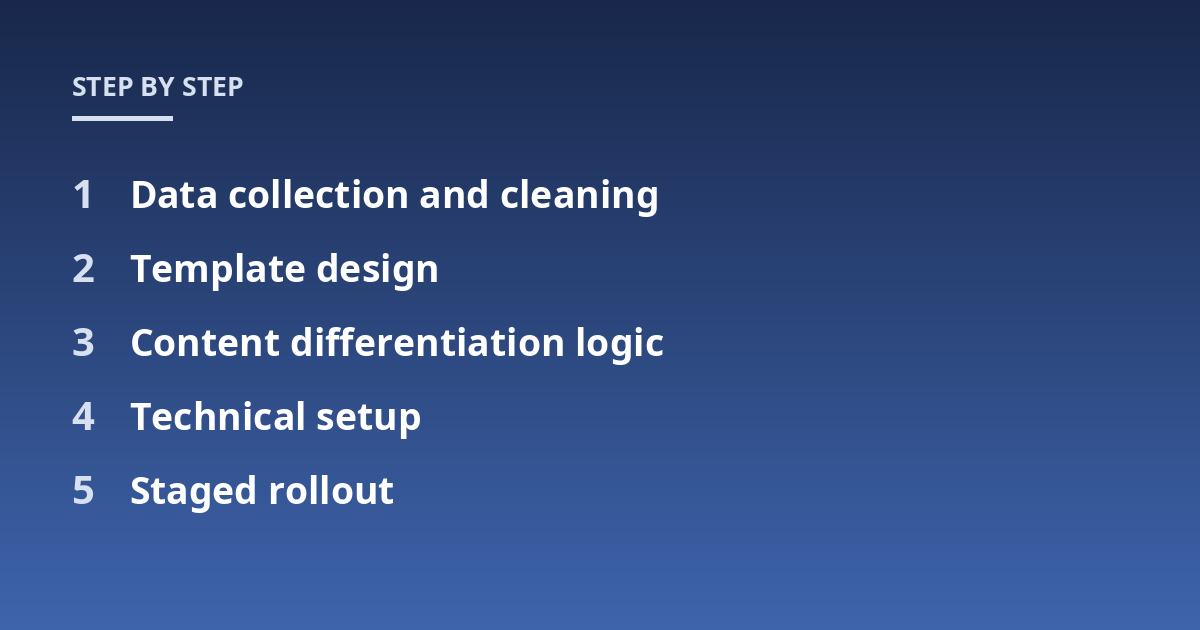
What Does a Real Programmatic SEO Workflow Look Like?
To make this concrete, here is a step-by-step workflow used by a medium-sized home services company targeting 500 suburbs across three states:
- Data collection and cleaning: They pulled city and suburb data from government databases, service area lists from their franchise network, and aggregated past job data for service frequency and common issues per location.
- Template design: They built three template variants: one for “emergency [service] in [suburb]” pages, one for “cost of [service] in [suburb]” pages, and one for “best [service] company in [suburb]” pages. Each template had 8 to 12 unique content sections with dynamic data insertion.
- Content differentiation logic: For each page, the system checked for at least 60% unique content compared to any other page in the set. If a page fell below the threshold, it triggered warnings and required manual edits or additional data fields.
- Technical setup: Unique title tags, meta descriptions, H1 headings, and local business schema were generated per page. Internal links connected each suburb page to the parent city page and to related service category pages.
- Staged rollout: They launched 50 pages in one high-value county first, monitored for 4 weeks, refined templates based on performance data, then scaled to the full 500 pages over 3 months.
- Ongoing monitoring: Monthly audits checked for content drift, data freshness, and ranking changes. Pages with declining traffic were flagged for content updates or data refresh.
The result after 8 months: a 240% increase in organic traffic from commercial long-tail queries, with the programmatic pages collectively accounting for 35% of total site revenue. Pages targeting single queries like “emergency drain cleaning in Evanston” generated consistent leads with minimal ongoing effort.
How Programmatic SEO Fits Into a Broader Content Strategy
Programmatic SEO is one layer in a full content strategy, not a replacement for everything. The best approach uses programmatic pages to cover the long tail of commercial and transactional queries, while traditional editorial content handles the top-of-funnel informational topics, brand building, and thought leadership. The two layers reinforce each other: informational articles build topical authority and internal link equity to programmatic pages, while programmatic pages capture the conversion-ready traffic that the educational content nurtures.
For example, a software review site might publish an editorial guide called “How to Choose a CRM for Small Business” that links out to 50 programmatic comparison pages like “HubSpot vs Pipedrive for Real Estate Agents.” The editorial content establishes trust and covers the consideration phase. The programmatic pages answer the specific comparison query and capture the user at the decision moment. This combined structure outperforms either approach used alone.
Conclusion
Programmatic SEO is a practical, data-driven method for capturing organic traffic from the long tail of search queries that manual content production cannot reach. It works by combining structured data, flexible templates, and automated pipelines to create pages that are individually relevant and technically sound. Success depends on execution quality: clean data, unique content per page, proper technical SEO, and ongoing monitoring. The approach is not a shortcut or a volume play; it is a systematic way to match user intent at scale for commercial and transactional queries. When done correctly, programmatic SEO delivers measurable, compounding growth that complements and strengthens your broader content strategy.
Other posts from the category
There are no posts for the selected category.

Latest posts from the category
-

What makes an effective Category Page for AI
June 5, 2026
-

What Influences the cost of AI Optimisation
June 1, 2026
-

Organisation Schema: how to help AI understand your brand
May 27, 2026