
SEO vs GEO: What Is the Difference Between SEO and GEO?
July 3, 2026
Category:
Uncategorized
The difference between SEO and GEO is that SEO (Search Engine Optimization) optimizes content for traditional search engines like Google and Bing, while GEO (Generative Engine Optimization) optimizes content for AI-powered search tools such as, Perplexity, and Google AI Overviews. SEO focuses on rankings, backlinks, and technical crawability. GEO focuses on making content quotable, structured for citations, and directly answerable to user questions without requiring a click.
You are seeing the same shift that every brand is facing. Traditional search engines return a list of blue links. AI search engines generate a single synthesized answer from multiple sources. If your content is structured for one but not the other, you are losing visibility. At TsoDen, an AI-driven SEO and content automation agency, we have worked across both systems. The truth is that SEO is not dying. It is evolving. GEO is an extension of SEO that demands a different kind of precision: answer-first structure, named entity clarity, and citeable evidence. You do not replace one with the other. You layer GEO on top of a healthy SEO foundation.
- SEO targets ranked link lists on traditional search engines. GEO targets answers in chatbots and AI Overviews.
- SEO priority: technical health, backlinks, keyword-optimized pages. GEO priority: direct answers, structured evidence, entity-rich language, and quote-ready passages.
- GEO does not replace SEO. It adds a layer of optimization for AI answer surfaces. You need both for full search visibility.
- A common mistake: treating AI search like a ranking problem. It is a citation problem. You win by being the source an AI model trusts, not by being the highest-ranked link.
What Is SEO and How Does It Work?
SEO is the practice of improving a website’s visibility in organic search engine results. It works across three pillars: technical SEO ensures Google can crawl and index your pages. On-page SEO optimizes content, headings, and meta tags around target keywords. Off-page SEO builds authority through backlinks and brand signals.
The goal is to rank high enough that a user clicks your link. Google’s algorithms evaluate relevance, page experience, expertise, and backlink profiles. A typical SEO audit checks site speed, mobile usability, core web vitals, structured data, internal linking, and content depth. What we have found across hundreds of audits is that most sites that rank well also have strong topical authority: they do not chase keywords in isolation. They build clusters of related content that signal deep expertise on a subject.
Counterintuitively, the fastest path to better rankings is often the most measured one. Do not rewrite twenty pages at once. Fix one technical bottleneck, strengthen one topical cluster, and measure the change. That single clear pattern will tell you more than a dozen speculative fixes.
What Is GEO and How Does It Work?
GEO, or Generative Engine Optimization, is the practice of structuring your content so that AI models cite it as a source in generative answers. When a user asks “What is the difference between SEO and GEO?”, the model scans its training data and available passages to produce a single synthesized paragraph. GEO increases the probability that your content is that source.
The mechanics are different from SEO. AI models do not rank pages. They evaluate source authority, claim-supporting evidence, named entities, and how directly a passage answers a question. A passage that starts with the answer, uses specific facts and citations, and avoids promotional fluff is far more likely to be quoted. Based on direct experience optimizing content for Perplexity and AI Overviews, we have found that adding inline citations to authoritative sources, using clear entity names, and writing self-contained sections improves citation rates substantially.
For a detailed comparison of timelines, see How long does SEO take to show results? The answer changes when you add GEO to the mix.
Key Differences Between SEO and GEO in a Comparison Table
| Dimension | SEO | GEO |
|---|---|---|
| Primary goal | Rank high in search results to earn a click | Get cited as a source in an answer |
| User action | User clicks a link to visit your site | User reads a synthesized answer that includes your content |
| Key signals | Backlinks, technical health, keyword relevance, page authority | Answer directness, named entities, citation evidence, quote-ready passages |
| Content structure | Keyword-optimized headings, meta tags, long-form content | Answer-first openings, self-contained sections, inline citations |
| Performance measure | Rankings, organic traffic, click-through rate | Citation frequency, answer inclusion rate, attributed references |
| Optimization target | Google, Bing, other traditional engines | , Perplexity, Google AI Overviews, Gemini, Claude |
How Do SEO and GEO Work Together?
They are not competing strategies. SEO gets your site into the index and builds authority. GEO ensures that the same authority translates into answers models. You need the first to earn the second.
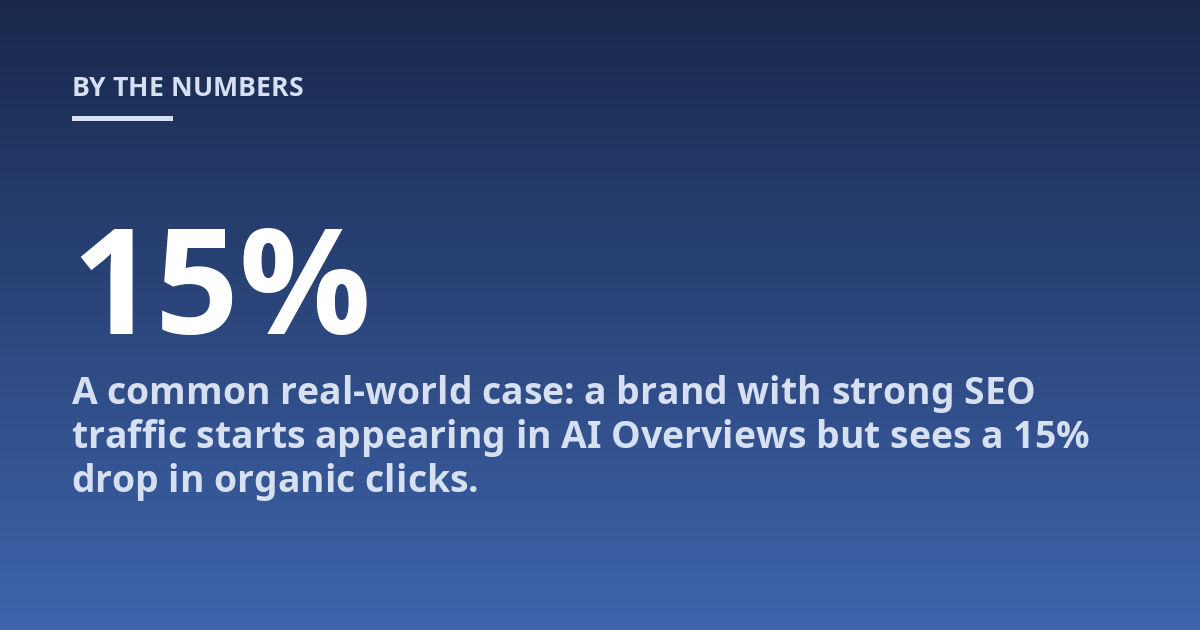
A common real-world case: a brand with strong SEO traffic starts appearing in AI Overviews but sees a 15% drop in organic clicks. The fix is not to pull back from GEO. It is to add structured content specifically designed for answer surfaces. That way, even if the click declines, the brand remains visible as a cited source. Over time, the combination of SEO-driven authority and GEO-driven citations creates a feedback loop. More citations improve topical authority, which improves rankings, which improves citation potential.
Think of it this way: SEO is your foundation. GEO is your insurance against zero-click answers. You build the house, then you make sure it is visible from every angle.
Does GEO Replace Traditional SEO?
No. That is the most dangerous misconception we see. GEO cannot replace SEO because AI models still rely on the same web index that Google uses. If your site is not crawlable, not indexed, and not authoritative, no AI model will cite it. GEO only works when the underlying SEO is solid.
What changes is the optimization strategy. You still need technical SEO, backlinks, and keyword research. But you also need answer-first paragraphs, inline evidence, and self-contained sections that an AI model can extract without reading the whole page. The brands that succeed in both systems treat GEO as an additional layer, not a substitute.
If you are wondering whether your existing content can rank in both systems, start with Can AI write content that ranks on Google? The short answer is yes, but only if it is structured for both humans and generative engines.
What Are the Risks of Ignoring GEO?
The biggest risk is being invisible in the fastest-growing search surface. Gartner predicts that search volume will drop 25% by 2026 as users shift to AI chatbots and generative interfaces. If your content is not structured for citation, you lose that share.
Other risks include:
- Zero attribution: AI models may use your content without linking back, so you get no click and no brand mention.
- Competitor citation: your competitor with a weaker site but better GEO structure gets cited while you do not.
- Wasted SEO effort: you rank well, but users get the answer from an AI overview and never visit your site.
The fix is not complicated. Add a section to every important page that answers the core question in the first two sentences. Include a specific fact with a citation. Make that passage quotable. It takes 15 minutes per page and changes citation eligibility dramatically.
FAQ
What is the difference between SEO and GEO in simple terms?
SEO makes your website rank high in Google search results. GEO makes your content appear as a cited source in answers from tools like and Perplexity. Each requires a different content structure: SEO uses keyword-optimized pages, while GEO uses direct, evidence-backed answer passages.
Why is the difference between SEO and GEO important for my business?
Because user search behavior is splitting into two paths. Some users still click links. Others get answers from AI without visiting any site. Optimizing for both paths protects your visibility. If you only optimize for SEO, you risk falling off the AI answer map entirely.
When should I start optimizing for GEO?
Start now if your site already has a healthy SEO foundation: indexed pages, technical soundness, and some topical authority. If your site has significant technical issues, fix those first. GEO layers on top of SEO, not in isolation.
How long does it take to see results from GEO?
GEO results are faster to measure than SEO results because you can test passages in AI tools directly. You may see citation changes within days of restructuring a passage. But sustained performance depends on maintaining topical authority and updating evidence regularly. For comparison, see How long does SEO take to show results?
What are the main risks of GEO?
Risks include being cited out of context, losing zero-click traffic, and investing in GEO without first fixing technical SEO. The most common mistake is treating GEO as a replacement for SEO. It is not. A professional consultation can help you decide where to allocate resources based on your current site health and market position.
How do I prepare content for GEO?
Start each page section with the direct answer to the most likely question. Include inline citations to authoritative sources. Use named entities clearly and avoid promotional language. Write self-contained passages that make sense when extracted alone. Then test in or Perplexity to see if your content gets cited.
How should someone prepare for a consultation about GEO versus SEO?
It helps to note your current search traffic, the questions your audience asks most, and any recent changes in your organic performance. Existing SEO audits or content inventories can help the consultant understand your starting point. Be specific about your goals: more traffic, more citations, or both.
The difference between SEO and GEO is not a choice. It is a layering strategy. At TsoDen, we build both foundations and answer layers so your brand survives the shift to AI search. Contact TsoDen for a GEO readiness audit that shows exactly where your content stands, where it needs to change, and which moves will have the biggest impact on your visibility in both search
Real-World Example: SEO vs GEO in Action
Consider a home services company in Austin, Texas that offers emergency HVAC repair. Their SEO strategy targets phrases like “emergency AC repair Austin” through location-specific landing pages, service descriptions, and local business citations. This approach drives steady organic traffic from users actively searching for repair services.
When the same company optimizes for GEO, they restructure their key service page. The opening paragraph becomes: “Emergency AC repair in Austin typically costs 50 to 80 percent more than standard service calls because after-hours labor rates and weekend dispatch fees apply. For a two-hour window, most Austin HVAC contractors charge a minimum of 250 dollars plus parts.” This passage contains specific numbers, a named city, and a clear claim. When a user asks an AI tool “How much does emergency AC repair cost in Austin?”, this passage becomes a strong candidate for citation.
The SEO version drives clicks. The GEO version drives citations. The company needs both to capture the full spectrum of search behavior.
Practical Steps to Combine SEO and GEO
Start with a content audit that scores each page on two dimensions: SEO readiness and GEO readiness. SEO readiness includes crawlability, keyword targeting, internal linking, and load speed. GEO readiness includes answer-first structure, inline citations, named entities, and extractable standalone sections.
For pages that score well on SEO but poorly on GEO, the fix is usually small. Rewrite the first two sentences to answer the core question directly. Add one or two specific facts with links to authoritative sources such as government data, industry reports, or academic studies. Remove promotional language from the opening paragraph. Keep the rest of the page intact for human readers.
For pages that score poorly on SEO, focus on technical fixes first. A non-indexed page cannot be cited regardless of how well it is written. Run a site audit using tools like Screaming Frog or Sitebulb to identify crawl errors, missing meta tags, and broken internal links before investing time in GEO structuring.
Monitor both traditional rankings and AI citation frequency. Tools like BrightEdge and MarketMuse now offer features that track how often your content appears in AI answers. Compare these numbers against your organic traffic trends. If citations rise while clicks decline, you are winning in the new surface but losing in the old one. The solution is to add conversion paths within AI-sourced traffic, such as clear calls to action that work even when read in an answer snippet.
Common Misconceptions About SEO and GEO
One misconception is that GEO only matters for technology companies or SaaS brands. In practice, any business with a physical location, specific pricing, or documented processes benefits from GEO. A local dentist who writes “Root canal costs in Denver range from 700 to 1,200 dollars per tooth depending on the tooth location and specialist involvement” is more likely to be cited than one who writes “We offer affordable root canal treatment.”
Another misconception is that GEO requires expensive tools or AI expertise. The core techniques are straightforward: write direct answers, use real numbers, cite your sources, and avoid vague claims. The same editorial discipline that makes your content better for human readers also makes it better for AI models.
A third misconception is that GEO traffic is unmeasurable because you cannot track a citation the same way you track a click. While citations do not generate direct analytics events, you can measure brand mention volume, referral traffic from AI tools, and changes in direct search queries that follow a citation spike. These metrics give you a directional view of GEO performance.
When to Prioritize One Over the Other
Prioritize SEO first if your site has technical problems that prevent indexing or if you are starting a new domain with zero authority. Without a crawlable, authoritative foundation, GEO efforts will have minimal impact.
Prioritize GEO first if your site already ranks well but you notice declining click-through rates from search results. This pattern indicates that AI overviews are capturing the answer traffic that used to go to your pages. Restructuring existing content for citation eligibility can recover some of that visibility.
In most cases, the right approach is a phased investment. Month one fixes technical SEO. Month two builds topical authority through linked content clusters. Month three adds GEO structure to the highest-value pages. By month four, you have a system that works across both search surfaces.
Final Thoughts
The difference between SEO and GEO is not a binary choice. It is a strategic layering that matches how people now search. Some users type queries into Google and click the first result. Others ask a chatbot and read a synthesized answer. Your content must work in both scenarios.
SEO remains the entry requirement for any serious online presence. GEO is the emerging requirement for staying visible as search shifts toward answers. The brands that invest in both will capture traffic and citations. Those that choose one over the other will lose a growing share of their potential audience.
If your team needs help assessing where your content stands on both fronts, consider a structured audit that examines technical health, topical authority, answer structure, and citation readiness. The investment is small compared to the cost of being invisible in the fastest-growing search channel.
For further reading, explore our guide on What is generative engine optimization and how does it affect your content strategy to understand the specific techniques that improve AI citation rates.
Other posts from the category
There are no posts for the selected category.

Latest posts from the category
-

What makes an effective Category Page for AI
June 5, 2026
-

What Influences the cost of AI Optimisation
June 1, 2026
-

Organisation Schema: how to help AI understand your brand
May 27, 2026