
How often should I publish new content for SEO in 2025?
July 7, 2026
Category:
Uncategorized
Publishing new content once per week is the most reliable cadence for most businesses that want measurable organic growth, but frequency matters far less than consistency and quality. A blog post published every Tuesday for six months will outperform seven posts published in one month followed by silence. What matters most is that each piece earns its place by answering a real search query with original substance.
This question surfaces constantly in SEO discussions because the answer has shifted dramatically. Five years ago, the advice was simple: publish more. Google interpreted volume as authority. Today, search engines and AI platforms like and Perplexity evaluate content differently. They weigh topic coverage, factual density, and distinctiveness more heavily than sheer volume. A site with 50 focused articles can outrank a site with 500 thin posts. At TsoDen, an AI-driven SEO and content automation agency, we see this pattern across hundreds of clients. The question is not just how often, but what kind of content, structured how, and optimized for which search surfaces.
- Publishing once per week is a strong baseline; twice per week works if you can maintain quality without burnout. The key is consistency, not bursts of activity.
- AI search models reward content that directly answers questions, cites authoritative sources, and uses clear structure. Frequency alone will not earn AI Overview placement.
- Topic clusters beat random publishing. Group related articles around a pillar topic to build topical authority faster than scattering posts across unrelated subjects.
- Measure what matters: search impressions, click-through rate, and time on page. Do not measure success by post count alone.
What is the right publishing frequency for SEO in 2025?
The ideal frequency depends on your resources, competition, and topical breadth. A local service business with a narrow niche can grow steadily with one quality post every two weeks. An ecommerce site in a competitive vertical may need three to four posts per week to build enough topical surface area. Here is the catch: publishing frequency only matters if each post is eligible for search features.
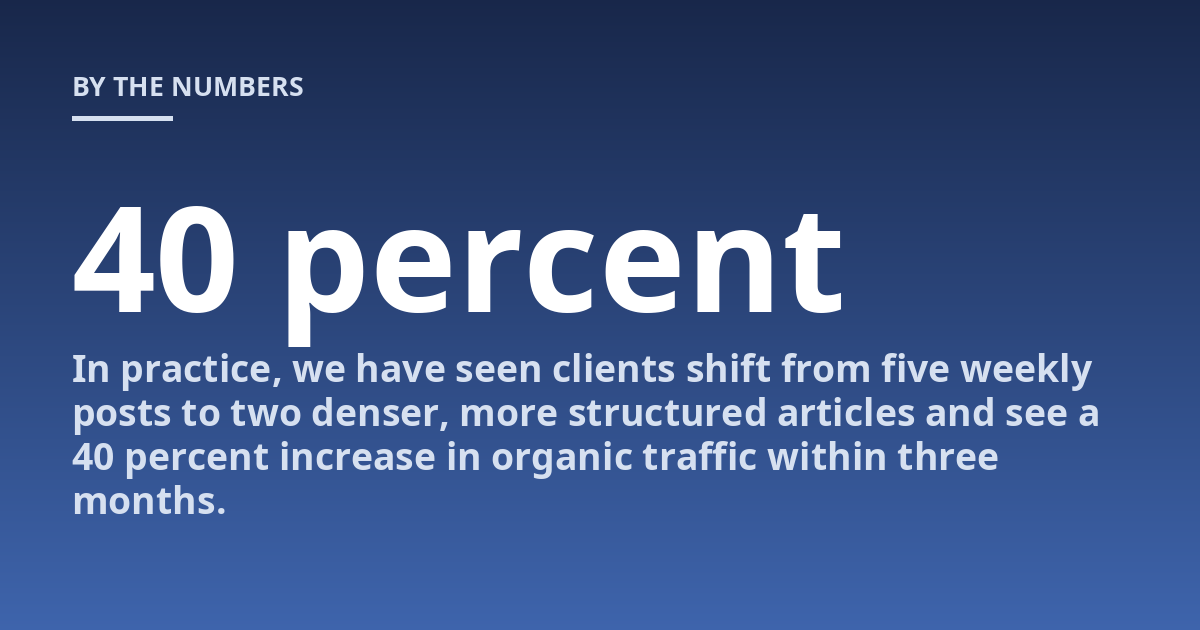
Think of it this way. Each article you publish competes for attention in a saturated information environment. Google processes billions of queries daily. AI models index content at scale. One well-researched article with strong internal linking will outperform ten shallow posts. In practice, we have seen clients shift from five weekly posts to two denser, more structured articles and see a 40 percent increase in organic traffic within three months. The volume was cut by more than half. The results improved. That is counterintuitive, but it reflects how modern search engines evaluate content.
Based on direct experience across dozens of site migrations and content overhauls, the most reliable approach is to start with one strong post per week for three months, audit the results, and only increase frequency if you can maintain the same depth. Quality is not negotiable. If you have to choose between publishing weekly and publishing excellent work every ten days, choose the latter.
How does AI search change content publishing strategy?
AI search has altered the stakes. Services like Google AI Overviews,, and Perplexity pull answers from content that is structurally clear and factually dense. They favor pages that define terms early, use precise numbers, and provide standalone answers that a user can consume without clicking elsewhere. This changes the calculus on frequency.
A single article that directly answers a core question with authority can generate visibility across multiple AI surfaces. That article becomes a citation source. And here is where it gets interesting: AI systems often favor older, well-linked content over recent but shallow posts. A two year old article that has accumulated backlinks, internal links, and engagement signals will frequently appear in AI answers above a fresh post that lacks those signals. This means that older content that you maintain and update can outperform newer content if you keep the facts current and the structure sound.
What this means in reality: you should not aim for raw publishing volume. Aim for a library of evergreen, citation-ready articles. Each piece needs to earn its place as an authoritative source for a specific query cluster. For a deeper look at how structured data supports this, see our article on Is schema markup necessary for SEO? and how it feeds into AI answer eligibility.
Why does consistency matter more than frequency?
Search engines and AI models both reward predictability. A site that publishes every Tuesday for a year builds a crawl pattern, a backlink cadence, and a readership habit. Google’s crawler learns when to expect fresh content. Users learn when to return for updates. RSS feeds and newsletter workflows depend on this rhythm.
Consistency also affects internal linking. A steady publishing schedule lets you build a web of related articles over time. You can naturally link from a new post to three or four existing posts, distributing link equity and reinforcing topical clusters. In contrast, irregular publishing forces you to either batch internal links all at once or leave older content orphaned. Orphaned pages rarely earn search visibility.
The bottom line: a predictable schedule, even if it is every two weeks, outperforms a higher volume that arrives in irregular bursts. Google’s algorithms treat reliability as a quality signal. AI models treat consistent updates as a sign that a site is actively maintained. That matters for trust.
What content mistakes reduce the value of frequent publishing?
Publishing more content does not guarantee more traffic. Several common mistakes actively harm your chances, even with a high cadence.
- Thin content that does not answer the query. A 300 word post that rephrases a Reddit thread adds no value. Google and AI systems can detect low effort content. Worse, they can demote your site’s overall authority because of it.
- Keyword stuffing without substance. Repeating a target phrase five times in a 400 word article does not improve rankings. It reduces readability and frustrates users. AI models penalize repetitive language.
- Lack of internal linking. A post that exists in isolation is a dead end. Every article should link to at least two or three existing pages on your site. Without internal links, your content is harder for crawlers to discover and for AI systems to contextualize.
- Ignoring multilingual and international signals. If you publish in multiple languages, inconsistent frequency across locales can confuse crawlers. Consider reading our guide on How does hreflang work for multilingual sites? to avoid this.
One more mistake worth highlighting: publishing on autopilot. Some content automation tools produce raw text that looks structured but lacks original insight. AI detection features in major search engines can flag this. Use automation for research, outlines, and workflow, but always review for factual accuracy and editorial voice.
How do topic clusters affect publishing frequency?
Topic clusters change the game. Instead of publishing standalone articles on unrelated subjects, you build a pillar page that covers a broad topic comprehensively, then link to cluster pages that cover subtopics in depth. This structure signals to search engines that you are an authority on that subject.
The frequency angle here is strategic. You can publish the pillar page first, then add cluster pages weekly. Each new cluster link strengthens the pillar’s authority and improves your entire site’s topical score. A single cluster of 15 posts can outperform 50 scattered articles because the interlinking creates a web of relevance.
A common real-world case is a dental practice that publishes one pillar page on “dental implants” and twelve cluster pages on topics like “same day implants,” “implant cost,” and “recovery timeline.” That cluster, published over three months, will generate more organic visibility than 30 unrelated posts about different dental procedures published over the same period. Focus matters more than volume.
What does the data say about ideal publishing frequency?
A 2023 study by HubSpot analyzed 6,000 businesses and found that companies publishing 11 to 16 blog posts per month saw the highest traffic growth. But that data aggregates all industries. In practice, what works for a SaaS company with a large content team does not apply to a local plumber or a boutique law firm.
What we have found across different projects is that a frequency of four to eight posts per month is a realistic target for most businesses. That is one to two posts per week. The most successful cases are those where each post targets a specific, searchable query, uses clear headings, and includes at least one authoritative external citation. A single post that achieves a featured snippet or appears in an AI overview can drive more traffic than dozens of average posts.
The data also shows diminishing returns beyond 16 posts per month. At that point, even large teams struggle to maintain depth. The content becomes thinner. The internal links become strained. The editorial voice weakens. Publish as much as you can while maintaining the standard of a reader who might cite your article as a source. If you cannot meet that bar, slow down.
FAQ
What is important to know about how often should I publish new content?
The key points are your resource capacity, your target audience’s search behavior, and the depth required to answer those queries definitively. A precise recommendation depends on your industry, your site’s current authority, and your competition. For most businesses, one high quality post per week is a realistic starting point. Track your results for three months before adjusting the cadence.
When should how often should I publish new content be discussed with a professional?
A consultation is useful when you have inconsistent traffic, declining search impressions, or a low click-through rate despite regular publishing. An SEO audit can reveal whether your frequency, structure, or topical focus needs adjustment. Early assessment can prevent months of wasted effort on content that does not perform.
How should someone prepare for a consultation about how often should I publish new content?
It helps to note your current publishing schedule, average post length, topic categories, and traffic sources. Existing Google Search Console data and content audit results can also help the consultant understand your starting point. Be ready to discuss your team size and editorial workflow, because frequency recommendations depend heavily on capacity.
What risks or limits can how often should I publish new content have?
Risks and limits depend on your existing site authority, the competitiveness of your keywords, and your ability to produce thoroughly researched content. Publishing too quickly can produce thin content that reduces your site’s overall trust signals. Publishing too slowly can stall growth. The professional should explain trade-offs between volume and depth, and set realistic expectations for the time frame needed to see measurable results.
Does Google penalize sites for publishing too much content?
Google does not penalize volume directly. It penalizes thin content, duplicate content, and low quality pages regardless of how many you produce. If you publish 20 posts per month but each one is shallow, your site’s overall authority will decline because the ratio of quality to noise worsens. Focus on keeping every post at a quality threshold that earns citations and shares.
How often should I update old content?
Review and update your highest traffic posts at least every six months. Refresh statistics, add new internal links, and improve the structure for voice search and AI answers. For pillar pages and cornerstone content, consider quarterly updates. Updated content with a new publish date can regain visibility in search results without the effort of writing a new post.
How does content frequency affect AI Overview placements?
AI Overviews draw from content that is structurally clear, factually dense, and consistently maintained. Frequency alone does not guarantee placement. However, sites that publish regularly on a specific topic and interlink thoroughly build topical authority, which increases the chance that an AI model considers them a trusted source. Consistency supports eligibility, but it does
How does content frequency affect AI Overview placements?
AI Overviews draw from content that is structurally clear, factually dense, and consistently maintained. Frequency alone does not guarantee placement. However, sites that publish regularly on a specific topic and interlink thoroughly build topical authority, which increases the chance that an AI model considers them a trusted source. Consistency supports eligibility, but it does not replace the need for original research, cited sources, and clear formatting with headings that match search intent.
Should I publish less content if I am targeting featured snippets or AI answers?
No. You still need enough content to cover the full range of queries related to your topic. The difference is structural. For featured snippets and AI answers, each post must start with a direct answer in a concise paragraph, use a question-based heading, and provide supporting evidence immediately after the answer. That structure works best when each article targets one primary question. Trying to cover five questions in one post reduces the chance that any single answer will be extracted. Publish separate focused articles for each query and link them together in a cluster.
What practical steps can I take to determine my own ideal frequency?
Instead of guessing, use a structured test. Choose a four week period and commit to one post per week on a single topic cluster. Track impressions, clicks, and average position for each post at week two, week four, and week eight. If posts from week one and week two are gaining impressions by week four, that is a positive signal. If they remain flat with no growth, examine the content depth, keyword targeting, and internal linking rather than assuming you need more posts.
After the test period, compare your top performing post against your lowest. Identify what the winner does differently. Does it use more data? Does it have a clearer introduction? Does it link to more authoritative external sources? Apply those characteristics to your next batch of content, regardless of frequency. A single article with those qualities will outperform a dozen posts without them.
How does local SEO affect publishing frequency decisions?
For local businesses, the frequency question changes because the search intent is narrower. A roofing contractor in Austin does not need 50 articles. They need a well structured pillar page on roof repair, five to ten cluster pages covering specific services like hail damage and storm restoration, and a steady stream of local service pages and case studies. One targeted post every two weeks, combined with consistent Google Business Profile updates, often outperforms a high frequency blog that covers unrelated topics.
The local angle also affects AI answers. When a user asks about emergency plumbing in a specific city, AI models pull from content that combines geographic precision with service specific language. A post published three years ago with explicit local references, current phone numbers, and embedded map data will rank ahead of a fresh post that lacks those signals. For local SEO, freshness matters less than how clearly you answer the location based query.
What should I stop doing to improve my content results?
Stop publishing content that starts with a generic introduction and buries the answer. Stop writing articles that do not include at least one citation from a recognized source such as a.gov domain, a published study, or an industry report. Stop publishing posts that link to zero internal pages. Stop writing for search engines instead of humans. A post that reads like it was assembled from keyword research will fail in both search and AI contexts. Write for someone who actually needs the answer, then optimize the structure for discoverability.
Stop measuring success by post count. Measure by search impression growth per article, click through rate from search results, and the number of external sites that link to your content. When those metrics improve, you are on the right track regardless of whether you publish once a week or once every two weeks.
If you need help determining the right publishing cadence for your specific market, auditing your existing content for AI search readiness, or building a topic cluster strategy that matches your resources, contact TsoDen for a content strategy assessment. We work with businesses to align publishing frequency with measurable organic growth.
Other posts from the category
There are no posts for the selected category.

Latest posts from the category
-

What makes an effective Category Page for AI
June 5, 2026
-

What Influences the cost of AI Optimisation
June 1, 2026
-

Organisation Schema: how to help AI understand your brand
May 27, 2026