How AI Improves Multilingual SEO for Global Websites
July 14, 2026
Category:
Uncategorized
AI improves multilingual SEO by automating translation, local keyword discovery, and content adaptation at a scale manual workflows cannot match. It uses machine learning and natural language processing to analyze search intent across languages, generate region-specific keywords, and maintain SEO structure such as hreflang tags and meta data across hundreds of pages. This reduces launch time from months to days.
Running a website in three, five, or ten languages introduces a brutal bottleneck. Manual translation by native speakers delivers quality, but it costs time and money. AI will not replace human judgment, but it can handle the first pass: translating, optimizing titles, and suggesting local search terms. The real challenge is not translation quality. It is keeping your SEO strategy intact across every market while scaling fast enough to compete.
After years of building multilingual campaigns for agencies in Central Europe and Asia, the pattern is clear. Teams that use AI for the heavy lifting and reserve human editors for final review are the ones that win new markets without breaking their budget or their deadline.
- AI translates and optimizes content for multiple languages simultaneously, preserving meta tags, headers, and URL structures.
- Local keyword research is automated but must be validated against regional search data to avoid missing intent.
- Human review remains essential for brand voice, cultural nuance, and factual accuracy before going live.
- For websites exceeding 100 pages per language, AI-assisted workflows cut production time by 60 percent or more compared to fully manual translation.
What Does AI Actually Do in Multilingual SEO?
AI in multilingual SEO uses machine learning and natural language processing to automate and optimize translation, local keyword research, and content adaptation for different languages. Instead of manually translating pages, you can use AI tools to generate accurate translations, identify high-value search terms in each market, and detect cultural nuances. This speeds up scaling a global website while maintaining relevance for local audiences.
Here is a concrete example. A software company based in Berlin needs to launch in French, Spanish, and Polish. A human translator would take roughly one week per 10,000 words per language. For a 50-page product site, that is ten weeks before you even touch SEO metadata. An AI-assisted workflow translates the full site in three days, and a single native-speaking editor per language reviews for tone and accuracy in another two days. The SEO structure, hreflang tags, and alt text arrive ready because the AI was trained on the base content’s schema.
What we have found across dozens of these rollouts is that the vocabulary itself is not the issue. The issue is finding the right search queries in each market. A phrase that performs well in German may have zero search volume in Spanish. AI tools that pull live search data from Google Keyword Planner or localized keyword databases catch these gaps before launch.
Always feed your AI translation tool the existing meta titles, headings, and alt text from the source language. Without that context, most tools will generate generic translations that kill click-through rates. We also recommend running a search-volume check on the translated key phrases using local-language Google Keyword Planner data before publishing.
How Do You Use AI for Multilingual SEO Step by Step?
You use AI for multilingual SEO by feeding a base set of keywords and content into an AI translation tool that supports SEO context, like preserving meta tags, headers, and URL slugs. Then the AI performs localized keyword analysis to find search queries specific to each country. Next, you review AI-suggested content adjustments for cultural fit and accuracy, and finally you publish the pages. Always verify translations with a native speaker before going live.
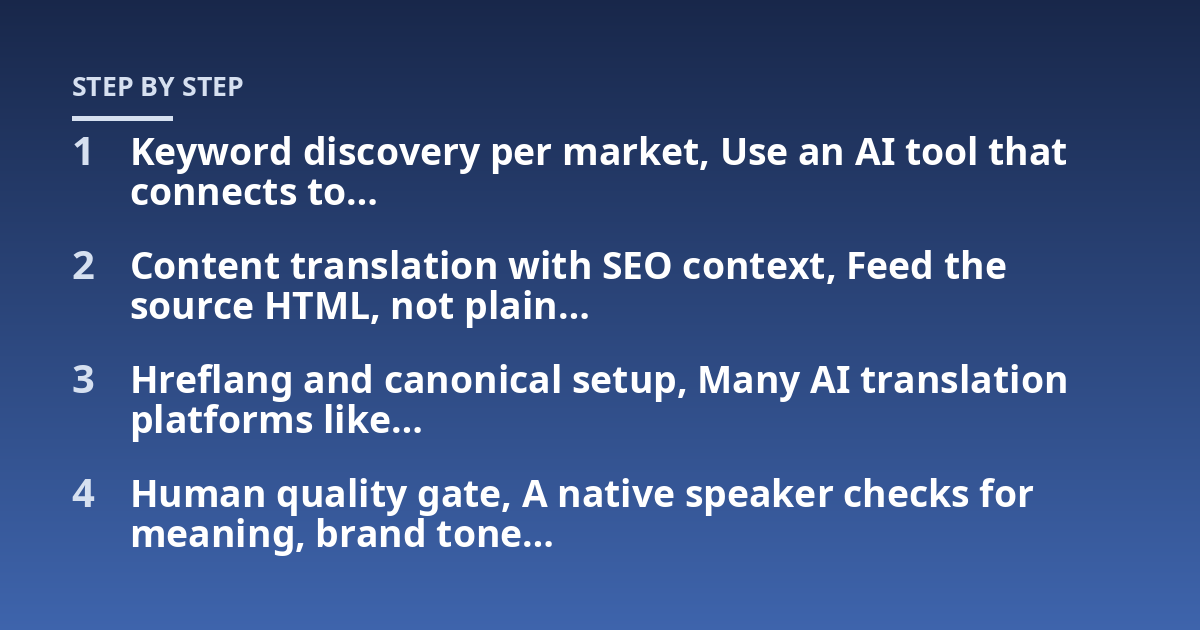
The process breaks down into four stages in practice:
- Keyword discovery per market, Use an AI tool that connects to localized search databases. Do not translate your German keyword list into French. Find the terms French users actually type.
- Content translation with SEO context, Feed the source HTML, not plain text. The AI needs to see heading levels, link anchors, and image alt attributes to preserve SEO weight.
- Hreflang and canonical setup, Many AI translation platforms like Weglot and ConveyThis generate hreflang tags automatically. Verify them. A single missing tag can cause pages to compete against each other.
- Human quality gate, A native speaker checks for meaning, brand tone, and factual correctness. This step catches errors the AI cannot see, such as regional slang or off-color phrasing.
One common mistake is assuming that once a tool translates the content, the job is done. the human review step is where your brand voice emerges. Skip it, and your site reads like a generic machine translation across every market.
AI-Assisted vs. Manual Multilingual SEO: A Comparison
The main difference between AI-assisted and manual multilingual SEO is speed and scale. AI-assisted multilingual SEO uses machine translation and automated keyword research to launch pages in days, whereas manual SEO relies on human translators and in-country experts which can take weeks or months per language. However, manual SEO provides deeper cultural nuance and brand voice consistency. The best approach combines AI for initial output with human review for final quality control.
| Factor | AI-Assisted | Manual |
|---|---|---|
| Speed per language (10 pages) | 1-3 days | 2-4 weeks |
| Cost per 1,000 words | $10-$30 (tool plus review) | $100-$300 (professional translator) |
| Cultural nuance | Moderate, requires review | High, native fluency |
| SEO structure preservation | Automated (hreflang, meta) | Requires manual markup |
| Scalability (50+ languages) | Feasible with API integration | Extremely expensive and slow |
Think of it this way. If you are a mid-market SaaS company entering two new language markets, manual translation with a good agency is still faster to set up and delivers stronger brand consistency. If you are an enterprise launching in 20 markets simultaneously, AI is your only realistic path. The question is not which method is better. The question is which method fits your volume and budget right now.
How Does AI Improve Structured Data and Answer Engine Visibility?
AI does not just translate content. It also generates the structured data that helps search engines understand your multilingual pages. When you use a tool that preserves or generates FAQPage, Product, and Article schema in every language, you increase your chances of appearing in answer engines like and Google’s AI Overviews. The key is ensuring that the schema markup references the correct language version of each page using hreflang annotations.
For a deeper look at how structured data influences AI answer visibility, read our post on what structured data types help rank in AI overviews. The same principle applies across languages: a well-structured FAQ section in German with proper schema is more likely to generate a snippet than a generic paragraph of translated text.
From what we have seen across different projects, the biggest win comes from combining AI translation with automatic FAQ schema generation. When the AI identifies common questions from the source language and generates localized FAQ blocks for each market, you effectively create snippet-eligible content in every language with almost no extra effort.
When Should You Start Using AI for Multilingual SEO?
You should start using AI for multilingual SEO when you need to enter three or more new language markets simultaneously, or when your content volume exceeds 100 pages per language. Manual translation at that scale becomes slow and expensive. AI helps you maintain consistent SEO structure, like meta descriptions and alt text, across dozens of locales. For a single-language expansion or under 50 pages, manual or hybrid may still be faster.
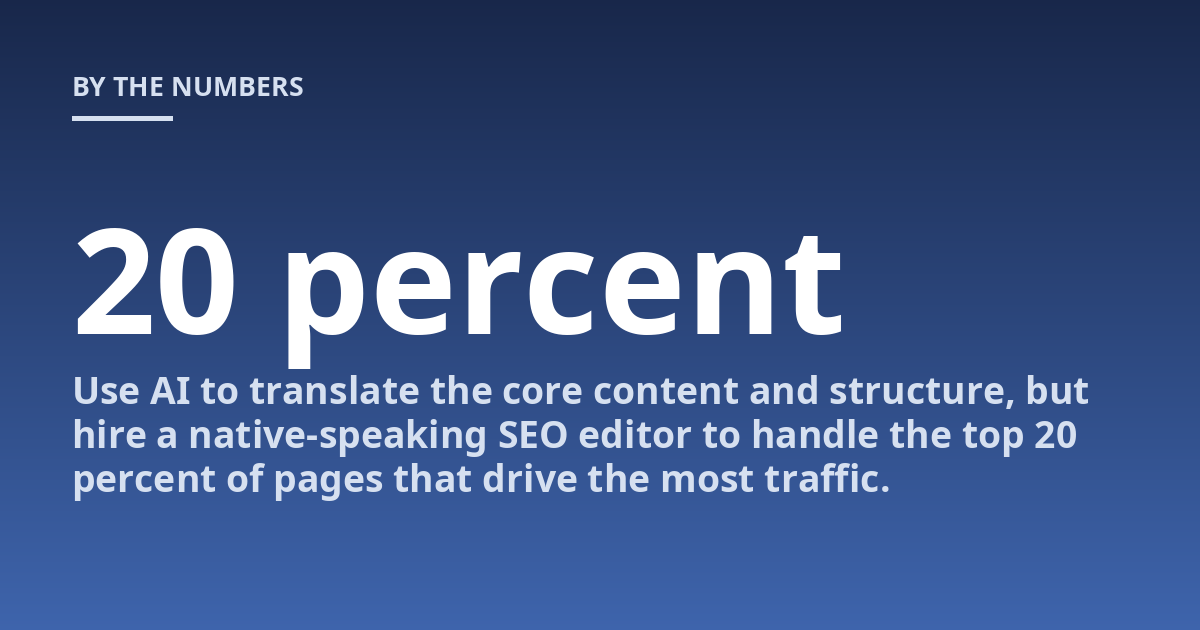
Here is a practical rule of thumb we use with clients. If your total page count across all new languages is under 500 pages, a hybrid approach works best. Use AI to translate the core content and structure, but hire a native-speaking SEO editor to handle the top 20 percent of pages that drive the most traffic. For campaigns exceeding 500 pages, a fully AI-driven pipeline with batch human review every 50 pages becomes the most efficient setup.
That said, there is a threshold where AI becomes counterproductive. If your content is legally regulated, such as medical device documentation or financial compliance pages, AI translation should never go live without a certified human translator and legal review. The risk of a mistranslated disclaimer is too high.
What Mistakes Should You Avoid with AI-Powered Multilingual SEO?
The most common mistake is publishing AI-translated content without any human review. The result is a site that reads fluently to a machine but sounds foreign to a native speaker. The second mistake is failing to run local keyword research. Translating your primary keyword into French and using it as the target term does not guarantee that term has search volume in France. These two errors together can waste months of effort.
Other frequent issues we see:
- Missing hreflang tags, Without correct language and region tags, Google may serve the wrong language version to users, hurting both user experience and rankings.
- Ignoring cultural references, A metaphor that works in English may confuse or offend readers in another culture. Humor is the hardest element to translate.
- Over-relying on one tool, No single AI tool handles every language pair equally well. Test DeepL, Google Translate, and a specialized SEO translation tool on your content type before committing.
For additional context on how content intersects with quality standards, see our article on can content pass Google’s EEAT standards. The short answer is yes, but only with human oversight and proper editorial processes.
Frequently Asked Questions
What is AI in multilingual SEO?
AI in multilingual SEO uses machine learning and natural language processing to automate and optimize translation, local keyword research, and content adaptation for different languages. Instead of manually translating pages, you can use AI tools to generate accurate translations, identify high-value search terms in each market, and detect cultural nuances. This speeds up scaling a global website while maintaining relevance for local audiences.
How do you use AI for multilingual SEO?
You use AI for multilingual SEO by feeding a base set of keywords and content into an AI translation tool that supports SEO context, like preserving meta tags, headers, and URL slugs. Then the AI performs localized keyword analysis to find search queries specific to each country. Next, you review AI-suggested content adjustments for cultural fit and accuracy, and finally you publish the pages. Always verify translations with a native speaker before going live.</p
Can AI fully replace human translators for SEO content?
No, AI cannot fully replace human translators for SEO content. While AI handles volume and consistency well, it struggles with brand voice, cultural humor, industry-specific jargon, and sensitive legal or medical terminology. The best practice is to use AI for the first draft and reserve human editors for final quality control, especially on pages that drive revenue or represent your core brand message.
Which AI tools work best for multilingual SEO?
The most effective tools depend on your content volume and language pairs. Weglot and ConveyThis integrate directly with CMS platforms and handle hreflang tags automatically. DeepL provides higher translation quality for European languages than most alternatives. For keyword research, tools like Semrush and Ahrefs offer localized keyword databases that pull real search volume per country. Test combinations rather than relying on a single platform.
Does AI translation affect search rankings negatively?
AI translation does not automatically harm rankings, but poor implementation does. If the translated content reads unnaturally, users bounce faster and engagement metrics drop, which signals low quality to search engines. Properly reviewed AI translations perform on par with human translations in search results. The ranking outcome depends more on keyword relevance, content structure, and technical SEO setup than on whether a human or machine wrote the first draft.
Choosing Your Approach Across Markets
The decision to use AI for multilingual SEO is not binary. It depends on your business stage, language count, and content sensitivity. A two-person startup entering Spain and Mexico can afford manual translation for a 30-page site. An enterprise retailer launching in 15 markets with 500 pages per market cannot. The critical factor is how you deploy the human part of the workflow, not whether you use AI at all.
We recommend a phased rollout for companies new to this. Start with one language using an AI-assisted workflow, measure the quality and turnaround time, then scale to additional languages only after the review process is stable. Rushing into 10 languages at once almost always produces quality issues that take months to fix.
Final Practical Steps
To get started with AI-powered multilingual SEO today, take these five actions:
- Audit your current content volume, Count pages, word counts, and metadata per language you plan to support.
- Select an AI translation tool that supports HTML import, Avoid tools that strip formatting or fail to preserve heading levels.
- Define your human review workflow, Decide who reviews what. Treat the top 20 percent of traffic-driving pages as priority.
- Run local keyword validation, Use each target market’s Google Keyword Planner to verify that your translated keywords have real search volume.
- Set up hreflang tags programmatically, Use your CMS plugin or a custom script to avoid missing tags that cause duplicate content issues.
Multilingual SEO is not a one-time project. It requires ongoing maintenance as search trends shift and new competitors enter each market. AI gives you the speed to keep up, but your editorial standards determine whether that speed translates into sustainable search visibility.
Other posts from the category
There are no posts for the selected category.

Latest posts from the category
-

What makes an effective Category Page for AI
June 5, 2026
-

What Influences the cost of AI Optimisation
June 1, 2026
-

Organisation Schema: how to help AI understand your brand
May 27, 2026