
Aeo vs Seo Whats the Difference and Why You Need Both
July 31, 2026
Category:
Uncategorized
The difference between answer engine optimization and search engine optimization lies in where your content appears and how users consume it. Search engine optimization targets traditional blue links on a results page, while answer engine optimization structures data to trigger summaries and direct answers. You need both strategies because modern searchers expect immediate results from chat interfaces alongside detailed pages from standard search.
The way users find information has fractured. A marketer can no longer assume a visitor will click through to the homepage after typing a query. Voice assistants, chatbots, and AI overviews now intercept complex questions before they reach a browser window. Relying solely on keywords gets your page ranked. Structuring data for extraction gets you cited. This split requires a unified approach that satisfies both algorithms simultaneously.
- AEO targets answers while SEO targets traditional search listings.
- Structured data and entity accuracy matter more in answer engines than in standard search.
- Content for AEO requires clear headers, direct definitions, and concise summaries.
- You lose visibility in AI chat tools if you ignore extraction-focused optimization.
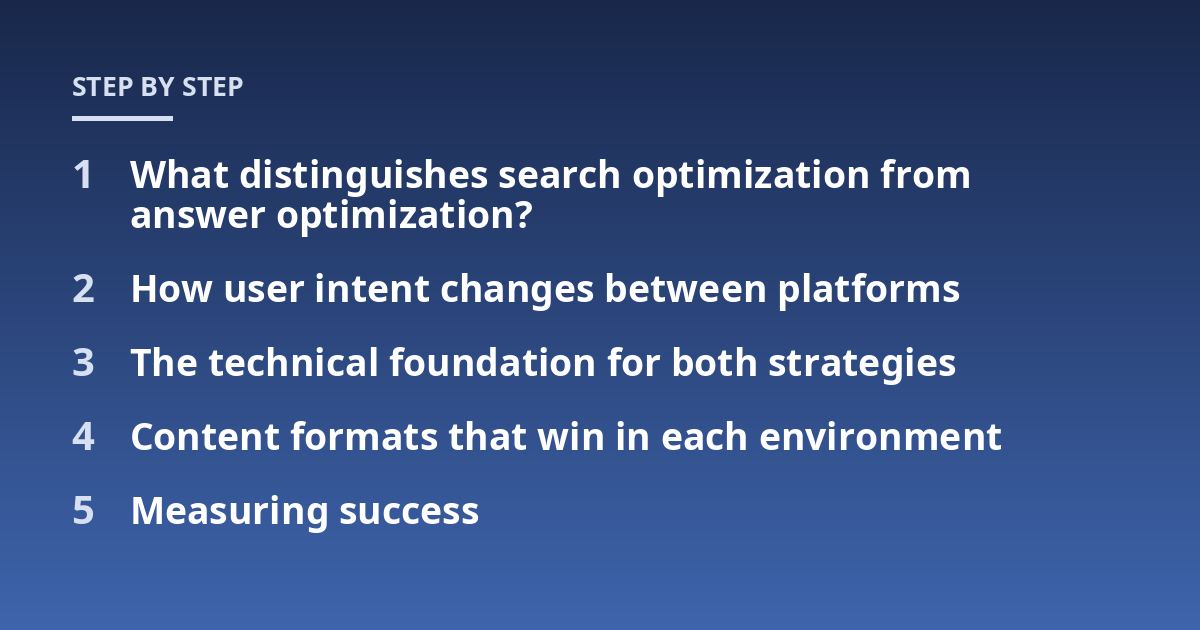
What distinguishes search optimization from answer optimization?
Search engine optimization builds authority and relevance to win clicks. It relies on backlinks, domain trust, and keyword alignment to push pages up a results list. Answer engine optimization focuses on extraction. AI models read your content to generate responses. They pull facts, definitions, and recommendations directly into the chat interface.
The goals diverge here. SEO wants you to leave their platform. AEO wants to keep the user inside the tool. This dynamic changes how you write. Standard search rewards depth and dwell time. Answer engines reward clarity and conciseness. An AI system needs to parse a sentence and pull out a fact without guessing.
In practice, this means your homepage headline must do double duty. It should contain the primary keyword for ranking while also defining the entity clearly for extraction. If an AI cannot verify what you offer within the first few sentences, it will skip your source. EEAT for content: Building trust with search engines covers how to align these goals in multilingual campaigns.
How user intent changes between platforms
User behavior splits based on the tool they open. A transactional query like “best accounting software” still drives clicks. Users want to compare features, read reviews, and make a purchase. Standard search handles this perfectly by showing comparison tables and vendor links.
A research query like “how does compound interest work over ten years” triggers text generation. The user often has no desire to visit three different finance blogs. They want the math explained in one place. If your site provides that explanation, you become a source. You may not get the click, but you own the mental real estate.
This shift affects content planning. You must identify which of your topics drive direct action and which drive information gathering. The former needs standard SEO tactics. The latter needs answer engine preparation. Ignoring the research intent leaves value on the table for brand awareness.
The technical foundation for both strategies
Structured data acts as the bridge between your content and AI models. Search engines use schema markup to understand page context. Answer engines use it to verify facts and extract entities. JSON-LD is the standard format for this data. You should mark up articles, FAQs, products, and local business information.
Not all structured data serves both purposes equally. An FAQ schema helps you rank for long-tail questions in standard search. It also feeds directly into AI chat responses when users ask those same questions. The difference lies in the surrounding context. AI models look for corroborating evidence across multiple sources to validate an answer.
Stop treating AI outputs as noise. Every time your brand appears in a chat response, you own that mental real estate even without a click. Prioritize schema types that define entities clearly, such as Organization and Product, so models can reference you accurately.
Technical audits must include both crawling and extraction tests. A page might crawl perfectly but fail the entity test because the schema is missing or malformed. Google provides tools to validate your markup. Third-party parsers can show how AI systems read your structure. Optimizing Content for AI Search Experiences explains how to automate these checks in WordPress.
Content formats that win in each environment
Standard search favors long-form content. It signals authority when you cover a topic from every angle. Answer engines prefer modularity. They scan for specific answers. A wall of text is useless to a model if the key fact is buried in paragraph four.
Structure your content for extraction. Use H2 headers that match common question patterns. Place direct answers at the top of sections. Avoid fluff, rhetorical questions, and vague transitions. AI systems discard these elements when generating summaries. They look for subject-verb-object clarity.
The writing style must adapt without losing voice. You can maintain a professional tone while increasing readability. Break complex ideas into lists. Use bold text sparingly to highlight key terms. Ensure your definitions are unambiguous. Multilingual SEO Automation: Scaling Content Across 10 Languages details how generative engines interpret different content structures.
Measuring success: traffic versus citations
Your analytics stack requires new metrics for answer engine performance. Google Analytics tracks clicks and sessions. It cannot measure when a user gets an answer from a chat tool and never leaves that tool. You need to track brand mentions and citation volume in AI outputs.
Surveys and qualitative research fill this gap. Ask your support team how users found them. Many will mention “Google chat” or “AI summary.” Social listening tools can also capture mentions of your brand in the context of generated responses. This data reveals which topics are working as extraction assets.
| Feature | Search Engine Optimization | Answer Engine Optimization |
|---|---|---|
| Primary Goal | Win clicks and drive traffic to a site. | Win extraction and appear in AI summaries. |
| Key Metric | Click-through rate, organic sessions, bounce rate. | Citation count, brand mentions in AI, entity accuracy. |
| Technical Focus | Page speed, mobile usability, backlinks. | Structured data, entity clarity, concise answers. |
| Content Style | In-depth guides, keyword-rich articles, reviews. | Direct definitions, Q&A format, list structures. |
| User Action | Read the page and click links within it. | Get a summary and leave the interface. |
Practical implementation steps
Start by auditing your highest-traffic pages. These are your strongest candidates for answer engine extraction because they already have authority. Add or refine structured data on these pages first. Mark up the core concepts and definitions clearly.
Review your content hierarchy. Ensure every H2 header promises a specific answer. Remove generic intro paragraphs that delay the main point. AI models penalize content that takes too long to deliver the requested information. Test your revised pages with an extraction tool to verify how they are parsed.
Maintain a regular update cycle for technical assets. Structured data breaks as you update templates. AI models evolve and change their citation habits. Quarterly audits of both SEO and AEO performance prevent slow decline in visibility. Focus on accuracy first, volume second.
FAQ
What is the main difference between AEO and SEO?
Search engine optimization focuses on ranking pages to earn clicks from a traditional results list. Answer engine optimization structures data so AI models can extract facts and cite your content in generated responses. SEO prioritizes keywords and backlinks for visibility. AEO prioritizes entity clarity, structured data, and direct answers for extraction. Both require technical soundness, but the user behavior they target differs significantly.
Does AEO replace SEO for marketers?
No, AEO does not replace SEO. Standard search still drives the majority of transactional traffic and detailed research. Users still visit websites to purchase products and read long-form reviews. However, ignoring answer engines means missing out on brand visibility in chat interfaces. You need a dual strategy that captures clicks through SEO while securing citations through AEO.
How does content automation affect SEO performance regarding answer engines?
Automated content can boost SEO if it follows quality guidelines and avoids duplication. For AEO, automation must prioritize structure over volume. AI models need clear definitions and accurate schemas to extract information. Poorly structured automation often fails the extraction test. Ensure your automated outputs include proper markup and concise answers to remain competitive in both search and chat results.
Why is structured data important for both strategies?
Structured data provides explicit context about your content that raw text cannot convey. Search engines use it to enhance snippets and understand page themes. Answer engines rely on it heavily to verify facts and identify entities. Without proper schema, an AI system may misinterpret your meaning or skip your source entirely. It is the most efficient way to communicate directly with algorithms.
How do you measure success in answer engine optimization?
You cannot measure AEO success solely through click-based analytics. Track brand mentions and citations in responses using listening tools. Monitor survey data for mentions of chat tools or summaries as traffic sources. Analyze which pages appear frequently in extraction tests. Success in AEO means owning the answer, even if the user does not click through to your site.
The split between traditional search and AI interfaces is permanent. Marketers who optimize only for clicks will lose visibility where conversations happen. Adopt a unified strategy that strengthens technical foundations, clarifies content structure, and tracks extraction metrics alongside traffic. Build for both environments now to secure full coverage of modern search behavior.
Other posts from the category
There are no posts for the selected category.

Latest posts from the category
-

What makes an effective Category Page for AI
June 5, 2026
-

What Influences the cost of AI Optimisation
June 1, 2026
-

Organisation Schema: how to help AI understand your brand
May 27, 2026