
How does hreflang affect international seo rankings?

October 31, 2026
Category:
Uncategorized
how does hreflang affect international seo rankings
How does hreflang affect international seo rankings?
How does hreflang affect international seo rankings by preventing duplicate content penalties and directing search engines to serve the correct language or regional version of your pages? It stops different versions of your site from competing against each other in search results. This ensures users see relevant content, which improves engagement metrics like click-through rates. Higher engagement signals lead to better organic visibility over time without changing core page authority.
International SEO requires more than translation. You need technical signals that tell Google how your pages relate across borders. Many teams neglect this step and lose valuable search traffic to competitors who do it right. A proper setup aligns your site architecture with user intent.
- Hreflang prevents self-cannibalization by signaling language and regional targeting to Google.
- Correct implementation requires reciprocal links between all versions of a page, including the default.
- Subdirectories generally outperform subdomains for consolidating domain authority in most cases.
- Regular audits catch broken tags and indexing errors that hurt international visibility.
How does hreflang prevent duplicate content issues?
Hreflang attributes tell search engines that multiple URLs contain similar content but target different audiences. Without these signals, Google sees your Spanish and English pages as potential duplicates. This triggers duplicate content filters that may demote or remove versions from indexing. The tool ensures each language version ranks in its intended market.
You often face this problem when running global campaigns. You might translate a landing page for France, Belgium, and Switzerland. All three use the same base structure. Google needs clear instructions to sort them out. Hreflang provides those instructions through code or sitemaps. It works by creating a web of relationships between your pages. Each URL points to its counterparts. It also points back to itself. This self-referencing is crucial for validation. The system checks that every version has a return link. Missing links create confusion in the index. Consider a user searching in German. The engine scans your site structure. It finds the German variant first through the hreflang tags. It serves that page instead of the English default. This keeps traffic focused on relevant markets.
You must include a self-referencing hreflang tag on every page. Omitting this causes Google to question the validity of your entire group, often resulting in incorrect language selection for users.
Which is better: subdirectories or subdomains?
Subdirectories keep all content under one main domain, which concentrates link equity. Subdomains split authority across different names. Most SEO practitioners prefer /en/, /fr/, and /de/ structures for this reason. Google treats subfolders as part of the root site.
You need to weigh technical constraints against marketing goals. Sometimes legal requirements force a separate domain structure. Other times, different teams manage regional sites independently. These factors might push you toward subdomains or ccTLDs.
| Structure Type | Authority Consolidation | Setup Complexity | Better For |
|---|---|---|---|
| Subdirectories | High | Low | Most global brands |
| Subdomains | Medium | Medium | Distinct product lines |
| ccTLDs | Low | High | Strong local presence |
Subdirectories simplify hreflang management. You maintain one sitemap and one set of headers. This reduces the chance of errors during deployment. If your budget allows for one strong domain, use subfolders.
What happens if you skip the x-default tag?
Omitting the x-default tag confuses Google when it encounters a language it does not recognize in your hreflang group. The engine might display an unrelated page to the user or drop the entire set from results. This tag acts as a safety net for unmatched queries.
You should use this tag to point to a language switcher or a generic landing page. It tells Google what to show someone who does not fit your specific language profiles. Without it, you lose control over that traffic segment.
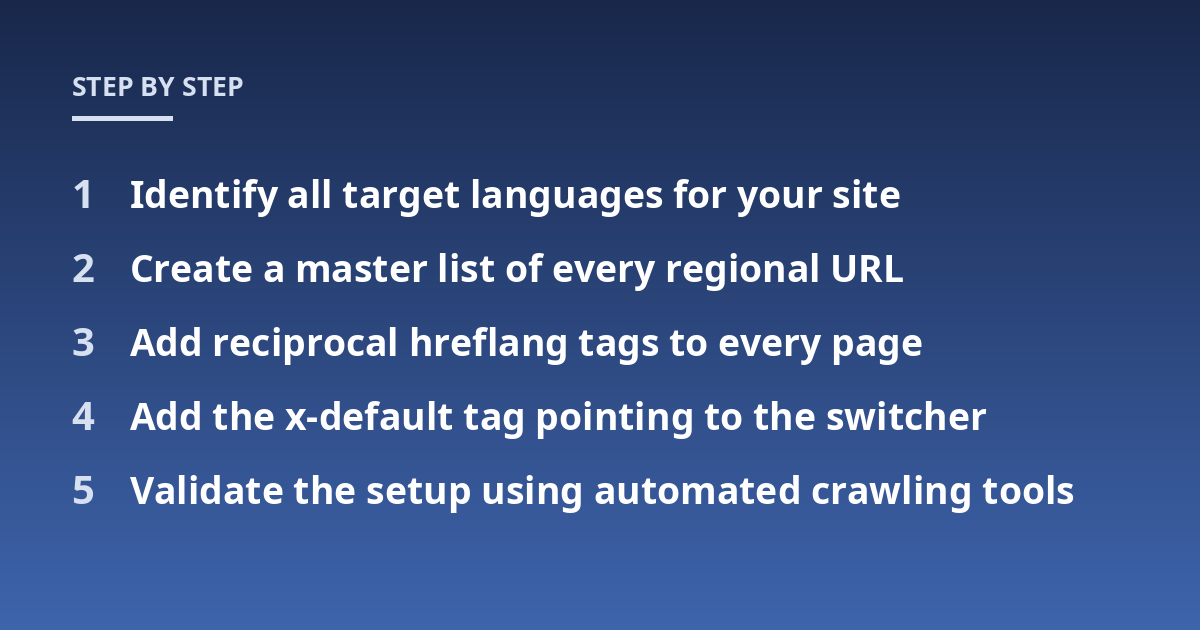
- Identify all target languages for your site
- Create a master list of every regional URL
- Add reciprocal hreflang tags to every page
- Add the x-default tag pointing to the switcher
- Validate the setup using automated crawling tools
We see this mistake often during large migrations. Teams focus on main languages and forget the default. The fix requires a full site audit to patch the holes. Do not assume Google will guess correctly.
How do you implement hreflang tags correctly?
You can add hreflang annotations in three ways: HTML headers, HTTP headers, or XML sitemaps. HTML headers work best for most sites. You place the code in the head section of every page. This method is transparent and easy to test.
You must ensure consistency across your entire site. If you use subdirectories, check that the URLs match exactly. Use absolute paths to avoid confusion. Relative paths can break depending on where the crawler lands.
Use a crawling tool like Screaming Frog to verify every page points back to all its variants. A single missing link can invalidate an entire group of regional pages, hurting your rankings.
Does hreflang impact PageSpeed or Core Web Vitals?
Hreflang tags themselves have negligible impact on loading speed. The attributes are just a few characters per URL pair. However, the infrastructure supporting them can slow down your site. Complex header scripts or large XML sitemaps add weight.
You must balance completeness with performance. Avoid adding hundreds of redundant links to single-page applications. Keep your sitemaps clean and updated. Slow sites hurt user experience regardless of language targeting.
What is the difference between geotargeting and hreflang?
Hreflang signals language and geographic relevance for specific pages. Geotargeting via Search Console targets an entire domain or folder to a country. Hreflang works within a set of URLs. Geotargeting applies at the site level.
You should use both tools together for maximum effect. Set hreflang to handle the content selection. Use geotargeting to give Google an extra hint about your primary market. This layered approach covers all bases.
Why is regular hreflang auditing necessary?
Your site changes constantly. New pages launch and old ones retire. hreflang tags become stale if you do not update them. Broken links accumulate over time, leading to indexing errors.
Schedule audits every quarter. Check for missing reciprocal links and incorrect language codes. Fix errors before they impact visibility. Automated tools can catch most issues if configured correctly.
How does hreflang interact with canonical tags?
Hreflang and canonical tags serve different purposes but often work together. Canonical tags tell Google which URL is the master version for ranking. Hreflang tells it which version to show users in specific regions.
You can have multiple self-referencing canonicals across your international site. Each regional page claims itself as canonical. This prevents search engines from consolidating rankings to a single default page. Keep the two systems aligned but separate.
How does AI automate multilingual SEO efficiency?
AI tools can generate and manage hreflang tags at scale for large enterprise sites. They map content clusters across languages automatically. This reduces manual errors and saves development time.
How do I optimize for Google AI overviews with schema
How do I optimize content for answer engines?
Answer engines rely on clear structure and direct answers to questions. Hreflang helps these systems find the right language version of your content. Use standard markup so AI crawlers can parse your international data easily.
What structured data helps rank in AI overviews?
Structured data like Organization and WebSite schemas support global visibility. Combine these with hreflang to provide complete context about your site’s languages. This helps search systems understand your international architecture.
How do I implement hreflang tags correctly on WordPress?
WordPress plugins like WPML or TranslatePress handle most hreflang needs automatically. They manage the HTML head and sitemap updates for you. Check your plugin settings to ensure all languages are active.
Can content pass Google’s standards?
Google prioritizes helpful, people-first content regardless of how it is made. Your international pages need quality writing in each language. Machine translation without human review often fails to meet these standards.
What mistakes should you avoid with hreflang?
The biggest mistake is creating circular links or missing return tags. You must also avoid mixing case sensitivity in language codes. Use lowercase letters like en-us, not En-US. Consistency prevents validation errors.
Which features matter most for international SEO?
The hreflang implementation is foundational. Without it, your other efforts may waste away in duplicate content filters. Focus on accurate tags first before investing in heavy link building.
Check your current setup today. If you have not audited your tags recently, you are likely losing traffic to technical errors. Start with a full crawl of your international site.
Other posts from the category
There are no posts for the selected category.

Latest posts from the category
-

What makes an effective Category Page for AI
June 5, 2026
-

What Influences the cost of AI Optimisation
June 1, 2026
-

Organisation Schema: how to help AI understand your brand
May 27, 2026