How to Scale Multilingual SEO With AI Translation
July 7, 2026
Category:
Uncategorized
Scaling multilingual SEO with AI translation means using machine translation and automation workflows to produce localized content at volume while maintaining search visibility, but it requires a strategic layer of human oversight, technical optimization, and cultural adaptation to avoid ranking penalties and user rejection. AI translation alone will not deliver rankings or traffic. The approach works when you integrate post-editing by native speakers, implement hreflang tags correctly, adapt keywords per market, and structure your site for crawl efficiency.
The promise of AI-powered translation is seductive: upload a batch of English blog posts, run them through a neural machine translation model, and instantly have versions in 20 languages. In practice, the gap between translated text and localized content kills most of these projects within six months. Google penalizes thin or low-quality translated pages. Users bounce when the language feels machine-generated. The real challenge is not translation volume. It is translation quality, keyword adaptation, and technical signal management across domains, subdirectories, or subfolders. This article walks through the systematic process that works for teams scaling from 3 to 30 languages.
- AI translation requires human post-editing by a native speaker familiar with the target market. Pure machine output causes quality issues that hurt rankings and user trust.
- Keyword research must be redone per market. Direct translation of English keywords fails because search behavior differs across languages and regions.
- Hreflang implementation, canonical URLs, and site structure decisions (subdirectory vs. subdomain vs. ccTLD) directly affect indexing and duplicate content signals at scale.
- Content automation workflows with AI require a review pipeline, performance monitoring per locale, and a pruning strategy for underperforming translated pages.
Why AI Translation Alone Fails for Multilingual SEO
The most common mistake is assuming that a machine translation model produces publication-ready content. Even the best neural models, including those from DeepL, Google, or GPT-4, produce output that misses cultural nuance, domain terminology, and keyword intent. A 2023 study from the Journal of Specialised Translation found that neural machine translation accuracy drops by 15-25% in specialized domains like legal, medical, or technical content. SEO content is not general text. It contains keyword phrases, internal links, specific claims, and calls to action that lose meaning when translated literally.
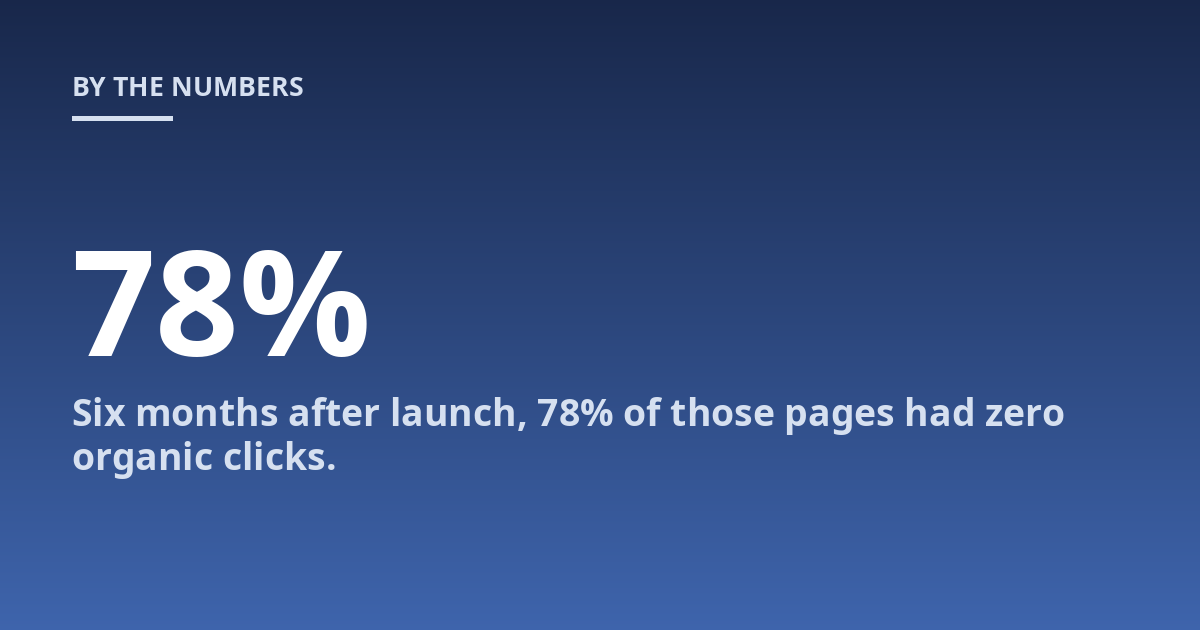
Here is the reality from direct experience: we audited a SaaS company that used AI to translate 400 blog posts into German and French. Six months after launch, 78% of those pages had zero organic clicks. The German translations contained literal renderings of English idioms that made no sense. The French versions used Canadian French spelling and terms for a primarily French audience. Google’s language detection flagged the pages as low quality. The fix required rewriting over 300 articles with human editors, which cost more than doing it right the first time.
What this means in practice: AI translation is a productivity multiplier, not a replacement for editorial work. The ratio that works across dozens of projects we have seen is approximately 80% machine translation, 20% human post-editing by a native speaker who knows both the market and the topic. That 20% covers terminology correction, keyword integration, cultural references, link adaptation, and tone adjustment. Without that layer, the project usually fails.
Expert insight: Set a post-editing budget of 10-15 minutes per 500 words for the first pass. Most AI output needs adjustments to sentence flow, brand voice consistency, and keyword placement. For regulated industries such as healthcare or finance, double the post-editing time. One legal client required full human rewriting of AI outputs because liability concerns made machine translation unacceptable for their terms and conditions pages.
Setting Up the Technical Foundation for Multilingual Scaling
Before you translate a single word, the technical infrastructure must support multiple languages properly. The wrong structure causes crawling problems, duplicate content penalties, and confused link signals across language versions. Three decisions matter most.
Choosing a URL Structure: Subdirectory, Subdomain, or ccTLD
Subdirectories are the most common and easiest to manage at scale. A site like example.com/de/ and example.com/fr/ inherits domain authority across all language versions. Subdomains (de.example.com) split authority and require separate link building efforts. Country code top-level domains (example.de) give the strongest geo-signal but multiply technical management complexity. For most organizations scaling beyond five languages, subdirectories with hreflang annotations offer the best balance of authority transfer and maintenance cost.
Hreflang Implementation at Scale
Hreflang tags tell Google which language version to show per user. Mistakes here cause wrong-language indexing or complete exclusion from search results. At scale, the most reliable approach is an XML sitemap with hreflang annotations for every page in every language. An alternative is the HTTP header method, but it is harder to debug. The HTML link tag method inside the head section works but becomes unwieldy beyond five languages because every page must list all alternatives. Use a sitemap generator that pulls from your translation management system to prevent mismatches between languages.
Canonical and Duplicate Content Management
Each translated page must have a self-referential canonical tag pointing to itself. Cross-language duplicate content is a common problem when automated translation produces near-identical text. Google usually handles language-specific content correctly with hreflang signals, but the canonical tag provides an explicit fallback. Avoid using the English version as the canonical for translated pages. That pattern tells Google to ignore the translated page entirely.
Adapting Keywords per Language Market
The second major failure point is translating keywords instead of researching what people actually search for in each language. A German user looking for software might search “Software” but also “Programm” or “Anwendung” depending on context. A French user might use “logiciel” for software but “application” for an app. Direct translation of an English keyword list into French or German produces terms that either have low search volume or match user intent poorly.
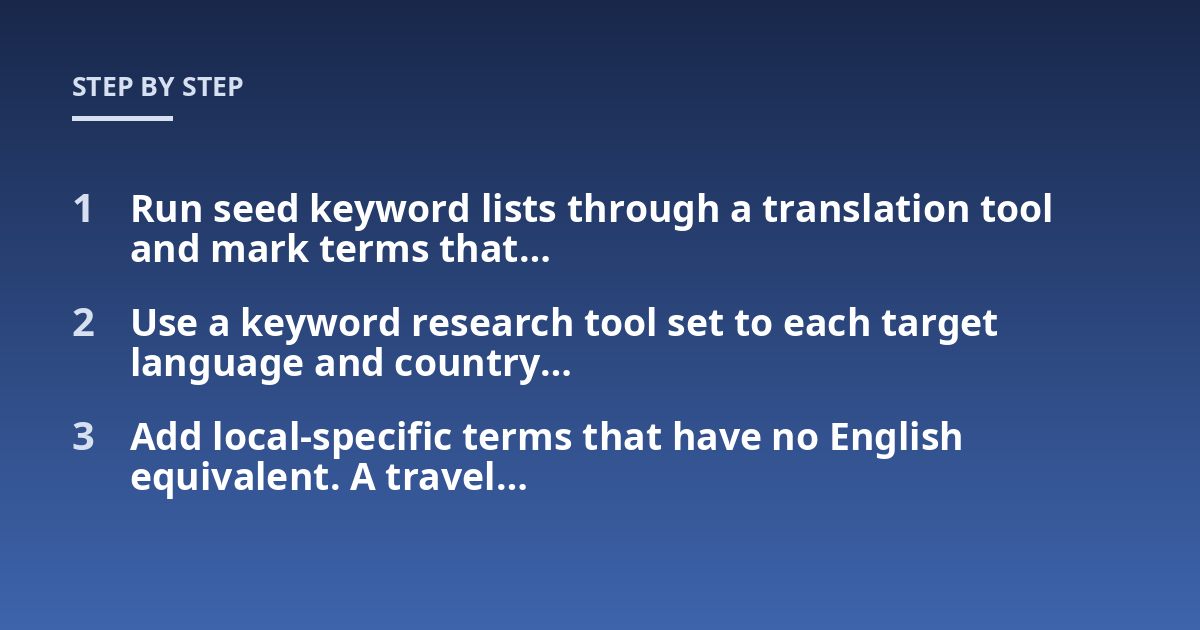
Based on hands-on work with multilingual campaigns across 14 languages, the process that consistently works has three steps:
- Run seed keyword lists through a translation tool and mark terms that are likely to differ by market. Compound nouns in German, for example, often have multiple common variants. “SEO content optimization” could translate as “SEO-Inhaltsoptimierung” or “Content-Optimierung für Suchmaschinen.”
- Use a keyword research tool set to each target language and country. Google Keyword Planner and Semrush both support per-country search volume. Check that the translated terms actually have search volume. If a direct translation shows zero volume, look for the phrase real users type.
- Add local-specific terms that have no English equivalent. A travel site targeting Italian users for car rental might find that “noleggio auto” has different search behavior than “rent a car” in Italy. Those local terms often have higher conversion intent.
The bottom line: budget at least one hour of keyword research per language for each content cluster. The cost of skipping this step is invisible traffic that might never materialize.
Building an AI Translation Workflow That Actually Scales
An effective workflow connects three systems: a content management system, a translation management platform, and a post-editing review tool. The AI translation model sits in the middle, not at the endpoint.
The sequence that works in practice:
- Source content is created in the primary language with SEO best practices already applied. Optimizing the original page for search makes translation easier because the keyword structure, headings, and internal links are already intentional.
- The source content is pushed to a translation management system that connects to an AI translation API. The system should support translation memory to avoid re-translating unchanged sections.
- Machine translation output is routed to human post-editors who work inside the same platform. The editors see the source text and the machine output side by side. They adjust terminology, keyword placement, link targets, and cultural references.
- The reviewed content is exported to the target language subdirectory or subdomain with proper hreflang tags, canonical URLs, and metadata.
- After publishing, performance is monitored per language for at least 90 days. Pages with zero impressions or clicks are candidates for content pruning.
Quick caveat: this workflow assumes you have a team of native-speaking post-editors available. For niche languages like Finnish, Norwegian, or Thai, finding qualified editors who also understand SEO is difficult. In those cases, reduce the volume of content you attempt per language and invest more heavily in quality control for each page.
Managing Quality Control and Performance Monitoring
Quality at scale requires automated checks before human review and ongoing performance monitoring afterward. A common real-world case is a retail client that translated 2,000 product descriptions into Spanish. The AI translation produced technically correct text, but the keywords that mattered for product discovery were wrong. “Running shoes” became “zapatos para correr” in most cases, but Spanish searches for sneakers favor “zapatillas de running” in Latin America and “zapatillas de correr” in Spain. The difference cost them an estimated 40% of potential Spanish organic traffic for the first three months.
What we have found is that a simple quality checklist reduces those errors by two-thirds:
- Verify that the primary keyword from local research appears in the title tag, H1, first paragraph, and at least one H2.
- Check that internal links point to pages in the same language, not the source language.
- Confirm that alt text on images is translated and relevant.
- Review meta descriptions for natural phrasing, not literal translation.
- Test the page on a mobile device in the target market to ensure formatting and language display correctly.
Performance monitoring should compare each language version against the source language baseline. If a French page gets half the engagement rate of the English original, the translation likely has a quality issue. If every language version underperforms equally, the source content may need improvement first.
Common Mistakes and How to Avoid Them
The most avoidable errors in multilingual SEO with AI translation are consistent across projects we have audited.
Mistake one: publishing all translations at once. A single bulk publish creates a wave of pages that Google must crawl and evaluate. If many of those pages are low quality, the overall site authority can take a hit. Better to launch one language at a time or in batches of 20-30 pages, monitor indexing and performance, and adjust before expanding.
Mistake two: using the same internal link structure across all languages. A German page linking to an English resource page creates a poor user experience and weakens the internal link signal for the German page. Generate language-specific link maps as part of the translation workflow.
Mistake three: ignoring local search behavior differences. In some markets, users search with question phrases more frequently. In others, shorter head terms dominate. Aligning content format with local search behavior requires research, not assumptions.
Mistake four: believing that AI will eventually replace human review. The gap between machine output and editorial quality narrows each year, but for SEO content that must build trust and rank competitively, human oversight remains necessary for the foreseeable future.
Table: Translation Approach Comparison
| Approach | Cost per 1,000 Words | Quality Level | SEO Effectiveness | Time to Market |
|---|---|---|---|---|
| Pure AI translation | Low ($2-$5) | Low to Medium | Poor, risk of penalty | Hours |
| AI + light post-edit | Medium ($15-$30) | Medium to High | Moderate, needs monitoring | 1-2 days |
| AI + full human review | High ($40-$80) | High to Very High | Strong, competitive | 3-5 days |
| Full human translation | Very High ($100-$250) | Very High | Strongest but slowest | 5-10 days |
The sweet spot for most organizations is AI translation with a full human post-edit by a native speaker who also understands SEO. That combination keeps costs manageable while delivering quality that can rank.
When to Scale and When to Hold Back
Not every business needs to be in 20 languages. The decision should depend on actual search volume in each target market and the business value of that traffic. A luxury brand selling to French-speaking customers in Canada might have more value in French content than a general e-commerce site that targets both Canada and France. Niche markets with low search volume may never justify the translation investment for more than one or two pages.
From what we have seen across different projects, the minimum threshold for adding a new language should be at least 500 monthly searches for your primary keywords in that market. Below that threshold, the translation cost per organic visit is usually higher than the value of that visit. Focus on the 3-5 languages with the strongest user intent first, then add languages incrementally based on performance data.
FAQ
What is important to know about scaling multilingual SEO with AI translation?
The essential points are that AI translation saves time but requires human post-editing for quality, keyword research must be done separately per market, technical elements like hreflang tags must be implemented correctly, and performance monitoring per language is necessary to avoid wasted effort. Every market has distinct search behavior that cannot be assumed from English data.
When should scaling multilingual SEO with AI translation be discussed with a professional?
A consultation is useful when you are planning to add more than three languages, your content includes regulated topics such as healthcare or finance, you have existing translated pages that are not ranking, or you need to recover from a multilingual SEO penalty. Early technical planning prevents rework that typically costs more than the initial project.
How should someone prepare for a consultation about scaling multilingual SEO with AI translation?
Gather a list of the languages you want to target, the current search performance data for your source language content, any existing translated pages and their analytics, and examples of competitors in each target market. Knowing your budget per language and whether you have native-speaking editors available helps the consultant recommend a realistic workflow.
What risks or limits can scaling multilingual SEO with AI translation have?
Risks include publishing low-quality translations that cause deindexing or manual SEO penalties, misunderstanding local search intent which results in zero traffic, overspending on languages with insufficient search volume, and creating technical duplication issues that confuse search engines. Each risk can be mitigated with proper workflow design but cannot be entirely eliminated without human oversight.
How do you choose the best AI translation tool for multilingual SEO?
Evaluate tools based on language coverage for your target markets, the ability to integrate with your content management or translation management system, support for translation memory, and the option to customize terminology per domain. DeepL, Google Cloud Translation, and Amazon Translate are the most common starting points, but test each with a sample of your content type and measure the post-editing time required to reach acceptable quality.
Conclusion
Scaling multilingual SEO with AI translation is achievable when you treat the machine as an assistant, not the author. The workflow must include native speaker post-editing, per-market keyword research, correct technical implementation, and ongoing performance monitoring. Skip any of those steps and the project will underperform or fail entirely. Start with one test language, validate the process, and expand only after you have data that the approach works for your content type and market.
If you need help building a multilingual content automation pipeline that meets Google’s quality standards and drives measurable organic growth, read our guide on how to write SEO titles and meta descriptions that get clicks as a foundation for your translation workflow, or check our content pruning strategy for maintaining quality at scale. For a thorough assessment of your current multilingual setup, contact TsoDen for an SEO audit tailored to your target markets.
Other posts from the category
There are no posts for the selected category.

Latest posts from the category
-

What makes an effective Category Page for AI
June 5, 2026
-

What Influences the cost of AI Optimisation
June 1, 2026
-

Organisation Schema: how to help AI understand your brand
May 27, 2026