
Measuring SEO ROI: The Metrics That Actually Matter in the AI Era
July 3, 2026
Category:
Uncategorized
Measuring SEO ROI effectively requires connecting organic search activities directly to business revenue and measurable conversion value. While traffic volume and keyword rankings provide necessary context, true return on investment is calculated by comparing the total cost of SEO efforts against the net profit generated from organic conversions. This shift moves focus from vanity visibility to actual profitability.
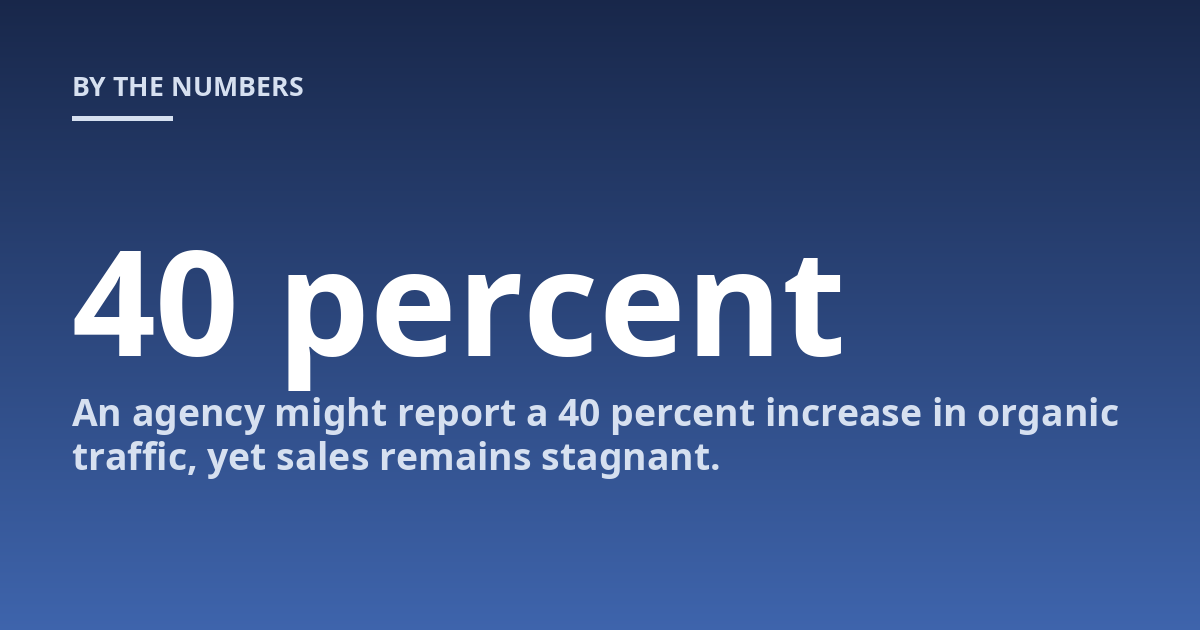
Marketing leaders often struggle with a fundamental disconnect between SEO reports and the balance sheet. An agency might report a 40 percent increase in organic traffic, yet sales remains stagnant. This discrepancy happens because not all traffic is created equal. As search evolves through AI Overviews and generative engine responses, the definition of success must shift from being seen to being chosen for transaction.
- Prioritize conversion value and revenue over simple click volume or rankings.
- Track attribution accurately to understand how organic touchpoints influence sales.
- Evaluate content efficiency by measuring the cost of acquisition through search versus paid channels.
Why Vanity Metrics Are Failing Your Marketing Strategy
Vanity metrics are data points that look impressive in a monthly report but provide zero insight into your bottom line. High organic traffic is meaningless if that traffic consists of users seeking information rather than users ready to purchase. For instance, ranking for a high-volume “what is” query might drive thousands of visitors, but those users rarely convert into paying customers.
The problem with relying on keyword rankings as your primary KPI is the lack of intent correlation. A position one ranking for a generic term does not guarantee revenue if that term lacks commercial intent. In practice, we have seen brands spend thousands on SEO to dominate terms that attract researchers rather than buyers. To avoid this trap, you must look at the quality of the traffic rather than just the quantity.
What works in 2024 is fundamentally different from what worked five years ago. With the rise of AI-driven search experiences, users are getting answers directly on the SERP without ever clicking a link. This means your visibility might stay high in terms of “brand impressions,” but your click-through rate (CTR) may drop significantly. If you only measure clicks, your SEO performance will appear to be declining even if your brand influence is actually growing.
The Core Framework for Measuring Real SEO ROI
A functional ROI framework must link organic search interactions directly to financial outcomes. You cannot calculate a return on investment using only non-monetary data like impressions or dwell time. To build an accurate model, you need to integrate your Google Analytics (or similar tool) with your CRM or sales data to map specific organic sessions to closed deals.
Successful measurement involves tracking three distinct layers of the funnel: visibility, engagement, and conversion. While many agencies focus on the first layer, business owners must focus on the third. Here is how you should categorize your metrics to ensure they align with commercial reality.
| Metric Category | Vanity Metric (Avoid) | Business Impact Metric (Focus) |
|---|---|---|
| Visibility | Total Impressions | Brand Mentions in AI Overviews |
| Engagement | Average Session Duration | Goal Completion Rate by Landing Page |
| Conversion | Total Organic Clicks | Customer Acquisition Cost (CAC) via Search |
| Revenue | Estimated Traffic Value | Actual Assisted Conversion Revenue |
One of the most common mistakes is ignoring assisted conversions. In many B2B and high-consideration consumer cycles, a user might find you via organic search during their research phase but eventually convert through a direct visit or an email link weeks later. If your SEO report only looks at last-click attribution, you will consistently undervalue the role of organic content in your sales cycle.
The most reliable way to prove SEO value is to calculate the “Search-Driven Lifetime Value” (LTV) of customers who originated through organic search. Comparing this LTV against your total monthly SEO spend provides a definitive ROI figure that no marketing manager can argue with.
Moving Beyond Rankings: Essential Metrics for AI Search Visibility
The emergence of AI Overviews and generative engines like Perplexity has changed the visibility landscape. You are no longer just competing for a blue link on page one; you are competing to be the cited source in an response. This requires a shift toward measuring “brand authority” and “entity presence.”
Measuring how often your brand is mentioned or cited within an AI response is a new, vital frontier. While traditional tools like SEMrush or Ahrefs are still useful for monitoring conventional rankings, they may not fully capture your footprint in the generative space. You should be looking at “Share of Voice” within specific AI-driven topics to understand if you are becoming a trusted authority in your niche.
This shift requires deep technical SEO and schema markup work. Without clear entity signals through structured data, AI models may struggle to associate your brand with the solutions you provide. High visibility in an AI environment often depends on how well you answer specific, complex queries that require a nuanced response rather than a simple list of facts.
The Impact of Content Automation and Efficiency
As brands increasingly use content automation to scale their organic reach, measuring ROI becomes more complex. It is easy to flood your site with thousands of pages using AI, but the cost of managing that technical debt and maintaining quality must be factored into your ROI calculation. You are not just paying for the words; you are paying for the strategy behind them.
To maximize efficiency, businesses should focus on calculating content productivity by assessing how much revenue each piece of content generates over its lifecycle. This is where How to Refresh Old Blog Posts for More Traffic in 2025 becomes essential. By using advanced research methods, you can ensure that every automated or human-led article targets high-intent queries rather than just filling up space.
building authority requires a structural approach to topical relevance. Instead of disjointed articles, your strategy should involve. A successful cluster-based approach creates multiple entry points for different stages of the buyer journey, making it much easier to attribute revenue to specific topic hubs rather than individual, isolated pages.
In practice, a high ROI in content automation is achieved when your cost per published piece decreases while your conversion rate per page increases. If you are scaling volume without an increase in engagement or lead quality, your SEO efficiency is actually declining despite the increased output.
How to Calculate Your Actual SEO Return on Investment
Calculating ROI for SEO is often more difficult than calculating it for paid search because organic results are cumulative and non-linear. However, a simplified mathematical approach provides the clarity needed for budget discussions. You should view SEO as an asset that appreciates over time rather than an expense like PPC.
To find your true ROI, use this formula: (Net Profit from Organic Conversions – Total SEO Cost) / Total SEO Cost x 100. Your total cost includes agency fees, internal staff salaries, content production costs, and technical tool subscriptions. Many companies fail to include the “cost of content” in their SEO spend, which leads to an inflated and inaccurate ROI.
Consider this real-world example: A SaaS company spends $5,000 per month on SEO (including tools and writers). This effort generates 20 organic trials that convert into 4 new customers. If each customer is worth $1,000 in monthly recurring revenue (MRR), the company has gained $4,000 in new MRR for a $5,000 investment. While they might not see immediate profit in month one, the compounding nature of organic growth means that by month six, those 20 trials per month may have matured into a much higher revenue stream.
Common Pitfalls in SEO ROI Reporting
The biggest pitfall is attempting to compare SEO directly against Google Ads on a day-to-day basis. Paid search is an “on/off” switch: when you stop paying, the traffic stops instantly. SEO is a long-term investment that follows a different growth curve. You must evaluate SEO performance over quarterly or even yearly intervals to account for its compounding effects.
Another error is ignoring the impact of seasonal trends and external market shifts. If your industry naturally slows down in Q3, your organic traffic will likely drop too. A competent strategist will distinguish between a failure in SEO strategy and a natural shift in search demand. Without this distinction, you risk cutting budget at exactly the wrong time.
Finally, avoid the trap of “reporting for reporting’s sake.” If your monthly report contains fifty different metrics but does not mention revenue, lead quality, or customer acquisition cost, it is not a useful document. A report should tell you whether your investment is working or if you need to pivot your tactical approach.
FAQ
What is important to know about measuring SEO ROI: the metrics that actually matter?
The most critical aspect of measuring ROI is aligning your metrics with your specific business objectives. You must determine whether your primary goal is immediate sales, lead generation for a long sales cycle, or brand awareness in an AI-driven ecosystem. Because every digital ecosystem varies, a precise assessment of your current data and individual commercial goals is necessary before making significant budget adjustments to your SEO strategy.
When should you discuss measuring SEO ROI with a professional?
You should seek a consultation when you notice a disconnect between reported traffic growth and actual revenue. If you see high rankings for important keywords but no increase in conversions, or if there is significant uncertainty regarding which organic channels are driving value, it is time to consult an expert. Early assessment of your attribution models can prevent small data discrepancies from turning into large budget misallocations.
How should one prepare for a consultation about SEO ROI?
Preparation requires gathering specific business data rather than just keyword lists. You should have access to your historical conversion data, knowledge of your current customer acquisition costs (CAC), and clarity on what a single lead is worth to your business. Having these figures ready allows an expert to perform a much deeper analysis of whether your organic search efforts are generating actual profit or simply vanity numbers.
What risks or limits can measuring SEO ROI have?
The accuracy of your ROI depends heavily on the quality of your tracking setup and the complexity of your sales cycle. In multi-touch attribution environments, it is difficult to assign 100 percent of a sale to organic search. A professional will explain these limitations and provide realistic expectations regarding how much credit can be accurately assigned to SEO versus other marketing channels like social media or direct traffic.
How does AI change the way we track SEO success?
AI changes the metric from “clicks” to “influence.” As search engines provide answers directly on the results page, you must move toward measuring brand sentiment and citation frequency in AI responses. Traditional click-through rates may decline even as your brand’s authority increases. Measuring your presence within these generative summaries is becoming a vital new way to prove organic value in the next era of search.
Effective SEO measurement requires moving away from a mindset of visibility and toward a mindset of profitability. By focusing on conversion-centric metrics, accounting for AI-driven search behaviors, and accurately calculating the true cost of content, you can transform SEO from a vague marketing expense into a predictable engine for business growth. Start by auditing your current attribution model today to ensure every dollar spent on organic search is actually driving measurable value.
Other posts from the category
There are no posts for the selected category.

Latest posts from the category
-

What makes an effective Category Page for AI
June 5, 2026
-

What Influences the cost of AI Optimisation
June 1, 2026
-

Organisation Schema: how to help AI understand your brand
May 27, 2026