
Will Content Get Penalized by Google?
July 7, 2026
Category:
Uncategorized
Google does not penalize content automatically or solely because AI created it. What Google penalizes is low-quality, unhelpful content that lacks expertise, experience, authoritativeness, or trustworthiness, regardless of whether a human or a machine produced it. The key is how you use AI, not that you use it at all.
This creates a real practical problem for business owners and marketers. On one hand, AI tools can produce content at scale faster than any human team. On the other, everyone has heard the warning stories about sites that lost rankings after flooding their blogs with thin, auto-generated posts. The confusion is understandable. What matters is the distinction between using AI as an assistant and using it as a replacement for editorial judgment.
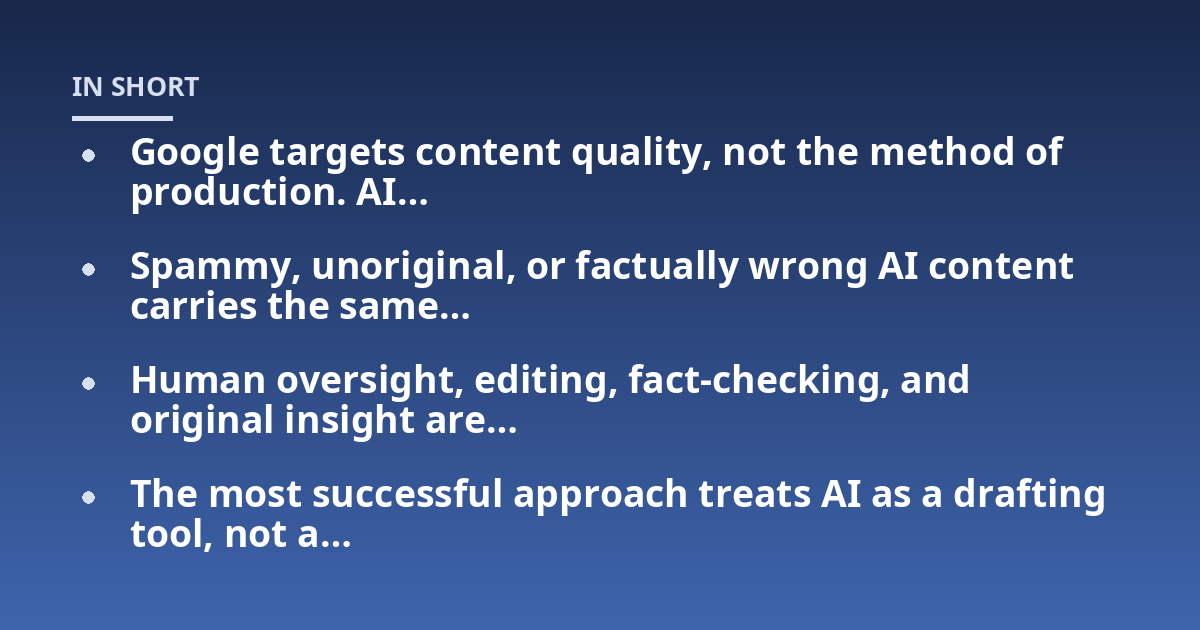
- Google targets content quality, not the method of production. AI content that meets E-E-A-T standards can rank well.
- Spammy, unoriginal, or factually wrong AI content carries the same penalty risk as the same content written by a human.
- Human oversight, editing, fact-checking, and original insight are what differentiate helpful AI-assisted content from automated noise.
- The most successful approach treats AI as a drafting tool, not a publishing shortcut.
What Google’s Guidelines Actually Say About AI Content
Google’s official guidance, updated in March 2024, is clear. The Search Quality Rater Guidelines and Google’s own blog posts state that the focus is on content quality, not content origin. Google uses its automated systems to assess whether content is helpful, reliable, and people-first. If content demonstrates genuine expertise, provides original research or analysis, and serves the user’s search intent, it satisfies Google’s criteria.
The confusion stems from older Google updates that targeted low-quality automated content. Those updates, like Panda in 2011 and later spam algorithm improvements, were about mass-produced, keyword-stuffed, nonsensical text. Google never targeted AI content specifically. It targeted spam. The same applies today.
Google’s systems also detect content created solely to manipulate search rankings. If your article is stuffed with keywords, lacks substance, or is a near-duplicate of another page, it will likely trigger quality filters. But those filters would catch a human-written version of the same page too.
Does Google Have a Specific AI Content Penalty?
No. Google does not maintain a separate penalty called “AI content penalty.” The penalty system works on quality signals. A site that publishes hundreds of product descriptions that all follow the same template and contain no unique information will struggle to rank. The same site that uses AI to generate a first draft, then has a subject matter expert review and expand it, can perform well.
Think of it this way: Google’s algorithms are trained to reward content that satisfies the searcher. If a reader clicks on your page and immediately bounces because the text is generic, Google interprets that as a quality failure. Whether a human or AI wrote the generic text is irrelevant to the algorithm.
What we’ve found across different projects is that the sites most likely to face ranking drops from AI content are those that skip the editorial process entirely. They publish raw AI output with minimal review. That approach carries the same risk as hiring a junior writer who produces shallow work without any oversight.
What Types of AI Content Are Most at Risk?
Some categories of content carry higher penalty risk than others. Based on concrete cases we’ve observed:
- Factual or medical claims without expert review. AI models hallucinate. If your content asserts a treatment works or gives dosage advice and it is wrong, the consequences go beyond SEO. You also violate YMYL (Your Money or Your Life) quality expectations.
- Thin affiliate pages. AI can generate hundreds of product roundups quickly, but if they lack first-hand testing, original photos, or specific pros and cons, they read as template-driven.
- News or timely content generated without verification. AI cannot report events. It can only summarize what it was trained on. Publishing “breaking news” without human verification is a fast route to misinformation penalties.
- Near-duplicate content across multiple pages. AI often produces similar phrasing when asked similar questions. If you do not vary the structure and add unique context, you end up with thin content clusters.
The most reliable approach is to treat AI output as a very fast first draft. Every paragraph should be read, rephrased where it sounds generic, fact-checked against a reliable source, and supplemented with your own experience or data. A simple but effective rule: if you would not attribute the sentence to yourself as an expert, do not publish it.
How to Use AI and Stay Compliant With Google’s Quality Standards
The practical path is straightforward. You do not need to abandon AI tools. You need better processes around them. Here is a framework that works in real campaigns:
| Stage | Human role | AI role | Quality check |
|---|---|---|---|
| Research | Identify search intent, audience questions, and gaps in existing content | Summarize competitor patterns, suggest subtopics, cluster keywords | Do the AI suggestions match actual user needs? |
| Drafting | Provide outline, tone guidelines, specific data points to include | Generate first draft based on the instructions | Does the draft cover the outline without hallucinating? |
| Editing | Rewrite generic sentences, add first-hand examples, check facts | Suggest alternative phrasing or fix grammar | Does the final text sound like a knowledgeable practitioner wrote it? |
| Quality review | Verify all claims, check for internal consistency, confirm sources exist | Check for readability, flag potential duplicate passages | Would you trust this page for a decision? |
The table above shows a human-led, AI-assisted process. The critical step is the editing and review phase. That is where the content gains the expertise signal Google evaluates. Without it, you are publishing raw output from a with no context and no accountability.
Google’s own guidance emphasizes that content should demonstrate first-hand experience. For example, if you run a dental clinic and write about tooth extraction recovery, AI cannot describe what a patient’s socket looks like during healing or what a dentist actually checks at a follow-up appointment. That knowledge must come from you. AI can structure the article, but the substance belongs to the practitioner.
This principle applies to any expertise topic. A financial advisor reviewing tax advice catches subtle errors. A restoration contractor reading AI text about emergency water extraction can add practical details about the first 24 hours that no model knows. That is where the ranking advantage lives.
Will Google’s AI Overviews or Search Generative Experience Change the Penalty Stance?
Google’s own AI Overviews, which summarize search results at the top of the SERP, create a different dynamic but do not change the penalty framework. Google still ranks pages based on quality signals. The Overview simply extracts content from those ranked pages. If your page provides a clear, well-sourced answer to a question, it can appear in the Overview regardless of whether you used AI to draft it.
The more important shift is that AI Overviews and other AI search features (, Perplexity) reward concise, authoritative answers. This means content that is direct, evidence-backed, and easy to cite performs well. That plays to the strengths of well-edited AI content, but only if the evidence is real.
A common real-world case is a business that publishes a FAQ page with short, direct answers supported by links to authoritative sources. That page often gets pulled into AI Overviews. If the business had written those answers with AI but then verified every statement with a domain expert, the Overview appearance is earned.
How Long Does SEO Take to Show Results When Using AI Content?
This depends on the same factors as any SEO campaign: competition, topic, content quality, and site authority. AI-assisted content that is genuinely useful and well-optimized can start attracting clicks within weeks, especially for low-competition queries. But the timeline is not affected by the use of AI itself. What matters is whether the content fills a gap in existing search results.
If you are building a new site on a competitive topic, expect a longer ramp regardless of production method. For a deeper breakdown of timelines, see our article on how long does SEO take to show results.
What Is the Difference Between SEO and GEO for AI Content?
Traditional SEO optimized pages for Google’s ranking algorithm. Generative Engine Optimization (GEO) optimizes content for how AI-powered search engines consume and cite information. The two overlap significantly. Both require clear structure, direct answers, and authoritative sources. But GEO places extra emphasis on making individual sections self-contained and quotable, because AI engines often pull a single paragraph as a citation.
If you are using AI to generate content, GEO principles are especially relevant. AI search models tend to cite content that is concise, fact-dense, and clearly attributed. That means your AI-assisted drafts need even more editorial care to ensure each paragraph stands alone. For a full comparison, read our piece on what is the difference between SEO and GEO.
FAQ
Will content get penalized by Google automatically?
No. Google does not automatically penalize content simply because AI produced it. Penalties apply to low-quality, unhelpful, or spammy content regardless of origin. If the AI content demonstrates expertise, provides original value, and satisfies user intent, it can rank. The risk comes from publishing AI output without human editorial review.
When should I reconsider using AI for content?
Reconsider using AI when the topic requires firsthand experience, for example medical procedures, legal advice, financial planning, or product reviews that depend on personal testing. AI cannot report on something it did not experience. In those cases, AI can help with structure, but the substantive content must come from a qualified human.
How should I prepare AI content for publication?
Start with a clear outline based on what users actually search for. Have AI draft the content against that outline. Then read every sentence. Rewrite anything that sounds generic, vague, or incorrect. Add specific examples from your own work. Check every fact against a reliable source. Only publish once you would feel comfortable attributing the text to yourself.
What risks come with content?
The main risks are hallucinated facts, lack of originality, and shallow coverage. AI can invent citations, misquote sources, or produce text that looks correct but is not. If published unchecked, this erodes trust with readers and can trigger Google quality filters. The corrective measure is the same for human-generated content: rigorous fact-checking and expert review.
Can Google detect content?
Google has stated publicly that its systems can detect patterns common to text, but the company does not use AI detection as a ranking signal. What the systems look for is quality: originality, depth, factual accuracy, and usefulness. AI text that reads as generic or factually inconsistent will likely be classified as low quality, but because of those issues, not because it. Some third-party detection tools exist, but they are unreliable and frequently produce false positives. Relying on them as a quality gate is a poor strategy; human editorial judgment is far more dependable.
Does republishing AI content from other sites create duplicate content penalties?
No site has ever been penalized for having duplicate content. Google applies duplicate content filters that determine which version to show in search results. If you republish text that exists elsewhere, your page may simply be excluded from the top results, not penalized. The real risk is that your version adds no value, so Google picks the original or a better version. The fix is to add original context, commentary, or data to any content you produce, whether AI-assisted or not. Unique insight prevents the duplicate filter issue entirely.
Can AI content appear in Google’s featured snippets or AI Overviews?
Yes. AI-assisted content that is well-researched, concise, and supported by authoritative sources can appear in featured snippets and AI Overviews. Google’s systems evaluate the clarity and accuracy of the answer, not how it was produced. A local cleaning company that uses AI to draft a page answering “how to remove mold from drywall,” then has a restoration expert verify each step and add safety warnings, can earn the snippet above a generic page from a national publication. The qualification is that the final page must be trustworthy and directly answer the query.
What is the safest approach for a site with no in-house expert?
If your site does not have a subject matter expert on staff, limit AI content to topics where you can reliably verify facts against public authoritative sources. For example, you can write about software features, historical events with clear records, or general how-to instructions on routine home maintenance. Avoid health, finance, legal, or safety topics. In those areas, a mistake can damage reader trust and trigger manual review from Google. A safer alternative is to collaborate with a freelance expert who reviews and approves the final draft before publication.
How often should I update content?
content requires the same refresh cadence as any other content. Review it every six to twelve months, or whenever the underlying information changes. For topics like tax regulations, medical guidelines, or product specifications, set calendar reminders to verify claims. AI models have training cutoffs and cannot update themselves after publication. Outdated content signals to Google that the page lacks ongoing maintenance, which can gradually weaken its ranking. A simple monthly content audit schedule prevents this drift.
Next Steps for Using AI Without Risking Google Penalties
The question “will content get penalized by google” has a clear answer: no, as long as the content is genuinely helpful and produced with human oversight. The practical actions you can take today are straightforward.
First, audit your existing content. Identify any pages that were published with minimal human editing. Those are the candidates for revision. Pull them into an editing workflow, add original examples, verify facts, and improve readability. That alone reduces risk more than any detection tool or policy change.
Second, build a content brief before you ask AI to draft anything. Write down the key question, the target audience, the specific points you want to cover, and any data or quotes you want included. The quality of the draft depends almost entirely on the quality of the brief. A vague prompt produces generic output. A detailed prompt with constraints gives you a draft worth editing.
Third, establish a review checklist. Every page must pass through a human editor who checks for hallucinations, verifies external links, adds first-hand experience, and confirms the page answers the original search intent. If your team is small, use a simple spreadsheet with columns for each check. Consistency matters more than complexity.
For a more complete breakdown of creating content that satisfies Google’s quality standards, see our overview on people-first content vs search-first content.
Final Verdict
Google does not penalize AI content. Google penalizes content that is unhelpful, inaccurate, or manipulative. Using AI as a drafting tool under expert supervision is a legitimate, effective way to produce content at scale. The risk is only present when you skip the human editorial step. Focus on accuracy, originality, and usefulness, and the question of penalties becomes irrelevant.
If you are still uncertain about your current content strategy, start with a small test. Publish one well-edited AI-assisted article on a topic you know well. Monitor its performance in search for 30 days. Compare it to a human-written article on a similar topic. The data will tell you more than any theoretical guideline. That is the most practical approach to answering “will content get penalized by google” for your specific situation.
Other posts from the category
There are no posts for the selected category.

Latest posts from the category
-

What makes an effective Category Page for AI
June 5, 2026
-

What Influences the cost of AI Optimisation
June 1, 2026
-

Organisation Schema: how to help AI understand your brand
May 27, 2026