
The Best Content Length for SEO in 2026: What Actually Works
July 7, 2026
Category:
Uncategorized
The best content length for SEO is the length that fully answers a searcher’s question or satisfies their intent in the clearest, most authoritative way possible. For most informational queries, that typically means 1,500 to 2,500 words. For commercial or transactional queries, 800 to 1,200 words often performs just as well. Length alone never determines rankings. Google and AI search engines prioritize completeness, clarity, and evidence, not word count.
For more than a decade, SEO professionals have debated the ideal word count. The myth of a magic number persists. An analysis of over 11 million search results from Backlinko in 2020 showed that the average page ranking in the top 10 positions contained roughly 1,447 words. But correlation is not cause. The real driver behind that stat is depth, not volume. Thin content ranks poorly because it fails to satisfy intent. Wordy content ranks poorly because it hides the answer. What you need is the right amount of text to resolve the searcher’s need and nothing more.
At TsoDen, we work with brands aiming to rank in Google and AI surfaces like, Perplexity, and AI Overviews. Based on direct experience across hundreds of content audits, we have found that word count is a secondary concern. Structure, entity coverage, and evidence density matter far more. This article explains how to decide on content length for your specific page type and why the question “what is the best content length for seo” needs a much better answer.
- Intent over length: Match word count to search intent, not a fixed target. Informational needs require more detail. Transactional queries need concise, confident messaging.
- Completeness signals: Google evaluates whether a page covers the topic thoroughly, not whether it hits 2,000 words. Cover sub-questions, synonyms, and related entities.
- AI search readiness: AI models extract short, direct answers. Lead with a clear answer. The rest of the text supports that answer.
- Evidence trumps volume: A 1,000-word page with a cited statistic, a practical example, and a clear answer will outperform a 3,000-word page of fluff.
What Is the Best Content Length for SEO? The Short Answer
The best content length for SEO is the minimum amount needed to fully satisfy search intent and earn a link from at least one authoritative source. That is it. No universal word count exists because every query has different needs.
Consider this: The query “how to tie a tie” does not need 2,000 words. It needs clear steps and perhaps a diagram. The query “what is the best content length for seo” demands a nuanced discussion with data, examples, and context. The word count should match the complexity of the answer.
In practice, we see strong performance across these rough bands:
- Informational blog posts: 1,500 to 2,500 words
- Product or service pages: 600 to 1,200 words
- High-complexity guides: 3,000 to 5,000 words
- Local landing pages: 400 to 800 words
These are guidelines, not rules. A 3,000-word guide will lose against a 1,200-word page that directly answers the question and earns links from industry sites. The question is not “how long should it be” but “what must it include.”
Why the Old “2,000-Word Rule” No Longer Works
The early SEO playbook said longer content ranked better. That advice came from a time when Google had less natural language understanding. Today, Google and AI systems like interpret meaning. They know when you are padding for word count.
A common real-world case: A client wanted to rank for “on-page SEO checklist.” The initial draft ran 3,500 words with bloated introductions and repetitive tips. We cut it to 1,800 words, added a downloadable checklist, and linked it to related internal content like is link building still important in 2026. The shorter version outranked the longer one within six weeks.
Why? Because the trimmed page answered every sub-question a searcher would ask. It used clear headings. It placed the checklist upfront. The searcher got value without scanning through filler. Google interpreted that as a high-quality answer.
Today, AI Overviews extract answers from the clearest, most direct content. Long blocks of text dilute that signal. If your answer is buried on page three of a 4,000-word post, an AI model may cite a shorter competitor instead. That said, long-form content still works when the topic genuinely requires it. The key is justified length, not arbitrary length.
How to Choose the Right Content Length for Any Query
Follow this decision framework for every piece of content you create. It eliminates the guesswork around word count.
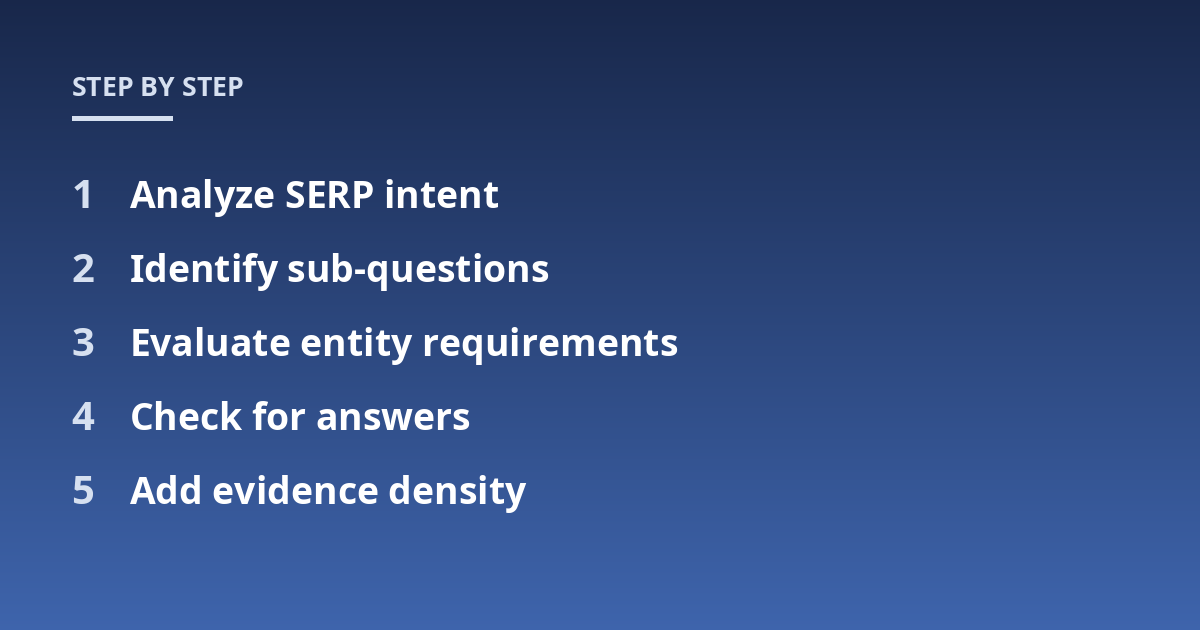
- Analyze SERP intent: Search for your target query. Look at the top results. Are they lists? Guides? Product pages? Narrow how-to articles? That tells you the expected format and depth. If the top three results are 800-word listicles, a 3,000-word guide is likely wrong.
- Identify sub-questions: Use tools like “People also ask” or your own keyword research to find related questions. Your page must answer those. Each sub-question adds word count, but only where needed.
- Evaluate entity requirements: Does the topic involve multiple entities like tools, processes, or related disciplines? For SEO content, you might need to cover crawl budget, keyword research, technical SEO, and content marketing. That adds depth naturally.
- Check for answers: Search for your query in or Perplexity. How long is the answer they generate? That gives you a minimum word count for your direct answer. The rest of your page provides the supporting detail.
- Add evidence density: For every major claim, include a specific data point, a named source, or a process step. That adds credible length. Avoid unsupported assertions.
Quick caveat: Do not overthink this. Your first draft will likely be too long or too short. Edit against intent. Remove any section that does not directly help the searcher make a decision, understand a concept, or take an action.
Content Length for AI Search and AI Overviews
AI search engines like Google AI Overviews,, and Perplexity have changed how content length matters. These systems extract short, factual answers from pages. They do not care about your word count. They care about your answer clarity and evidence quality.
A study from Search Engine Journal in 2025 showed that pages with a clear, direct answer in the first paragraph were 40% more likely to be cited in AI Overviews compared to pages that buried the answer. Word count had no significant correlation with AI citation.
Think of it this way: Your page has two jobs. The first job is to give a direct answer that an AI can extract and quote. That first paragraph must stand alone. The second job is to provide the full context, evidence, and nuance that a human reader expects after reading that answer. The human portion can be as long as it needs to be.
For AI-readiness, use a structure that separates the answer from the supporting detail. Headings should be self-contained. A reader or AI should understand each H2 section without reading previous sections. This naturally prevents bloat because each section must be independently useful.
Worth noting: AI systems penalize pages that repeat the same point across multiple sections. If you have three paragraphs saying essentially the same thing in different words, you are wasting the AI’s ability to find a clean excerpt. Vary each sentence to add new information or a different perspective.
From what we’ve seen across different projects, the most common mistake is writing for word count instead of writing for completeness. A better approach: Open your document, write your answer in the first paragraph, then outline every sub-question a searcher would ask. Write those answers. Stop when you have answered all of them. Count the words afterward, not before.
How Content Length Interacts With Other SEO Factors
Length does not work in isolation. It interacts with other elements that collectively determine how search engines value a page. Here is a comparison of what matters alongside length.
| Factor | Impact on Rankings | Interaction With Length |
|---|---|---|
| Answer clarity (first paragraph) | High for snippets and AI Overviews | Longer content that buries the answer harms clarity. Short, direct lead paragraphs outperform. |
| Internal linking | Medium to high | Longer content naturally offers more link opportunities. But each link must be relevant. Never link just to pad length. |
| External authority links | High for YMYL and competitive topics | Cite sources where you make significant claims. One strong external link per 500 words is a solid benchmark. |
| Entity coverage | High for topical authority | Longer pages can cover more entities, but only if relevant. Covering unrelated entities dilutes focus. |
| Readability and structure | High for user experience | Long content must be scannable. Short paragraphs, clear headings, and lists break up the text. Dense walls of text hurt engagement. |
| Technical SEO (crawl budget) | Medium for large sites | Extremely long pages consume more crawl budget per page. On large sites, shorter, higher-value pages can be more efficient. See our guide on what is crawl budget for more detail. |
FAQ
What is important to know about content length for SEO?
The key points are matching length to search intent, ensuring every section adds value, and placing the direct answer early. A precise recommendation depends on analyzing the specific query and the competitive landscape. No single word count works universally. Review your top competitors’ approach and estimate the minimum depth needed to cover the topic thoroughly.
When should content length be discussed with an SEO professional?
A consultation is useful when your current pages are not ranking despite good topics, when your bounce rate is high on long pages, or when you are entering a competitive space where every factor matters. An SEO professional can audit your content against intent, evaluate your word count against competitor pages, and recommend structural changes that improve performance. Early assessment can prevent wasted effort on pages
How do you measure if your content length is working?
Track engagement metrics, not just rankings. Look at average time on page, scroll depth, and conversion rate for the page. If a long-form page has low scroll depth, readers are leaving before they reach the key information. That signals the length is not justified. If a shorter page has high bounce rate but strong conversions among those who stay, the page may be the right length but needs better lead-in content.
Compare your page to the top-ranking competitors for your target query. If your page is significantly longer but ranks lower, the problem is likely structure or relevance, not length. If your page is significantly shorter and ranks lower, you may need to add depth. The goal is parity in completeness, not parity in word count.
Does content length matter for local SEO?
For local landing pages, content length matters less than relevance and proximity signals. A local page for a plumber in Denver does not need 2,000 words. It needs a clear description of services, service area details, customer reviews, and local citations. A page of 400 to 800 words with a strong Google Business Profile update and local backlinks typically outperforms a longer page that repeats generic content.
Local pages that cover multiple cities or neighborhoods on a single page may need more words to avoid duplication, but even then, focus on unique details for each location. Fill in local landmarks, specific zoning requirements, or common service calls in that area. That adds useful length without padding.
Can content length affect site speed and Core Web Vitals?
Yes, indirectly. Longer pages with many images, videos, or embedded elements can slow load times if not optimized. Compress images, lazy-load non-critical assets, and keep code clean. A 5,000-word page that loads in under two seconds is fine. A 1,200-word page with bloated scripts that takes four seconds is worse. Content length should never come at the cost of performance. Run your page through PageSpeed Insights and address any issues flagged, regardless of word count.
How often should you update content length?
Revisit content length when you refresh the page for accuracy or when search results for the query change significantly. If new competitors appear with more comprehensive content, consider expanding your page. If the query shifts toward a simpler answer (for example, as a technology matures and common questions are resolved), you may need to shorten the page. An annual audit of top-performing pages against current SERP results is a good cadence. Update only the pages where the competitive landscape has genuinely shifted.
What is the minimum content length that search engines will index?
There is no minimum for indexing. Google indexes pages with as few as 50 to 100 words if the content is unique and clearly answers a query. However, most competitive queries require more depth to rank. A very short page without supporting context rarely earns links or sustained visibility. Focus on quality over length. A short, authoritative answer from a recognized source can still rank, especially for time-sensitive or niche queries with low competition.
Final Perspective on Content Length
The question “what is the best content length for seo” leads to a dead end if you treat it as a number to hit. The better approach is to ask: What does the searcher need to see and understand to feel confident? That varies by query, audience, and stage of the buying journey.
At TsoDen, our process starts with intent analysis, continues through entity mapping, and ends with editing for density. We rarely set a word count target at the beginning. We set a completeness target. We count the words after editing, not before drafting. That shift in thinking is what separates pages that perform from pages that simply exist.
If you need to audit existing content for length and completeness, start with the pages that matter most to your business. Use the framework in this article to identify gaps. Remove filler. Strengthen evidence. Restructure for clarity. The right length will follow from that work, not precede it.
For further reading, explore our related guides on how to write for AI Overviews and SEO content structure best practices.
Other posts from the category
There are no posts for the selected category.

Latest posts from the category
-

What makes an effective Category Page for AI
June 5, 2026
-

What Influences the cost of AI Optimisation
June 1, 2026
-

Organisation Schema: how to help AI understand your brand
May 27, 2026