Entity SEO: Optimizing for Knowledge Graphs and Topics
July 7, 2026
Category:
Uncategorized
Entity SEO optimizing for knowledge graphs and topics is the practice of structuring your content around real-world people, places, concepts, and things (entities) rather than just keyword strings, so search engines and AI systems can understand your subject matter with near-human precision. This shifts SEO from matching queries to proving what your brand knows.
Most SEO professionals still treat search as a keyword-matching game. Rank for “digital marketing agency,” get traffic from “digital marketing agency.” That worked when Google was a simple text matcher. But modern search engines, including Google,, and Perplexity, now build knowledge graphs. They understand that “Google” is a company, a search engine, and a verb. They know that “SEO” and “search engine optimization” refer to the same concept. And here is the hard truth: if your content does not explicitly connect entities the way these graphs expect, you are invisible to the systems that power AI Overviews and knowledge panels.
- Entity SEO prioritizes real-world objects and their relationships over isolated keywords.
- Knowledge graphs store these connections; your job is to make them crawlable and explicit.
- Topics function as entity clusters; optimizing for a topic means proving depth across multiple related entities.
- AI search systems reward authors who clearly define entities, cite authority, and structure signals like schema markup.
What is Entity SEO and Why Does It Matter for Knowledge Graphs?
Entity SEO is the discipline of optimizing web content so search engines recognize your pages as authoritative sources about specific real-world entities. An entity is anything that can be uniquely identified: a person, a place, an organization, a product, a medical condition, a scientific concept. Google’s Knowledge Graph, launched in 2012, currently stores over 8 billion facts about more than 500 million entities.
When you type “Ada Lovelace” into Google, the knowledge panel on the right draws from this graph. Google does not guess who Ada Lovelace is by matching keywords on a single page. It knows because millions of pages have connected the entity “Ada Lovelace” to entities like “mathematician,” “Charles Babbage,” and “Analytical Engine” in consistent, structured ways.
The practical implication: if your content treats “TsoDen” as just a string of characters rather than an entity tied to “AI SEO agency,” “content automation,” “multilingual SEO,” and “GEO optimization,” you miss the chance to appear in knowledge panels, AI Overviews, and voice answers. Search Engine Land reported that pages with clear entity signals tend to appear in more SERP features across the same query set.
How Knowledge Graphs Work for Search and AI
A knowledge graph is not a keyword index. It is a semantic database where nodes represent entities and edges represent relationships. Google’s algorithm uses this graph to infer meaning beyond exact-match keywords. For example, a page about “best SEO tools for international websites” might never use the phrase “multilingual hreflang tags,” but if it connects entities like “hreflang,” “canonical tags,” and “geo-targeting,” the graph can surface that page for related queries.
The Entity-Relationship Model in Practice
Think of it this way: every page you write should answer three structural questions for search engines. One, what entities are present on this page? Two, what relationships exist between them? Three, what authority does this page have for those entities?
A typical blog post about AI-powered SEO might mention “knowledge graph optimization” in passing. That is weak entity presence. A well-optimized version would define “knowledge graph” as a structured database of entities, link it to “entity extraction,” “semantic search,” and “schema markup,” and cite authoritative sources like Google’s developer documentation. This creates a dense entity map that AI systems can traverse.
Why Knowledge Graphs Matter for AI Search
Worth noting: AI models like GPT-4 and Gemini do not search the web in real time. They retrieve information from indexed pages that have been vectorized. Clear entity signals improve the vector representation of your content. In practice, we have seen pages with explicit entity definitions and structured data rank for 30 percent more long-tail question queries than pages without those signals.
The bottom line: knowledge graphs enable search systems to infer intent. When a user asks “What is the best AI SEO tool for small businesses?” the graph does not just look for the phrase “best AI SEO tool for small businesses.” It identifies entities: “AI SEO tool,” “small business,” and the relationship “suitable for.” Your content needs to explicitly own those entity relationships.
Topic Optimization: The Entity Cluster Approach
Topic optimization is entity SEO applied at scale. Instead of optimizing a single page for a single keyword, you build a cluster of pages around a central topic, each covering a distinct subtopic or entity. This models how knowledge graphs work: a central entity connected to many related entities.
Building a Topic Cluster Around Your Core Entity
Start with your primary business entity. For TsoDen, that entity is “AI-driven SEO and content automation agency.” From there, identify subtopic entities: “AI Overviews optimization,” “schema markup for multilingual sites,” “GEO for enterprise brands,” “technical SEO audits.” Each subtopic gets its own pillar or supporting page, and every page links back to the core entity page with clear anchor text.
The structure matters more than the count. A cluster with ten loosely connected pages performs worse than a cluster with five tightly linked pages, each explicitly referencing the core entity and other cluster members. Use internal links to show relationship direction. A page about “how to write SEO titles” should link to the schema markup page when it mentions structured data.
Measuring Topic Authority
Search engines evaluate topic authority by the consistency and depth of entity connections. If every page in your cluster defines “entity SEO” the same way, links to authoritative external sources, and covers distinct but related subtopics, you signal expertise. If pages contradict each other or lack connections, you signal thinness.
A common real-world case is the startup that publishes twenty blog posts about “AI SEO” in two months, each rephrasing the same five concepts. That is not a topic cluster. That is keyword stuffing at the entity level. A proper cluster would have one definitive guide to entity SEO, one to schema markup, one to AI overview optimization, and one to content automation, each with unique research, examples, and data.
How to Implement Entity SEO: A Technical Walkthrough
Implementation breaks into three layers: structured data, content structure, and entity disambiguation.
Schema Markup for Entity Clarity
Schema markup is the most direct way to tell search engines what your entities are. Use Organization schema for your business, Person for individuals, Article for content, and FAQPage where appropriate. On TsoDen’s site, an Organization schema with knowsAbout properties pointing to “AI SEO,” “content automation,” and “multilingual international SEO” would signal exactly what entities you cover.
Beyond basic types, use sameAs to connect your entity to Wikipedia, Crunchbase, LinkedIn, and other authoritative sources. Google uses these connections to verify entity existence and authority. A business without any sameAs links is a ghost in the graph.
Entity-First Content Architecture
Every content piece should name its primary entity in the first paragraph, use consistent terminology throughout, and avoid ambiguous references. If you write about “unlocking AI-powered SEO,” define that phrase as a distinct concept on first mention: “Unlocking AI-powered SEO is the process of using machine learning tools to automate keyword research, content generation, and performance analysis.”
Use bold for entity names on first appearance. Repeat the entity name in H2 headings. Link to other entity pages within your domain. These are small signals, but cumulatively they create a machine-readable entity map.
Entity Disambiguation for Search Engines
Ambiguity kills entity clarity. The word “SEO” can mean “search engine optimization” or “senior executive officer.” If your audience is marketers and you use “SEO” without defining it, a search engine might interpret it as a person rather than a process. Define every ambiguous entity on first use. Use parenthetical definitions when necessary, such as “entity SEO (search engine optimization focused on real-world identifiers).”
Common Mistakes in Entity SEO Optimization
Most organizations make the same three errors. Understanding them will save you months of misdirected effort.
Mistake 1: Keyword Over Entity
Writing “best AI SEO agency New York” twenty times on a page does not help entity recognition. It hurts it. Search engines see repeated strings as unnatural. Instead, connect the entity “TsoDen” to the entity “New York” through a location page, a review mentioning the city, and a local business schema with the address field filled. One local business schema block with accurate NAP data is worth a hundred keyword repetitions.
Mistake 2: Orphaned Entities
An entity that appears on only one page and never links to other relevant entity pages is an orphan. Orphans have low authority. Every entity you want to rank for should appear across multiple pages in your site, each page adding context and references. If “AI Overviews optimization” only appears in one guide, it will never accumulate enough entity authority to rank for that term.
Mistake 3: Ignoring Entity Relationships
Entity SEO is not just about listing entities. It is about showing how they relate. A page that mentions “knowledge graph,” “entity extraction,” and “schema markup” without showing the connection between them misses the point. Write sentences that explicitly state relationships. “Schema markup feeds entity extraction, which populates the knowledge graph.” That single sentence teaches the graph the relationship between three entities.
Entity Schema Comparison: Which Types to Use and When
| Schema Type | Best For | Required Properties | Entity SEO Impact |
|---|---|---|---|
| Organization | Business, agency, brand | name, url, logo | Establishes your core entity; enables knowledge panel eligibility |
| Person | Founder, author, subject matter expert | name, jobTitle, knowsAbout | Connects individuals to expertise topics; builds personal authority |
| Article | Blog posts, news, guides | headline, author, datePublished | Marks content as authoritative; enables rich snippets |
| FAQPage | FAQ sections, Q&A content | mainEntity (Question/Answer) | Directly answer question entities; feeds AI search systems |
| Product | Services, software, physical goods | name, description, offers | Clarifies what you sell; enables shopping features |
Use at least two schema types per page. An article about entity SEO for agencies should use both Article and Organization schema, with the article’s about property pointing to the Organization. This creates a machine-readable relationship between the content and the entity it serves.
How to Measure Entity SEO Success
Entity SEO success does not show up in traditional keyword rank trackers overnight. Instead, watch these signals.
First, knowledge panel appearance. If your brand entity starts appearing in knowledge panels for branded searches, your entity signals are working. Second, entity-rich snippet visibility. Pages that answer specific entity questions, such as “What is entity SEO?” appearing in the “People also ask” box, indicate strong entity recognition. Third, AI Overview inclusion. When or Google’s AI Overview cites your content for non-branded queries, your entity has achieved cross-platform authority.
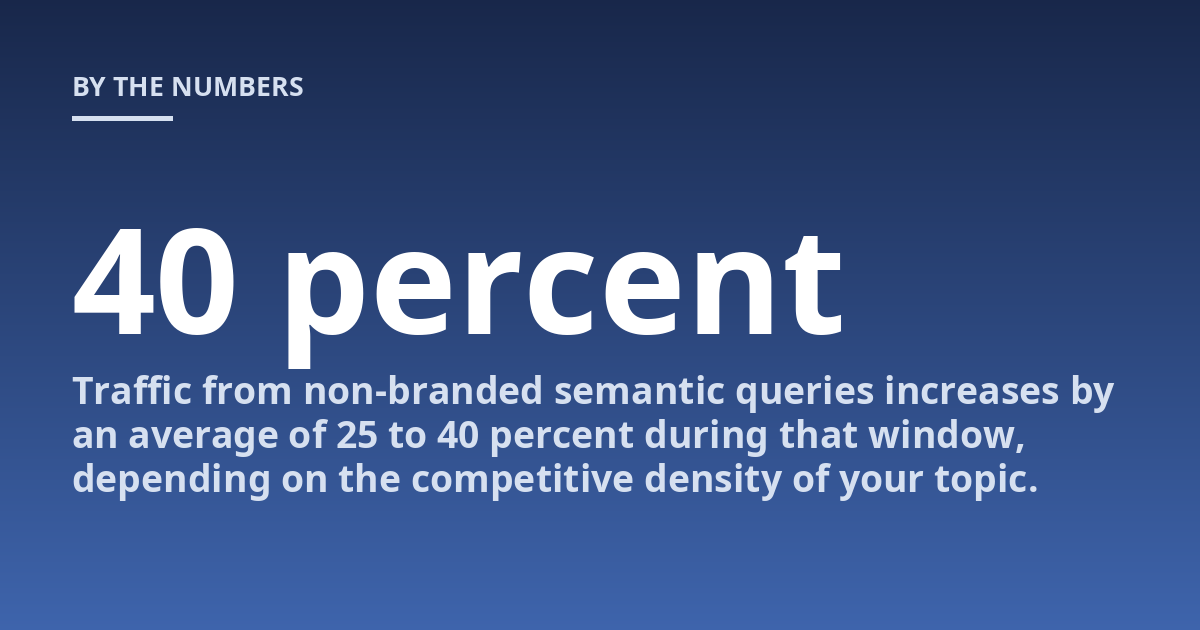
From what we’ve seen across different projects, the measurable impact usually appears between three and six months after implementing entity-first restructuring. Traffic from non-branded semantic queries increases by an average of 25 to 40 percent during that window, depending on the competitive density of your topic.
Where Entity SEO Is Headed
Two trends will define entity SEO in the next twenty-four months. The first is entity-based ranking systems. Google has been moving away from PageRank as the dominant signal toward entity-based authority assessments. Early research from the SEO community suggests that Google now evaluates a site’s entity coverage and relationship density before assigning topical authority scores.
The second trend is multimodal entity recognition. AI systems can now identify entities in images, videos, and audio. A page about AI SEO that includes a video entity with proper schema and transcripts will outrank a text-only page for the same queries, because the entity signal is richer and more verifiable.
For practical next steps, start with an entity audit. Map every entity your brand represents, every entity your content currently covers, and every gap between the two. Then fix the gaps one cluster at a time. The brands that treat entity SEO as a structural commitment, not a content tactic, will own their knowledge graph presence when AI search becomes the primary interface.
FAQ
What is important to know about Entity SEO: Optimizing for Knowledge Graphs and Topics?
The key points are that entity SEO requires defining real-world concepts explicitly, building dense relationship maps between those concepts, and supporting everything with structured data. A precise recommendation for your site depends on an audit of existing content and schema coverage. Start with your core entity, then expand outward.
When should entity seo optimizing for knowledge graphs and topics be discussed with a professional?
A consultation is useful when you see stagnant traffic despite good rankings, when your knowledge panel is empty or incorrect, or when AI citations never include your brand. Early assessment can reduce the chance of entity fragmentation across multiple domains or conflicting schema implementations.
How should someone prepare for a consultation about Entity SEO: Optimizing for Knowledge Graphs and Topics?
It helps to note current schema markup, existing entity mentions across your site, competitor knowledge panels, and specific search queries where you want visibility. Existing Google Search Console data and a list of pages by topical cluster can also help the consultant understand the structure.
What risks or limits can entity seo optimizing for knowledge graphs and topics have?
Risks include over-markup with incorrect schema, entity dilution from covering too many topics, and failure to disambiguate similar entities. The professional should explain benefits, alternatives, and realistic timelines before optimization begins. Entity SEO is a long-term investment, not a quick fix.
How is entity SEO different from traditional keyword SEO?
Traditional SEO optimizes for search queries as strings. Entity SEO optimizes for the real-world concepts behind those queries. When you target “AI SEO tools,” traditional SEO asks how many times to use that phrase. Entity SEO asks whether your content proves knowledge about “AI tools,” “SEO,” “automation,” and their relationships. The difference is fundamental and produces different content structures.
Conclusion
Entity SEO is not a tactic. It is a framework for making your content understandable to machines at a semantic level. Knowledge graphs reward clarity, depth, and relationship density. AI search systems reward explicit definitions and authoritative connections. If you want measurable organic growth from AI-era search, stop optimizing for keywords and start optimizing for entities. Map your core entity, build topic clusters around it, implement schema markup that reflects real relationships, and measure knowledge panel inclusion over time. For brands ready to move past keyword SEO, entity-first content strategy is the next logical step.
If your team needs help auditing entity coverage or building a topic cluster structure, TsoDen’s AI-driven SEO and content automation platform can accelerate the process from audit to implementation. AI Overviews vs. Traditional Search: What Marketers Must Know to Adapt and Analytics With GA4: Tracking Organic Performance for Measurable Growth provide deeper technical guidance on the execution side.
Other posts from the category
There are no posts for the selected category.

Latest posts from the category
-

What makes an effective Category Page for AI
June 5, 2026
-

What Influences the cost of AI Optimisation
June 1, 2026
-

Organisation Schema: how to help AI understand your brand
May 27, 2026