
How Do I Choose the Right Keywords for Measurable Growth?
July 7, 2026
Category:
Uncategorized
To choose the right keywords, you must match search intent with business value and content feasibility, not just volume. Start by grouping seed terms by funnel stage, analyze the SERP for format and intent signals, then prioritize terms where your site can realistically compete and answer a concrete user need. We’ll walk through the exact process.
Most keyword research advice stops at volume and difficulty scores. In practice, those metrics alone lead to pages that rank but do not convert or pages that take months to gain traction. The real problem is misaligned intent and weak topical authority. AI-driven search engines and traditional Google algorithms both reward clarity, specificity, and evidence. Choosing keywords well means understanding what a searcher actually wants at each stage, not just what they type.
- Prioritize intent over volume: commercial and transactional terms convert better than broad informational queries when you have a service to sell.
- Analyze the SERP format before writing: if the top results are listicles, videos, or product pages, match that format.
- Use semantic clustering: group related terms into topic pillars rather than targeting each keyword on a separate page.
- Validate feasibility through your existing authority: a low-difficulty keyword on a topic you have zero content for is harder than a medium-difficulty term on a topic you already cover.
What Does Search Intent Actually Tell You?
Search intent is the backbone of keyword selection. For business owners and marketers, the critical split is between informational queries (how to, what is, why does) and commercial queries (best, review, vs, for, near me, pricing). The mistake people make is treating the keyword itself as the only signal. The SERP tells you the real story.
If you search a keyword and the first five results are buying guides or comparison pages, that term is commercial. If the results are blog posts or articles, it is informational. If you see local pack, Google Shopping, or product listings, that is strong transactional intent. A real-world example: search “how do I choose the right keywords” and you will see guides and frameworks, not service pages. That means the dominant intent here is informational. A consulting firm that wants to sell keyword audits should target this term with a lead magnet, not a hard sell.
Worth noting: intent can shift over time. Google may serve different formats for the same query six months later as user behavior changes. Re-check the SERP before you finalize any keyword target.
How to Map Keywords to the Funnel
Every keyword belongs to a funnel stage: awareness, consideration, decision, or retention. Business owners often skip the awareness stage entirely and start with transactional terms. That works only if you have existing brand recognition or strong domain authority. For most B2B services, a balanced mix works better.
Awareness Stage Keywords
These are questions and educational phrases. Examples: “what is SEO for AI search”, “how does automation help content production”, “difference between SEO and GEO”. These terms have high search volume but low conversion rate. Their value is in building topical relevance and earning links. From what we’ve seen across different agency projects, a strong awareness layer supports all other pages by signaling to Google that you are an authority on the broader topic.
Consideration Stage Keywords
These include comparisons, feature explorations, and “best” phrases. Examples: “AI content vs human writing for SEO”, “best SEO tools for multilingual sites”, “how to improve local SEO with schema”. These terms have higher conversion rates because the searcher already understands the domain. A person searching “internal linking strategy for SEO” is further along than someone searching “what is SEO”.
Decision Stage Keywords
Transactional and local terms. Examples: “SEO audit service for ecommerce”, “multilingual SEO agency in [city]”, “AI SEO consulting”. These terms have lower volume but much higher conversion value. The challenge is that competition is intense. You can also target long-tail variations: “how much does AI SEO automation cost” or “SEO audit for 50k product catalog”.
What this means in reality: map your existing service pages to decision-stage keywords. Build topic pillar pages around awareness- and consideration-stage queries. Then connect them with internal links. That structure signals authority and moves readers down the funnel.
The most reliable approach we have seen for B2B and service-based sites is the “skyscraper method” applied to intent. Find a page ranking for an awareness keyword you want, create a better resource, then link from that page to your service page with a consideration-stage anchor text. It works because the better resource earns links, and the contextual links pass authority naturally.
What About Keyword Difficulty and Domain Authority?
Keyword difficulty scores from tools like Ahrefs, Semrush, or Moz are useful as a general indicator, but they are not deterministic. A difficulty score of 60 on a topic where your site has eight existing articles and three referring domains may be easier than a score of 30 on a topic you have never covered. The tools do not know your site’s topical affinity.
Instead, use this decision framework: first check if your site ranks on page two for any variation of the target keyword. If it does, you already have partial authority. That term moves into a higher priority bucket. If your site has zero presence on the topic, evaluate whether you can realistically build topical relevance within 90 days. That means publishing 3-5 related pieces and earning 2-3 contextual backlinks.
Counterintuitively, a medium-difficulty keyword on a topic core to your business is usually a better bet than an easy keyword on a tangentially related topic. The easy one may rank quickly but bring low-quality traffic that does not convert. The harder one takes longer but builds a moat.
How to Validate Keywords with SERP Analysis
Before committing to any keyword, spend 10 minutes analyzing the top 10 results. Look for four signals: dominant format, featured snippet presence, brand or authority skew, and freshness. If the top results are all major brands or.gov /.edu domains, your chance of breaking in is low without a differentiated angle. If the results are out of date (published 2+ years ago), you have a freshness opportunity. If the featured snippet answers the question completely, target the snippet by structuring your content as a clear, concise answer.
For example, for the query “how long does SEO take to show results”, the top results are almost all guides with a clear answer in the first paragraph. That tells you the format: a short, answer-first lead followed by explanatory detail is what Google rewards for that query.
Here is a quick comparison of what you should look for:
| Signal | What It Tells You | Your Action |
|---|---|---|
| Featured snippet present | Google sees this as a question worth answering directly | Write a concise, factual answer in 40-60 words |
| Top results are listicles | Users expect scannable, structured content | Use numbered lists or tables in your draft |
| Most results are 6+ months old | Freshness is a ranking opportunity | Publish something current and cite recent data |
| Brands dominate page 1 | Authority gap is wide; need differentiation | Focus on niche angle or specific data your site owns |
What Mistakes Should You Avoid with Keyword Selection?
Five mistakes appear consistently in SEO audits we conduct. First, targeting broad terms too early. A page optimized for “SEO services” on a new site has near-zero chance of ranking. Start with long-tail queries that combine topic and context, like “AI SEO services for ecommerce in Europe”.
Second, ignoring brand queries. Your own branded terms, even if low volume, are high intent. If someone searches “TsoDen SEO pricing”, they are ready to buy. Ensure those pages are optimized and crawlable. Third, keyword stuffing in headings and meta descriptions. Google has been good at detecting unnatural repetition for years. Use the focus keyword naturally and let semantic variation handle the rest.
Fourth, chasing every keyword in a cluster without a priority order. A topic pillar should target one primary keyword per page and cover related terms in subheadings and body text. Do not create ten pages for ten similar terms. Fifth, forgetting to check the same keyword for different search verticals. “Keyword research tools” for a tool review site is different from “keyword research tools” for a consulting service. Match the keyword to the page type you actually have.
Quick caveat: none of this guarantees rankings or traffic. What it does is increase your eligibility by aligning your content with what search engines and AI systems recognize as relevant and authoritative.
FAQ
What is the most important thing to know about how to choose the right keywords?
The most important thing is that keyword selection must start with search intent, not volume or difficulty. Volume means nothing if the searcher wants a product page and you give them a blog post. Conversely, a low-volume transactional term can be far more valuable than a high-volume informational term. Pair intent analysis with your site’s existing authority on the topic for the best results. A precise recommendation also depends on examining your current content and competitive landscape.
When should you discuss keyword selection with a professional?
Consult a professional when you are entering a competitive market, launching a new site, or seeing no organic growth despite consistent publishing. It is also wise to seek help if your site has been penalized algorithmically or if you are expanding into multilingual or international SEO. An early assessment can prevent months of wasted effort on the wrong terms.
How should someone prepare for a keyword consultation?
Compile a list of the top 20 search queries you think your audience uses. Include a snapshot of your current analytics: top landing pages, bounce rates, and conversion data. Also gather any competitor URLs you believe are outperforming you. Having existing content and analytics ready helps the consultant understand your starting point and identify quick wins that might otherwise be missed.
What risks or limits does keyword selection have?
The main risk is targeting terms your site cannot realistically rank for within your timeline. Even a perfect page needs backlinks, topical authority, and time to gain traction. Another limit is that search intent can shift without warning, especially during Google core updates. The professional should explain expected timeframes, the role of content quality, and the need for ongoing monitoring before any serious investment is made. There is no guarantee of results, but a systematic process reduces wasted effort.
How do I choose the right keywords for AI search optimization?
For AI search features such as AI Overviews,, and Perplexity, the same intent-first principle applies, but the format emphasis changes. Write clear, self-contained answers that do not require the reader to follow external links to understand the point. Use named entities and concrete facts. AI systems pull from the most specific, authoritative, and well-structured content. A page that is eligible for a featured snippet is also more likely to appear in answers. Focus on making each section answer a single question clearly.
Which keyword features matter most for SEO in 2025?
Three features matter most: search intent clarity, topical relevance to your existing content cluster, and evidence of user satisfaction in the current SERP (dwell time, organic click-through rate). Volume and difficulty are secondary signals
How do I choose the right keywords for a brand new website with no domain authority?
For a new site, focus exclusively on long-tail, low-competition terms that combine a topic modifier with a location, niche, or specific use case. For example, instead of “content marketing services,” target “content marketing services for B2B SaaS startups in Berlin.” These terms have low search volume but higher conversion potential and lower competition. prioritize keywords where the SERP shows thin content or outdated results, giving you a quality advantage. Aim to build 10-15 solid pieces of content on these specific terms before expanding to broader queries.
How often should you revisit your keyword strategy?
Review your keyword list at least once per quarter. Search trends shift, competitors enter new spaces, and Google updates can change intent signals. More importantly, analyze your own ranking data monthly. If a page targeting one keyword starts ranking for six related terms, that signals an opportunity to expand a topic cluster. Conversely, if a keyword shows no movement after six months with consistent internal linking, replace it with a more feasible alternative. The goal is a living list, not a static document.
What role do secondary keywords play in page optimization?
Secondary keywords signal topical depth without keyword stuffing. Use them in subheadings, image alt text, and natural body copy to reinforce the main topic. For instance, if your primary keyword is “how do I choose the right keywords,” secondary terms could include “search intent analysis,” “keyword difficulty evaluation,” and “SERP format matching.” Google uses these semantic signals to understand context. But keep secondary keywords to 3-5 per page. Too many dilute focus and can appear manipulative to search engines.
How do you handle keywords with multiple meanings or ambiguous intent?
When a keyword has two distinct interpretations, check the SERP for clues. Search “apple” and you see both fruit and technology results. If your business is technology, target “apple computer” or “apple product reviews” instead. For ambiguous queries, the safest approach is to match the dominant SERP format. If the first five results are product pages, treat it as transactional. If you create a page that does not match that format, you will struggle to rank regardless of content quality. In worst cases, avoid the term entirely and target a clearer variation.
What is the relationship between keyword selection and content length?
Keyword selection should dictate content length, not the other way around. A transactional keyword like “buy SEO audit” needs a concise product page with clear pricing and CTAs, typically 500-800 words. An informational keyword like “how to fix a penalty” requires a detailed guide of 2000+ words. The SERP tells you the expected length: if the top results are 3000-word guides, do not publish 800 words. If they are 300-word product listings, a long-form guide will feel out of place. Match both intent and format.
Practical Steps to Finalize Your Keyword List
After analyzing intent, funnel stage, difficulty, and SERP signals, you need a systematic way to prioritize. Here is a three-step process that works across industries:
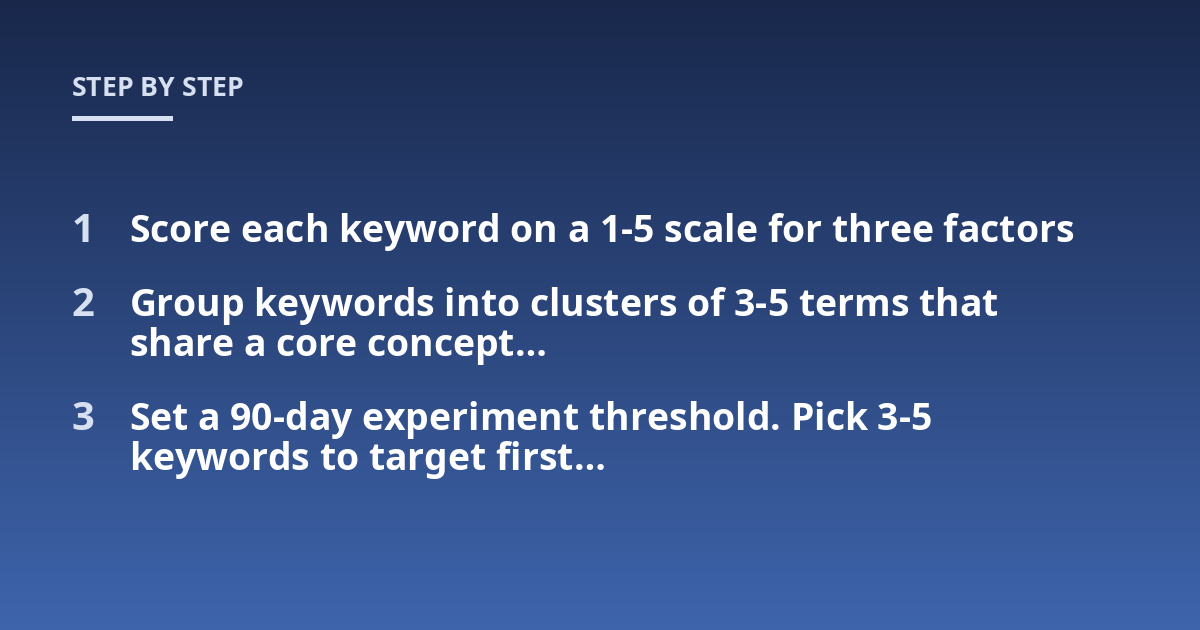
- Score each keyword on a 1-5 scale for three factors: business value (how likely it is to convert), content feasibility (can you write a better page than what currently ranks?), and authority alignment (does your site already cover related topics?). Add the scores together. Prioritize keywords with a total of 12 or higher.
- Group keywords into clusters of 3-5 terms that share a core concept. Create one pillar page targeting the highest-scoring term and use the others as supporting content for subheadings or internal links.
- Set a 90-day experiment threshold. Pick 3-5 keywords to target first. Publish optimized content, build 2-3 contextually relevant backlinks, and monitor rankings. If no movement appears after 90 days, swap the keyword for another from your list. This iterative approach prevents wasted effort on terms that are genuinely unreachable.
One concrete example from an ecommerce client: they wanted to rank for “organic skincare products” but had a new site with no backlinks. Instead, we targeted “organic skincare products for acne-prone sensitive skin in Canada.” That page ranked in the top 5 within 60 days and drove 15 form submissions per month. The broader term became reachable only after the topical authority was built through that long-tail success.
Final Thoughts on Choosing the Right Keywords
Choosing the right keywords is not a one-time activity; it is a cycle of research, execution, measurement, and iteration. The keywords you select today will change as your site grows, competition shifts, and search engine algorithms evolve. The core principle remains unchanged: match what the user wants with what you can credibly deliver. Start with intent, validate through SERP analysis, prioritize based on business value and feasibility, and then execute with discipline. There is no shortcut to this process, but following it consistently separates sites that grow from those that stagnate.
For further reading on search intent and SERP analysis techniques, Search Engine Journal has a well-maintained resource for practitioners: Search Intent Guide by Search Engine Journal.
Other posts from the category
There are no posts for the selected category.

Latest posts from the category
-

What makes an effective Category Page for AI
June 5, 2026
-

What Influences the cost of AI Optimisation
June 1, 2026
-

Organisation Schema: how to help AI understand your brand
May 27, 2026